PUBLISHER: Mordor Intelligence | PRODUCT CODE: 1851343

PUBLISHER: Mordor Intelligence | PRODUCT CODE: 1851343
4K Display Resolution - Market Share Analysis, Industry Trends & Statistics, Growth Forecasts (2025 - 2030)
The 4K display resolution market size is estimated at USD 217.23 billion in 2025 and is forecast to reach USD 412.57 billion by 2030, advancing at a 13.69% CAGR.
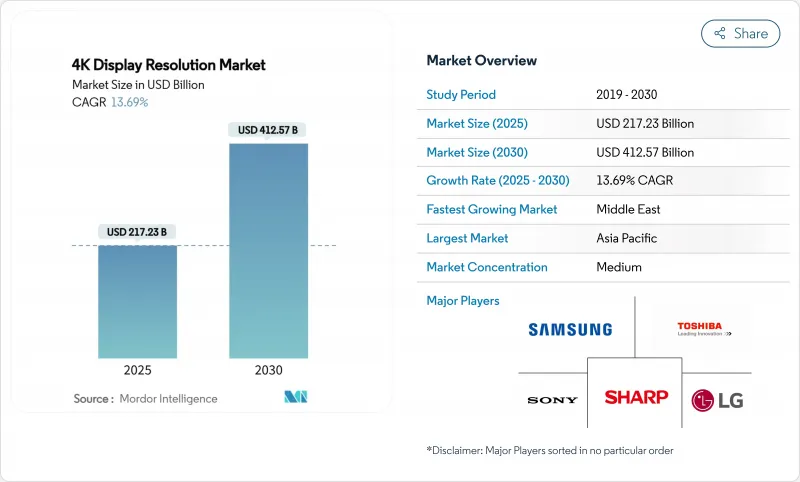
Fast-declining panel costs, a richer supply of native 4K streaming content, and expanding corporate use cases are allowing the technology to move from premium positioning into mass adoption. Asia Pacific's manufacturing scale keeps average selling prices low while the region's consumers display a marked preference for larger screens. Hybrid-work demand and immersive gaming are further tightening refresh cycles, encouraging brands to launch increasingly specialized models. At the same time, supply chain risks around chipsets and evolving energy-efficiency rules in Europe urge vendors to diversify component sourcing and accelerate R&D in low-power backlighting.
Global 4K Display Resolution Market Trends and Insights
Rapid OTT-led Uptake of 4K Streaming in North America
Streaming platforms delivered more than 60% of their new content in 4K during 2024, setting a stronger pull for compatible screens in household upgrades. Bandwidth gains from Wi-Fi 7, which supports data rates up to 46 Gbit/s, remove the previous bottlenecks that limited mainstream 4K adoption. Millimeter-wave rollouts, with Japan targeting 50,000 base stations by 2027, add further capacity that benefits cross-border content providers. The result is a steeper replacement cycle for television sets and monitors, with streaming services shaping feature roadmaps around HDR performance and wider color gamuts. Brands that synchronize panel launches with blockbuster content premieres are capturing early-adopter interest ahead of key sales quarters.
Panel Subsidies and Capacity Expansion in China and South Korea
Government incentives trimmed capital costs for new LCD and QD-OLED lines, enabling firms such as BOE Technology and Samsung Display to run plants at high utilization. Samsung Display plans to raise QD-OLED monitor panel shipments by 50% to 1.43 million units in 2025, giving OEM partners more scope to refresh premium catalogs. Economies of scale flowing from these investments support competitive pricing in the 50-65" mainstream sweet spot, while yield-driven cost erosion in Mini-LED backlights widens adoption in mid-tier models. The subsidy-induced volume surge is already filtering through global supply chains, lowering bill-of-materials outlays for downstream assemblers.
HDMI 2.1 Chipset Shortages 2024-25
Constrained wafer starts at leading foundries have a limited supply of HDMI 2.1 retimer and switch ICs, delaying volume shipments of flagship gaming monitors and high-end TVs. Himax Technologies reported that 82.9% of 2024 revenue came from display driver ICs, underscoring dependence on a narrow component pool. Vendors redirected scarce chipsets to models with higher gross margins, creating temporary stockouts in mid-tier SKUs. The scarcity also accelerated DisplayPort 2.1 adoption, as seen in MSI's new QD-OLED monitor, signaling possible long-term interface diversification even after supply normalizes.
Other drivers and restraints analyzed in the detailed report include:
- Esports Demand for 4K/144 Hz Gaming Monitors in Europe
- Adoption of 4K Surgical and Diagnostic Displays in U.S. and Japan
- EU Eco-design Rules Raising Compliance Costs for >65" TVs
For complete list of drivers and restraints, kindly check the Table Of Contents.
Segment Analysis
Gaming monitors accounted for a 14.1% CAGR forecast between 2025 and 2030, the fastest trajectory within the 4K display resolution market. Samsung upheld a 21.0% global share in 2024, while its 34.6% slice of the OLED sub-segment confirmed a first-mover advantage in emerging QD-OLED stacks. The segment thrives on esports sponsorship visibility, frequent model refreshes, and the synergy with powerful GPUs such as NVIDIA GeForce RTX 4090 that unlocked stable 4K/144 Hz gameplay. Monitor brands elevate specifications with higher peak brightness, tandem OLED layers, and DisplayPort 2.1 input to differentiate premium SKUs. Profitability remains thicker than mainstream TVs because enthusiast buyers value response time, HDR contrast, and color coverage.
Smart TVs preserved leadership with a 68% revenue share in 2024, supported by wide 4K streaming content libraries and falling BOM costs. Corporate video walls and digital signage screens gained importance as hybrid-work hubs required wide viewing angles and high pixel density. Medical displays formed a high-margin niche, with 4K surgical monitors like Sony's LMD-32M1MD achieving VESA HDR1000 compliance for operating theaters. Smartphones and tablets with native 4K remain limited to creator-focused uses because energy draw offsets mobile benefits. Overall, consumer appetite for richer entertainment and workplace collaboration sustains multi-segment momentum within the 4K display resolution market.
OLED panels are projected to expand at a 16.7% CAGR, the swiftest run in the 4K display resolution market. Samsung Display's plan to ship 1.43 million QD-OLED monitor panels in 2025 exemplifies the capacity scaling that propels wider use beyond flagship TVs. Superior contrast, pixel-level dimming, and the introduction of tandem OLED stacks now reach gaming monitors, encouraging ASP premiums. LG's 2025 G5 TV, with a 165 Hz native refresh and Micro Lens Array optics, underscores the continued pace of OLED R&D.
LCD technology retained 71% share in 2024 because of vast installed tooling, mature supply chains, and cost competitiveness for mid-range sets. Mini-LED backlighting adds local dimming and higher luminance, bridging performance gaps with OLED at a lower cost. Sony's HDR1000-rated surgical monitor demonstrates Mini-LED influence in specialty verticals. Micro-LED remains confined to ultra-large formats, evidenced by Hisense's 136-inch showpiece, until manufacturing yields improve. The coexistence of multiple panel types ensures that each application - gaming, signage, healthcare - receives an optimal balance of cost, brightness, and longevity within the expanding 4K display resolution market.
The 4K Display Resolution Market Report is Segmented by Product Type (Smart TV, Monitor, Smartphone, Tablet, and More), Panel Technology (LCD, OLED, Mini-LED, and Micro-LED), Screen Size (Sub 32 Inch, 32-49 Inch, 50-65 Inch, 66-84 Inch, and Above 85 Inch), End-User Vertical (Consumer Electronics, Gaming and Esports Venues, Business and Education, and More), and Geography. The Market Forecasts are Provided in Terms of Value (USD).
Geography Analysis
Asia Pacific generated 46% of 2024 revenue, cementing its position as the largest territory in the 4K display resolution market. China's subsidies enabled swift capacity ramps, while South Korea's OLED leadership supplied high-margin panels globally. Japan's goal of installing 50,000 millimeter-wave bases by 2027 reinforces the regional network backbone supporting 4K streaming uptake. India and Southeast Asia entered a new adoption phase as falling ASPs aligned with rising discretionary income, unlocking large untapped volumes.
The Middle East is forecast to post the highest CAGR at 13.6% between 2025 and 2030. GCC corporations rolled out 4K video walls to enhance hybrid collaboration, boosting demand for fine-pixel-pitch LED assemblies. Sony Middle East and Africa reported notable sales gains and aims to release the INZONE M9 4K monitor within 2025, reflecting the region's appetite for premium displays. Online channels have already captured 20% of regional TV sales, prompting brands to fine-tune e-commerce logistics.
North America's mature installed base still grew on the back of fast OTT content adoption and a robust gaming monitor upgrade cycle. Healthcare institutions expanded to 4K diagnostic suites, widening a lucrative sub-segment less exposed to price wars. Europe faced a dual narrative: tech-savvy consumers embraced larger OLED sets while stricter Eco-design norms raised compliance costs for panels over 65", nudging suppliers toward energy-efficient Mini-LED designs. Latin America and Africa remained emergent frontiers; limited 4K broadcast spectrum in parts of Sub-Saharan Africa tempered growth, though rising broadband coverage signals future upside.
- Samsung Electronics Co. Ltd
- LG Display Co. Ltd
- BOE Technology Group Co. Ltd
- TCL Technology (CSOT)
- Sony Group Corporation
- Toshiba Corporation
- Panasonic Holdings Corporation
- Sharp Corporation
- Hisense Group
- Koninklijke Philips N.V.
- Innolux Corporation
- AU Optronics Corp.
- Dell Technologies Inc.
- ASUSTeK Computer Inc.
- Acer Inc.
- Vizio Inc.
- Skyworth Group Ltd
- Barco NV
- Eizo Corporation
- ViewSonic Corporation
- BenQ Corporation
Additional Benefits:
- The market estimate (ME) sheet in Excel format
- 3 months of analyst support
TABLE OF CONTENTS
1 INTRODUCTION
- 1.1 Study Assumptions and Market Definition
- 1.2 Scope of the Study
2 RESEARCH METHODOLOGY
3 EXECUTIVE SUMMARY
4 MARKET LANDSCAPE
- 4.1 Market Overview
- 4.2 Market Drivers
- 4.2.1 Rapid OTT?led Uptake of 4K Streaming in North America
- 4.2.2 Panel Subsidies and capacity Expansion in China and South Korea
- 4.2.3 Esports Demand for 4K/144 Hz Gaming Monitors in Europe
- 4.2.4 Adoption of 4K Surgical and Diagnostic Displays in United States and Japan
- 4.2.5 Hybrid-Work LED Videowalls Driving Gulf Cooperation Council Countries Corporate Installations
- 4.2.6 Mini-LED Yield-Driven Price Erosion in Taiwan-made 50-65? Panels
- 4.3 Market Restraints
- 4.3.1 HDMI 2.1 Chipset Shortages 2024-25
- 4.3.2 EU Ecodesign Rules Raising Compliance Costs for Above 65? TVs
- 4.3.3 Limited 4K Broadcast Spectrum in Sub-Saharan Africa
- 4.3.4 Premium 8K Cannibalisation in Japan and South Korea
- 4.4 Industry Ecosystem Analysis
- 4.5 Technological Outlook
- 4.6 Porter's Five Forces Analysis
- 4.6.1 Threat of New Entrants
- 4.6.2 Bargaining Power of Suppliers
- 4.6.3 Bargaining Power of Buyers
- 4.6.4 Threat of Substitutes
- 4.6.5 Intensity of Competitive Rivalry
5 MARKET SIZE AND GROWTH FORECASTS (VALUES)
- 5.1 By Product Type
- 5.1.1 Smart TV
- 5.1.2 Monitor
- 5.1.3 Smartphone
- 5.1.4 Tablet
- 5.1.5 Laptop
- 5.1.6 Digital Signage/Videowall
- 5.1.7 Projection Screen
- 5.1.8 Head-Mounted Display (HMD)
- 5.1.9 Medical Display
- 5.1.10 Others
- 5.2 By Panel Technology
- 5.2.1 LCD (IPS/VA/TN)
- 5.2.2 OLED
- 5.2.3 Mini-LED
- 5.2.4 Micro-LED
- 5.2.5 Others
- 5.3 By Screen Size
- 5.3.1 Below 32 inch
- 5.3.2 32-49 inch
- 5.3.3 50-65 inch
- 5.3.4 66-84 inch
- 5.3.5 Above 84 inch
- 5.4 By End-user Vertical
- 5.4.1 Consumer Electronics (Household)
- 5.4.2 Gaming and Esports Venues
- 5.4.3 Business and Education
- 5.4.4 Retail and Advertisement
- 5.4.5 Media and Entertainment Production
- 5.4.6 Healthcare
- 5.4.7 Aerospace and Defence
- 5.4.8 Others
- 5.5 Geography
- 5.5.1 North America
- 5.5.1.1 United States
- 5.5.1.2 Canada
- 5.5.1.3 Mexico
- 5.5.2 Europe
- 5.5.2.1 Germany
- 5.5.2.2 United Kingdom
- 5.5.2.3 France
- 5.5.2.4 Italy
- 5.5.2.5 Spain
- 5.5.2.6 Nordics (Denmark, Sweden, Norway, Finland)
- 5.5.2.7 Rest of Europe
- 5.5.3 Asia-Pacific
- 5.5.3.1 China
- 5.5.3.2 Japan
- 5.5.3.3 South Korea
- 5.5.3.4 India
- 5.5.3.5 Southeast Asia
- 5.5.3.6 Australia
- 5.5.3.7 Rest of Asia-Pacific
- 5.5.4 South America
- 5.5.4.1 Brazil
- 5.5.4.2 Argentina
- 5.5.4.3 Rest of South America
- 5.5.5 Middle East
- 5.5.5.1 Gulf Cooperation Council Countries
- 5.5.5.2 Turkey
- 5.5.5.3 Rest of Middle East
- 5.5.6 Africa
- 5.5.6.1 South Africa
- 5.5.6.2 Nigeria
- 5.5.6.3 Rest of Africa
- 5.5.1 North America
6 COMPETITIVE LANDSCAPE
- 6.1 Market Concentration
- 6.2 Strategic Moves and Developments
- 6.3 Market Share Analysis
- 6.4 Company Profiles (includes Global level Overview, Market level overview, Core Segments, Financials as available, Strategic Information, Market Rank/Share for key companies, Products and Services, and Recent Developments)
- 6.4.1 Samsung Electronics Co. Ltd
- 6.4.2 LG Display Co. Ltd
- 6.4.3 BOE Technology Group Co. Ltd
- 6.4.4 TCL Technology (CSOT)
- 6.4.5 Sony Group Corporation
- 6.4.6 Toshiba Corporation
- 6.4.7 Panasonic Holdings Corporation
- 6.4.8 Sharp Corporation
- 6.4.9 Hisense Group
- 6.4.10 Koninklijke Philips N.V.
- 6.4.11 Innolux Corporation
- 6.4.12 AU Optronics Corp.
- 6.4.13 Dell Technologies Inc.
- 6.4.14 ASUSTeK Computer Inc.
- 6.4.15 Acer Inc.
- 6.4.16 Vizio Inc.
- 6.4.17 Skyworth Group Ltd
- 6.4.18 Barco NV
- 6.4.19 Eizo Corporation
- 6.4.20 ViewSonic Corporation
- 6.4.21 BenQ Corporation
7 MARKET OPPORTUNITIES AND FUTURE OUTLOOK
- 7.1 White-space and Unmet-need Assessment

