PUBLISHER: Mordor Intelligence | PRODUCT CODE: 2121878

PUBLISHER: Mordor Intelligence | PRODUCT CODE: 2121878
Halal Food And Beverage - Market Share Analysis, Industry Trends & Statistics, Growth Forecasts (2026 - 2031)
According to Mordor Intelligence, the halal food and beverages market size is expected to increase from USD 810.25 billion in 2025 to USD 880.41 billion in 2026 and reach USD 1,304.21 billion by 2031, growing at a CAGR of 8.55% over 2026-2031.
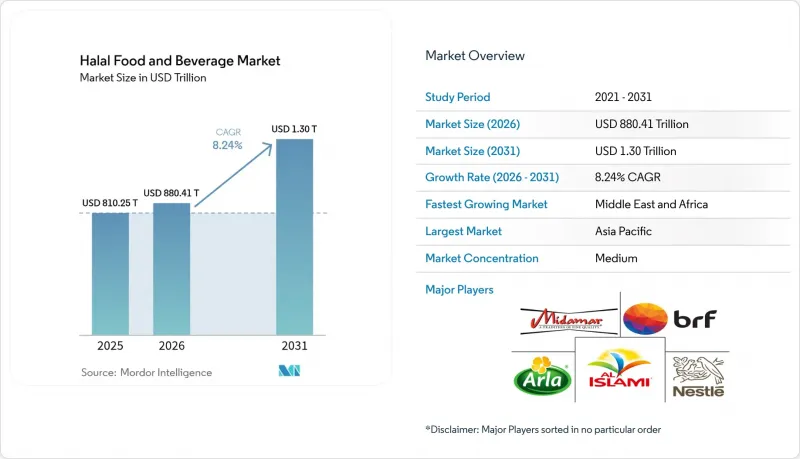
This report is Segmented by Product Type (Halal Food and Halal Beverages), Form (Conventional and Organic), Distribution Channels (Supermarkets/Hypermarkets, Convenience Stores, Online Retail Stores, and More), and Geography (North America, Europe, Asia-Pacific, South America, and the Middle East and Africa). The Market Forecasts are Provided in Terms of Value (USD) and Volume (Tonnes).
Global Halal Food And Beverage Market Trends and Insights
Rising Global Demand and Cultural Awareness for Halal Products
With the growth of the Muslim population and the expansion of its diaspora, retail assortments are undergoing significant changes, moving beyond the confines of traditional ethnic aisles. In the Asia-Pacific and Africa regions, Indonesia, where 87% of the population identifies as Muslim, and Nigeria, home to 110 million Muslim consumers, serve as key demand drivers. However, the most notable strategic shift is taking place in non-Muslim-majority markets. In these regions, halal certification has evolved beyond its religious roots to symbolize ethical slaughter, traceability, and hygiene standards. These attributes strongly appeal to flexitarian and health-conscious consumers. During 2024-2025, Tesco and Carrefour expanded their halal-certified private-label product ranges in the United Kingdom and France. This strategic move repositions halal certification as a mainstream quality indicator rather than a niche religious requirement. The growing elasticity in demand highlights a critical insight: brands that treat halal certification as a mere compliance formality risk losing market share to competitors who integrate it as a fundamental aspect of their product development and differentiation strategies.
Halal Certification as a Symbol of Quality and Trust
Certification bodies are transitioning from traditional paper-based audits to sophisticated digital verification systems that establish trust at the transaction level. In October 2025, the Islamic Religious Council of Singapore launched QR-code certificates, enabling consumers to scan product packaging to access real-time audit trails, abattoir video feeds, and ingredient sourcing maps. This innovation transforms certification from a static logo into an interactive assurance tool. Similarly, in 2025, JAKIM initiated a pilot project to integrate artificial intelligence and blockchain into its certification processes. This initiative aims to reduce audit cycle times from weeks to days while creating tamper-proof records to prevent counterfeit labels. These technological advancements highlight that certification premiums will increasingly favor bodies offering digital transparency over traditional theological endorsements. Consequently, brands are compelled to select certification partners based on their API compatibility and data-sharing capabilities.
Stringent Regulatory and Safety Compliance Requirements
Multi-jurisdiction exporters face a compliance labyrinth in which JAKIM, BPJPH, MUIS, and the Emirates Authority for Standardization and Metrology (ESMA) impose overlapping yet non-harmonized audit protocols, ingredient whitelists, and documentation formats. Organic halal products confront dual-certification complexity, requiring simultaneous adherence to USDA Organic or EU Organic standards alongside halal theological requirements, a process that extends time-to-market by 3-6 months and inflates certification fees by 40-60% relative to single-label products. Small and medium enterprises in Africa and South America, lacking dedicated regulatory affairs teams, often abandon export ambitions or partner with certification consultants who command 15-20% of first-year export revenue, compressing margins and deterring market entry. This regulatory friction suggests that certification bodies offering mutual recognition agreements and unified digital portals will capture disproportionate market share, as brands prioritize jurisdictions that minimize redundant audits.
Other drivers and restraints analyzed in the detailed report include:
- Government Initiatives Supporting Halal Production Standards
- Broadening Distribution Channels for Halal Goods
- Elevated Costs Associated with Halal Certification Processes
For complete list of drivers and restraints, kindly check the Table Of Contents.
Segment Analysis
Halal beverages are projected to achieve a strong CAGR of 9.12% through 2031. This growth rate is expected to surpass the broader halal food and beverages market, reflecting a shift in consumer preferences toward energy drinks, functional waters, and non-alcoholic malt alternatives. In 2025, the energy drink brand Carabao, newly certified, expanded into Southeast Asian convenience chains and secured placements in Gulf hypermarkets, showcasing its cross-regional brand expansion. Halal food retained a dominant 68.21% share of the 2025 market value, supported by well-established certification processes and cold-chain logistics. Meanwhile, dairy products gained momentum from Arla's capacity expansion in Bahrain, which positioned European cheese under halal certification for Middle Eastern consumers.
The confectionery, bakery, and snack segment continues to deliver steady but commoditized volumes. However, the growing demand for ready meals and baby food, especially those with dual halal-organic certifications, demonstrates a premium elasticity of 25-40% compared to standard offerings. Halal-certified plant-based proteins, now approved in multiple jurisdictions, align with sustainability, animal welfare, and religious values, creating a new premium segment within the halal food and beverages market. While theological clarity on plant-based certifications is still developing, proactive audits are fostering acceptance and unlocking additional revenue opportunities for innovators in the alternative protein sector.
Complete Report Scope:
- Product Type
- Halal Food
- Dairy and Dairy Alternatives
- Confectionery
- Sugar Confectionery
- Chocolates
- Snack Bars
- Others
- Bakery
- Savory Snacks
- Meat, Poultry, and Seafood
- Red Meat
- Seafood
- Poultry
- Baby Food
- Ready Meals
- Condiments and Sauces
- Other Product Types
- Halal Beverages
- Halal Food
- By Form
- Conventional
- Organic
- By Distribution Channels
- Supermarkets/Hypermarkets
- Convenience Stores
- Online Retail Stores
- Other Distribution Channels
- By Geography
- North America
- United States
- Canada
- Mexico
- Rest of North America
- Europe
- Germany
- United Kingdom
- France
- Italy
- Spain
- Netherlands
- Sweden
- Poland
- Belgium
- Rest of Europe
- Asia-Pacific
- China
- India
- Japan
- Australia
- South Korea
- Vietnam
- Indonesia
- Rest of Asia-Pacific
- South America
- Brazil
- Argentina
- Chile
- Peru
- Colombia
- Rest of South America
- Middle East and Africa
- United Arab Emirates
- Saudi Arabia
- South Africa
- Nigeria
- Rest of Middle East and Africa
- North America
Geography Analysis
In 2025, Asia-Pacific contributed 55.69% of global revenue, driven by Indonesia's mandatory certification, which resulted in over 1 million new approvals within a year. Malaysian SMEs utilized the MyHalal Portal to enhance export readiness, reducing approval times by a third and gaining access to Middle Eastern shelves. India's 2025 voluntary halal labeling amendment has the potential to reach 200 million Muslim consumers, but variations in state-level enforcement and disputes over certifying authority limit immediate gains. In China, processors in Xinjiang and Ningxia primarily focus on meeting domestic demand for the country's 25 million Muslims, avoiding politically sensitive exports.
The Middle East and Africa are expected to witness the highest growth, with a forecasted CAGR of 10.37% through 2031. Gulf states are expanding domestic poultry and dairy production to support food security initiatives. JBS has allocated USD 85 million to double poultry production in Saudi Arabia, while BRF has invested USD 160 million in a Jeddah facility with an annual capacity of 40,000 tonnes. West Africa, with its 110 million Muslim consumers and growing middle class, holds significant potential, though challenges such as cold-chain limitations and inconsistent enforcement remain. Egypt's strategic port location positions it as a potential distribution hub, but bureaucratic certification delays deter investment.
North America and Europe are experiencing slower growth rates but benefit from higher per-unit margins. Fragmented private certifications, including IFANCA and HMA, create consumer confusion but also provide opportunities for premium narratives linking animal welfare to halal principles. In 2025, retailers increased shelf space for private-label certified products, with Carrefour France reporting double-digit unit growth. South America remains focused on exports, with Brazil and Argentina supplying beef and poultry to Gulf and Southeast Asian markets, leveraging existing slaughter capacities despite low domestic awareness. Across these regions, integrating tech-enabled audits with local sourcing narratives will be critical for companies aiming to strengthen their competitive position in the halal food and beverages market.
- Nestle S.A.
- Al Islami Foods LLC
- American Halal Company, Inc.
- Arla Foods A.m.b.A
- Beyond Meat, Inc.
- Midamar Corporation
- Crescent Specialty Foods, Inc.
- Almarai Company Limited
- SADAFCO
- BRF S.A.
- Shan Foods
- Riz Global Foods
- Maple Leaf Foods Inc.
- Zabiha Halal
- Tanmiah Food Company
- JBS S.A.
- Toufayan Bakeries
- Kikkoman Corporation
- Aldella Food Production Co.
- Savola Group Company
Additional Benefits:
- The market estimate (ME) sheet in Excel format
- 3 months of analyst support
TABLE OF CONTENTS
1 INTRODUCTION
- 1.1 Study Assumptions and Market Definition
- 1.2 Scope of the Study
2 RESEARCH METHODOLOGY
3 EXECUTIVE SUMMARY
4 MARKET LANDSCAPE
- 4.1 Market Overview
- 4.2 Market Drivers
- 4.2.1 Rising Global Demand and Cultural Awareness for Halal Products
- 4.2.2 Halal Certification as a Symbol of Quality and Trust
- 4.2.3 Government Initiatives Supporting Halal Production Standards
- 4.2.4 Broadening Distribution Channels for Halal Goods
- 4.2.5 Innovation and New Product Development in Halal Segments
- 4.2.6 Impact of Digital Marketing and Social Media on Halal Branding
- 4.3 Market Restraints
- 4.3.1 Stringent Regulatory and Safety Compliance Requirements
- 4.3.2 Elevated Costs Associated with Halal Certification Processes
- 4.3.3 Low Awareness Levels Among Consumers in Non-Muslim Markets
- 4.3.4 Challenges from Fraud and Mislabeling in Halal Supply Chains
- 4.4 Consumer Behavior Analysis
- 4.5 Regulatory Landscape
- 4.6 Technological Outlook
- 4.7 Porter's Five Forces
- 4.7.1 Bargaining Power of Suppliers
- 4.7.2 Bargaining Power of Buyers
- 4.7.3 Threat of New Entrants
- 4.7.4 Threat of Substitutes
- 4.7.5 Competitive Rivalry
5 MARKET SIZE AND GROWTH FORECASTS (VALUE AND VOLUME)
- 5.1 Product Type
- 5.1.1 Halal Food
- 5.1.1.1 Dairy and Dairy Alternatives
- 5.1.1.2 Confectionery
- 5.1.1.2.1 Sugar Confectionery
- 5.1.1.2.2 Chocolates
- 5.1.1.2.3 Snack Bars
- 5.1.1.2.4 Others
- 5.1.1.3 Bakery
- 5.1.1.4 Savory Snacks
- 5.1.1.5 Meat, Poultry, and Seafood
- 5.1.1.5.1 Red Meat
- 5.1.1.5.2 Seafood
- 5.1.1.5.3 Poultry
- 5.1.1.6 Baby Food
- 5.1.1.7 Ready Meals
- 5.1.1.8 Condiments and Sauces
- 5.1.1.9 Other Product Types
- 5.1.2 Halal Beverages
- 5.1.1 Halal Food
- 5.2 By Form
- 5.2.1 Conventional
- 5.2.2 Organic
- 5.3 By Distribution Channels
- 5.3.1 Supermarkets/Hypermarkets
- 5.3.2 Convenience Stores
- 5.3.3 Online Retail Stores
- 5.3.4 Other Distribution Channels
- 5.4 By Geography
- 5.4.1 North America
- 5.4.1.1 United States
- 5.4.1.2 Canada
- 5.4.1.3 Mexico
- 5.4.1.4 Rest of North America
- 5.4.2 Europe
- 5.4.2.1 Germany
- 5.4.2.2 United Kingdom
- 5.4.2.3 France
- 5.4.2.4 Italy
- 5.4.2.5 Spain
- 5.4.2.6 Netherlands
- 5.4.2.7 Sweden
- 5.4.2.8 Poland
- 5.4.2.9 Belgium
- 5.4.2.10 Rest of Europe
- 5.4.3 Asia-Pacific
- 5.4.3.1 China
- 5.4.3.2 India
- 5.4.3.3 Japan
- 5.4.3.4 Australia
- 5.4.3.5 South Korea
- 5.4.3.6 Vietnam
- 5.4.3.7 Indonesia
- 5.4.3.8 Rest of Asia-Pacific
- 5.4.4 South America
- 5.4.4.1 Brazil
- 5.4.4.2 Argentina
- 5.4.4.3 Chile
- 5.4.4.4 Peru
- 5.4.4.5 Colombia
- 5.4.4.6 Rest of South America
- 5.4.5 Middle East and Africa
- 5.4.5.1 United Arab Emirates
- 5.4.5.2 Saudi Arabia
- 5.4.5.3 South Africa
- 5.4.5.4 Nigeria
- 5.4.5.5 Rest of Middle East and Africa
- 5.4.1 North America
6 COMPETITIVE LANDSCAPE
- 6.1 Market Concentration
- 6.2 Strategic Moves
- 6.3 Market Ranking Analysis
- 6.4 Company Profiles (Includes Global-level Overview, Market-level Overview, Core Segments, Financials, Strategic Info, Market Rank/Share, Products & Services, Recent Developments)
- 6.4.1 Nestle S.A.
- 6.4.2 Al Islami Foods LLC
- 6.4.3 American Halal Company, Inc.
- 6.4.4 Arla Foods A.m.b.A
- 6.4.5 Beyond Meat, Inc.
- 6.4.6 Midamar Corporation
- 6.4.7 Crescent Specialty Foods, Inc.
- 6.4.8 Almarai Company Limited
- 6.4.9 SADAFCO
- 6.4.10 BRF S.A.
- 6.4.11 Shan Foods
- 6.4.12 Riz Global Foods
- 6.4.13 Maple Leaf Foods Inc.
- 6.4.14 Zabiha Halal
- 6.4.15 Tanmiah Food Company
- 6.4.16 JBS S.A.
- 6.4.17 Toufayan Bakeries
- 6.4.18 Kikkoman Corporation
- 6.4.19 Aldella Food Production Co.
- 6.4.20 Savola Group Company
7 MARKET OPPORTUNITIES AND FUTURE OUTLOOK

