PUBLISHER: Mordor Intelligence | PRODUCT CODE: 1906081

PUBLISHER: Mordor Intelligence | PRODUCT CODE: 1906081
Middle East And Africa Construction Equipment - Market Share Analysis, Industry Trends & Statistics, Growth Forecasts (2026 - 2031)
The Middle East And Africa Construction Equipment Market size in 2026 is estimated at USD 4.64 billion, growing from 2025 value of USD 4.31 billion with 2031 projections showing USD 6.74 billion, growing at 7.74% CAGR over 2026-2031.
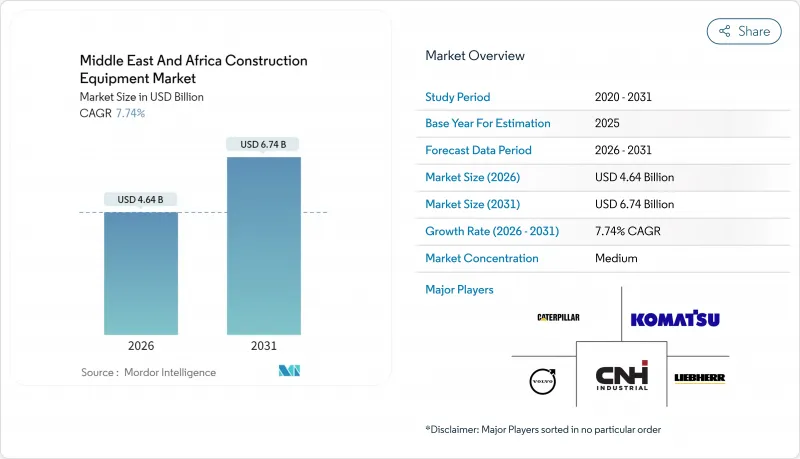
The construction equipment market benefits from an unprecedented USD 2 trillion infrastructure pipeline across the Gulf Cooperation Council (GCC), positioning regional growth far ahead of the global average. Saudi Arabia drives spending through Vision 2030 mega-projects, while Qatar sustains momentum with post-World-Cup investments and continues to implement National Vision 2030 diversification programs. Robust contractor backlogs, a clear pivot toward digital fleet optimization, and expanding mining activity for battery minerals collectively reinforce demand resilience. Meanwhile, the diesel-powered fleet maintains dominance despite accelerating adoption of hybrid and fully electric machines as contractors balance reliability with emerging sustainability requirements.
Middle East And Africa Construction Equipment Market Trends and Insights
GCC Mega-Projects Pipeline Accelerates Equipment Demand
Saudi Arabia's Vision 2030 agenda earmarks USD 1 trillion for infrastructure, including NEOM development that requires tower cranes, prompting Wolffkran and Zamil Group to establish the region's first tower-crane manufacturing facility. The UAE supports momentum with more than USD 650 billion in active or awarded projects, while Qatar's USD 25 billion National Rail Scheme sustains construction work. Joint ventures such as NEOM's SAR 1.3 billion robotics deal with Samsung C&T cut manual rebar labor by 80% yet intensify demand for automated equipment fleets. Long-term visibility and sovereign funding insulate the construction equipment market from global slowdowns, ensuring steady machine order books for OEMs and dealers.
Region-Wide Shift From Ownership To Rental Models
Contractors are pivoting toward rental to combat the two-fifth surge in equipment purchase prices since 2020. United Rentals reported a revenue uptick in 2024 as Middle East customers expand short-term contracts covering telematics, service, and operator training. Herc Rentals projects regional growth in 2025 on similar bundled offerings. Saudi Arabia's rental niche is tracking a double-digit CAGR, driven by cash-flow optimization during a high-interest environment. The model improves fleet utilization and opens access to next-generation electric excavators without large upfront capital, keeping the construction equipment market aligned with evolving sustainability targets.
Oil-Price Cyclicality Defers Capex Decisions
Sharp upward shifts in crude prices reduce discretionary fleet budgets because contractors anticipate cost-plus contract renegotiations and financing constraints. The offshore sector slashed in CAPEX in 2020, postponing platform expansions that otherwise require specialized cranes and pipelayers. Nigeria showcases the sensitivity: construction input costs spike when Brent exceeds tightening lending and dampening new equipment orders despite GDP growth. Nonetheless, diversified GCC economies cushion volatility via sovereign-backed public works that hold procurement schedules steady, limiting downside risk for the construction equipment market.
Other drivers and restraints analyzed in the detailed report include:
- Rapid Urban Housing Programmes Across Africa
- Local-Content Rules Driving Oem-Local Jv Assembly Lines
- Political & Security Hotspots Curb Project Execution
For complete list of drivers and restraints, kindly check the Table Of Contents.
Segment Analysis
Excavators accounted for 35.75% of Middle East and Africa construction equipment market in 2025, underscoring their pivotal role across public mega-projects, mining, and housing developments. The construction equipment market size attached to excavators is on track to rise at a 7.79% CAGR through 2031 in response to heavy trenching needs on Qatar's National Rail Scheme and limestone overburden removal at Egyptian cement sites. Excavators equipped with grade-control automatics and high-reach demolition booms deliver one-fifth efficiency gains, prompting repeat orders from Tier 1 contractors.
Demand also reflects battery-mineral extraction in the DRC, where deep-pit cobalt mines require 90-ton units with reinforced undercarriages. Stringent construction safety codes boost preference for excavators with 360-degree cameras and telematics, enabling one-fifth utilization improvements. Complementary categories including wheel loaders and crawler cranes, support aggregate transfer and high-rise lifts yet trail excavators in growth momentum. Telescopic handlers grow within modular housing plants in Saudi Arabia, while backhoe loaders supply utility trenching across mixed-traffic urban roads.
Diesel and ICE models represented 72.63% of Middle East and Africa construction equipment market in 2025, validating continued reliance on conventional powertrains in desert and off-grid African sites. High thermal-tolerance engines paired with multi-stage filtration safeguard uptime against 50 °C ambient conditions. Nevertheless, the electric and hybrid cohort is advancing at a 7.75% CAGR as GCC decarbonization policies push clients toward lower Scope 1 emissions targets.
Caterpillar's 320 Electric excavator delivers an eight-hour shift on a single charge and slots directly into fleet telematics dashboards, simplifying adoption within mixed-power fleets. Urban metro tunneling in Dubai increasingly specifies zero-tailpipe machines, while mining operators exploit reduced ventilation costs underground. Persistent constraints-battery degradation under heat and limited charging infrastructure-slow penetration outside metropolitan hubs, yet rental firms accelerate exposure by bundling mobile chargers into equipment-as-a-service packages.
The Middle East and Africa Construction Equipment Market Report is Segmented by Machinery Type (Excavators, Wheel Loaders, and More), Drive Type (Diesel/ICE and More), Power Output (Less Than or Equal To 100 HP and More), Application (Infrastructure & Transport, Oil & Gas, and More), End-User (Contractors, and More), and Geography. The Market Forecasts are Provided in Terms of Value (USD) and Volume (Units).
List of Companies Covered in this Report:
- Caterpillar Inc.
- Komatsu Ltd.
- Volvo AB
- Hitachi Construction Machinery
- Liebherr Group
- CNH Industrial (Case CE)
- JCB Ltd.
- Doosan Corporation
- Kobelco Construction Machinery
- Tadano Ltd.
- Manitowoc Company Inc.
- Sumitomo Construction Machinery
- Mitsubishi Corporation
- XCMG
- SANY Heavy Industry
- Hyundai Genuine
- Deere & Company (Wirtgen)
- Bobcat Company
- Zoomlion Heavy Industry
- Terex Corporation
Additional Benefits:
- The market estimate (ME) sheet in Excel format
- 3 months of analyst support
TABLE OF CONTENTS
1 Introduction
- 1.1 Study Assumptions & Market Definition
- 1.2 Scope of the Study
2 Research Methodology
3 Executive Summary
4 Market Landscape
- 4.1 Market Overview
- 4.2 Market Drivers
- 4.2.1 GCC Mega-Projects Pipeline Accelerates Equipment Demand
- 4.2.2 Region-Wide Shift From Ownership To Rental Models
- 4.2.3 Rapid Urban Housing Programmes Across Africa
- 4.2.4 Local-Content Rules Driving Oem-Local Jv Assembly Lines
- 4.2.5 Telematics-As-A-Service For Remote Desert Fleet Optimisation
- 4.2.6 Battery-Mineral Mining (Lithium, Manganese) Needs Heavy Loaders
- 4.3 Market Restraints
- 4.3.1 Oil-Price Cyclicality Defers Capex Decisions
- 4.3.2 Political & Security Hotspots Curb Project Execution
- 4.3.3 Port Congestion Delays Critical Spare-Parts Flow
- 4.3.4 Shortage Of Technicians For Next-Gen Electric Machines
- 4.4 Value / Supply-Chain Analysis
- 4.5 Regulatory Landscape
- 4.6 Technological Outlook
- 4.7 Porter's Five Forces
- 4.7.1 Threat of New Entrants
- 4.7.2 Bargaining Power of Buyers
- 4.7.3 Bargaining Power of Suppliers
- 4.7.4 Threat of Substitutes
- 4.7.5 Competitive Rivalry
5 Market Size & Growth Forecasts (Value (USD))
- 5.1 By Machinery Type
- 5.1.1 Excavators
- 5.1.2 Wheel Loaders
- 5.1.3 Crawler Cranes
- 5.1.4 Telescopic Handlers
- 5.1.5 Backhoe Loaders
- 5.1.6 Skid-Steer & Compact Track Loaders
- 5.1.7 Motor Graders
- 5.1.8 Bulldozers & Dozers
- 5.1.9 Asphalt Pavers & Road Rollers
- 5.1.10 Articulated Dump Trucks
- 5.1.11 Trenchers & Misc.
- 5.2 By Drive Type
- 5.2.1 Diesel / ICE
- 5.2.2 Electric & Hybrid
- 5.2.3 Hydraulic
- 5.3 By Power Output
- 5.3.1 Less than or equal to 100 HP
- 5.3.2 101-200 HP
- 5.3.3 201-400 HP
- 5.3.4 More than 400 HP
- 5.4 By Application
- 5.4.1 Infrastructure & Transport
- 5.4.2 Oil & Gas
- 5.4.3 Mining & Quarrying
- 5.4.4 Commercial Buildings
- 5.4.5 Residential
- 5.4.6 Industrial / Manufacturing
- 5.5 By End-User
- 5.5.1 Contractors
- 5.5.2 Equipment Rental Companies
- 5.5.3 Government & Municipalities
- 5.5.4 Mining Firms
- 5.6 By Country
- 5.6.1 Saudi Arabia
- 5.6.2 United Arab Emirates
- 5.6.3 Qatar
- 5.6.4 Oman
- 5.6.5 Kuwait
- 5.6.6 Bahrain
- 5.6.7 South Africa
- 5.6.8 Rest of Middle East and Africa
6 Competitive Landscape
- 6.1 Market Concentration
- 6.2 Strategic Moves
- 6.3 Market Share Analysis
- 6.4 Company Profiles (includes Global Level Overview, Market Level Overview, Core Segments, Financials as Available, Strategic Information, Market Rank/Share for Key Companies, Products and Services, SWOT Analysis, and Recent Developments)
- 6.4.1 Caterpillar Inc.
- 6.4.2 Komatsu Ltd.
- 6.4.3 Volvo AB
- 6.4.4 Hitachi Construction Machinery
- 6.4.5 Liebherr Group
- 6.4.6 CNH Industrial (Case CE)
- 6.4.7 JCB Ltd.
- 6.4.8 Doosan Corporation
- 6.4.9 Kobelco Construction Machinery
- 6.4.10 Tadano Ltd.
- 6.4.11 Manitowoc Company Inc.
- 6.4.12 Sumitomo Construction Machinery
- 6.4.13 Mitsubishi Corporation
- 6.4.14 XCMG
- 6.4.15 SANY Heavy Industry
- 6.4.16 Hyundai Genuine
- 6.4.17 Deere & Company (Wirtgen)
- 6.4.18 Bobcat Company
- 6.4.19 Zoomlion Heavy Industry
- 6.4.20 Terex Corporation
7 Market Opportunities & Future Outlook
- 7.1 White-Space & Unmet-Need Assessment

