PUBLISHER: Mordor Intelligence | PRODUCT CODE: 1906181

PUBLISHER: Mordor Intelligence | PRODUCT CODE: 1906181
Portable Magnetic Resonance Imaging - Market Share Analysis, Industry Trends & Statistics, Growth Forecasts (2026 - 2031)
The Portable Magnetic Resonance Imaging Market was valued at USD 4.38 billion in 2025 and estimated to grow from USD 4.64 billion in 2026 to reach USD 6.23 billion by 2031, at a CAGR of 6.05% during the forecast period (2026-2031).
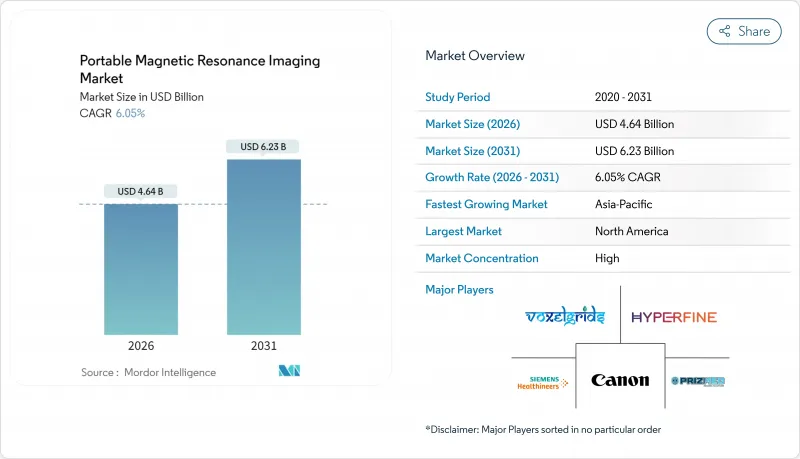
Growth stems from the marriage of ultra-low-field magnet design, AI-based image enhancement, and a rising demand for bedside neuro-critical diagnostics. Hospitals adopt the systems first because they can embed them in intensive-care workflows without new shielded rooms, while venture funding shortens product cycles and enables rapid international roll-outs. Integration into mobile stroke units broadens first-hour stroke care, and early battlefield trials expand the addressable base beyond civilian facilities. Challenges around image resolution and reimbursement remain, yet November 2024 CMS guidelines on remote scanning mark a regulatory inflection that improves provider confidence.
Global Portable Magnetic Resonance Imaging Market Trends and Insights
Cost-Effectiveness Versus Fixed MRI Systems
Portable units avoid shielded rooms and liquid-helium cooling, cutting capital outlays by more than 60% while trimming operating costs and technician requirements. A single cart-based scanner can rotate among ICUs, emergency bays, or rural clinics, boosting utilization well above fixed-suite averages. The total-cost-of-ownership gap resonates in budget-constrained health systems that need imaging expansion without major infrastructure spend. Pricing innovations, such as USD 499 full-body AI-enhanced scans, further democratize routine imaging access.
Rising Venture & Corporate Funding
USD 90 million raised by Hyperfine, USD 17 million by Chipiron, and multimillion-dollar seed rounds for simulation software firms illustrate deep investor conviction that the portable MRI market can serve emergency, rural, and military verticals simultaneously. Strategic tie-ups between NVIDIA and multiple scanner vendors accelerate AI pipelines and reinforce the thesis that imaging hardware and cloud computation are converging.
Inferior Image Resolution & Coil Limitations
Low-field magnets between 0.064 T and 0.55 T generate lower signal-to-noise ratios than 1.5 T or 3 T systems, compromising fine anatomical visualization. While AI denoising narrows the gap, physics still caps achievable spatial resolution, and flexible lightweight coils reduce radio-frequency homogeneity. Missed micro-lesions in pediatric neuro-oncology remain a sticking point that slows adoption in tertiary centers.
Other drivers and restraints analyzed in the detailed report include:
- Growing Need for Neuro-Critical Point-of-Care Imaging
- Pre-Hospital Mobile Stroke Units and Advanced Ambulances
- Uncertain Reimbursement Pathways
For complete list of drivers and restraints, kindly check the Table Of Contents.
Segment Analysis
Neurology accounted for 45.12% of the portable MRI market in 2025, confirming that rapid bedside brain imaging drives initial demand. This dominance supports a portable MRI market size commanding nearly half the segment revenue and demonstrates tangible workflow benefits in stroke and traumatic brain injury cases. The ACTION-PMR multicenter trial underpins neurologists' confidence by matching 90% of high-field diagnostic decisions within emergency timeframes. Growth continues as hospitals embed scanners in neuro-ICUs to monitor cerebral edema or hemorrhage without patient transfer.
Pediatrics and neonatal care is expanding at a 6.95% CAGR and is projected to outpace all other clinical groups through 2031. Bedside imaging mitigates sedation risks and eliminates neonatal transport, vital factors in intensive care nurseries. Reduced acoustic noise and an open, non-claustrophobic bore also lower distress in young patients. Subsequent AI-enhanced reconstruction further clarifies small structures, steadily narrowing the resolution gap that once barred infant brain screening. Musculoskeletal use grows as radiologists exploit position-dependent scans for weight-bearing joint assessment, while cardiology and abdominal scanning remain limited until temporal and spatial resolution improve.
The Global Portable MRI Market Report is Segmented by Application (Neurology, Musculoskeletal, Gastroenterology, Cardiology, Pediatrics/Neonatal, Others), Facility Type (Hospitals, Diagnostic Imaging Centers, Ambulatory Surgery Centers, Mobile Stroke Units & Field Deployments, Others), and Geography (North America, Europe, Asia-Pacific, Middle East & Africa, South America). The Market Forecasts are Provided in Terms of Value (USD).
Geography Analysis
North America generated 42.74% of global revenue in 2025, anchoring the portable MRI market on the back of ample venture funding, FDA-cleared products, and the earliest reimbursement discussions. Hyperfine's USD 90 million cumulative raise and Chipiron's U.S. Series A exemplify investor appetite, while DoD grants sustain battlefield prototypes that could filter back to civilian trauma care. CMS recognition of remote scanning standards signals regulatory momentum likely to catalyze payer codes over the next two years.
Asia-Pacific is forecast to grow at an 7.78% CAGR through 2031, the highest regional pace. China's rural diagnostics initiatives and India's tele-radiology networks create fertile ground for cost-efficient imaging solutions. Japan supports portable MRI deployment through its 6,300-scanner installed base and robust AI research ecosystem. The region also manufactures advanced permanent magnets, shortening supply chains and lowering price points, factors that will expand the portable MRI market in mid-income economies.
Europe maintains steady adoption as national health systems validate mobile stroke units in Germany and helium-free truck solutions in the UK. CE-mark approvals for AI-powered portable units clear the regulatory pathway, yet stringent HTA reviews slow large-scale procurement until long-term outcomes are proven. Middle East & Africa and South America remain nascent, but field-deployable units are well suited to areas with dispersed populations and limited imaging infrastructure, setting the stage for leapfrog adoption once financing vehicles mature.
- Hyperfine
- Siemens Healthineers
- GE HealthCare Technologies Inc.
- Koninklijke Philips
- Canon
- United Imaging Healthcare Co. Ltd.
- Fujifilm Holdings Corp.
- Esaote
- Synaptive Medical Inc.
- Time Medical Systems
- Aspect Imaging Ltd.
- Voxelgrids Innovations
- PrizMed Imaging Solution Inc.
- Cobalt Health
- JMP Medical Sp. z o.o.
- MR Resources Inc.
- Mediso Medical Imaging Systems
- Shenzhen Anke High-tech Co.
- Shenzhen Basda Medical Apparatus
- Oxford Instruments
Additional Benefits:
- The market estimate (ME) sheet in Excel format
- 3 months of analyst support
TABLE OF CONTENTS
1 Introduction
- 1.1 Study Assumptions & Market Definition
- 1.2 Scope of the Study
2 Research Methodology
3 Executive Summary
4 Market Landscape
- 4.1 Market Overview
- 4.2 Market Drivers
- 4.2.1 Cost-Effectiveness Versus Fixed MRI Systems
- 4.2.2 Rising Venture & Corporate Funding
- 4.2.3 Growing Need For Neuro-Critical Point-Of-Care Imaging
- 4.2.4 Pre-Hospital Mobile Stroke Units And Advanced Ambulances Are Piloting Compact MRI Scanners
- 4.2.5 Battlefield & Disaster-Relief Adoption Potential
- 4.2.6 Military Medical Corps And Disaster-Relief Agencies Are Trialing Ruggedized Portable Mri Systems For Field Hospitals,
- 4.3 Market Restraints
- 4.3.1 Inferior Image Resolution & Coil Limitations
- 4.3.2 Uncertain Reimbursement Pathways
- 4.3.3 Limited Clinician Familiarity With Low-Field Image Characteristics
- 4.3.4 Battery Life / EMI Issues In Austere Settings
- 4.4 Value / Supply-Chain Analysis
- 4.5 Regulatory Landscape
- 4.6 Technological Outlook
- 4.7 Porter's Five Forces
- 4.7.1 Threat of New Entrants
- 4.7.2 Bargaining Power of Buyers
- 4.7.3 Bargaining Power of Suppliers
- 4.7.4 Threat of Substitutes
- 4.7.5 Competitive Rivalry
5 Market Size & Growth Forecasts (Value)
- 5.1 By Application
- 5.1.1 Neurology
- 5.1.2 Musculoskeletal
- 5.1.3 Gastroenterology
- 5.1.4 Cardiology
- 5.1.5 Pediatrics / Neonatal
- 5.1.6 Others
- 5.2 By Facility Type
- 5.2.1 Hospitals
- 5.2.2 Diagnostic Imaging Centers
- 5.2.3 Ambulatory Surgery Centers
- 5.2.4 Mobile Stroke Units & Field Deployments
- 5.2.5 Others
- 5.3 By Geography
- 5.3.1 North America
- 5.3.1.1 United States
- 5.3.1.2 Canada
- 5.3.1.3 Mexico
- 5.3.2 Europe
- 5.3.2.1 Germany
- 5.3.2.2 United Kingdom
- 5.3.2.3 France
- 5.3.2.4 Italy
- 5.3.2.5 Spain
- 5.3.2.6 Rest of Europe
- 5.3.3 Asia-Pacific
- 5.3.3.1 China
- 5.3.3.2 Japan
- 5.3.3.3 India
- 5.3.3.4 Australia
- 5.3.3.5 South Korea
- 5.3.3.6 Rest of Asia-Pacific
- 5.3.4 Middle East & Africa
- 5.3.4.1 GCC
- 5.3.4.2 South Africa
- 5.3.4.3 Rest of Middle East & Africa
- 5.3.5 South America
- 5.3.5.1 Brazil
- 5.3.5.2 Argentina
- 5.3.5.3 Rest of South America
- 5.3.1 North America
6 Competitive Landscape
- 6.1 Market Concentration
- 6.2 Market Share Analysis
- 6.3 Company Profiles (includes Global overview, market overview, core segments, financials, strategic info, rank/share, products & services, recent developments)
- 6.3.1 Hyperfine Inc.
- 6.3.2 Siemens Healthineers AG
- 6.3.3 GE HealthCare Technologies Inc.
- 6.3.4 Koninklijke Philips N.V.
- 6.3.5 Canon Medical Systems Corp.
- 6.3.6 United Imaging Healthcare Co. Ltd.
- 6.3.7 Fujifilm Holdings Corp.
- 6.3.8 Esaote SpA
- 6.3.9 Synaptive Medical Inc.
- 6.3.10 Time Medical Systems
- 6.3.11 Aspect Imaging Ltd.
- 6.3.12 Voxelgrids Innovations Pvt. Ltd.
- 6.3.13 PrizMed Imaging Solution Inc.
- 6.3.14 Cobalt Health
- 6.3.15 JMP Medical Sp. z o.o.
- 6.3.16 MR Resources Inc.
- 6.3.17 Mediso Medical Imaging Systems
- 6.3.18 Shenzhen Anke High-tech Co.
- 6.3.19 Shenzhen Basda Medical Apparatus
- 6.3.20 Oxford Instruments plc
7 Market Opportunities & Future Outlook
- 7.1 White-space & Unmet-Need Assessment

