PUBLISHER: Mordor Intelligence | PRODUCT CODE: 2125306

PUBLISHER: Mordor Intelligence | PRODUCT CODE: 2125306
Oxygen - Market Share Analysis, Industry Trends & Statistics, Growth Forecasts (2026 - 2031)
According to Mordor Intelligence, the oxygen market size is expected to increase from 91.22 Million tons in 2025 to 95.38 Million tons in 2026 and reach 119.20 Million tons by 2031, growing at a CAGR of 4.56% over 2026-2031.
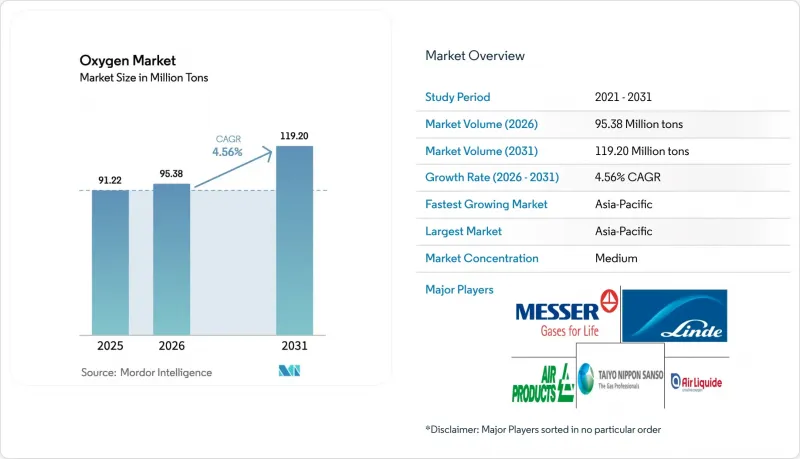
This report is Segmented by Form (Gas, Liquid, and Solid), Type (Industrial and Medical), Application (Metals and Mining, Chemical Industry, Oil and Gas, Healthcare, Pharmaceutical, and Other Applications), and Geography (Asia-Pacific, North America, Europe, South America, and Middle-East and Africa). The Market Forecasts are Provided in Terms of Volume (Tons).
Global Oxygen Market Trends and Insights
Rising Incidence of Acute and Chronic Respiratory Disorders
Global prevalence of chronic obstructive pulmonary disease and asthma reached 545 million in 2023, climbing 3.2% annually in low- and middle-income nations where air-quality deterioration and tobacco use persist. Disability-adjusted life years tied to respiratory illness rose to 7.8% of the total burden in South Asia, pushing hospitals in India, Bangladesh, and Pakistan to scale medical-gas systems quickly. Emergency departments in the United States logged an 18% jump in oxygen-dependent episodes between 2020 and 2024, a shift that triggered upgrades from cylinder bundles to bulk liquid storage in major urban centers. WHO's updated treatment guidelines now require that every inpatient ward equipped for respiratory care maintain continuous high-flow oxygen availability, ensuring that procurement of pressure-swing-adsorption (PSA) plants and cylinder-filling hubs accelerates across lower-income regions. Collectively, these factors add direct volume and ensure recurring demand for the oxygen market across both public and private healthcare networks.
Steel and Non-Ferrous Metal Production Growth in Asia
China produced 1.02 billion tons of crude steel in 2024, capturing a 53% global share, while India's output reached 144 million tons on a 7.4% year-on-year rise. Blast-furnace oxygen enrichment that lifts inlet concentration from 21% to 28% is trimming furnace coke consumption by 12% per ton of hot metal, lowering cost curves and tightening emission caps at Chinese mills. Indonesia and Vietnam commissioned nickel-pig-iron smelters that each consume up to 1.2 tons of oxygen per ton of product, generating steady offtake in Sulawesi and Quang Ngai. South Korea's hydrogen direct-reduction pilot at Pohang signals a pivot to oxygen-intensive downstream melting, adding future strength to the oxygen market in East Asia. Robust ferrous and non-ferrous production therefore anchors long-run industrial gas demand well beyond the forecast window.
Availability of Alternate Cutting/Fuel Gases (LPG, Acetylene)
Liquefied petroleum gas and acetylene increasingly displace oxygen-fuel pairs in small-scale welding where portability outweighs pure flame temperature. A 2024 American Welding Society survey showed 38% of workshops in the United States and Mexico moved to LPG-air torches for steel up to 25 mm thick, saving USD 120 per month on cylinder rental. Propane-oxygen hybrids in Indian shipyards and construction sites reduce overall oxygen draw per cut by 15% while simplifying logistics. Plasma-arc systems based on compressed air or nitrogen capture 22% cutting share in Europe on falling equipment costs, nudging down oxygen market volumes in fabrication. Although these alternatives carry trade-offs in cut quality and speed, their lower handling risks and cost advantages slow oxygen penetration in selected user segments.
Other drivers and restraints analyzed in the detailed report include:
- Expansion of On-Purpose Hydrogen and Oxy-Fuel Projects
- Hospital Shift to PSA Micro-Plants in Emerging Markets
- Trace-Contaminant Limits for EU MDR Oxygen APIs
For complete list of drivers and restraints, kindly check the Table Of Contents.
Segment Analysis
Gaseous supply held 87.68% oxygen market share in 2025 as on-site air-separation units dispatch flows at 5-40 bar straight into steel furnaces, chemical reactors, and chip fabs. Liquid oxygen expands at a 4.55% CAGR because cryogenic trucks deliver steady volumes to Chile's Atacama copper belt, Australia's Pilbara mines, and LNG-to-power islands where pipelines prove uneconomical. The oxygen market size attributable to solid oxygen remains marginal because of limited aerospace and laboratory usage.
Emerging trends add electrolyzer-generated oxygen to existing networks, cutting blended costs by 8% in Germany's Ruhr Valley pilot led by ThyssenKrupp and Air Liquide. LNG power complexes at ExxonMobil's Baytown and Reliance Jamnagar now store liquid oxygen in cryogenic tanks to cushion plant upsets, illustrating how liquid logistics underpin resiliency. Regulatory frameworks-ISO 21969 for vessel design and ASME codes for high-pressure oxygen piping-tighten inspection intervals, favoring large suppliers that can bundle engineering and compliance into long-term contracts. Collectively, these mechanics reinforce gaseous leadership while carving a distinct growth lane for liquid in the oxygen market.
Complete Report Scope:
- By Form
- Gas
- Liquid
- Solid
- By Type
- Industrial
- Medical
- By Application
- Metals and Mining
- Chemical Industry
- Oil and Gas
- Healthcare
- Pharmaceutical
- Other Applications
- By Geography
- Asia-Pacific
- China
- India
- Japan
- South Korea
- ASEAN Countries
- Rest of Asia-Pacific
- North America
- United States
- Canada
- Mexico
- Europe
- Germany
- United Kingdom
- France
- Italy
- NORDIC Countries
- Rest of Europe
- South America
- Brazil
- Argentina
- Rest of South America
- Middle-East and Africa
- Saudi Arabia
- South Africa
- Rest of Middle-East and Africa
- Asia-Pacific
Geography Analysis
Asia-Pacific led with a 41.52% oxygen market share in 2025 and is on track for a 5.45% CAGR through 2031. China's 1.02 billion-ton steel output and India's 144 million tons anchor regional volume, while Indonesia's nickel smelters and Vietnam's electronics corridors add pockets of intensity. South Korea contributes high-purity spikes as Samsung and SK Hynix move to sub-3 nm nodes. ASEAN financing through the Asian Development Bank supported 420 PSA installations that shrink rural cylinder dependence in Indonesia, the Philippines, and Myanmar.
North America is anchored by hydrogen hubs, oxy-fuel retrofits, and hospital upgrades. Seven domestic hubs aim to yield 800,000 tons of co-product oxygen yearly once fully operational, with 40% already tied up in Gulf Coast petrochemical contracts. Canada pilots hydrogen iron-making in Ontario, and Mexico's automotive corridor lifts welding demand in Monterrey and Guanajuato. In Europe, mixing carbon-capture incentives with stringent MDR purity rules raises capital intensity for medical suppliers.
South America and the Middle East and Africa collectively weigh in a smaller share but outpace mature economies. Brazil's green-hydrogen pilots and EAF steel expansions shape demand, while Argentina's lithium extraction relies on oxygenated leaching . Saudi Arabia's Neom complex will internally absorb most of its 1.2 million-ton output, limiting merchant spillover yet signaling potential for future offtake if local networks mature. South Africa's platinum smelters and PSA deployments respond to lessons from COVID-19-era shortages. National regulations, from Brazil's ANVISA to South Africa's Essential Medicines List, reinforce market access requirements that cement sustained oxygen market growth.
- Air Liquide
- Air Products and Chemicals, Inc.
- AIR WATER INC
- Axcel Gases
- Gruppo SIAD
- Guangdong Huate Gas Co., Ltd.
- Gulfcryo
- Hangzhou Oxygen Group Co., Ltd.
- INOX-Air Products Inc.
- International Industrial Gases Ltd
- Iwatani Corporation
- Linde PLC
- Messer SE & Co. KGaA
- NIPPON SANSO HOLDINGS CORPORATION
- Sauerstoffwerk Friedrichshafen GmbH
- SOL Spa
- Steelman Gases Pvt. Ltd.
- Yingde Gas Shanghai
Additional Benefits:
- The market estimate (ME) sheet in Excel format
- 3 months of analyst support
TABLE OF CONTENTS
1 Introduction
- 1.1 Study Assumptions and Market Definition
- 1.2 Scope of the Study
2 Research Methodology
3 Executive Summary
4 Market Landscape
- 4.1 Market Overview
- 4.2 Market Drivers
- 4.2.1 Rising Incidence of Acute and Chronic Respiratory Disorders
- 4.2.2 Steel and Non-Ferrous Metal Production Growth in Asia
- 4.2.3 Expansion of On-Purpose Hydrogen and Oxy-Fuel Projects
- 4.2.4 Hospital Shift to PSA Micro-Plants in Emerging Markets
- 4.2.5 Ultra-High-Purity O2 Demand from Advanced-Node Semiconductors
- 4.3 Market Restraints
- 4.3.1 Availability of Alternate Cutting/Fuel Gases (LPG, Acetylene)
- 4.3.2 Global Shortage of Large-Bore Cryogenic Iso-Tankers
- 4.3.3 Trace-Contaminant Limits for EU MDR Oxygen Apis
- 4.4 Value Chain Analysis
- 4.5 Porter's Five Forces
- 4.5.1 Bargaining Power of Suppliers
- 4.5.2 Bargaining Power of Buyers
- 4.5.3 Threat of New Entrants
- 4.5.4 Threat of Substitutes
- 4.5.5 Degree of Competition
5 Market Size and Growth Forecasts (Volume)
- 5.1 By Form
- 5.1.1 Gas
- 5.1.2 Liquid
- 5.1.3 Solid
- 5.2 By Type
- 5.2.1 Industrial
- 5.2.2 Medical
- 5.3 By Application
- 5.3.1 Metals and Mining
- 5.3.2 Chemical Industry
- 5.3.3 Oil and Gas
- 5.3.4 Healthcare
- 5.3.5 Pharmaceutical
- 5.3.6 Other Applications
- 5.4 By Geography
- 5.4.1 Asia-Pacific
- 5.4.1.1 China
- 5.4.1.2 India
- 5.4.1.3 Japan
- 5.4.1.4 South Korea
- 5.4.1.5 ASEAN Countries
- 5.4.1.6 Rest of Asia-Pacific
- 5.4.2 North America
- 5.4.2.1 United States
- 5.4.2.2 Canada
- 5.4.2.3 Mexico
- 5.4.3 Europe
- 5.4.3.1 Germany
- 5.4.3.2 United Kingdom
- 5.4.3.3 France
- 5.4.3.4 Italy
- 5.4.3.5 NORDIC Countries
- 5.4.3.6 Rest of Europe
- 5.4.4 South America
- 5.4.4.1 Brazil
- 5.4.4.2 Argentina
- 5.4.4.3 Rest of South America
- 5.4.5 Middle-East and Africa
- 5.4.5.1 Saudi Arabia
- 5.4.5.2 South Africa
- 5.4.5.3 Rest of Middle-East and Africa
- 5.4.1 Asia-Pacific
6 Competitive Landscape
- 6.1 Market Concentration
- 6.2 Strategic Moves
- 6.3 Market Share (%)/Ranking Analysis
- 6.4 Company Profiles (includes Global level Overview, Market level overview, Core Segments, Financials as available, Strategic Information, Products and Services, Recent Developments)
- 6.4.1 Air Liquide
- 6.4.2 Air Products and Chemicals, Inc.
- 6.4.3 AIR WATER INC
- 6.4.4 Axcel Gases
- 6.4.5 Gruppo SIAD
- 6.4.6 Guangdong Huate Gas Co., Ltd.
- 6.4.7 Gulfcryo
- 6.4.8 Hangzhou Oxygen Group Co., Ltd.
- 6.4.9 INOX-Air Products Inc.
- 6.4.10 International Industrial Gases Ltd
- 6.4.11 Iwatani Corporation
- 6.4.12 Linde PLC
- 6.4.13 Messer SE & Co. KGaA
- 6.4.14 NIPPON SANSO HOLDINGS CORPORATION
- 6.4.15 Sauerstoffwerk Friedrichshafen GmbH
- 6.4.16 SOL Spa
- 6.4.17 Steelman Gases Pvt. Ltd.
- 6.4.18 Yingde Gas Shanghai
7 Market Opportunities and Future Outlook
- 7.1 White-space and Unmet-need Assessment

