PUBLISHER: Mordor Intelligence | PRODUCT CODE: 1906282

PUBLISHER: Mordor Intelligence | PRODUCT CODE: 1906282
POP Display - Market Share Analysis, Industry Trends & Statistics, Growth Forecasts (2026 - 2031)
The POP display market size in 2026 is estimated at USD 17.14 billion, growing from 2025 value of USD 16.27 billion with 2031 projections showing USD 22.23 billion, growing at 5.35% CAGR over 2026-2031.
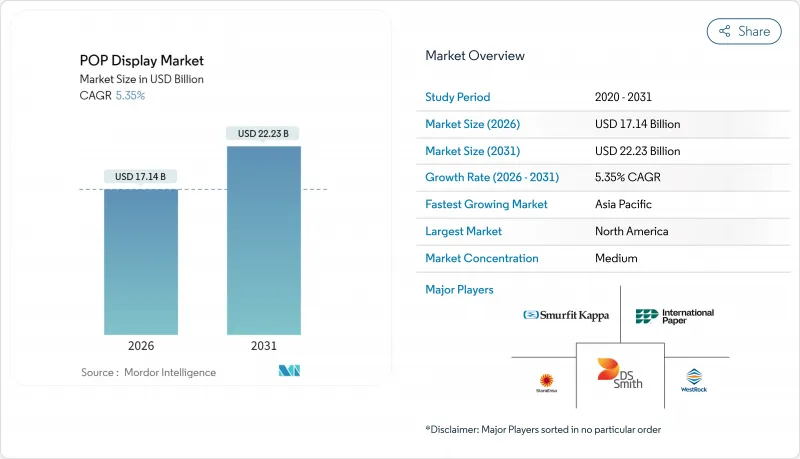
Retailers continue to invest in on-shelf theatre because impulse purchases still originate in stores even as e-commerce grows. Floor displays and corrugated cardboard solutions remain the backbone of merchandising programs, reflecting retailers' need for cost-effective, recyclable materials that can be deployed quickly across national store networks. Heightened interest in retail media networks is driving the integration of sensors and digital screens into physical displays, allowing brands to measure engagement and optimize planograms in real time. At the same time, sustainability legislation and raw-material cost spikes are accelerating the shift toward fibre-based substrates and closed-loop supply chains.
Global POP Display Market Trends and Insights
Surging FMCG and Convenience-Store Roll-outs in Emerging Economies
Aggressive store-opening campaigns by chains such as 7-Eleven and Lawson are fuelling localised demand for compact merchandising fixtures that can generate maximum impact within tight footprints. Small-format stores already represent 73% of modern grocery trade in Indonesia, compared with 47% in 2013, underscoring the need for vertical, modular solutions that fit limited floor space.
Retailers' Demand for High-conversion In-store Touchpoints
Brand owners now expect every square foot of selling space to deliver measurable returns. Ferrero's 2025 Perfect Store programme illustrates this shift, with displays linked to analytics dashboards that reveal SKU-level performance in real time. Such data-rich installations allow category managers to tweak placement during a promotion cycle rather than after it.
E-commerce and Digital Ads Siphoning In-store Budgets
A tilt toward online advertising has curbed some physical merchandising spend as marketing chiefs chase attributable clicks. Research finds ROI uncertainty and store interference fears slowing adoption of in-store retail media, delaying budget migration back to fixtures. To compensate, retailers are piloting audio ads and shelf-edge screens that require minimal floor-space reconfiguration.
Other drivers and restraints analyzed in the detailed report include:
- Fibre-based Corrugated Replacing Plastics
- Smart Sensor-equipped POP for Real-time Analytics
- Volatile Linerboard and Resin Pricing Squeezes Margins
For complete list of drivers and restraints, kindly check the Table Of Contents.
Segment Analysis
Floor units held 43.15% share of the POP display market in 2025 and are expanding at 5.75% CAGR, confirming that large-format fixtures remain the anchor of experiential selling zones. Countertop and end-cap units target impulse moments near tills and aisle terminations. Pallet displays support warehouse clubs and discount retailers, enabling cross-docking straight to sales floors. The Look Company notes that grocers now fuse sampling stations with floor graphics to trigger recipe-led baskets, spurring demand for hybrid cardboard-and-screen constructions.Floor displays' scale allows embedded sensors, QR codes and NFC tags, linking physical touchpoints to retail-media networks. As brands pay tenancy fees for prime floor real estate, store operators derive new income streams, further scaling the POP display market. End-cap upgrades mirror that trend, offering dynamic LED headers that switch creatives by daypart, improving SKU rotation without manual relabeling.
Corrugated cardboard represented 35.05% of the POP display market size in 2025, but foam board is advancing at 6.1% CAGR because its smooth surface delivers high-definition print crucial for cosmetics and tech gadgets. Fibre dominance stems from its light weight, recyclability and comparatively low unit cost. Plastic and metal remain vital for long-life gondolas in outdoor or high-humidity zones, yet taxes on virgin polymer intensify substitution pressure. Emergent bio-composite boards mix cellulose with crop residue, promising similar crush resistance at lower grammage. Retailers welcome such substrates because they simplify end-of-life recycling audits mandated by EPR regimes. Foam board's rise is pronounced in premium skincare where structure, colour fidelity and edge-lit logos elevate shelf presence without heavy steel frames.
POP Display Market is Segmented by Product Type (Countertop Displays, Floor Displays, End-Cap Displays, and More), Material (Corrugated Cardboard, Plastic, Metal, and More), Sales Channel (Department Stores, Supermarkets and Hypermarkets, and More), End User (Food and Beverages, Cosmetics and Personal Care and More) and by Geography. The Market Forecasts are Provided in Terms of Value (USD).
Geography Analysis
North America retained 24.25% share of the POP display market in 2025. Growth through 2030 stems from retail-media rollouts and capital investments such as WestRock's automated Wisconsin "superplant," which enhances corrugated capacity and shortens lead times. US grocers increasingly monetise end-cap inventory through programmatic booking systems that bundle digital kiosks with fibre kiosks. Canada's EPR legislation spurs demand for displays certified for curbside recycling, while Mexico's rising middle class drives adoption of branded shippers in convenience chains linked to cross-border supply hubs.
Asia-Pacific will record the fastest CAGR at 5.55% through 2031 as convenience chains plan 10,000 additional outlets by 2026. Chinese smart retail operators retrofit stores with AI-driven planogram optimisation, compressing refresh cycles from weeks to hours. India's organised retail corridor adds malls in second-tier cities, where brands deploy bilingual graphics and QR-coded recipe demos to build category education. Southeast Asian formats, often under 200 sqm, rely on slim, fold-flat towers that ship in knock-down kits to minimise freight.Europe's POP display market dynamics revolve around sustainability. The UK's plastic-tax framework and Germany's VerpackG law incentivise closed-loop substrates gov.uk. Retailers demand chain-of-custody certification, propelling interest in FSC-certified corrugated and water-based inks. French hypermarkets trial paper-based cooler claddings that resist condensation, extending fibre usage into refrigerated aisles. Digital adoption is growing as well, with grocery groups in the Netherlands linking ESL-equipped gondolas to mobile apps for instant promotions. Despite inflationary headwinds, premium positioning across cosmetics and gourmet food sustains unit values, offsetting volume softness in price-sensitive categories.
- DS Smith PLC
- WestRock Company
- Smurfit Kappa Group PLC
- International Paper Company
- Stora Enso Oyj
- Pratt Industries Inc.
- Sonoco Products Company
- Graphic Packaging International
- Georgia-Pacific LLC
- Menasha Packaging Company LLC
- Creative Displays Now!
- PPDandG
- Shenzhen WOW Display Co. Ltd.
- Mondi Group PLC
- Durabox Displays
- FFR Merchandising
- Parkway Display Products Ltd.
- Great Northern Corporation
- Hansen Display Group
- Repack Canada
Additional Benefits:
- The market estimate (ME) sheet in Excel format
- 3 months of analyst support
TABLE OF CONTENTS
1 INTRODUCTION
- 1.1 Study Assumptions and Market Definition
- 1.2 Scope of the Study
2 RESEARCH METHODOLOGY
3 EXECUTIVE SUMMARY
4 MARKET LANDSCAPE
- 4.1 Market Overview
- 4.2 Market Drivers
- 4.2.1 Surging FMCG and C-store roll-outs in emerging economies
- 4.2.2 Retailers demand for high-conversion in-store touchpoints
- 4.2.3 Sustainable, fibre-based corrugated replacing plastics
- 4.2.4 Smart sensor-equipped POP for real-time analytics
- 4.2.5 Modular display-as-a-service rental models gain traction
- 4.2.6 3-D printing enabling ultra-short-run custom displays
- 4.3 Market Restraints
- 4.3.1 E-commerce and digital ads siphoning in-store budgets
- 4.3.2 Volatile linerboard and resin pricing squeezes margins
- 4.3.3 Strict landfill and plastics-tax regulations
- 4.3.4 Shrink-floor retail concepts lowering display density
- 4.4 Supply-Chain Analysis
- 4.5 Regulatory Landscape
- 4.6 Technological Outlook
- 4.7 Porter's Five Forces Analysis
- 4.7.1 Bargaining Power of Suppliers
- 4.7.2 Bargaining Power of Buyers
- 4.7.3 Threat of New Entrants
- 4.7.4 Threat of Substitutes
- 4.7.5 Intensity of Competitive Rivalry
- 4.8 Assesment of Macroeconomic Factors on the market
5 MARKET SIZE AND GROWTH FORECASTS (VALUE)
- 5.1 By Product Type
- 5.1.1 Countertop Displays
- 5.1.2 Floor Displays
- 5.1.3 End-cap Displays
- 5.1.4 Pallet Displays
- 5.1.5 Others
- 5.2 By Material
- 5.2.1 Corrugated Cardboard
- 5.2.2 Plastic
- 5.2.3 Metal
- 5.2.4 Wood
- 5.2.5 Others
- 5.3 By Sales Channel
- 5.3.1 Department Stores
- 5.3.2 Supermarkets and Hypermarkets
- 5.3.3 Specialty Stores
- 5.3.4 Others
- 5.4 By End User
- 5.4.1 Food and Beverages
- 5.4.2 Cosmetics and Personal Care
- 5.4.3 Pharmaceuticals
- 5.4.4 Electronics and Appliances
- 5.4.5 Others
- 5.5 By Geography
- 5.5.1 North America
- 5.5.1.1 United States
- 5.5.1.2 Canada
- 5.5.1.3 Mexico
- 5.5.2 South America
- 5.5.2.1 Brazil
- 5.5.2.2 Argentina
- 5.5.2.3 Rest of South America
- 5.5.3 Europe
- 5.5.3.1 Germany
- 5.5.3.2 United Kingdom
- 5.5.3.3 France
- 5.5.3.4 Italy
- 5.5.3.5 Spain
- 5.5.3.6 Rest of Europe
- 5.5.4 Asia-Pacific
- 5.5.4.1 China
- 5.5.4.2 Japan
- 5.5.4.3 India
- 5.5.4.4 South Korea
- 5.5.4.5 Southeast Asia
- 5.5.4.6 Rest of Asia-Pacific
- 5.5.5 Middle East and Africa
- 5.5.5.1 Middle East
- 5.5.5.1.1 Saudi Arabia
- 5.5.5.1.2 United Arab Emirates
- 5.5.5.1.3 Turkey
- 5.5.5.1.4 Rest of Middle East
- 5.5.5.2 Africa
- 5.5.5.2.1 South Africa
- 5.5.5.2.2 Nigeria
- 5.5.5.2.3 Egypt
- 5.5.5.2.5 Rest of Africa
- 5.5.5.1 Middle East
- 5.5.1 North America
6 COMPETITIVE LANDSCAPE
- 6.1 Market Concentration
- 6.2 Strategic Moves
- 6.3 Market Share Analysis
- 6.4 Company Profiles (includes Global level Overview, Market level overview, Core Segments, Financials as available, Strategic Information, Market Rank/Share for key companies, Products and Services, and Recent Developments)
- 6.4.1 DS Smith PLC
- 6.4.2 WestRock Company
- 6.4.3 Smurfit Kappa Group PLC
- 6.4.4 International Paper Company
- 6.4.5 Stora Enso Oyj
- 6.4.6 Pratt Industries Inc.
- 6.4.7 Sonoco Products Company
- 6.4.8 Graphic Packaging International
- 6.4.9 Georgia-Pacific LLC
- 6.4.10 Menasha Packaging Company LLC
- 6.4.11 Creative Displays Now!
- 6.4.12 PPDandG
- 6.4.13 Shenzhen WOW Display Co. Ltd.
- 6.4.14 Mondi Group PLC
- 6.4.15 Durabox Displays
- 6.4.16 FFR Merchandising
- 6.4.17 Parkway Display Products Ltd.
- 6.4.18 Great Northern Corporation
- 6.4.19 Hansen Display Group
- 6.4.20 Repack Canada
7 MARKET OPPORTUNITIES AND FUTURE OUTLOOK
- 7.1 White-space and Unmet-need Assessment

