
PUBLISHER: Mordor Intelligence | PRODUCT CODE: 1906923

PUBLISHER: Mordor Intelligence | PRODUCT CODE: 1906923
Indonesia Hospitality Real Estate - Market Share Analysis, Industry Trends & Statistics, Growth Forecasts (2026 - 2031)
The Indonesia Hospitality Real Estate Market is expected to grow from USD 2.44 billion in 2025 to USD 2.7 billion in 2026 and is forecast to reach USD 4.46 billion by 2031 at 10.58% CAGR over 2026-2031.
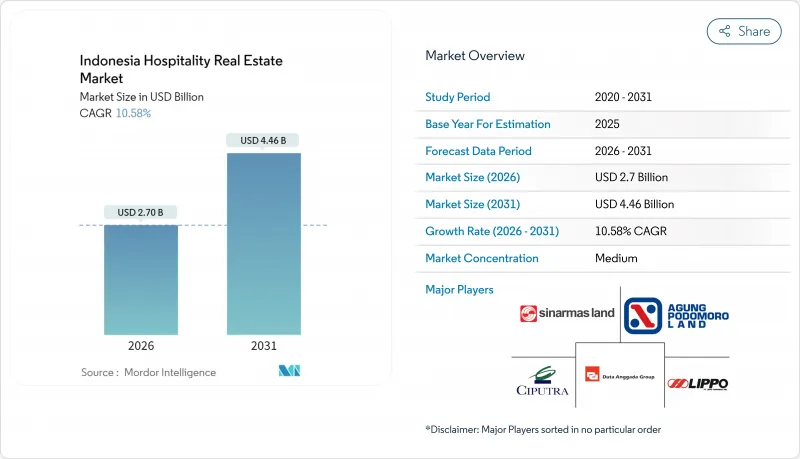
Government infrastructure spending of USD 25.5 billion in 2025, combined with the ongoing Nusantara Capital City program, anchors the sector's long-run demand. Tourism's USD 72.5 billion contribution to 2024 GDP demonstrates strong post-pandemic resilience. New air routes, tax-friendly Special Economic Zones, and visa-on-arrival expansions further stimulate pipeline activity, while cautious monetary conditions and complex land rules temper foreign investor appetite. Institutional capital continues to favor branded assets, yet locally owned independents retain pricing agility across secondary cities.
Indonesia Hospitality Real Estate Market Trends and Insights
Government-Backed Destination Development Programs Unlocking New Hotel Corridors
Dedicated federal spending is opening new demand corridors beyond Bali and Jakarta. The USD 3.7 billion private hospitality commitments tied to Nusantara Capital City underscore investor confidence in the government's long-horizon strategy. Super-priority sites spanning Lake Toba to Labuan Bajo receive direct budget allocations, creating predictable construction timelines and de-risked feasibility models. North Sulawesi's USD 50.0 million influx into hotels and restaurants illustrates capital migration toward lesser-known islands. State guarantees under the National Strategic Projects framework streamline licensing, compress financing costs, and differentiate Indonesia from neighboring tourism markets that rely on ad-hoc growth.
Visa Liberalization and Streamlined Arrivals Procedures Increasing International Visitation
Simplified entry rules produced 4.09 million foreign arrivals in the first four months of 2024, a 24.85% jump year-over-year. Malaysia, Australia, and China collectively represent 36% of total visitors, reducing single-market vulnerability. Occupancy of star-rated hotels reached 47.14% in April 2024, up 5.77 percentage points from 2023. Traffic spikes at Ngurah Rai and Soekarno Hatta airports confirm the immediate linkage between policy change and RevPAR gains. Streamlined screening minimizes arrival friction and positions the Indonesia hospitality real estate market for share gains against regional competitors still operating tight border controls.
Land/Title Structuring and Foreign-Ownership Limits Complicating Acquisitions and Timelines
Equity structures must navigate the Building Use Rights framework that restricts outright foreign ownership to 85% in designated zones. Tenure uncertainty complicates 25-year management contracts typical for global flags. Protracted multilevel approvals can stretch land closing by up to two years, inflating interest carry and eroding IRRs. The Mandalika case, fraught with disputes, illustrated how unresolved titles derail marquee resort schemes despite federal support. Savvy sponsors now allocate greater contingency for land due diligence to keep the Indonesia hospitality real estate market timetable credible.
Other drivers and restraints analyzed in the detailed report include:
- Large-Scale Public Works Creating Sustained Business/MICE Room Nights
- Air Connectivity Upgrades Improving Access and RevPAR Potential
- Regulatory Unpredictability Raising Development Risk
For complete list of drivers and restraints, kindly check the Table Of Contents.
Segment Analysis
Hotels controlled 71.64% of the Indonesia hospitality real estate market size in 2025, supported by corporate contracts, government allotments, and stopover traffic in Jakarta and Surabaya. Full-service formats maintain baseline occupancy even during leisure slumps, shielding cash flows amid demand cycles. Resorts and spas, though holding a smaller base, deliver the fastest 10.92% CAGR as wellness and experiential travel accelerate. The segment benefits from upgraded island airports and the SEZ toolkit that offsets heavy upfront infrastructure spend. Developers leverage master-planned tourism zones to cluster resorts with retail and attractions, enhancing the average length of stay. Pipeline data indicates seven new five-star resorts scheduled in Bali by 2027, while North Sulawesi and Flores record their first international flag announcements. Rising domestic affluence sustains weekday resort occupancy, a notable shift from pre-2024 patterns dominated by weekend peaks. Regulatory clarity favoring eco-sensitive designs supports investor sentiment for resort assets positioned away from congested beaches.
The hotel sub-sector continues to attract institutional capital targeting stabilized yield, especially in transit-oriented developments near rail and toll-road junctions. Brands prioritize flexible room mixes that combine traditional keys with serviced-suite wings to capture extended-stay demand. Resorts, meanwhile, deploy asset-light management agreements allowing owner participation in F&B, spa, and activity revenues. Both categories underscore the Indonesia hospitality real estate market as a dual-track opportunity: steady urban income plays versus higher-beta leisure plays with stronger ADR upside.
The Indonesia Hospitality Real Estate Market Report is Segmented by Property Type (Hotels, Resorts & Spas, Others), by Type (Chain Hotels, Independent Hotels), by Asset Class (Affordable/Budget, Midscale, Luxury), and by Region (DKI Jakarta, West Java, East Java, Rest of Indonesia). The Market Forecasts are Provided in Terms of Value (USD).
List of Companies Covered in this Report:
- Sinar Mas Land
- Agung Podomoro Land
- Ciputra Group
- Duta Anggada Group
- Lippo Karawaci
- PP Properti
- Plaza Indonesia Realty
- Tokyu Land Indonesia
- Pakuwon Jati
- Surya Semesta Internusa
- Santika Indonesia Hotels & Resorts
- Accor Indonesia
- Marriott International Indonesia
- Archipelago International
- RedDoorz Syariah
- Swiss-Belhotel International
- PT Pegipegi Travel
- Hary Murti Group
- MNC Land
- Bumi Serpong Damai Hospitality
- ARTOTEL Group
Additional Benefits:
- The market estimate (ME) sheet in Excel format
- 3 months of analyst support
TABLE OF CONTENTS
1 Introduction
- 1.1 Study Assumptions & Market Definition
- 1.2 Scope of the Study
2 Research Methodology
3 Executive Summary
4 Market Insights and Dynamics
- 4.1 Market Overview
- 4.2 Market Drivers
- 4.2.1 Government-backed destination development programs unlocking new hotel corridors
- 4.2.2 Visa liberalization and streamlined arrivals procedures increasing international visitation
- 4.2.3 Large-scale public works (new cities, industrial zones, government complexes) creating sustained business/MICE room nights
- 4.2.4 Air connectivity upgrades-new routes, airport expansions, and LCC growth-improving access and RevPAR potential
- 4.2.5 Investment incentives (SEZs/tax holidays/fast-track permits) accelerating hospitality project viability
- 4.3 Market Restraints
- 4.3.1 Land/title structuring and foreign-ownership limits complicating acquisitions and timelines
- 4.3.2 Regulatory unpredictability (local moratoriums, zoning shifts, operating restrictions) raising development risk
- 4.3.3 Currency volatility and elevated financing costs lifting capex and return hurdles
- 4.4 Value / Supply-Chain Analysis
- 4.5 Regulatory & Policy Landscape
- 4.6 Technological Outlook
- 4.7 ESG & Sustainability Imperatives
- 4.8 Investments (Real Estate, FDI and Others) in Hospitality Industry
- 4.9 Porter's Five Forces
- 4.9.1 Bargaining Power of Suppliers
- 4.9.2 Bargaining Power of Buyers
- 4.9.3 Threat of New Entrants
- 4.9.4 Threat of Substitutes
- 4.9.5 Intensity of Competitive Rivalry
5 Market Size & Growth Forecasts (Value,USD)
- 5.1 By Property Type
- 5.1.1 Hotels
- 5.1.2 Resorts & Spas
- 5.1.3 Others (Serviced Apartments, boutique inns, etc)
- 5.2 By Type
- 5.2.1 Chain Hotels
- 5.2.2 Independent Hotels
- 5.3 By Asset Class
- 5.3.1 Affordable/Budget
- 5.3.2 Midscale
- 5.3.3 Luxury
- 5.4 By Region
- 5.4.1 DKI Jakarta
- 5.4.2 West Java (Jawa Barat)
- 5.4.3 East Java (Jawa Timur)
- 5.4.4 Rest of Indonesia
6 Competitive Landscape
- 6.1 Market Concentration
- 6.2 Strategic Moves
- 6.3 Company Profiles (includes Global level Overview, Market level overview, Core Segments, Financials as available, Strategic Information, and Recent Developments)
- 6.3.1 Sinar Mas Land
- 6.3.2 Agung Podomoro Land
- 6.3.3 Ciputra Group
- 6.3.4 Duta Anggada Group
- 6.3.5 Lippo Karawaci
- 6.3.6 PP Properti
- 6.3.7 Plaza Indonesia Realty
- 6.3.8 Tokyu Land Indonesia
- 6.3.9 Pakuwon Jati
- 6.3.10 Surya Semesta Internusa
- 6.3.11 Santika Indonesia Hotels & Resorts
- 6.3.12 Accor Indonesia
- 6.3.13 Marriott International Indonesia
- 6.3.14 Archipelago International
- 6.3.15 RedDoorz Syariah
- 6.3.16 Swiss-Belhotel International
- 6.3.17 PT Pegipegi Travel
- 6.3.18 Hary Murti Group
- 6.3.19 MNC Land
- 6.3.20 Bumi Serpong Damai Hospitality
- 6.3.21 ARTOTEL Group
7 Market Opportunities & Future Outlook
- 7.1 White-space & Unmet-Need Assessment

