PUBLISHER: Mordor Intelligence | PRODUCT CODE: 1906942

PUBLISHER: Mordor Intelligence | PRODUCT CODE: 1906942
Liquid Packaging Cartons - Market Share Analysis, Industry Trends & Statistics, Growth Forecasts (2026 - 2031)
The liquid packaging cartons market was valued at 6.16 million tonnes in 2025 and estimated to grow from 6.41 million tonnes in 2026 to reach 7.79 million tonnes by 2031, at a CAGR of 3.98% during the forecast period (2026-2031).
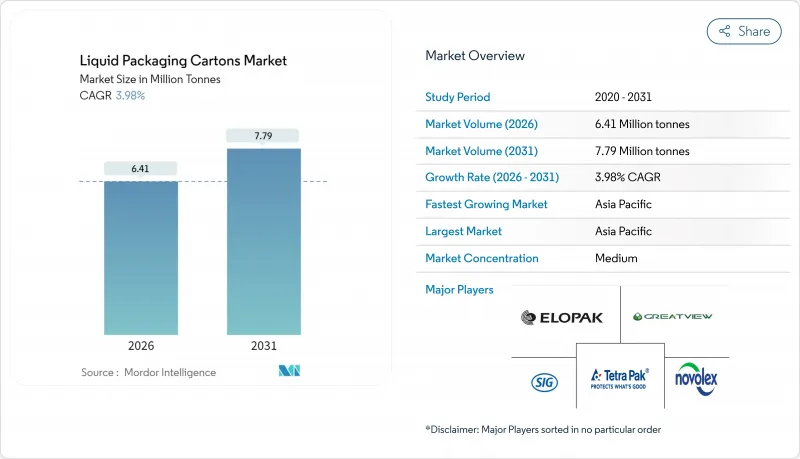
Regulatory momentum favoring fiber-based materials, barrier-technology breakthroughs that prolong shelf life, and the rapid digitization of grocery retail are enlarging the liquid packaging cartons market footprint across both mature and emerging economies. Asia-Pacific delivers the strongest uplift as public nutrition programs and evolving food-contact rules deepen demand for ambient-stable packs. Simultaneously, premiumization trends in dairy and plant-based beverages advance the adoption of value-added carton formats, while sustainability-linked financing channels funnel capital toward fiber innovations. Competitive intensity is mounting as incumbents invest heavily in decarbonization and recycling capacity to defend share against regional specialists that exploit local cost advantages and agile market entry strategies.
Global Liquid Packaging Cartons Market Trends and Insights
UHT Dairy Demand in Emerging Asia
Indonesia's Free Nutritious Meals Program pushes the nation's dairy intake from 4.2 million tonnes in 2024 to 5.3 million tonnes in 2025, generating sustained uptake of aseptic cartons that tolerate tropical logistics without refrigeration. China's GB 4806 food-contact rules elevate compliance premiums, granting certified carton suppliers pricing power within the liquid packaging cartons market. These forces reinforce the region's leadership in value and volume growth, encouraging multinationals to localize production and forge long-term supply contracts with domestic processors. Rising middle-class incomes further spur household penetration of shelf-stable dairy. Collectively, these factors lift Asia-Pacific's contribution to the global liquid packaging cartons market well above historic averages.
E-commerce Grocery Growth Pushing Ambient Formats
Online grocery is forecast to control 61% of global retail by 2025, channeling demand toward ambient products that remove cold-chain complexity and lessen fulfillment costs. Ambient-stable beverages benefit most, positioning the liquid packaging cartons market as a direct enabler of e-commerce efficiency. Retailers prioritize fiber-based packs that are stackable, lightweight, and recyclable, further reinforcing the shift. These advantages resonate strongly in urban zones where last-mile emissions and congestion drive packaging choices.
PET Bottle Lightweighting Narrowing Carbon Gap
Lightweight PET advances erode cartons' life-cycle carbon lead, with cradle-to-grave differentials contracting under 20 kg CO2e per 1,000 litres in some beverage use cases.As PET incorporates higher recycled content, cost-performance ratios improve, tempting price-sensitive juice and water brands to retain polymer bottles. Carton suppliers must therefore accelerate barrier innovation and recycling rates to prevent substitution, especially in North American and EU markets where PET ecosystems are already well capitalized.
Other drivers and restraints analyzed in the detailed report include:
- Cellulose-Based Barrier Breakthroughs Cutting Polymer Layers
- Brand Premiumization in Dairy and Plant-Based Segments Boosting Value-Added Carton Formats
- Volatile Liquid Board Prices Tied to Pulp Shortages
For complete list of drivers and restraints, kindly check the Table Of Contents.
Segment Analysis
Dairy milk retained 48.30% share of the liquid packaging cartons market in 2025, translating to nearly 3 million tonnes. Non-dairy alternatives, however, outpaced with a 5.42% CAGR that will lift their contribution to 21.80% by 2031, propelled by dietary shifts, lactose-free preferences, and ethical purchasing drivers. The liquid packaging cartons market size for oat, almond, and soy beverages benefits from aseptic processing that preserves nutrients without additives. Technical adaptations, such as shear-sensitive homogenization and enzyme-assisted viscosity control, demand robust barrier materials to curb oxidative flavor degradation. Consequently, converters collaborate with fillers on customized specifications that balance shelf life and cost.
Premium formulations with fortification or added flavors increase product value, allowing brand owners to absorb higher carton costs. Dairy milk remains vital in regions with established consumption patterns, especially where government initiatives bolster student nutrition. Yet even within dairy, value migrates toward low-fat, vitamin-enriched products that favor cartons capable of high-graphic print for on-pack storytelling. Over the forecast horizon, the co-existence of dairy and plant-based categories broadens the addressable liquid packaging cartons market rather than cannibalizing volume.
The Liquid Packaging Cartons Market Report is Segmented by Liquid Type (Dairy-Based Milk, Non-Dairy Milk, Juices, Energy and Functional Drinks, and More), Packaging Type (Aseptic Cartons, and Gable Top Cartons), Opening Format (Screw Cap, Straw Hole, and Pull Tab), and Geography (North America, Europe, Asia Pacific, South America, Middle East, and Africa). The Market Forecasts are Provided in Terms of Volume (Tonnes).
Geography Analysis
Asia-Pacific accounted for 45.38% of 2025 shipments, roughly 2.8 million tonnes, and its 5.92% CAGR positions the region to exceed 3.95 million tonnes by 2031. Expansion is driven by Indonesia's school meal initiative serving 82 million beneficiaries and China's elevated regulatory standards that reward compliant carton suppliers.Southeast Asian urbanization accelerates on-the-go beverage demand, boosting pull tab and small-format aseptic packs.
North America trails with a mature but high-value presence. Incremental growth aligns with plant-based milk adoption, while tightening EPR regulations spur investment in domestic recycling lines. European demand remains steady, underpinned by sugar-tax reformulation and ESG financing that favor fiber over PET. However, aggressive PET lightweighting erodes the liquid packaging cartons market share in discounted private-label juices.
Latin America benefits from dairy fortification programs and expanding middle-class purchasing power, yet currency volatility and supply-chain fragility curb immediate upside. The Middle East and Africa register modest but steady gains as ambient-stable packaging supports dairy access in climates where refrigeration costs remain prohibitive. Collectively, geography diversification cushions the global liquid packaging cartons market against regional shocks and positions the industry for balanced, multi-continent expansion.
- Tetra Pak International SA
- SIG Group AG
- Pactiv Evergreen Inc. (Novolex)
- Elopak AS
- Greatview Aseptic Packaging Co. Ltd
- Nippon Paper Industries Co. Ltd
- UFlex Limited (ASEPTO)
- IPI Srl (Coesia)
- Lami Packaging (Kunshan) Co. Ltd
- Visy Industries
- Klabin SA
- Obeikan Industrial Investment Group
- Nampak Ltd
- Italpack Srl
- Parksons Packaging Ltd
- Shandong Bihai Packaging Materials Co. Ltd
- Southern Packaging Group Ltd
Additional Benefits:
- The market estimate (ME) sheet in Excel format
- 3 months of analyst support
TABLE OF CONTENTS
1 INTRODUCTION
- 1.1 Study Assumptions and Market Definition
- 1.2 Scope of the Study
2 RESEARCH METHODOLOGY
3 EXECUTIVE SUMMARY
4 MARKET LANDSCAPE
- 4.1 Market Overview
- 4.2 Market Drivers
- 4.2.1 UHT dairy demand in emerging Asia
- 4.2.2 E-commerce grocery growth pushing ambient formats
- 4.2.3 ESG-linked financing favouring fibre-based packs
- 4.2.4 Sugar-tax led reformulations increasing juice carton adoption
- 4.2.5 Cellulose-based barrier breakthroughs cutting polymer layers
- 4.2.6 Brand premiumisation in dairy and plant-based segments boosting value-added carton formats
- 4.3 Market Restraints
- 4.3.1 PET bottle lightweighting narrowing carbon gap
- 4.3.2 Aseptic recycling infrastructure deficits
- 4.3.3 Volatile liquid board prices tied to pulp shortages
- 4.3.4 Labelling and food-contact compliance costs rising with stricter global regulations
- 4.4 Industry Value Chain Analysis
- 4.5 Regulatory Landscape
- 4.6 Technological Outlook
- 4.7 Porter's Five Forces Analysis
- 4.7.1 Bargaining Power of Buyers
- 4.7.2 Bargaining Power of Suppliers
- 4.7.3 Threat of Substitutes
- 4.7.4 Threat of New Entrants
- 4.7.5 Intensity of Competitive Rivalry
5 MARKET SIZE AND GROWTH FORECASTS (VOLUME)
- 5.1 By Liquid Type
- 5.1.1 Dairy-based Milk
- 5.1.2 Non-dairy Milk
- 5.1.3 Juices
- 5.1.4 Energy and Functional Drinks
- 5.1.5 Other Liquid Types
- 5.2 By Packaging Type
- 5.2.1 Aseptic Cartons
- 5.2.2 Gable Top Cartons
- 5.3 By Opening Format
- 5.3.1 Screw Cap
- 5.3.2 Straw Hole
- 5.3.3 Pull Tab
- 5.4 By Geography
- 5.4.1 North America
- 5.4.1.1 United States
- 5.4.1.2 Canada
- 5.4.1.3 Mexico
- 5.4.2 South America
- 5.4.2.1 Brazil
- 5.4.2.2 Argentina
- 5.4.2.3 Rest of South America
- 5.4.3 Europe
- 5.4.3.1 United Kingdom
- 5.4.3.2 Germany
- 5.4.3.3 France
- 5.4.3.4 Italy
- 5.4.3.5 Russia
- 5.4.3.6 Spain
- 5.4.3.7 Rest of Europe
- 5.4.4 Asia-Pacific
- 5.4.4.1 China
- 5.4.4.2 Japan
- 5.4.4.3 India
- 5.4.4.4 Australia and New Zealand
- 5.4.4.5 Indonesia
- 5.4.4.6 Thailand
- 5.4.4.7 Rest of Asia-Pacific
- 5.4.5 Middle East and Africa
- 5.4.5.1 Middle East
- 5.4.5.1.1 United Arab Emirates
- 5.4.5.1.2 Saudi Arabia
- 5.4.5.1.3 Rest of Middle East
- 5.4.5.2 Africa
- 5.4.5.2.1 South Africa
- 5.4.5.2.2 Nigeria
- 5.4.5.2.3 Rest of Africa
- 5.4.5.1 Middle East
- 5.4.1 North America
6 COMPETITIVE LANDSCAPE
- 6.1 Market Concentration
- 6.2 Strategic Moves
- 6.3 Market Share Analysis
- 6.4 Company Profiles (includes Global level Overview, Market level overview, Core Segments, Financials as available, Strategic Information, Market Rank/Share for key companies, Products and Services, and Recent Developments)
- 6.4.1 Tetra Pak International SA
- 6.4.2 SIG Group AG
- 6.4.3 Pactiv Evergreen Inc. (Novolex)
- 6.4.4 Elopak AS
- 6.4.5 Greatview Aseptic Packaging Co. Ltd
- 6.4.6 Nippon Paper Industries Co. Ltd
- 6.4.7 UFlex Limited (ASEPTO)
- 6.4.8 IPI Srl (Coesia)
- 6.4.9 Lami Packaging (Kunshan) Co. Ltd
- 6.4.10 Visy Industries
- 6.4.11 Klabin SA
- 6.4.12 Obeikan Industrial Investment Group
- 6.4.13 Nampak Ltd
- 6.4.14 Italpack Srl
- 6.4.15 Parksons Packaging Ltd
- 6.4.16 Shandong Bihai Packaging Materials Co. Ltd
- 6.4.17 Southern Packaging Group Ltd
7 MARKET OPPORTUNITIES AND FUTURE OUTLOOK
- 7.1 White-space and Unmet-need Assessment

