PUBLISHER: Mordor Intelligence | PRODUCT CODE: 2120762

PUBLISHER: Mordor Intelligence | PRODUCT CODE: 2120762
North America Agricultural Machinery - Market Share Analysis, Industry Trends & Statistics, Growth Forecasts (2026 - 2031)
According to Mordor Intelligence, the North America agricultural machinery market size is projected to expand from USD 54.3 billion in 2025 and USD 57.5 billion in 2026 to USD 76.6 billion by 2031, registering a 5.90% CAGR between 2026 to 2031.
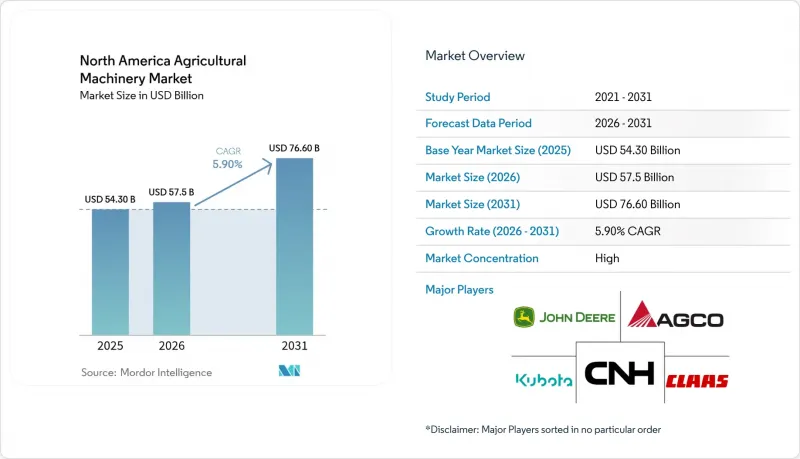
This report is Segmented by Type (Tractor, Equipment, Irrigation Machinery, Harvesting Machinery, Haying and Forage Machinery, and Other Types) and by Geography (United States, Canada, Mexico, and Rest of North America). The Market Forecasts are Provided in Terms of Value (USD).
North America Agricultural Machinery Market Trends and Insights
Robust Farm-Income Outlook and Subsidy Programs
Federal support programs continue to underpin machinery demand even as crop receipts soften. In March 2022, the Government of Canada invested in agricultural machinery innovation and technology, reinforcing the role of public funding in sustaining capital expenditure. Direct government payments, including climate-focused allocations, have provided a cushion that allowed producers to maintain investment despite lower crop prices. The Farm Bill extended crop insurance subsidies and introduced targeted grants for precision equipment that reduce nitrogen runoff, lowering the effective cost of GPS-guided planters and variable-rate spreaders. Canada mirrors this pattern through programs that stabilized income for prairie growers, while Mexico's initiatives allocated significant funding to smallholder mechanization, disproportionately benefiting key agricultural states. Subsidy-driven liquidity compresses replacement cycles, as operators trade in older tractors for precision-ready fleets.
Rising Labor Scarcity and Wage Inflation
Agricultural labor markets have tightened sharply, with many producers ranking workforce availability as their primary constraint. Average farm wages have continued to climb, while seasonal visa processing delays have extended hiring timelines. According to the Association of Equipment Manufacturers (AEM), sales of 4WD tractors increased by 31.7%, from 3,466 units in 2022 to 4,564 in 2023, reflecting the increasing adoption of mechanization to offset labor shortages. This wage pressure disproportionately affects labor-intensive segments such as vegetable harvesting, orchard management, and livestock handling, driving adoption of autonomous tractors, robotic weeders, and self-propelled forage harvesters. Canada faces parallel constraints, with provinces offering incentives to attract operators during harvest, while Mexico's rural-to-urban migration is eroding the traditional labor pool. Cooperatives are pooling capital for shared machinery fleets, making mechanization a survival imperative for mid-sized operations.
High Upfront and Maintenance Costs of Advanced Machinery
The rising cost of tractors, planters, and combines has placed significant financial pressure on producers, particularly smaller operators. Modern precision equipment carries high purchase prices, while maintenance expenses add further strain through software subscriptions and premium replacement parts. For smallholders, even compact machinery can be prohibitively expensive without subsidized financing. The result is a widening technology gap between large-scale farms, which can spread costs across extensive acreage, and smaller producers, who struggle to justify investments. This dynamic concentrates market growth among larger operations that can achieve payback through efficiency gains and precision farming benefits.
Other drivers and restraints analyzed in the detailed report include:
- Precision-Agriculture Adoption Accelerating Equipment Replacement
- Climate-Smart Grants Driving Low-Emission Equipment
- Volatile Commodity Prices Curbing Capital Expenditure (CapEx) Cycles
For complete list of drivers and restraints, kindly check the Table Of Contents.
Segment Analysis
By type, tractors accounted for market share of 47.3% of the North America agricultural machinery market size in 2025. Tractors remain the backbone of crop operations, reflecting their indispensable role across diverse farming systems. According to the Association of Equipment Manufacturers (AEM), retail sales of tractors above 100 HP and 4WD tractors increased by 5.2% and 31.7% respectively from 2022 to 2023. The segment benefits from autonomous retrofits that have been tested extensively, validating real-world uptime and reducing skepticism about driverless tillage. These innovations highlight tractors as the central hub of mechanization, integrating precision technologies that improve efficiency and productivity. Their dominance underscores how farms continue to prioritize versatile equipment capable of handling multiple tasks, while also adapting to new digital platforms that enhance connectivity and operational control.
Irrigation machinery is projected to post the fastest 6.4% CAGR from 2026 to 2031. Irrigation equipment is gaining momentum as water-scarcity mitigation projects expand across North America, with center-pivot conversions accelerating adoption in Mexico. This segment is anticipated to outpace other categories, driven by the need for sustainable water management and climate resilience. Precision irrigation systems are increasingly integrated with digital monitoring tools, enabling farmers to optimize water use while maintaining yields. The growth trajectory reflects how irrigation machinery is evolving from a support function into a strategic investment, positioning itself as one of the most dynamic areas of agricultural equipment demand.
Complete Report Scope:
- By Type
- Tractor
- Less Than 40 HP
- 40 to 100 HP
- More than 100 HP
- 4WD Tractors
- Equipment
- Plows
- Harrows
- Cultivators and Tillers
- Other Equipment
- Irrigation Machinery
- Sprinkler
- Drip
- Other Irrigation
- Harvesting Machinery
- Combine Harvesters
- Forage Harvesters
- Other Harvesting
- Haying and Forage Machinery
- Mowers
- Balers
- Other Haying and Forage
- Other Types
- Tractor
- By Geography
- United States
- Canada
- Mexico
- Rest of North America
List of Companies Covered in this Report:
- Deere & Company
- CNH Industrial N.V.
- AGCO Corporation
- Kubota Corporation
- CLAAS KGaA mbH
- Mahindra & Mahindra Limited
- Netafim Inc.
- Lindsay Corporation
- Trimble Inc.
- Horsch Maschinen GmbH
- KUHN SAS
- Bernard Krone Holding SE & Co. KG
- The Toro Company
- Vermeer Corporation
- J.C. Bamford Excavators Ltd.
Additional Benefits:
- The market estimate (ME) sheet in Excel format
- 3 months of analyst support
TABLE OF CONTENTS
1 Introduction
- 1.1 Study Assumptions and Market Definition
- 1.2 Scope of the Study
2 Research Methodology
3 Executive Summary
4 Market Landscape
- 4.1 Market Overview
- 4.2 Market Drivers
- 4.2.1 Robust farm-income outlook and subsidy programs
- 4.2.2 Rising labor scarcity and wage inflation
- 4.2.3 Precision-agriculture adoption accelerating equipment replacement
- 4.2.4 Original Equipment Manufacturer (OEM) embedded-finance boosting purchasing power
- 4.2.5 Subscription-based machinery access models
- 4.2.6 Climate-Smart grants driving low-emission equipment
- 4.3 Market Restraints
- 4.3.1 High upfront and maintenance costs of advanced machinery
- 4.3.2 Volatile commodity prices curbing capital expenditure (CapEx) cycles
- 4.3.3 Interest-rate-driven credit tightening at the farm level
- 4.3.4 Battery-grade semiconductor supply constraints for e-tractors
- 4.4 Regulatory Landscape
- 4.5 Technological Outlook
- 4.6 Porter's Five Forces
- 4.6.1 Bargaining Power of Suppliers
- 4.6.2 Bargaining Power of Buyers
- 4.6.3 Threat of New Entrants
- 4.6.4 Threat of Substitute Products
- 4.6.5 Intensity of Competitive Rivalry
5 Market Size and Growth Forecasts (Value)
- 5.1 By Type
- 5.1.1 Tractor
- 5.1.1.1 Less Than 40 HP
- 5.1.1.2 40 to 100 HP
- 5.1.1.3 More than 100 HP
- 5.1.1.4 4WD Tractors
- 5.1.2 Equipment
- 5.1.2.1 Plows
- 5.1.2.2 Harrows
- 5.1.2.3 Cultivators and Tillers
- 5.1.2.4 Other Equipment
- 5.1.3 Irrigation Machinery
- 5.1.3.1 Sprinkler
- 5.1.3.2 Drip
- 5.1.3.3 Other Irrigation
- 5.1.4 Harvesting Machinery
- 5.1.4.1 Combine Harvesters
- 5.1.4.2 Forage Harvesters
- 5.1.4.3 Other Harvesting
- 5.1.5 Haying and Forage Machinery
- 5.1.5.1 Mowers
- 5.1.5.2 Balers
- 5.1.5.3 Other Haying and Forage
- 5.1.6 Other Types
- 5.1.1 Tractor
- 5.2 By Geography
- 5.2.1 United States
- 5.2.2 Canada
- 5.2.3 Mexico
- 5.2.4 Rest of North America
6 Competitive Landscape
- 6.1 Market Concentration
- 6.2 Strategic Moves
- 6.3 Market Share Analysis
- 6.4 Company Profiles (Includes Global Level Overview, Market Level Overview, Core Segments, Financials as Available, Strategic Information, Market Rank/Share for Key Companies, Products and Services, and Recent Developments)
- 6.4.1 Deere & Company
- 6.4.2 CNH Industrial N.V.
- 6.4.3 AGCO Corporation
- 6.4.4 Kubota Corporation
- 6.4.5 CLAAS KGaA mbH
- 6.4.6 Mahindra & Mahindra Limited
- 6.4.7 Netafim Inc.
- 6.4.8 Lindsay Corporation
- 6.4.9 Trimble Inc.
- 6.4.10 Horsch Maschinen GmbH
- 6.4.11 KUHN SAS
- 6.4.12 Bernard Krone Holding SE & Co. KG
- 6.4.13 The Toro Company
- 6.4.14 Vermeer Corporation
- 6.4.15 J.C. Bamford Excavators Ltd.
7 Market Opportunities and Future Outlook

