
PUBLISHER: Mordor Intelligence | PRODUCT CODE: 1907246

PUBLISHER: Mordor Intelligence | PRODUCT CODE: 1907246
North America Soup - Market Share Analysis, Industry Trends & Statistics, Growth Forecasts (2026 - 2031)
The North American soup market is expected to grow from USD 6.73 billion in 2025 to USD 7 billion in 2026 and is forecast to reach USD 8.54 billion by 2031 at 4.03% CAGR over 2026-2031.
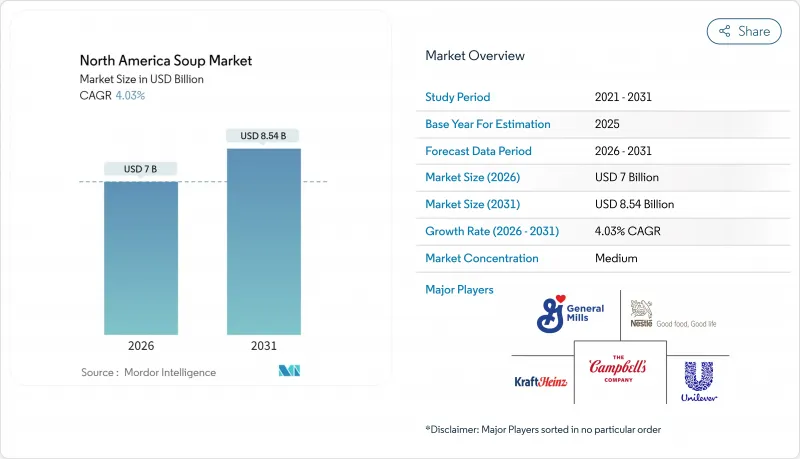
This market expansion is attributed to the evolving consumer preferences toward convenient, nutritious, and diverse soup offerings. Market growth is primarily driven by the increasing demand for ready-to-eat soups, organic and plant-based products, and advanced packaging solutions. The chilled and frozen soup segments exhibit substantial growth rates as consumers increasingly gravitate toward premium and fresh alternatives. Furthermore, the market demonstrates robust demand for organic and clean-label soups, driven by heightened health consciousness, while product innovations in flavors and formulations address diverse consumer preferences and international culinary trends. The proliferation of e-commerce platforms and the modernization of retail channels facilitate enhanced product accessibility throughout urban and suburban regions.
North America Soup Market Trends and Insights
Convenience and ready-to-eat Options
Convenience and ready-to-eat options are key drivers of the North America Soup Market, influencing consumer purchasing patterns. The fast-paced lifestyles of North American consumers have increased demand for quick, time-saving meal solutions, particularly ready-to-eat and instant soups. According to the International Food Information Council (IFIC), in 2024, 57% of American consumers considered convenience as a critical factor in their food and beverage purchase decisions . This consumer preference has prompted manufacturers to develop products requiring minimal preparation time while maintaining nutritional value and taste. The convenience trend extends beyond time-saving to include storage efficiency, portability, and extended shelf life. Shelf-stable and instant soups offer long-lasting options that consumers can store in their pantries, providing reliable meals during busy schedules or emergencies. These features have established soups as a preferred quick meal, snack, or comfort food among various consumer groups, including busy professionals, students, and families.
Shift toward clean and functional ingredients
The North American Soup Market is experiencing significant growth driven by consumer demand for clean and functional ingredients. Consumers increasingly prefer soups without artificial additives, preservatives, and genetically modified organisms (GMOs), while seeking organic, plant-based, gluten-free, and dairy-free options. This shift reflects the broader health and wellness trend, where consumers choose nutrient-dense foods that provide additional health benefits. In response, manufacturers are simplifying their ingredient lists and incorporating superfoods, fiber, antioxidants, and plant proteins to support digestive health, immunity, and overall wellness. For example, in January 2025, Natural Grocers introduced six new varieties of savory soups that are certified organic, non-GMO, and made with plant-based, gluten- and dairy-free ingredients. This launch demonstrates how companies are meeting market demands by developing products that combine nutritional benefits with taste, appealing to vegans, vegetarians, and flexitarians seeking convenient, healthy meal options.
High sodium and preservative concerns
Sodium content and preservative concerns constrain the North American soup market due to increasing health awareness and regulatory requirements. The Food and Drug Administration (FDA) mandates that low-sodium products contain no more than 140 mg of sodium per reference amount consumed, requiring manufacturers to adapt their formulations. In Mexico, the NOM-051 front-of-package warning label regulation, updated in 2023, requires prominent warnings on high-sodium products, potentially impacting consumer purchasing decisions. These regulatory requirements necessitate significant investment in reformulation research to reduce sodium while maintaining flavor profiles. The reformulation process presents technical challenges, particularly for shelf-stable soups that rely on sodium for preservation and taste. Manufacturers must explore alternative preservation methods, such as high-pressure processing or natural preservatives, which can increase production costs and complexity.
Other drivers and restraints analyzed in the detailed report include:
- Aging population seeking nutrient-dense, easy-to-open formats
- Product innovation and flavor variety
- Competition from fresh and home-cooked meals
For complete list of drivers and restraints, kindly check the Table Of Contents.
Segment Analysis
The Shelf Stable Soup segment holds a 46.12% market share in 2025, driving the overall soup market through its convenience, accessibility, and versatility. The segment's success stems from meeting consumer needs for easy-to-store, long-lasting, and quick-to-prepare food options that align with modern lifestyles. Shelf-stable soups offer extended shelf life without refrigeration, reducing food waste while improving supply chain efficiency and retail distribution. Product innovation continues to strengthen the segment's position by addressing diverse consumer preferences and health considerations. The segment maintains consistent demand throughout the year due to pantry stocking practices and comfort food preferences, regardless of seasonal or economic conditions.
Chilled Soup represents the fastest-growing segment in the North America Soup Market, with a CAGR of 4.26% through 2031. Growth stems from consumer preferences for fresh, minimally processed foods that meet wellness and clean-label requirements. The segment positions itself in the premium category, emphasizing superior taste, nutritional value, and natural ingredients without preservatives. Advances in refrigerated packaging technology support product freshness and convenience. The expansion of modern retail formats has increased the availability and consumption of chilled soups. The segment's growth also benefits from consumer interest in diverse flavors and convenient consumption options.
In 2025, the Non-Vegetarian Soup category maintains a dominant market share of 64.54%. This segment's performance is attributed to sustained consumer demand for protein-enriched meal solutions, specifically in chicken, beef, and seafood-based variants. The substantial nutritional composition and distinctive flavor profiles attract consumers seeking nutritionally complete meals, particularly during cold seasons. Manufacturing entities continue to enhance their product portfolios through the integration of traditional formulations with international flavor profiles to address evolving consumer preferences. The segment's market position is reinforced by organizations' commitment to premium ingredient procurement protocols.
The Vegetarian Soup segment demonstrates significant market potential with a projected CAGR of 4.71% through 2031. This trajectory is indicative of heightened consumer engagement with plant-based dietary options, health consciousness, and environmental sustainability considerations. The segment's market penetration encompasses both dedicated vegetarians and flexitarian consumers seeking nutritionally optimized meal alternatives. Companies focus on incorporating fresh vegetables, incorporation of premium vegetables, whole grains, and certified organic ingredients to address consumer requirements for natural and sustainable product offerings. For instance, in November 2024, Amy's Kitchen expanded its product portfolio with five new soup variants that synthesize international and American Southern culinary traditions, utilizing organic components and fresh agricultural produce, exemplifying the segment's emphasis on premium, authentic product development.
The North American Soup Market Report is Segmented by Product Type (Dry Soup, Shelf Stable Soup, Chilled Soup, Frozen Soup, and Others), Category (Vegetarian Soup and Non-Vegetarian Soup), Packaging Type (Cans, Pouches, Cartons, and Other Packaging Types), Distribution Channel (On-Trade and Off-Trade), and Geography (North America, Europe, Asia-Pacific and More). The Market Forecasts are Provided in Terms of Value (USD).
List of Companies Covered in this Report:
- The Campbell's Company
- General Mills Inc.
- Kraft Heinz Company
- Nestle SA
- Unilever PLC
- B&G Foods, Inc.
- Conagra Brands Inc.
- Amy's Kitchen
- The Hain Celestial Group, Inc.
- Baxters Food Group Ltd.
- Blount Fine Foods
- Del Monte Foods Corporation Inc.
- Kettle & Fire Inc.
- Nissin Foods
- Uptons Naturals
- Ottogi Corporation
- Bes'Dam Soup
- Aylmer soups
- Mitchell's Soup Co.
- Mitchell's Soup Co.
Additional Benefits:
- The market estimate (ME) sheet in Excel format
- 3 months of analyst support
TABLE OF CONTENTS
1 INTRODUCTION
- 1.1 Study Assumptions and Market Definition
- 1.2 Scope of the Study
2 RESEARCH METHODOLOGY
3 EXECUTIVE SUMMARY
4 MARKET LANDSCAPE
- 4.1 Market Overview
- 4.2 Market Drivers
- 4.2.1 Convenience and ready-to-eat options
- 4.2.2 Shift toward clean and functional ingredients
- 4.2.3 Aging population seeking nutrient-dense, easy-to-open formats
- 4.2.4 Product Innovation and flavor variety
- 4.2.5 Sustainability and ethical sourcing
- 4.2.6 Seasonality and cold weather consumption
- 4.3 Market Restraints
- 4.3.1 High sodium and preservative concerns
- 4.3.2 Competition from fresh and home-cooked meals
- 4.3.3 Raw material price fluctuations and supply chain issues
- 4.3.4 Perception of processed and canned foods
- 4.4 Consumer Behaviour Analysis
- 4.5 Regulatory Landscape
- 4.6 Porter's Five Forces Analysis
- 4.6.1 Threat of New Entrants
- 4.6.2 Bargaining Power of Buyers
- 4.6.3 Bargaining Power of Suppliers
- 4.6.4 Threat of Substitutes
- 4.6.5 Intensity of Competitive Rivalry
5 MARKET SIZE AND GROWTH FORECASTS (VALUE AND VOLUME)
- 5.1 By Product Type
- 5.1.1 Dry Soup
- 5.1.2 Shelf Stable Soup
- 5.1.3 Chilled Soup
- 5.1.4 Frozen Soup
- 5.1.5 Others
- 5.2 By Category
- 5.2.1 Vegetarian Soup
- 5.2.2 Non-Vegetarian Soup
- 5.3 By Packaging Type
- 5.3.1 Cans
- 5.3.2 Pouches
- 5.3.3 Cartons
- 5.3.4 Other Packaging types
- 5.4 By Distribution Channel
- 5.4.1 On-Trade
- 5.4.2 Off-trade
- 5.4.2.1 Supermarkets/Hypermarkets
- 5.4.2.2 Convenience/ Grocery Stores
- 5.4.2.3 Online Retail Stores
- 5.4.2.4 Other Distribution Channels
- 5.5 By Geography
- 5.5.1 United States
- 5.5.2 Canada
- 5.5.3 Mexico
- 5.5.4 Rest of North America
6 COMPETITIVE LANDSCAPE
- 6.1 Market Concentration
- 6.2 Strategic Moves
- 6.3 Market Share Analysis
- 6.4 Company Profiles (includes Global level Overview, Market level overview, Core Segments, Financials as available, Strategic Information, Market Rank/Share for key companies, Products and Services, and Recent Developments)
- 6.4.1 The Campbell's Company
- 6.4.2 General Mills Inc.
- 6.4.3 Kraft Heinz Company
- 6.4.4 Nestle SA
- 6.4.5 Unilever PLC
- 6.4.6 B&G Foods, Inc.
- 6.4.7 Conagra Brands Inc.
- 6.4.8 Amy's Kitchen
- 6.4.9 The Hain Celestial Group, Inc.
- 6.4.10 Baxters Food Group Ltd.
- 6.4.11 Blount Fine Foods
- 6.4.12 Del Monte Foods Corporation Inc.
- 6.4.13 Kettle & Fire Inc.
- 6.4.14 Nissin Foods
- 6.4.15 Uptons Naturals
- 6.4.16 Ottogi Corporation
- 6.4.17 Bes'Dam Soup
- 6.4.18 Aylmer soups
- 6.4.19 Mitchell's Soup Co.
- 6.4.20 Mitchell's Soup Co.
7 MARKET OPPORTUNITIES AND FUTURE OUTLOOK

