
PUBLISHER: Mordor Intelligence | PRODUCT CODE: 1907295

PUBLISHER: Mordor Intelligence | PRODUCT CODE: 1907295
Glass Fiber - Market Share Analysis, Industry Trends & Statistics, Growth Forecasts (2026 - 2031)
The Glass Fiber Market was valued at 8.02 Million tons in 2025 and estimated to grow from 8.34 Million tons in 2026 to reach 10.17 Million tons by 2031, at a CAGR of 4.03% during the forecast period (2026-2031).
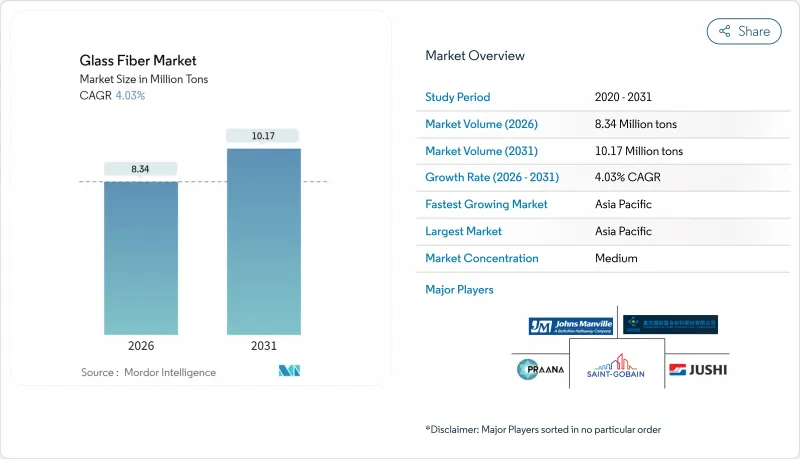
Demand resilience reflects the material's combination of tensile strength, corrosion resistance, and cost efficiency, characteristics that continue to displace metals and other legacy materials in infrastructure, mobility, and energy systems. Construction insulation orders recovered quickly after pandemic-related slowdowns, electric-vehicle (EV) programs accelerated composite uptake in automotive platforms, and wind-energy commitments triggered record blade production. These three demand pillars, together with product innovations such as low-carbon manufacturing lines and closed-loop recycling, are helping producers withstand raw-material cost inflation and trade uncertainties. Capacity rationalization and regional self-sufficiency programs are also reshaping competitive strategies as suppliers position themselves close to end-user growth hubs.
Global Glass Fiber Market Trends and Insights
Post-Pandemic Construction Acceleration Drives Glass Wool Demand
Asia-Pacific construction spending rebounded strongly in 2024 as governments advanced stimulus pipelines encompassing data-center campuses, semiconductor fabs, and mass-transit networks. These projects specify high-performance insulation to curb operational carbon, placing glass wool on tender lists ahead of lower-R-value substitutes within the glass fiber market. In India, green-building certification is embedded in municipal approval workflows, encouraging developers to select recyclable, flame-resistant insulation. Underground transit corridors highlight glass fiber reinforced polymer (GFRP) rebar because corrosion rates are lower than steel in water-logged environments. Major producers responded with brownfield furnace debottlenecking and new low-carbon melters powered by renewable electricity, actions that shorten lead times to metropolitan construction clusters[1]. Supply tightness has begun to ease as additional capacity ramps up, yet regional demand momentum suggests utilization will remain above 85% through 2026.
Automotive Lightweighting Accelerates Composite Integratio
Battery-electric vehicle programs reward every kilogram saved with measurable range extension, so platform engineers substitute chopped-strand polypropylene and long-fiber thermoplastics in structural brackets, seat frames, and under-hood components. Tier-1 suppliers have commercialized composite leaf springs that cut unsprung mass by 30% while retaining fatigue life, reinforcing demand trends in the glass fiber market. Beyond the skateboard chassis, high-voltage battery enclosures now specify flame-retardant glass fiber/epoxy skins over structural foams, combining thermal shielding with electromagnetic compatibility. Automotive procurement teams also evaluate hybrid lay-ups that place carbon reinforcement only in load-critical zones, offsetting the latter's higher cost with glass fiber in secondary layers. The resulting material mix strengthens long-term demand visibility for chopped strands, rovings, and multi-end rovings designed for class-A surface finishes.
Carbon-Fiber Price Competition Pressures Premium Applications
Expansion projects in China, the United States, and the Middle East are doubling global carbon-fiber nameplate capacity between 2023 and 2027. Economies of scale, lower-cost polyacrylonitrile precursors, and automation have already trimmed average prices by more than 15% compared with 2022 levels. As cost curves fall, automotive and aerospace engineers revisit material selection for selective structural parts, intensifying competitive pressures within the glass fiber market. Hybrid fabrics that alternate carbon and glass to balance stiffness and impact resistance further cannibalize glass volumes at the top of the performance pyramid. Glass fiber producers counteract by developing higher-modulus S-glass and corrosion-resistant E-CR formulations, though these upgrades narrow, rather than eliminate, the price gap to carbon. Unless carbon pricing or recycling credits favor glass, the premium application share may drift toward carbon-rich laminates over the next product cycle.
Other drivers and restraints analyzed in the detailed report include:
- Wind-Energy Expansion Drives Roving Consumption
- Building-Energy Codes Accelerate Insulation Retrofits
- Raw-Material Cost Inflation Pressures Manufacturing Margins
For complete list of drivers and restraints, kindly check the Table Of Contents.
Segment Analysis
Rovings anchored 33.41% of 2025 demand and remain the fastest-expanding product form. Their linear-strand architecture delivers the unidirectional strength essential for 100-meter-plus turbine skins, a use case that alone accounts for a third of global roving shipments. The glass fiber market size attributed to roving is forecast to grow 4.39% annually as offshore installations escalate and as automotive over-molded composites gain scale in leaf springs, seat backs, and battery frames. Process upgrades such as inline cake cutting and advanced sizing formulations improve wet-out and reduce void content, enabling higher throughput in pultrusion and filament winding.
Producers are also trialing virtual sensors on winder stations, transmitting data to cloud-based quality modules that cut waste and document carbon footprints-digital upgrades increasingly relevant across the glass fiber market. Mats occupy the second-largest slot, favored for spray-up boat hulls and roofing membranes where conformability outweighs directional strength. Strands and yarns cater to PCB laminates, filtration, and 5G radome fabrics, niches that demand tight diameter tolerance and minimal shot content.
The Glass Fiber Report is Segmented by Product Form (Roving, Mats, Strands, and More), Fiber Type (E-Glass, S-Glass, E-CR Glass, and More), End-User Industry (Building and Construction, Automotive, Wind Energy, Aerospace and Defense, Marine, Sports and Leisure, and Other End-User Industries), and Geography (Asia-Pacific, North America, Europe, and More). The Market Forecasts are Provided in Terms of Volume (Tons)
Geography Analysis
Asia-Pacific dominated with 49.78% of 2025 shipments and is projected to retain leadership through 2031 at a 4.51% CAGR. National industrial policies encourage domestic sourcing of turbine blades, EV parts, and high-speed rail components, effectively locking in local suppliers across the glass fiber market. China invests in carbon-neutral furnaces powered by captive wind farms, an initiative that lowers embedded emissions and qualifies exports for low-carbon product categories.
North America's market is growing wth building-energy codes and EV platform launches offsetting slower oil-and-gas composite pipe demand. Expanded solar and wind tax credits amplify the replacement cycle for turbine blades, a trend that benefits mid-continent roving plants. Recycled content mandates in select U.S. states encourage the use of cullet, supporting scrap markets and reducing dependence on imported soda ash. Europe's outlook hinges on offshore wind build-outs in the North Sea and Baltic, but trade defense measures under investigation may reshape supply chains should tariffs on Asian rovings intensify. Glass fiber reinforced pressure vessels could see early adoption in green-hydrogen corridors linking the Gulf to Europe. Latin America's modest baseline is anchored by Brazilian wind parks and Mexico's automotive assembly plants, both of which are ramping post-pandemic. Regional producers may struggle with feedstock import costs; nonetheless, free-trade agreements and nearshoring initiatives draw investment aimed at shortening trans-Pacific freight legs.
- 3B - the fibreglass company
- AGY
- ASAHI FIBER GLASS Co., Ltd
- China Jushi Co., Ltd.
- Chongqing International Composite Materials Co., Ltd.
- Envalior
- Gurit Services AG
- Heraeus Holding
- Johns Manville
- Nippon Electric Glass Co., Ltd.
- PFG FIBER GLASS CORPORATION
- Praana Group
- Saint-Gobain
- Taishan Fiberglass Inc.(CTG)
- Taiwan Glass Ind. Corp.
Additional Benefits:
- The market estimate (ME) sheet in Excel format
- 3 months of analyst support
TABLE OF CONTENTS
1 Introduction
- 1.1 Study Assumptions and Market Definition
- 1.2 Scope of the Study
2 Research Methodology
3 Executive Summary
4 Market Landscape
- 4.1 Market Overview
- 4.2 Market Drivers
- 4.2.1 Post-Pandemic Construction Boom in Asia Drives Demand for Glass Wool Insulation
- 4.2.2 Vehicle-Light-Weighting Pushes Chopped-Strand Composites into EV Platforms
- 4.2.3 Wind-Turbine Blade Length Growth (more than 120 M) Increases Roving Consumption
- 4.2.4 Mandatory Building-Energy Codes in EU and NA Accelerate Retrofit Insulation
- 4.2.5 Hydrogen-Pipe Projects Specify E-CR Glass for Chemical Resistance
- 4.3 Market Restraints
- 4.3.1 Carbon-Fiber Price Erosion Squeezes Glass-Fiber's "Value Gap"
- 4.3.2 Rock-Wool Makers Target less than 100 Kg/M3 Density Niche in HVAC Insulation
- 4.3.3 Rising Soda-Ash and Energy Prices Hurt Margin in China Smelters
- 4.4 Value Chain Analysis
- 4.5 Porter's Five Forces
- 4.5.1 Bargaining Power of Suppliers
- 4.5.2 Bargaining Power of Consumers
- 4.5.3 Threat of New Entrants
- 4.5.4 Threat of Substitute Products
- 4.5.5 Degree of Competition
5 Market Size and Growth Forecasts (Volume)
- 5.1 By Product Form
- 5.1.1 Roving
- 5.1.2 Mats
- 5.1.3 Strands
- 5.1.4 Yarn
- 5.1.5 Glass Wool
- 5.1.6 Others (Milled Fiber and Fabrics)
- 5.2 By Fiber Type
- 5.2.1 E-Glass
- 5.2.2 S-Glass
- 5.2.3 E-CR Glass
- 5.2.4 C-Glass
- 5.2.5 Others
- 5.3 By End-user Industry
- 5.3.1 Building and Construction
- 5.3.2 Automotive
- 5.3.3 Wind Energy
- 5.3.4 Aerospace and Defense
- 5.3.5 Marine
- 5.3.6 Sports and Leisure
- 5.3.7 Other End-user Industries (Electronics)
- 5.4 By Geography
- 5.4.1 Asia-Pacific
- 5.4.1.1 China
- 5.4.1.2 India
- 5.4.1.3 Japan
- 5.4.1.4 South Korea
- 5.4.1.5 Indonesia
- 5.4.1.6 Vietnam
- 5.4.1.7 Malaysia
- 5.4.1.8 Thailand
- 5.4.1.9 Rest of Asia-Pacific
- 5.4.2 North America
- 5.4.2.1 United States
- 5.4.2.2 Canada
- 5.4.2.3 Mexico
- 5.4.3 Europe
- 5.4.3.1 Germany
- 5.4.3.2 France
- 5.4.3.3 United Kingdom
- 5.4.3.4 Italy
- 5.4.3.5 Spain
- 5.4.3.6 Russia
- 5.4.3.7 Turkey
- 5.4.3.8 Nordics
- 5.4.3.9 Rest of Europe
- 5.4.4 South America
- 5.4.4.1 Brazil
- 5.4.4.2 Argentina
- 5.4.4.3 Colombia
- 5.4.4.4 Rest of South America
- 5.4.5 Middle-East and Africa
- 5.4.5.1 Saudi Arabia
- 5.4.5.2 United Arab Emirates
- 5.4.5.3 Qatar
- 5.4.5.4 Egypt
- 5.4.5.5 South Africa
- 5.4.5.6 Nigeria
- 5.4.5.7 Rest of Middle-East and Africa
- 5.4.1 Asia-Pacific
6 Competitive Landscape
- 6.1 Market Concentration
- 6.2 Strategic Moves
- 6.3 Market Share (%)/Ranking Analysis
- 6.4 Company Profiles (includes Global level Overview, Market level overview, Core Segments, Financials as available, Strategic Information, Market Rank/Share for key companies, Products and Services, and Recent Developments)
- 6.4.1 3B - the fibreglass company
- 6.4.2 AGY
- 6.4.3 ASAHI FIBER GLASS Co., Ltd
- 6.4.4 China Jushi Co., Ltd.
- 6.4.5 Chongqing International Composite Materials Co., Ltd.
- 6.4.6 Envalior
- 6.4.7 Gurit Services AG
- 6.4.8 Heraeus Holding
- 6.4.9 Johns Manville
- 6.4.10 Nippon Electric Glass Co., Ltd.
- 6.4.11 PFG FIBER GLASS CORPORATION
- 6.4.12 Praana Group
- 6.4.13 Saint-Gobain
- 6.4.14 Taishan Fiberglass Inc.(CTG)
- 6.4.15 Taiwan Glass Ind. Corp.
7 Market Opportunities and Future Outlook
- 7.1 White-space and Unmet-need Assessment

