
PUBLISHER: Mordor Intelligence | PRODUCT CODE: 1907298

PUBLISHER: Mordor Intelligence | PRODUCT CODE: 1907298
North America Peas - Market Share Analysis, Industry Trends & Statistics, Growth Forecasts (2026 - 2031)
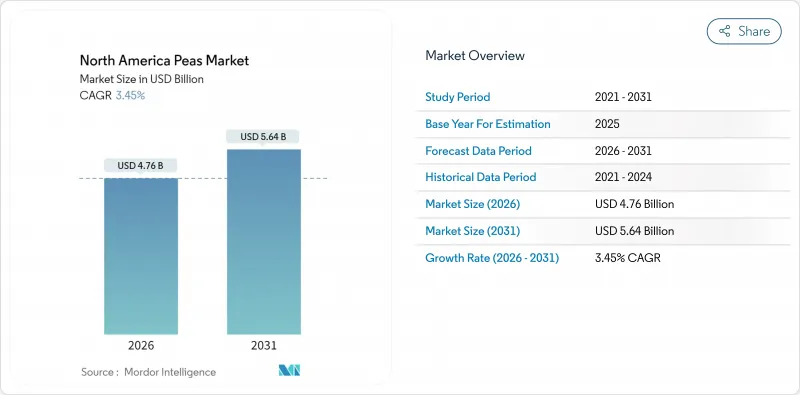
The North America pea market was valued at USD 4.60 billion in 2025 and estimated to grow from USD 4.76 billion in 2026 to reach USD 5.64 billion by 2031, at a CAGR of 3.45% during the forecast period (2026-2031).
The market growth is driven by increasing demand for clean-label plant proteins, climate-smart agricultural incentives, and processing capacity expansions. However, climate volatility and trade policy changes pose challenges to supply stability. Food and beverage manufacturers are incorporating pea ingredients into meat alternatives, gluten-free pasta, and protein shakes, which expands the market reach. Companies implementing vertical integration strategies optimize their operations across sourcing, processing, and distribution channels, helping manage input costs and maintain product traceability. Additionally, trade restrictions on Chinese pea protein imports and government subsidies for regenerative agriculture strengthen domestic production and encourage farmers to include peas in crop rotation for soil nitrogen enhancement.
North America Peas Market Trends and Insights
Rising Demand for Pea Protein
Pea protein is gaining traction as food and nutrition brands seek alternatives to allergenic ingredients like soy and dairy. Manufacturers are expanding production capacity, indicating strong market confidence. Advancements in extraction methods have improved solubility and reduced undesirable flavors, enabling broader product applications. The development of thermostable variants allows for high-temperature processing, expanding usage in ready-to-drink beverages and shelf-stable items. Clear regulatory guidelines for labeling and organic certification enable brands to position pea protein as a mainstream ingredient. Processors are incorporating it into formulations that address both health and sustainability requirements.
Growing Preference for Plant-based Diets
Health awareness and environmental concerns are driving consumers toward plant-based diets. Consumers prefer foods with reduced environmental impact compared to animal-based products. Peas have emerged as a significant crop due to their role in regenerative agriculture and positive environmental impact assessments. The versatility of peas allows their incorporation across food categories, including snacks and ready meals. Retailers use sustainability certifications to enhance product visibility and consumer confidence. The increasing demand for peas continues to influence food choices and purchasing patterns in global markets.
Price Volatility Tied to Global Trade Policies
Global trade dynamics affect pea pricing and availability. Tariffs, export volumes, and currency fluctuations create market uncertainty. Temporary policy adjustments affect long-term planning capabilities. Currency depreciation increases equipment costs while potentially improving export competitiveness. Market participants use hedging and forward contracts to manage risk, though these strategies may limit upside potential. The industry requires adaptability to address pricing pressures and maintain supply chain stability.
Other drivers and restraints analyzed in the detailed report include:
- Increasing Application in Processed Food and Snacks
- Demand for Gluten-free Ingredients
- Regulatory Scrutiny of Phytosanitary
For complete list of drivers and restraints, kindly check the Table Of Contents.
Segment Analysis
The North America Peas Market Report is Segmented by Geography (United States, Canada, and Mexico). The Report Includes Production Analysis (Volume), Consumption Analysis (Value and Volume), Export Analysis (Value and Volume), Import Analysis (Value and Volume), and Price Trend Analysis. The Market Forecasts are Provided in Terms of Value (USD) and Volume (Metric Tons).
List of Companies Covered in this Report:
- Market Overview
- Market Drivers
- Market Restraints
- Regulatory Landscape
- Technological Outlook
- Value / Supply-Chain Analysis
- PESTLE Analysis
- List of Stakeholders
Additional Benefits:
- The market estimate (ME) sheet in Excel format
- 3 months of analyst support
TABLE OF CONTENTS
1 Introduction
- 1.1 Study Assumptions and Market Definition
- 1.2 Scope of the Study
2 Research Methodology
3 Executive Summary
4 Market Landscape
- 4.1 Market Overview
- 4.2 Market Drivers
- 4.2.1 Rising Demand for Pea Protein
- 4.2.2 Growing Preference for Plant-based Diets
- 4.2.3 Increasing Application in Processed Food and Snacks
- 4.2.4 Demand for Gluten-free Ingredients
- 4.2.5 Regenerative-agriculture Incentives for Nitrogen-fixing Crops
- 4.2.6 Strategic Procurement by Other Allied Industries
- 4.3 Market Restraints
- 4.3.1 Climatic Variability
- 4.3.2 Price Volatility Tied to Global Trade Policies
- 4.3.3 Rising Incidence of Diseases and Pests
- 4.3.4 Regulatory Scrutiny of Phytosanitary
- 4.4 Regulatory Landscape
- 4.5 Technological Outlook
- 4.6 Value / Supply-Chain Analysis
- 4.7 PESTLE Analysis
5 Market Size and Growth Forecasts (Value and Volume)
- 5.1 By Geography (Production Analysis (Volume), Consumption Analysis (Volume and Value), Import Analysis (Volume and Value), Export Analysis (Volume and Value), and Price Trend Analysis)
- 5.1.1 United States
- 5.1.2 Canada
- 5.1.3 Mexico
6 Competitive Landscape
- 6.1 List of Stakeholders
- 6.1.1 AGT Food and Ingredients Inc. (Fairfax Financial Holdings Limited)
- 6.1.2 Archer Daniels Midland Co.
- 6.1.3 Bunge Global SA (Viterra)
- 6.1.4 Parrish & Heimbecker, Limited (P&H)
- 6.1.5 The Scoular Company
- 6.1.6 Cargill, Incorporated
- 6.1.7 Ingredion Incorporated
- 6.1.8 Avena Foods (Ironbridge Equity Partners)
- 6.1.9 Marubeni Corporation (Columbia Grain International, LLC)
- 6.1.10 Pulse Canada
- 6.1.11 B&G Foods, Inc. (Green Giant)
- 6.1.12 Seneca Foods Corporation (Libby's)
- 6.1.13 Louis Dreyfus Holding B.V.
7 Market Opportunities and Future Outlook

