PUBLISHER: Mordor Intelligence | PRODUCT CODE: 1910460

PUBLISHER: Mordor Intelligence | PRODUCT CODE: 1910460
Liquid Applied Membrane - Market Share Analysis, Industry Trends & Statistics, Growth Forecasts (2026 - 2031)
The Liquid Applied Membrane Market was valued at USD 7.36 billion in 2025 and estimated to grow from USD 7.74 billion in 2026 to reach USD 9.97 billion by 2031, at a CAGR of 5.19% during the forecast period (2026-2031).
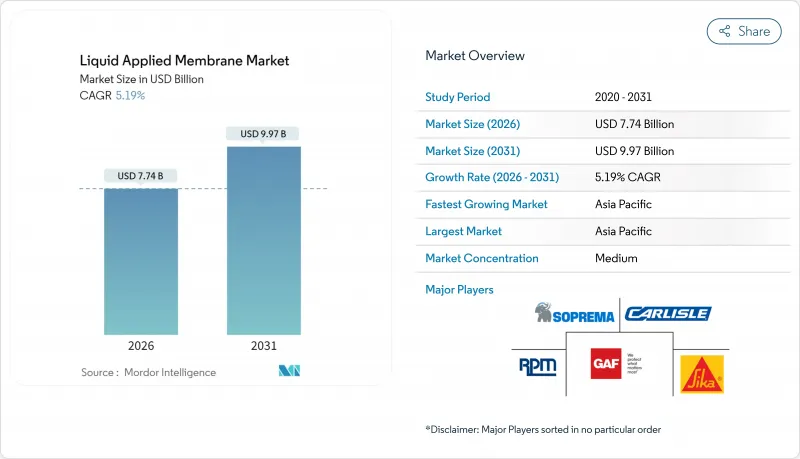
End-users continue shifting from roll goods to seamless coatings because the latter bridge cracks, tolerate movement, and deliver longer service life, all of which lower lifecycle costs. Infrastructure renewal programs in China, India, and the United States keep demand resilient, while stringent low-VOC rules in California, Canada, and the European Union tilt specifications toward water-borne chemistries. Architectural codes that reward cool roofs, photovoltaic integration, and green-roof assemblies further accelerate uptake. Manufacturers counter margin pressure by launching self-healing, PV-ready, and rapid-cure systems that cut downtime on congested job sites.
Global Liquid Applied Membrane Market Trends and Insights
Growing Usage of Waterproofing Membranes for Building Longevity
Owners now treat advanced coatings as capital assets that curb unplanned repairs. Oak Ridge National Laboratory estimates that extending commercial roof life by just five years could trim United States disposal costs by USD 2.5 billion annually while cutting landfill volume. Liquid systems such as MAPEI's Mapelastic AquaDefense bridge cracks up to 3.2 mm and remain flexible under thermal cycling, making them attractive in seismic zones. Insurance carriers have begun offering premium discounts when owners specify long-life membranes, adding a financial incentive that reinforces adoption.
Cost-Effective Retrofitting for Aging Roofs in Mature Economies
In Canada, SOPREMA resurfaced the CF Champlain shopping center roof, slicing material spend 45% and shortening construction schedules 35% versus full tear-off, all while extending service life another 25 years. Because coatings conform to irregular substrates, contractors avoid disruptive deck removal, allowing malls, hospitals, and schools to stay open. Resurfacing also reduces waste disposal volume and embodied carbon, helping facilities teams achieve ESG goals without large cap-ex budgets.
Availability of Sheet and Prefabricated Membranes
Thermoplastic rolls such as TPO retain a labor-speed edge on wide-open logistics buildings, enabling contractors to install over 900 m2 per shift. Manufacturers responded to coating growth by launching self-adhered sheets that reduce torch risk, eroding one differentiator of liquids. Nonetheless, liquids hold strong in complex penetrations, vertical transitions, and occupied retrofits where flame-free work is mandatory.
Other drivers and restraints analyzed in the detailed report include:
- Infrastructure Boom in Asia-Pacific and Africa
- Regulations Mandating VOC-Free Solutions
- Applicator Skill Shortages in Emerging Markets
For complete list of drivers and restraints, kindly check the Table Of Contents.
Segment Analysis
Bituminous coatings accounted for 30.10% of the liquid-applied membranes market share in 2025, reflecting decades of field data and low unit cost. Polyurethane led value growth at a 6.24% CAGR, supported by elastomeric performance that tolerates solar modules, cool-roof pigments, and movement joints without embrittlement.
Acrylic dispersions gain traction in refurbishments because crews can apply them with rollers and clean up using water. PMMA fills high-traffic balconies and stadium concourses where rapid 30-minute cure delivers schedule certainty. Hybrid chemistries such as polyurethane-bitumen blends and polyurea-modified elastomers address niche demands for ultra-fast return-to-service or cold-weather application, expanding design flexibility for specifiers.
The Liquid-Applied Membranes Report is Segmented by Type (Cementitious, Bituminous, Polyurethane, Polyurea, Acrylic, and More), Application (Roofing, Walls, Underground and Tunnels, and Other Applications), End-User Sector (Residential, Commercial, Industrial, and Institutional and Infrastructure), and Geography (Asia-Pacific, North America, Europe, and More). The Market Forecasts are Provided in Terms of Value (USD).
Geography Analysis
Asia-Pacific generated 52.70% of 2025 global revenue and is expected to climb at a 6.65% CAGR through 2031. Chinese metro extensions, Indian smart-city corridors, and ASEAN flood-control tunnels collectively require hundreds of millions of square meters of waterproofing. Local developers increasingly demand EN 14891 and GB 50108 compliance, pushing imports to upgrade testing certificates.
North America represents a mature but opportunity-rich arena dominated by reroofing. U.S. municipalities expand cool-roof rebates, while Canada's federal VOC rule effective 2025 accelerates water-borne technology penetration. Mexico's Coatzacoalcos immersed-tube tunnel specified GCP's Integritank system for seamless corrosion protection, underscoring regional competence in complex projects.
Europe's renovation wave centers on decarbonization, with Germany's BEG subsidy requiring airtightness upgrades that often incorporate fluid air-barriers. Georgia's adoption of EU VOC caps signals regulatory harmonization eastward. Middle East and Africa present high growth but challenging climatic extremes; Dubai's Expo City parks selected aliphatic polyurea to survive 45 °C summers without chalking.
- Alchimica
- ARDEX Group
- Bostik
- Carlisle Companies Incorporated
- Fosroc Inc.
- GAF Materials LLC
- HB Fuller
- Holcim
- Johns Manville
- MAPEI SpA
- RPM INTERNATIONAL INC.
- Saint-Gobain
- Sika AG
- SOPREMA Group
Additional Benefits:
- The market estimate (ME) sheet in Excel format
- 3 months of analyst support
TABLE OF CONTENTS
1 Introduction
- 1.1 Study Assumptions and Market Definition
- 1.2 Scope of the Study
2 Research Methodology
3 Executive Summary
4 Market Landscape
- 4.1 Market Overview
- 4.2 Market Drivers
- 4.2.1 Growing Usage of Waterproofing Membranes for Building Longevity
- 4.2.2 Cost-Effective Retrofitting for Aging Roofs in Mature Economies
- 4.2.3 Infrastructure Boom in APAC And Africa
- 4.2.4 Regulations Mandating VOC-Free Solutions
- 4.2.5 Rapid Adoption of PV-Ready Liquid Roof Skins
- 4.3 Market Restraints
- 4.3.1 Availability of Sheet and Prefabricated Membranes
- 4.3.2 Volatile Petrochemical Feedstock Prices
- 4.3.3 Applicator Skill Shortages in Emerging Markets
- 4.4 Value Chain Analysis
- 4.5 Porter's Five Forces
- 4.5.1 Bargaining Power of Suppliers
- 4.5.2 Bargaining Power of Consumers
- 4.5.3 Threat of New Entrants
- 4.5.4 Threat of Substitutes
- 4.5.5 Degree of Competition
5 Market Size and Growth Forecasts (Value)
- 5.1 By Type
- 5.1.1 Cementitious
- 5.1.2 Bituminous
- 5.1.3 Polyurethane
- 5.1.4 Polyurea
- 5.1.5 Acrylic (Dispersion)
- 5.1.6 PMMA
- 5.1.7 Hybrid (polyurethane/polyurea (PU/PUA), modified polyurethane-bituminous, etc.)
- 5.2 By Application
- 5.2.1 Roofing
- 5.2.2 Walls
- 5.2.3 Underground and Tunnels
- 5.2.4 Other Applications (Floors, Balconies, Walkways, Podiums, Tanks, Potable Water Tanks, Planter Boxes, etc.)
- 5.3 By End-use Sector
- 5.3.1 Residential
- 5.3.2 Commercial
- 5.3.3 Industrial
- 5.3.4 Institutional and Infrastructure
- 5.4 Geography
- 5.4.1 Asia-Pacific
- 5.4.1.1 China
- 5.4.1.2 India
- 5.4.1.3 Japan
- 5.4.1.4 South Korea
- 5.4.1.5 ASEAN
- 5.4.1.6 Rest of Asia-Pacific
- 5.4.2 North America
- 5.4.2.1 United States
- 5.4.2.2 Canada
- 5.4.2.3 Mexico
- 5.4.3 Europe
- 5.4.3.1 Germany
- 5.4.3.2 United Kingdom
- 5.4.3.3 France
- 5.4.3.4 Italy
- 5.4.3.5 Russia
- 5.4.3.6 Rest of Europe
- 5.4.4 South America
- 5.4.4.1 Brazil
- 5.4.4.2 Argentina
- 5.4.4.3 Rest of South America
- 5.4.5 Middle-East and Africa
- 5.4.5.1 Saudi Arabia
- 5.4.5.2 South Africa
- 5.4.5.3 Rest of Middle-East and Africa
- 5.4.1 Asia-Pacific
6 Competitive Landscape
- 6.1 Market Concentration
- 6.2 Strategic Moves
- 6.3 Market Share (%)/Ranking Analysis
- 6.4 Company Profiles (includes Global level Overview, Market level overview, Core Segments, Financials as available, Strategic Information, Market Rank/Share, Products and Services, Recent Developments)
- 6.4.1 Alchimica
- 6.4.2 ARDEX Group
- 6.4.3 Bostik
- 6.4.4 Carlisle Companies Incorporated
- 6.4.5 Fosroc Inc.
- 6.4.6 GAF Materials LLC
- 6.4.7 HB Fuller
- 6.4.8 Holcim
- 6.4.9 Johns Manville
- 6.4.10 MAPEI SpA
- 6.4.11 RPM INTERNATIONAL INC.
- 6.4.12 Saint-Gobain
- 6.4.13 Sika AG
- 6.4.14 SOPREMA Group
7 Market Opportunities and Future Outlook
- 7.1 White-space and Unmet-Need Assessment

