
PUBLISHER: Mordor Intelligence | PRODUCT CODE: 1910503

PUBLISHER: Mordor Intelligence | PRODUCT CODE: 1910503
Off-road Vehicle - Market Share Analysis, Industry Trends & Statistics, Growth Forecasts (2026 - 2031)
Off-road Vehicle Market size in 2026 is estimated at USD 24.33 billion, growing from 2025 value of USD 22.47 billion with 2031 projections showing USD 36.25 billion, growing at 8.28% CAGR over 2026-2031.
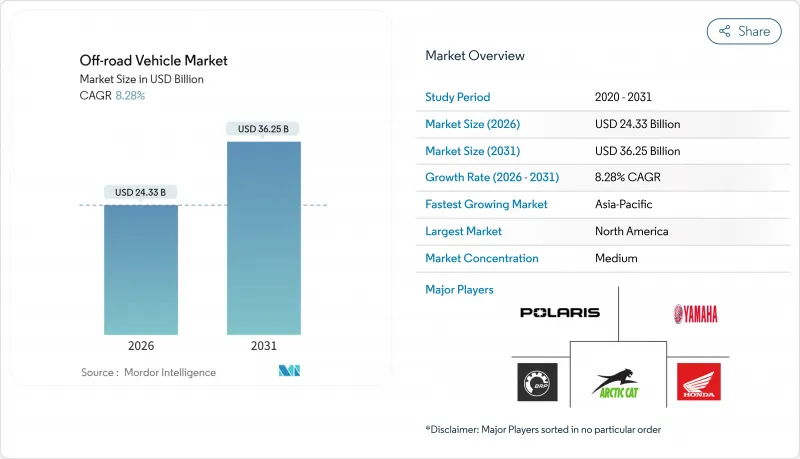
This growth arises from a confluence of rising outdoor recreation participation, accelerating electrification, and expanding utility applications that continue to offset cyclical revenue fluctuations among leading manufacturers. Growing trail infrastructure funding, precision-farming uptake, and military mobility modernization programs further widen demand pools, while technology convergence around electronic power steering (EPS), telematics, and advanced suspension systems enhances value propositions for both consumer and commercial buyers. Even with revenue contractions at major suppliers during 2024, the off-road vehicle market shows resilience through diversification into electric variants, specialty defense contracts, and subscription-based connectivity services that solidify long-term revenue streams.
Global Off-road Vehicle Market Trends and Insights
Surge In Outdoor Recreational Tourism
Outdoor recreation contributed USD 1.2 trillion to U.S. GDP in 2024, equal to 2.3% of national output and supporting multiple jobs. Participation increased, spurring ATV and UTV purchases for trail riding and overlanding. In 2024, motorcycling and ATVing generated a large share of value-added economic output, underscoring strong demand in the off-road vehicle market. State grant programs amplify the effect: Colorado's Outdoor Recreation Fund distributed a massive amount to access projects, while Oregon's matching grants nurtured rural manufacturing clusters. Trail systems create powerful spillovers; Minnesota's snowmobile network generates significant annual tourism revenue, reinforcing the sector's multiplier effect on local economies and stabilizing seasonal vehicle sales.
Tactical ATV/UTV Procurement By Defense Forces
Defense agencies seek light mobility assets for border patrol, special operations, and logistics in difficult terrain. India's upcoming northern-border tender specifies helicopter-sling capability, four-seat layouts, and autonomous navigation options to maximize tactical flexibility. Europe's FAMOUS program, coordinated by Finland, focuses on Arctic operability with vehicles tolerating -46 °C start-up and amphibious functionality for thaw periods. The United States allocates some amount annually to acquire Ultra-Light Combat Vehicles with 4,500-pound curb-weight caps and 250-mile range requirements. Such multi-program momentum encourages vendors to develop modular chassis that accept armor kits, counter-drone sensors, and hybrid powertrains, strengthening order backlogs despite civilian cyclical swings.
Lithium Supply-Chain Crunch For E-Powertrains
China currently refines more than three-fifths of global lithium and fabricates four-fifths of batteries, creating exposure for global OEMs as demand surges. The United States allocated funding under the Inflation Reduction Act for domestic processing, but permitting hurdles and community concerns are delaying mine openings. Electro-chemical extraction startups promise lower-impact solutions yet remain pre-commercial. Until diversified supply materializes, battery prices may remain volatile, constraining the total-cost parity that accelerates electric ATV adoption, particularly in price-sensitive developing markets.
Other drivers and restraints analyzed in the detailed report include:
- Rapid Mechanization Of Midsize Farms
- Adoption Of Advanced EPS & Telematics
- Rising Injury-Related Regulations & Speed Caps
For complete list of drivers and restraints, kindly check the Table Of Contents.
Segment Analysis
UTVs and side-by-sides captured 50.68% of the off-road vehicle market share in 2025 by blending passenger capacity, cargo utility, and suspension sophistication. The segment reached a robust level of off-road vehicle market size, buoyed by recreation, agriculture, and defense orders. Electric UTV derivatives now post the fastest 8.32% CAGR as OEMs introduce 15 kWh battery packs delivering 80 km/h top speed and sub-3-hour recharge cycles.
Demand for all-terrain vehicles (ATVs) remains robust in regions with strict width restrictions that favor narrower chassis. In contrast, niche demand for amphibious and snowmobile platforms persists where climatic extremes prevail. Competitive differentiation hinges on adjustable suspension, Polaris's DYNAMIX live valve architecture, and cabin digitization through touchscreen ride-command systems. The vehicle-type portfolio, therefore, balances legacy ICE volumes against emerging electric growth vectors, enabling OEMs to hedge against propulsion uncertainty.
Sports and recreation account for 41.05% of the off-road vehicle market in 2025, benefiting from record trail participation as millions of Americans venture outdoors. Military and law enforcement demand will escalate at an 8.35% CAGR as procurement agencies seek light tactical mobility with helicopter-sling compatibility and hybrid silent-watch modes.
Agriculture and forestry absorb mid-displacement UTVs outfitted with PTO-driven implements, while construction firms requisition high-payload units for remote-site logistics. Emerging tourism concepts such as guided overlanding expeditions further widen commercial use cases. Multi-role adaptability, therefore, sustains baseline volumes even when consumer discretionary spending dips.
Internal-combustion engines commanded 83.05% of the off-road vehicle market share in 2025, backed by ubiquitous fueling infrastructure and mature supply chains. Battery-electric models, however, record the steepest 8.30% CAGR, reflecting policy push and falling cell costs.
Hybrid range-extender concepts bridge customer anxiety by pairing 10 kWh packs with compact generators, extending runtime without compromising low-speed torque. Hydrogen fuel-cell prototypes remain R&D efforts but signal pathways for heavy-duty rescue fleets requiring rapid cold-weather refueling. Propulsion diversification mitigates regulatory risks while inviting new supplier ecosystems around battery leasing and recycling.
The Off-Road Vehicle Market Report is Segmented by Vehicle Type (All-Terrain Vehicles and More), Application (Sports & Recreation and More), Propulsion Type (Internal-Combustion and More), Engine Displacement (Less Than 400 Cc and More), Power Output (Less Than 50 KW and More), Drive Type (2-Wheel Drive and More), Seating Capacity, and Geography. The Market Forecasts are Provided in Terms of Value (USD) and Volume (Units).
Geography Analysis
North America secured 37.84% of off-road vehicle market share in 2025, underpinned by the outdoor recreation GDP contribution and extensive trail networks subsidized by state grants. Snowbelt states invested huge amount annually in grooming programs that stimulated in tourism receipts, while Wisconsin and Alaska reimbursed 100% of eligible trail maintenance costs, anchoring steady demand even during economic slowdowns. Dealer financing partnerships, such as Sheffield Financial's renewal with Polaris, ease credit access for buyers and sustain showroom turnover. Nevertheless, conservation-area restrictions across Canadian provinces introduce operational complexity, nudging OEMs to supply quieter powertrains and emission-compliant engines to satisfy permitting criteria.
Asia-Pacific delivers the fastest 8.42% CAGR through 2031 as urbanizing middle-class consumers embrace outdoor lifestyle brands and governments fund rural connectivity. India's ATV sales grew drastically which was supported by adventure-tourism marketing and agricultural mechanization drives. Regional OEMs such as CFMOTO leverage vertically integrated supply chains to offer competitive pricing, enabling them to capture export contracts and reach two-fifth global market share.
Europe's growth lags but regulatory thrust aligns with electrification imperatives. Stage V emission norms for non-road machinery elevate R&D spending on after-treatment and alternative powertrains, indirectly spurring innovation in hybrid and fuel-cell concepts. New NRMM rules effective 2028 set small-series thresholds of 70 units, granting boutique electric startups manageable certification pathways. Nordic countries deploy long-run trail-maintenance subsidies to catalyze tourism, a template that Germany and Austria now evaluate for alpine regions. Consequently, although compliance burdens restrain short-term volumes, long-term demand will pivot toward low-emission models, allowing European suppliers to recoup investments through premium pricing.
- Polaris Inc.
- Bombardier Recreational Products Inc. (Can-Am)
- Yamaha Motor Corp.
- Textron Inc. (Arctic Cat)
- Kawasaki Heavy Industries Ltd.
- Suzuki Motor Corp.
- Honda Motor Co. Ltd.
- CFMOTO Powersports Inc.
- Kwang Yang Motor Co. Ltd. (Kymco)
- American LandMaster
- Tracker Off-Road (Bass Pro Shops)
- Kubota Corp. (RTV)
- John Deere (Gator)
- Mahindra & Mahindra Ltd.
- Segway Powersports
- Hisun Motors Corp.
- Linhai Group
- TGB (Taiwan Golden Bee)
- DRR USA
Additional Benefits:
- The market estimate (ME) sheet in Excel format
- 3 months of analyst support
TABLE OF CONTENTS
1 Introduction
- 1.1 Study Assumptions & Market Definition
- 1.2 Scope of the Study
2 Research Methodology
3 Executive Summary
4 Market Landscape
- 4.1 Market Overview
- 4.2 Market Drivers
- 4.2.1 Surge In Outdoor Recreational Tourism
- 4.2.2 Tactical ATV/UTV Procurement By Defense Forces
- 4.2.3 Rapid Mechanization Of Midsize Farms
- 4.2.4 Adoption Of Advanced EPS & Telematics
- 4.2.5 Demand For Low-Noise E-Atvs For Drone Cinematography
- 4.2.6 Nordic Trail-Maintenance Subsidies Expanding Riding Networks
- 4.3 Market Restraints
- 4.3.1 High Upfront & Lifecycle Costs
- 4.3.2 Lithium Supply-Chain Crunch For E-Powertrains
- 4.3.3 Rising Injury-Related Regulations & Speed Caps
- 4.3.4 Conservation-Area Usage Bans
- 4.4 Value / Supply-Chain Analysis
- 4.5 Regulatory Landscape
- 4.6 Technological Outlook
- 4.7 Porter's Five Forces Analysis
- 4.7.1 Threat of New Entrants
- 4.7.2 Bargaining Power of Buyers
- 4.7.3 Bargaining Power of Suppliers
- 4.7.4 Threat of Substitutes
- 4.7.5 Intensity of Competitive Rivalry
5 Market Size & Growth Forecasts (Value (USD) and Volume (Units))
- 5.1 By Vehicle Type
- 5.1.1 All-Terrain Vehicles (ATV)
- 5.1.2 Utility Task Vehicles (UTV) / Side-by-Sides
- 5.1.3 Dirt / Off-road Motorcycles
- 5.1.4 Snowmobiles
- 5.1.5 Amphibious & Specialty ORVs
- 5.2 By Application
- 5.2.1 Sports & Recreation
- 5.2.2 Agriculture & Forestry
- 5.2.3 Industrial & Construction
- 5.2.4 Military & Law-Enforcement
- 5.2.5 Other Commercial (tourism, search-and-rescue)
- 5.3 By Propulsion Type
- 5.3.1 Internal-Combustion (Gasoline / Diesel)
- 5.3.2 Hybrid
- 5.3.3 Battery-Electric
- 5.3.4 Hydrogen Fuel-Cell
- 5.4 By Engine Displacement (cc)
- 5.4.1 Less than 400 cc
- 5.4.2 400 - 800 cc
- 5.4.3 More than 800 cc
- 5.5 By Power Output (kW)
- 5.5.1 Less than 50 kW
- 5.5.2 50 - 100 kW
- 5.5.3 More than 100 kW
- 5.6 By Drive Type
- 5.6.1 2-Wheel Drive
- 5.6.2 4-Wheel / All-Wheel Drive
- 5.7 By Seating Capacity
- 5.7.1 1 Rider
- 5.7.2 2 Riders
- 5.7.3 More than or equal to 3 Passengers
- 5.8 By Geography
- 5.8.1 North America
- 5.8.1.1 United States
- 5.8.1.2 Canada
- 5.8.1.3 Rest of North America
- 5.8.2 South America
- 5.8.2.1 Brazil
- 5.8.2.2 Argentina
- 5.8.2.3 Rest of South America
- 5.8.3 Europe
- 5.8.3.1 Germany
- 5.8.3.2 France
- 5.8.3.3 United Kingdom
- 5.8.3.4 Italy
- 5.8.3.5 Spain
- 5.8.3.6 Russia
- 5.8.3.7 Rest of Europe
- 5.8.4 Asia-Pacific
- 5.8.4.1 China
- 5.8.4.2 Japan
- 5.8.4.3 India
- 5.8.4.4 South Korea
- 5.8.4.5 Australia
- 5.8.4.6 Rest of Asia-Pacific
- 5.8.5 Middle East and Africa
- 5.8.5.1 United Arab Emirates
- 5.8.5.2 Saudi Arabia
- 5.8.5.3 Turkey
- 5.8.5.4 Egypt
- 5.8.5.5 South Africa
- 5.8.5.6 Rest of Middle East and Africa
- 5.8.1 North America
6 Competitive Landscape
- 6.1 Market Concentration
- 6.2 Strategic Moves
- 6.3 Market Share Analysis
- 6.4 Company Profiles (Includes Global Level Overview, Market Level Overview, Core Segments, Financials as Available, Strategic Information, Market Rank/Share for Key Companies, Products and Services, SWOT Analysis, and Recent Developments)
- 6.4.1 Polaris Inc.
- 6.4.2 Bombardier Recreational Products Inc. (Can-Am)
- 6.4.3 Yamaha Motor Corp.
- 6.4.4 Textron Inc. (Arctic Cat)
- 6.4.5 Kawasaki Heavy Industries Ltd.
- 6.4.6 Suzuki Motor Corp.
- 6.4.7 Honda Motor Co. Ltd.
- 6.4.8 CFMOTO Powersports Inc.
- 6.4.9 Kwang Yang Motor Co. Ltd. (Kymco)
- 6.4.10 American LandMaster
- 6.4.11 Tracker Off-Road (Bass Pro Shops)
- 6.4.12 Kubota Corp. (RTV)
- 6.4.13 John Deere (Gator)
- 6.4.14 Mahindra & Mahindra Ltd.
- 6.4.15 Segway Powersports
- 6.4.16 Hisun Motors Corp.
- 6.4.17 Linhai Group
- 6.4.18 TGB (Taiwan Golden Bee)
- 6.4.19 DRR USA
7 Market Opportunities & Future Outlook
- 7.1 White-space & Unmet-Need Assessment

