PUBLISHER: Mordor Intelligence | PRODUCT CODE: 2122873

PUBLISHER: Mordor Intelligence | PRODUCT CODE: 2122873
Middle East And Africa Alcoholic Beverage - Market Share Analysis, Industry Trends & Statistics, Growth Forecasts (2026 - 2031)
According to Mordor Intelligence, the Middle East and Africa alcoholic beverage market size is projected to expand from USD 154.11 billion in 2025 and USD 164.86 billion in 2026 to USD 230.68 billion by 2031, registering a CAGR of 6.95% between 2026 to 2031.
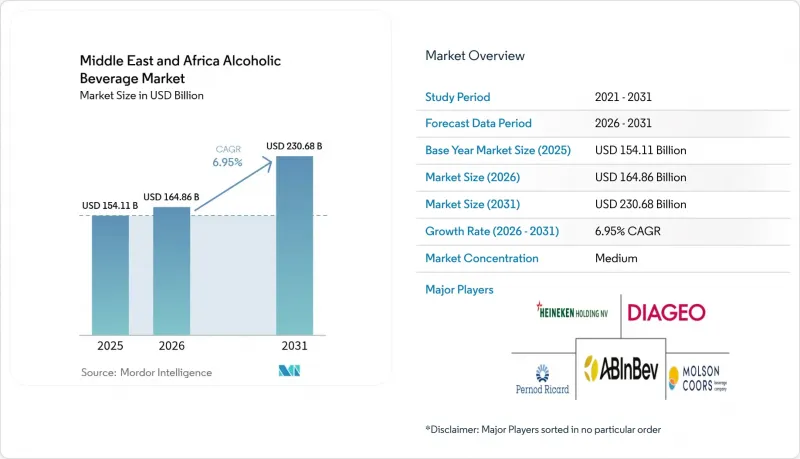
This report is Segmented by Product Type (Beer, Wine, Spirits, and Others), End-User (Male and Female), Packaging Type (Bottles, Cans, and Others), Distribution Channel (On-Trade, Off-Trade), and Geography (South Africa, Saudi Arabia, United Arab Emirates, and More). The Market Forecasts are Provided in Terms of Value (USD) and Volume (Liters).
Middle East And Africa Alcoholic Beverage Market Trends and Insights
Premiumization and Experience-Led Consumption
Affluent consumers in Gulf states and South African metropolitan areas are trading up to ultra-premium spirits and limited-edition releases, a behavioral shift that is compressing volume growth while inflating revenue per transaction. Diageo reported that its Reserve portfolio, comprising brands priced above USD 50 per bottle, grew 18% in Middle Eastern markets during fiscal 2025, outpacing its mainstream spirits by a factor of three[1]. This premiumization wave is intertwined with experiential retail: Dubai Duty Free's liquor division generated USD 290.6 million in 2025, with single-malt whiskies and cognacs accounting for 41% of spirits revenue despite representing only 22% of unit sales. South Africa's wine estates are leveraging this trend by launching cellar-door experiences and pairing menus, converting casual buyers into high-margin direct-to-consumer customers. The dynamic is self-reinforcing: as disposable incomes rise and social media amplifies luxury signaling, brands can command higher price points without sacrificing share, effectively decoupling revenue growth from volume expansion.
Expansion of Travel Retail and Duty-Free Channels
Travel retail is emerging as a disproportionately influential channel, capturing 9% of regional revenue in 2025 but contributing 14% of incremental growth, according to data extrapolated from Dubai Duty Free's performance metrics. The UAE's position as a global aviation hub, handling over 140 million passengers in 2025, creates a captive, high-spending audience for duty-free alcohol, with average basket sizes 2.3 times higher than domestic off-trade purchases, according to the UAE Government. Saudi Arabia's planned Red Sea International Airport and NEOM Bay Airport will add 20 million annual passenger capacity by 2030, each featuring duty-free zones where alcohol sales will be permitted despite broader domestic prohibitions. This channel's appeal extends beyond price arbitrage: limited-edition releases and exclusive packaging drive impulse purchases among transit passengers, a behavior that brands exploit through airport-exclusive SKUs. Egypt and Morocco are upgrading terminal retail infrastructure to capture spillover demand from European and Asian travelers, though execution lags Gulf benchmarks due to regulatory inconsistencies and lower per-passenger spend.
Regulatory Uncertainty and Policy Volatility
Abrupt policy shifts in key markets are compressing investment horizons and inflating risk premiums. Saudi Arabia's 2026 announcement permitting alcohol in tourist zones arrived without detailed licensing frameworks, leaving operators uncertain about eligibility criteria, fee structures, and enforcement protocols. Egypt reversed a planned excise-tax reduction in January 2025, instead imposing a 15% surcharge on imported spirits, a decision communicated with 48 hours' notice that stranded inventory and disrupted Q1 pricing strategies. Nigeria's multiple regulatory agencies, NAFDAC, Customs, and state-level boards, issue conflicting guidance on labeling, import permits, and distribution, forcing brands to maintain parallel compliance teams and inflating go-to-market costs by an estimated 18-22% relative to comparably sized African markets. This volatility deters long-term capital commitments: Heineken's Dubai brewery represents a rare greenfield investment, whereas most multinational expansions favor asset-light partnerships or third-party manufacturing to preserve exit optionality. The World Health Organization's 2025 alcohol taxation report highlights that MEA jurisdictions exhibit the highest year-over-year variance in excise rates globally, a pattern that penalizes supply-chain optimization and favors agile, locally embedded competitors.
Other drivers and restraints analyzed in the detailed report include:
- Growth of Hospitality, Entertainment, and Mega-Events
- Rising Popularity of Low-Alcohol and No-Alcohol Alternatives
- Cultural and Religious Sensitivities
For complete list of drivers and restraints, kindly check the Table Of Contents.
Segment Analysis
Beer's 53.68% share of 2025 revenue reflects entrenched consumption habits, distribution ubiquity, and price accessibility, yet wine's 9.09% forecast CAGR through 2031 signals a structural reallocation toward higher-margin, premiumized categories. Lager dominates beer volume, accounting for an estimated 78% of segment sales, driven by Heineken, AB InBev, and Carlsberg portfolios optimized for hot-climate refreshment and mass-market pricing. Low-alcohol beer is carving a niche in health-conscious and religiously observant demographics, with Heineken 0.0 achieving distribution in 12,400 Middle Eastern outlets by end-2025, up from 7,800 in 2024. Ale and craft styles remain subscale but are growing 16-19% annually in South Africa's urban centers, where microbreweries leverage local ingredients and experiential taprooms to command premium pricing.
Wine's acceleration is driven by South African exports, which reached 421 million liters in 2025, with Middle Eastern and African destinations accounting for 34% of the volume, up from 28% in 2023, according to Wines of South Africa (WoSA). Still wine accounts for 68% of category revenue, yet sparkling wine is expanding faster, with an estimated 11-13% CAGR, as celebratory occasions and hospitality venues drive prosecco and cava adoption. Fortified wines, including port and sherry, retain niche appeal in Gulf markets where sweeter profiles align with regional palate preferences. Spirits, encompassing whisky, rum, vodka, and cognac, benefit from premiumization tailwinds: Diageo's Reserve portfolio grew 18% in Middle Eastern markets during fiscal 2025, with single-malt Scotch and aged cognacs leading growth. Tequila and mezcal are emerging categories, with Pernod Ricard's Altos and Olmeca brands achieving 27% growth in UAE on-trade channels in 2025, driven by cocktail culture and bartender advocacy. Liqueurs and other spirits capture residual demand, often serving as mixers or ingredients in RTD formulations.
Male consumers' 70.21% share of 2025 revenue underscores entrenched gender disparities in alcohol access and social acceptability, yet the female segment's 8.07% forecast CAGR, outpacing the overall market by 112 basis points, reflects urbanization, workforce participation, and targeted marketing. Diageo's 2025 consumer survey across the UAE, South Africa, and Egypt found that 41% of female respondents aged 25-40 consumed alcohol at least monthly, up from 34% in 2023, with wine and RTD cocktails preferred over beer and spirits.
Brands are responding with gender-neutral packaging, influencer partnerships, and occasion-based messaging that de-emphasizes traditional male-coded imagery. Pernod Ricard's Beefeater Pink Strawberry gin, launched in South African retail in April 2025, achieved 62% female purchase incidence, demonstrating the commercial viability of explicitly targeting this cohort. Male consumption patterns are bifurcating: premium spirits and craft beer attract affluent urban professionals, while value lagers and local spirits dominate rural and lower-income segments. The strategic implication is that female-segment growth is disproportionately concentrated in higher-margin categories, amplifying its revenue contribution beyond its volume share and justifying incremental marketing investment despite cultural and regulatory headwinds in several markets.
Complete Report Scope:
- By Product Type
- Beer
- Ale Beer
- Lager
- Low-Alcohol Beer
- Other Beer Types
- Wine
- Fortified Wine
- Stilll Wine
- Sparkling Wine
- Other Wines Types
- Spirits
- Brandy and Cognac
- Liquer
- Tequilla and Mezcel
- Rum
- Whisky
- Other Spirit Types
- Others
- Beer
- By End User
- Male
- Female
- By Packaging Type
- Bottles
- Cans
- Others
- By Distribution Channel
- On-trade
- Off-trade
- By Geography
- South Africa
- Saudi Arabia
- United Arab Emirates
- Nigeria
- Egypt
- Morocco
- Turkey
- Rest of Middle East and Africa
List of Companies Covered in this Report:
- Anheuser-Busch InBev SA/NV
- Heineken Holdings N.V.
- Diageo plc
- Pernod Ricard SA
- Molson Coors Beverage Company
- Edward Snell & Co Pty Ltd
- Suntory Holdings Limited
- Brown-Forman Corporation
- Bacardi Limited
- KWV Wines & Spirits
- Refriango LDA
- Oude Molen Distillery (Pty) Ltd
- DGB (Pty) Ltd.
- Halewood Artisanal Spirits PLC
- Tokara Wine Estate
- Castel Group
- Midtown Factory LLC
- Van Ryn's Distillery
- United Dutch Breweries
- Intercontinental Distillers Limited
Additional Benefits:
- The market estimate (ME) sheet in Excel format
- 3 months of analyst support
TABLE OF CONTENTS
1 INTRODUCTION
- 1.1 Study Assumptions and Market Definition
- 1.2 Scope of the Study
2 RESEARCH METHODOLOGY
3 EXECUTIVE SUMMARY
4 MARKET LANDSCAPE
- 4.1 Market Overview
- 4.2 Market Drivers
- 4.2.1 Premiumization and experience-led consumption
- 4.2.2 Expansion of travel retail and duty-free channels
- 4.2.3 Growth of hospitality, entertainment, and mega-events
- 4.2.4 Rising popularity of low-alcohol and no-alcohol alternatives
- 4.2.5 Convenient ready-to-drink (RTD) offerings
- 4.2.6 Product innovation and flavor variety
- 4.3 Market Restraints
- 4.3.1 Regulatory uncertainty and policy volatility
- 4.3.2 Cultural and religious sensitivities
- 4.3.3 High pricing due to taxes and duties
- 4.3.4 Illicit and unregulated alcohol trade
- 4.4 Consumer Behavior Analysis
- 4.5 Regulatory Outlook
- 4.6 Technological Outlook
- 4.7 Porter's Five Forces
- 4.7.1 Threat of New Entrants
- 4.7.2 Bargaining Power of Buyers
- 4.7.3 Bargaining Power of Suppliers
- 4.7.4 Threat of Substitute Products
- 4.7.5 Intensity of Competitive Rivalry
5 MARKET SIZE AND GROWTH FORECASTS (VALUE AND VOLUME)
- 5.1 By Product Type
- 5.1.1 Beer
- 5.1.1.1 Ale Beer
- 5.1.1.2 Lager
- 5.1.1.3 Low-Alcohol Beer
- 5.1.1.4 Other Beer Types
- 5.1.2 Wine
- 5.1.2.1 Fortified Wine
- 5.1.2.2 Stilll Wine
- 5.1.2.3 Sparkling Wine
- 5.1.2.4 Other Wines Types
- 5.1.3 Spirits
- 5.1.3.1 Brandy and Cognac
- 5.1.3.2 Liquer
- 5.1.3.3 Tequilla and Mezcel
- 5.1.3.4 Rum
- 5.1.3.5 Whisky
- 5.1.3.6 Other Spirit Types
- 5.1.4 Others
- 5.1.1 Beer
- 5.2 By End User
- 5.2.1 Male
- 5.2.2 Female
- 5.3 By Packaging Type
- 5.3.1 Bottles
- 5.3.2 Cans
- 5.3.3 Others
- 5.4 By Distribution Channel
- 5.4.1 On-trade
- 5.4.2 Off-trade
- 5.5 By Geography
- 5.5.1 South Africa
- 5.5.2 Saudi Arabia
- 5.5.3 United Arab Emirates
- 5.5.4 Nigeria
- 5.5.5 Egypt
- 5.5.6 Morocco
- 5.5.7 Turkey
- 5.5.8 Rest of Middle East and Africa
6 COMPETITIVE LANDSCAPE
- 6.1 Market Concentration
- 6.2 Strategic Moves
- 6.3 Market Share Analysis
- 6.4 Company Profiles (includes Global level Overview, Market level overview, Core Segments, Financials, Strategic Information, Market Rank/Share, Products and Services, Recent Developments)
- 6.4.1 Anheuser-Busch InBev SA/NV
- 6.4.2 Heineken Holdings N.V.
- 6.4.3 Diageo plc
- 6.4.4 Pernod Ricard SA
- 6.4.5 Molson Coors Beverage Company
- 6.4.6 Edward Snell & Co Pty Ltd
- 6.4.7 Suntory Holdings Limited
- 6.4.8 Brown-Forman Corporation
- 6.4.9 Bacardi Limited
- 6.4.10 KWV Wines & Spirits
- 6.4.11 Refriango LDA
- 6.4.12 Oude Molen Distillery (Pty) Ltd
- 6.4.13 DGB (Pty) Ltd.
- 6.4.14 Halewood Artisanal Spirits PLC
- 6.4.15 Tokara Wine Estate
- 6.4.16 Castel Group
- 6.4.17 Midtown Factory LLC
- 6.4.18 Van Ryn's Distillery
- 6.4.19 United Dutch Breweries
- 6.4.20 Intercontinental Distillers Limited
7 MARKET OPPORTUNITIES AND FUTURE TRENDS

