PUBLISHER: Mordor Intelligence | PRODUCT CODE: 1910554

PUBLISHER: Mordor Intelligence | PRODUCT CODE: 1910554
Graphite Electrode - Market Share Analysis, Industry Trends & Statistics, Growth Forecasts (2026 - 2031)
Graphite Electrode market size in 2026 is estimated at 1.73 million tons, growing from 2025 value of 1.67 million tons with 2031 projections showing 2.05 million tons, growing at 3.51% CAGR over 2026-2031.
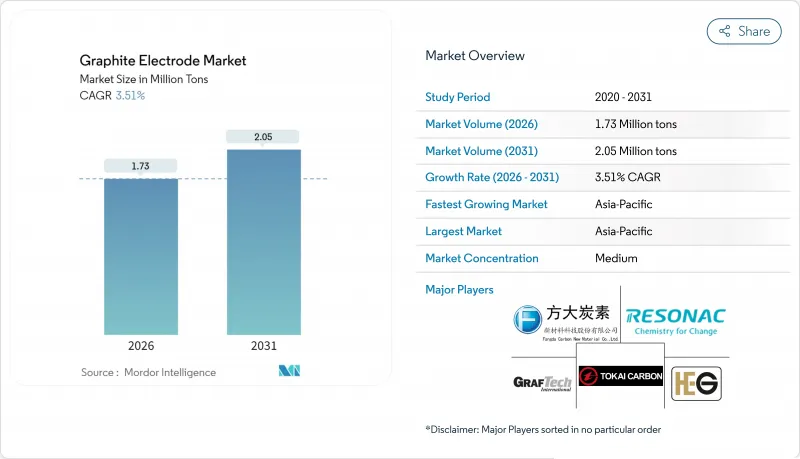
Demand growth stems from the steel industry's pivot toward electric-arc-furnace (EAF) technology, stronger environmental regulations, and the operational advantages of ultra-high-power (UHP) electrodes. Intensifying policy pressure to decarbonize steelmaking, especially in China and the European Union, supports long-run uptake of scrap-based production, while premium electrode grades help mills cut electricity consumption per ton of steel. Needle coke supply risk and competition from battery-grade graphite constrain short-term capacity additions, yet vertical integration and recycling advances partially offset raw-material pressure. Asia-Pacific remains the principal demand hub, underpinned by large steel output, rapid EAF adoption, and trade realignments favoring non-Chinese suppliers. Competitive strategies increasingly revolve around securing feedstock, deploying AI-enabled furnace optimization, and commercializing closed-loop recycling for spent electrodes.
Global Graphite Electrode Market Trends and Insights
Shift to Electric-Arc-Furnace Steelmaking
EAF steelmaking represents 30% of global output in 2025 and is expected to reach 40% by 2030 as policy mandates tighten on blast furnace emissions. The route emits up to 70% less CO2 than the traditional blast-oxygen pathway, supporting corporate net-zero commitments in Europe and East Asia. China banned new coal-based steel projects in H1 2024, reinforcing the trend despite continued additions of ironmaking capacity. EAF flexibility lets mills modulate production when electricity prices spike, useful in regions with volatile energy markets. The shift sustains long-run demand for high-performance electrodes that tolerate higher current densities, strengthening the graphite electrode market.
Rising Global Steel-Scrap Availability
Scrap pools grow as infrastructure built decades earlier reaches end-of-life, boosting feedstock for secondary steelmaking in North America and Europe. Advances in sorting improve scrap purity, letting mills hit tight quality specifications without virgin iron ore. Asia-Pacific nations accelerate investment in modern shredding and logistics networks that collect and process household and industrial scrap. Each ton of EAF steel consumes 1-2 kg of graphite electrodes, so expanding scrap flows create predictable electrode demand and growth in the graphite electrode market. The trend also reduces reliance on coking coal, aligning with decarbonization goals.
Needle Coke Price Volatility & Supply Risk
Needle coke constitutes up to 60% of electrode production cost and relies on specialized petroleum refining capacity concentrated in a handful of plants. A 3% drop in U.S. coke output in 2024 tightened supply, while battery-sector demand compounds pressure on availability. Quality specifications involving sulfur and the coefficient of thermal expansion narrow the pool of acceptable material, limiting substitution. Spot prices fluctuated by more than 40% within twelve months, forcing electrode makers to hedge and lock in long-term contracts wherever possible. Delays in greenfield needle-coke projects keep the graphite electrode market tight through 2027.
Other drivers and restraints analyzed in the detailed report include:
- Accelerating Demand for Ultra-High-Power Electrodes
- Closed-Loop Recycling of Spent Electrodes into Battery-Grade Carbon
- Cyclicality of Global Steel Production
For complete list of drivers and restraints, kindly check the Table Of Contents.
Segment Analysis
UHP electrodes accounted for a dominant 69.88% graphite electrode market share in 2025 and are estimated to grow at a 4.06% CAGR through 2031. The segment benefits from the rollout of mega-EAF units exceeding 400 tons per heat, which require elevated current densities while maintaining structural integrity. Mills' focus on total cost of ownership; consequently, longer electrode life and reduced change-out downtime justify premium pricing. The graphite electrode market continues shifting volume from high-power (SHP) and regular-power (RP) grades toward UHP, compressing ASP differentials over time as technology matures.
Production of UHP electrodes demands top-tier needle coke and multiple graphitization cycles, prompting vertically integrated players to secure feedstock via captive cokers and forward contracts. New entrants confront capital hurdles and stringent quality validation, preserving current competitive hierarchies in the graphite electrode market. Regional blast-oxygen furnace retrofits to EAF, especially in India and Southeast Asia, sustain incremental UHP demand. Sustainability certifications on carbon footprint intensify procurement scrutiny, favoring suppliers who demonstrate closed-loop recycling and renewable-energy usage in their operations.
The Graphite Electrode Market Report is Segmented by Electrode Grade (Ultra High Power (UHP), High Power (SHP), Regular Power (RP)), Application (Electric Arc Furnace, Basic Oxygen Furnace, Non-Steel), and Geography (Asia-Pacific, North America, Europe, South America, Middle East and Africa). The Market Forecasts are Provided in Terms of Volume (Tons).
Geography Analysis
Asia-Pacific dominated the graphite electrode market in 2025, holding 59.12% share and registering the fastest 4.58% CAGR through 2031. China's policy curbs on new coal-based ironmaking combined with India's ambitious infrastructure pipeline underpin regional growth. Japanese import tariffs of 95.2% on Chinese electrodes, effective March 2025, prompt local buyers to diversify toward domestic and Korean suppliers, altering intra-Asian trade flows. South Korea's premium steel segment relies on UHP electrodes for automotive-grade outputs, while its expanding battery-material ecosystem fosters closed-loop recycling collaborations.
North America sustains mid-single-digit demand increases anchored by robust scrap collection networks and continuous efficiency upgrades at EAF mills. Abundant shale-gas electricity in the Midwest and Southeast supports low operating costs, encouraging capacity expansions by leading mini-mills. Canada leverages hydroelectric power to run EAFs in Ontario and Quebec, achieving low Scope 2 emissions targets that drive premium electrode procurement. Mexico's proximity to U.S. scrap and surging automotive production adds incremental tonnage to regional electrode imports.
Europe contends with lingering macro-economic softness; however, from 2025 the region anticipates a 2.20% recovery in apparent steel consumption after multi-year contraction. High energy costs propel mills toward digital furnace optimization and flexible production scheduling, both demanding reliable UHP electrodes. The EU Battery Regulation 2023/1542 boosts interest in recycling spent electrodes into anode material, integrating steel and battery supply chains reinforcing the graphite electrode market. Eastern European nations with lower labor costs and growing construction sectors, including Poland and Turkey, capture new EAF investments that lift electrode shipments into the late decade.
- El 6 LLC
- Fangda Carbon New Material Technology Co. Ltd
- GrafTech International
- Graphite India Limited
- HEG Limited
- Jilin Carbon New Material Co., Ltd.
- Kaifeng Pingmei New Carbon Materials Technology Co. Ltd
- Liaoning Dantan Technology Group Co. Ltd (Dan Carbon)
- Nantong Yangzi Carbon Co. Ltd
- Nippon Carbon Co. Ltd
- Resonac Holdings Corporation
- Sangraf International Inc.
- SEC Carbon Limited
- Tokai Carbon Co. Ltd
- Zhongze Group
Additional Benefits:
- The market estimate (ME) sheet in Excel format
- 3 months of analyst support
TABLE OF CONTENTS
1 Introduction
- 1.1 Study Assumptions and Market Definition
- 1.2 Scope of the Study
2 Research Methodology
3 Executive Summary
4 Market Landscape
- 4.1 Market Overview
- 4.2 Market Drivers
- 4.2.1 Shift to electric-arc-furnace (EAF) steelmaking
- 4.2.2 Rising global steel-scrap availability
- 4.2.3 Accelerating demand for ultra-high-power (UHP) electrodes
- 4.2.4 Closed-loop recycling of spent electrodes into battery-grade carbon
- 4.2.5 Refiners' investments in premium needle-coke capacity
- 4.3 Market Restraints
- 4.3.1 Needle-coke price volatility and supply risk
- 4.3.2 Cyclicality of global steel production
- 4.3.3 Silicon-rich battery anodes squeezing graphite feedstock
- 4.4 Value Chain Analysis
- 4.5 Porter's Five Forces
- 4.5.1 Bargaining Power of Suppliers
- 4.5.2 Bargaining Power of Buyers
- 4.5.3 Threat of New Entrants
- 4.5.4 Threat of Substitute Products and Services
- 4.5.5 Degree of Competition
5 Market Size and Growth Forecasts (Value and Volume)
- 5.1 By Electrode Grade
- 5.1.1 Ultra High Power (UHP)
- 5.1.2 High Power (SHP)
- 5.1.3 Regular Power (RP)
- 5.2 By Application
- 5.2.1 Electric Arc Furnace
- 5.2.2 Basic Oxygen Furnace
- 5.2.3 Non-steel
- 5.3 By Geography
- 5.3.1 Asia-Pacific
- 5.3.1.1 China
- 5.3.1.2 India
- 5.3.1.3 Japan
- 5.3.1.4 South Korea
- 5.3.1.5 Malaysia
- 5.3.1.6 Thailand
- 5.3.1.7 Indonesia
- 5.3.1.8 Vietnam
- 5.3.1.9 Rest of Asia-Pacific
- 5.3.2 North America
- 5.3.2.1 United States
- 5.3.2.2 Canada
- 5.3.2.3 Mexico
- 5.3.3 Europe
- 5.3.3.1 Germany
- 5.3.3.2 United Kingdom
- 5.3.3.3 Italy
- 5.3.3.4 France
- 5.3.3.5 Russia
- 5.3.3.6 Spain
- 5.3.3.7 Turkey
- 5.3.3.8 NORDIC Countries
- 5.3.3.9 Rest of Europe
- 5.3.4 South America
- 5.3.4.1 Brazil
- 5.3.4.2 Argentina
- 5.3.4.3 Colombia
- 5.3.4.4 Rest of South America
- 5.3.5 Middle East and Africa
- 5.3.5.1 Saudi Arabia
- 5.3.5.2 Qatar
- 5.3.5.3 United Arab Emirates
- 5.3.5.4 Egypt
- 5.3.5.5 South Africa
- 5.3.5.6 Rest of Middle East and Africa
- 5.3.1 Asia-Pacific
6 Competitive Landscape
- 6.1 Market Concentration
- 6.2 Strategic Moves
- 6.3 Market Share (%)**/Ranking Analysis
- 6.4 Company Profiles (includes Global level Overview, Market level Overview, Core Segments, Financials, Strategic Info, Market Rank/Share, Products and Services, Recent Developments)
- 6.4.1 El 6 LLC
- 6.4.2 Fangda Carbon New Material Technology Co. Ltd
- 6.4.3 GrafTech International
- 6.4.4 Graphite India Limited
- 6.4.5 HEG Limited
- 6.4.6 Jilin Carbon New Material Co., Ltd.
- 6.4.7 Kaifeng Pingmei New Carbon Materials Technology Co. Ltd
- 6.4.8 Liaoning Dantan Technology Group Co. Ltd (Dan Carbon)
- 6.4.9 Nantong Yangzi Carbon Co. Ltd
- 6.4.10 Nippon Carbon Co. Ltd
- 6.4.11 Resonac Holdings Corporation
- 6.4.12 Sangraf International Inc.
- 6.4.13 SEC Carbon Limited
- 6.4.14 Tokai Carbon Co. Ltd
- 6.4.15 Zhongze Group
7 Market Opportunities and Future Outlook
- 7.1 White-space and Unmet-Need Assessment

