
PUBLISHER: Mordor Intelligence | PRODUCT CODE: 1910610

PUBLISHER: Mordor Intelligence | PRODUCT CODE: 1910610
India Container Glass - Market Share Analysis, Industry Trends & Statistics, Growth Forecasts (2026 - 2031)
The India Container Glass Market was valued at 4.27 million tonnes in 2025 and estimated to grow from 4.47 million tonnes in 2026 to reach 5.64 million tonnes by 2031, at a CAGR of 4.75% during the forecast period (2026-2031).
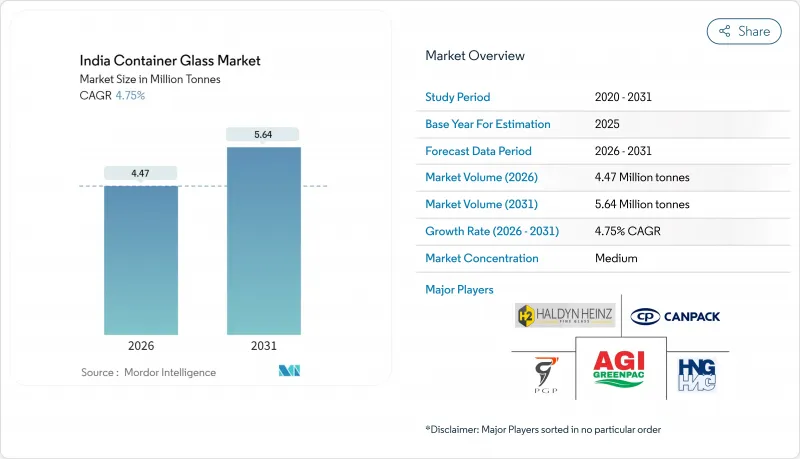
This growth trajectory reflects India's expanding packaged food and beverage consumption, driven by urbanization and rising disposable incomes, while government policies increasingly favor sustainable packaging solutions over single-use plastics. Beverages dominate the end-user landscape with a 63.85% market share in 2024, fueled by India's craft brewery expansion from 45 microbreweries in 2016 to more than 500 today, alongside robust alcohol-consumption growth that positions India's alcoholic-beverage segment to reach USD 55 billion by 2027. The cosmetics and personal-care segment emerges as the fastest-growing application at a 6.09% CAGR for 2025-2030, reflecting premiumization trends and ESG commitments that favor glass over plastic packaging. By color segmentation, flint glass commands a 58.71% market share in 2024, while amber glass leads growth prospects at a 5.96% CAGR, driven by pharmaceutical and specialty-beverage applications requiring UV protection.
India Container Glass Market Trends and Insights
Packaged Food and Beverage Boom Fuels Glass-Container Demand
India's packaged-food and beverage sector continues to expand, driven by urbanization rates exceeding 35% and rising middle-class consumption that favors convenience and quality. The Production-Linked Incentive (PLI) scheme for food processing has attracted INR 10,900 crore in committed investments across 171 active beneficiaries.This investment creates downstream demand for premium glass packaging that meets international food-safety standards. Pharmaceutical-grade glass manufacturers benefit as processed-food companies adopt Type I borosilicate containers for premium products requiring extended shelf life and chemical inertness. The sector's shift toward export-oriented production further amplifies glass demand because many international markets mandate higher packaging standards than domestic plastic alternatives typically provide.
Alcohol-Consumption Growth Expands Core Glass Bottle Demand
India's alcoholic-beverage segment is on track to reach USD 55 billion by 2027. Pernod Ricard's planned investment of INR 1,785 crore in Asia's largest malt distillery in Nagpur underscores confidence in premium-spirits growth and calls for specialized amber and flint glass bottles that protect product integrity while conveying brand prestige. State excise departments are imposing stricter quality controls and anti-counterfeiting measures that glass packaging inherently supports through tamper-evident closures and embossed-branding capabilities.
Plastic and Flexible-Packaging Substitution Erodes Demand
Cost-sensitive segments continue to migrate toward flexible packaging, notably in food applications where glass's weight adds logistics costs. Advanced barrier films and multilayer structures offer comparable shelf-life protection at 40-60% lower total cost, including transportation and handling. E-commerce growth amplifies the trend because glass breakage rates can exceed 3-5%, versus less than 1% for flexible alternatives, diminishing glass's value proposition in price-sensitive markets.
Other drivers and restraints analyzed in the detailed report include:
- ESG Commitments and Premium Perception Favor Glass Over Plastics
- Craft Microbrewery Surge Spurs Demand for Short-Run Premium Bottles
- Energy-Intensive Melting and CO2 Emissions Raise Cost Risks
For complete list of drivers and restraints, kindly check the Table Of Contents.
Segment Analysis
The cosmetics and personal-care segment is projected to grow at a 5.85% CAGR during 2026-2031, buoyed by premiumization and consumer preference for packaging that signals authenticity and sustainability. Beverages maintain market dominance with a 63.20% share in 2025, supported by alcohol-market expansion toward USD 55 billion by 2027 and the proliferation of more than 500 microbreweries. Food-processing PLI incentives totaling INR 10,900 crore across 171 beneficiaries also spur demand for pharmaceutical-grade glass containers meeting export standards.
Pharmaceutical demand accelerates through India's role as a generics hub, with 118 clusters across 19 states producing roughly 1,187,260 tonnes annually and requiring Type I borosilicate glass for sterile applications. The perfumery niche, though smaller in tonnage, commands premium pricing because of stringent aesthetic and chemical-compatibility requirements.
India Container Glass Market Report is Segmented by End-User (Beverages [Alcoholic {Beer, Wine, Spirits, Other Alcoholic Beverages}, and Non-Alcoholic {Carbonated Drinks (CSDs), Dairy Product Based Drinks, and More}], Food [Jam and Jelly, Condiments and Sauces, and More], Cosmetics and Personal Care, Perfumery and More), Color (Flint, Amber, Green, and More). The Market Forecasts are Provided in Terms of Volume (Tonnes).
List of Companies Covered in this Report:
- AGI Greenpac Limited
- CANPACK India Private Limited
- Hindusthan National Glass & Industries Limited
- PGP Glass Private Limited
- Haldyn Heinz Fine Glass Private Limited
- Gerresheimer AG
- Sunrise Glass Industries Private Limited
- Pragati Glass Private Limited
- Empire Industries Limited
- Borosil Limited
- Kapoor Glass India Private Limited
- Khemka Glass Private Limited
- Jagdamba Glass Works Private Limited
- Mono Industries Limited
Additional Benefits:
- The market estimate (ME) sheet in Excel format
- 3 months of analyst support
TABLE OF CONTENTS
1 INTRODUCTION
- 1.1 Study Assumptions and Market Definition
- 1.2 Scope of the Study
2 RESEARCH METHODOLOGY
3 EXECUTIVE SUMMARY
4 MARKET LANDSCAPE
- 4.1 Market Overview
- 4.2 Market Drivers
- 4.2.1 Packaged Food and Beverage Boom Fuels Glass Container Demand
- 4.2.2 Alcohol Consumption Growth Expands Core Glass Bottle
- 4.2.3 ESG Commitments and Premium Perception Favor Glass Over Plastics
- 4.2.4 Craft Microbrewery Surge Spurs Demand for Short-Run Premium Bottles
- 4.2.5 Government Push Against Single-Use Plastics
- 4.2.6 Recycled-PET Mandate Tightens Supply, Prompting Shift Back to Glass
- 4.3 Market Restraints
- 4.3.1 Plastic and Flexible Packaging Substitution Erodes
- 4.3.2 Energy-Intensive Melting and CO2 Emissions Raise Cost Risks
- 4.3.3 Raw Material Price Volatility Squeezes Smaller Furnaces
- 4.3.4 Gas Price Spike in Taj Trapezium Zone Curtails Firozabad Capacity
- 4.4 PESTEL Analysis
- 4.5 Industry Supply-Chain Analysis
- 4.6 Container Glass Furnace Capacity and Locations in India
- 4.6.1 Plant Locations and Year of Commencement
- 4.6.2 Production Capacities
- 4.6.3 Types of Furnaces
- 4.6.4 Color of Glass Produced
- 4.7 Export-Import Data of Container Glass - Covering Key Import and Export Destinations
- 4.7.1 Import Volume and Value, 2021-2024
- 4.7.2 Export Volume and Value, 2021-2024
- 4.8 Porter's Five Forces Analysis
- 4.8.1 Threat of New Entrants
- 4.8.2 Bargaining Power of Suppliers
- 4.8.3 Bargaining Power of Buyers
- 4.8.4 Threat of Substitutes
- 4.8.5 Competitive Rivalry
- 4.9 Raw Material Analysis
- 4.10 Recycling Trends for Glass Packaging
- 4.11 Demand vs Supply Analysis for Glass Packaging
5 MARKET SIZE AND GROWTH FORECASTS (VOLUME)
- 5.1 By End-user
- 5.1.1 Beverages
- 5.1.1.1 Alcoholic
- 5.1.1.1.1 Beer
- 5.1.1.1.2 Wine
- 5.1.1.1.3 Spirits
- 5.1.1.1.4 Other Alcoholic Beverages (Cider and Other Fermented Drinks)
- 5.1.1.2 Non-Alcoholic
- 5.1.1.2.1 Juices
- 5.1.1.2.2 Carbonated Drinks (CSDs)
- 5.1.1.2.3 Dairy Product Based Drinks
- 5.1.1.2.4 Other Non-Alcoholic Beverages
- 5.1.1.1 Alcoholic
- 5.1.2 Food (Jam, Jelly, Marmalades, Honey, Sausages and Condiments, Oil, Pickles)
- 5.1.3 Cosmetics and Personal Care
- 5.1.4 Pharmaceuticals (excluding Vials and Ampoules)
- 5.1.5 Perfumery
- 5.1.1 Beverages
- 5.2 By Color
- 5.2.1 Green
- 5.2.2 Amber
- 5.2.3 Flint
- 5.2.4 Other Colors
6 COMPETITIVE LANDSCAPE
- 6.1 Market Concentration
- 6.2 Strategic Moves and Developments
- 6.3 Company Market Share Analysis, (Based on Latest Production Capacity)
- 6.4 Company Profiles (includes Global level Overview, Market level overview, Core Segments, Financials as available, Strategic Information, Market Rank/Share for key companies, Products and Services, and Recent Developments)
- 6.4.1 AGI Greenpac Limited
- 6.4.2 CANPACK India Private Limited
- 6.4.3 Hindusthan National Glass & Industries Limited
- 6.4.4 PGP Glass Private Limited
- 6.4.5 Haldyn Heinz Fine Glass Private Limited
- 6.4.6 Gerresheimer AG
- 6.4.7 Sunrise Glass Industries Private Limited
- 6.4.8 Pragati Glass Private Limited
- 6.4.9 Empire Industries Limited
- 6.4.10 Borosil Limited
- 6.4.11 Kapoor Glass India Private Limited
- 6.4.12 Khemka Glass Private Limited
- 6.4.13 Jagdamba Glass Works Private Limited
- 6.4.14 Mono Industries Limited
7 MARKET OPPORTUNITIES AND FUTURE OUTLOOK
- 7.1 White-space and Unmet-Need Assessment

