
PUBLISHER: Mordor Intelligence | PRODUCT CODE: 1910652

PUBLISHER: Mordor Intelligence | PRODUCT CODE: 1910652
Fava Bean - Market Share Analysis, Industry Trends & Statistics, Growth Forecasts (2026 - 2031)
The fava bean market is expected to grow from USD 4.10 billion in 2025 to USD 4.23 billion in 2026 and is forecast to reach USD 4.93 billion by 2031 at 3.15% CAGR over 2026-2031.
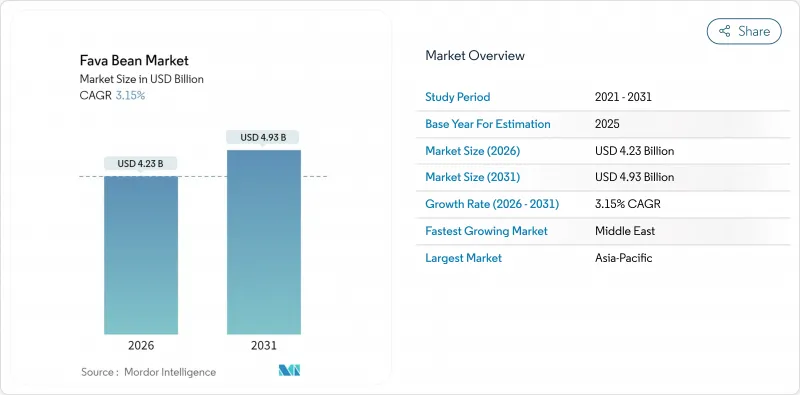
Steady momentum reflects rising demand for sustainable proteins, expanding feed inclusion in poultry and aquaculture, and rotational benefits that cut nitrogen fertilizer costs. The Asia-Pacific region holds the lion's share of consumption, while the Middle East records the fastest growth, as governments prioritize food security and domestic protein production. Plant-based protein demand has catalyzed significant investments, with BENEO inaugurating a USD 65 million pulse processing facility in Germany in April 2025 to enhance fava bean protein extraction capabilities. Simultaneously, companies like Burcon NutraScience launched FavaPro, a 90% pure fava bean protein isolate, targeting the clean-label protein market. Key market risks include climate-related production volatility, with drought sensitivity affecting yield stability across major growing regions, and regulatory uncertainties surrounding vicine and convicine content limits in feed applications. The absence of established commodity futures markets for fava beans creates price volatility that challenges long-term supply agreements, while emerging carbon credit schemes present both opportunities for premium pricing and compliance complexities. Trade policy shifts, including China's 10% tariff on US agricultural goods and 100% tariff on Canadian peas, are reshaping global pulse trade flows and creating new arbitrage opportunities.
Global Fava Bean Market Trends and Insights
Plant-based protein demand surge
Consumer interest in cleaner labels and animal-free diets positions fava beans as a strategic ingredient, with 12% of surveyed shoppers now recognizing the crop as a viable protein source. Clinical work published in 2025 showed that Vicia fava protein hydrolysate boosted leg strength by 2.35 kg and muscular endurance by 21.6% in resistance-trained adults, bolstering functional claims. Extraction breakthroughs at the University of Alberta achieve 94% purity without chemicals, satisfying clean-label criteria while lowering costs. Companies, including Burcon NutraScience and Roquette, now commercialize 90% purity isolates aimed at dairy alternatives and ready-to-drink shakes.
Rising feed inclusion in poultry and aquaculture
Feed formulators are increasingly swapping soybean meal with fava beans to cut costs and diversify their supply. Trials in South Africa have confirmed that inclusion rates of up to 30% in broiler diets do not compromise growth or carcass quality. Recent fish studies show that 60% fava bean diets improved tilapia muscle hardness and chewiness, elevating fillet market value. Price advantages stand out with beans trading at EUR 340-350 (USD 374-385) per metric ton versus soy at EUR 440-450 (USD 484-495) per metric ton. Fermentation and pelleting technologies now deactivate anti-nutritional factors, adding 12.5% to broiler weight gain in recent trials. Regulatory approvals, including U.S. Food and Drug Administration Generally Recognized as Safe status for isolates, widen the addressable feed market.
Rising fungal diseases
Ascochyta blight presents a mounting challenge, with humid and variable weather creating optimal conditions for disease spread. Yield losses become severe when early pod infection occurs, pushing growers toward costlier fungicide regimes. Genetic resistance is complex, combining polygenic and major gene traits, slowing breeding progress. Integrated pest management that rotates crops and deploys resistant cultivars proves effective but demands high farmer knowledge and seed access. Saskatchewan Pulse Growers flags disease control as pivotal for profitability and export quality. Research funding gaps risk delaying resistant variety rollouts, prolonging reliance on chemical treatments that clash with sustainability goals.
Other drivers and restraints analyzed in the detailed report include:
- Cost savings from nitrogen-fixing rotation
- Government pulse-crop incentives
- Heat and drought sensitivity
For complete list of drivers and restraints, kindly check the Table Of Contents.
Geography Analysis
Asia-Pacific commands 46.87% of the global fava bean market in 2025, supported by China's 30% share of world output and entrenched culinary traditions such as doubanjiang and steamed broad bean snacks. Domestic processors now shift toward high-margin isolates, reinforcing regional value capture. Australia strengthens its dual role as producer and exporter, pushing cultivation northward with new climate-resilient varieties and leveraging port capacity expansions to meet Middle Eastern import demand. Asia-Pacific's logistical edge and integrated supply chains translate into stable pricing, yet heat stress episodes in northern China pose an emerging risk.
Europe blends rising local production with persistent import reliance that exposes processors to external shocks. Imports originate mainly from Egypt at 38%, Australia at 18%, and Ukraine at 11%, underscoring the need for diversified sources. The European Union protein strategy pushes acreage growth via eco-scheme payments, and Germany hosts the BENEO plant that boosts continental processing capacity. Despite policy momentum, agronomic hurdles such as fungal disease pressure and cool-season rainfall variability temper production gains. The region's emphasis on clean-label proteins keeps demand resilient even when harvest volumes fluctuate, sustaining import channels.
The Middle East posts the fastest regional CAGR at 6.79%, fueled by strategic food security plans and deep cultural affinity for dishes like ful medames. Egypt advances as both a supplier to Europe and a large domestic consumer, investing in value-added processing to raise export revenue. Turkey promotes pulse diversification to reduce cereal dependence amid volatile grain markets. Water scarcity and heatwaves challenge yields, driving interest in drought-tolerant lines and expanded irrigation schemes. The region's import dependency on Australian and European beans underlines the growing linkage between Mediterranean weather and local availability, reinforcing the case for localized production expansion.
- Market Overview
- Market Drivers
- Market Restraints
- Regulatory Landscape
- Technological Outlook
- Value / Supply Chain Analysis
- PESTLE Analysis
- List of Stakeholders
Additional Benefits:
- The market estimate (ME) sheet in Excel format
- 3 months of analyst support
TABLE OF CONTENTS
1 Introduction
- 1.1 Study Assumptions and Market Definition
- 1.2 Scope of the Study
2 Research Methodology
3 Executive Summary
4 Market Landscape
- 4.1 Market Overview
- 4.2 Market Drivers
- 4.2.1 Plant-based protein demand surge
- 4.2.2 Rising feed inclusion in poultry and aquaculture
- 4.2.3 Cost savings from nitrogen-fixing rotation
- 4.2.4 Government pulse-crop incentives
- 4.2.5 Commercialization of protein isolates for sports nutrition
- 4.2.6 Emerging carbon-credit schemes
- 4.3 Market Restraints
- 4.3.1 Rising fungal diseases
- 4.3.2 Heat and drought sensitivity
- 4.3.3 Vicine and convicine limits in poultry feed
- 4.3.4 Absent commodity futures market drives volatility
- 4.4 Regulatory Landscape
- 4.5 Technological Outlook
- 4.6 Value / Supply Chain Analysis
- 4.7 PESTLE Analysis
5 Market Size and Growth Forecasts
- 5.1 Geography (Production Analysis, Consumption Analysis by Value and Volume, Import Analysis by Value and Volume, Export Analysis by Value and Volume, and Price Trend Analysis)
- 5.1.1 North America
- 5.1.1.1 United States
- 5.1.1.2 Canada
- 5.1.1.3 Mexico
- 5.1.2 Europe
- 5.1.2.1 Germany
- 5.1.2.2 United Kingdom
- 5.1.2.3 France
- 5.1.2.4 Russia
- 5.1.2.5 Italy
- 5.1.2.6 Spain
- 5.1.2.7 Sweden
- 5.1.3 Asia-Pacific
- 5.1.3.1 China
- 5.1.3.2 Japan
- 5.1.3.3 Australia
- 5.1.4 South America
- 5.1.4.1 Argentina
- 5.1.4.2 Peru
- 5.1.4.3 Brazil
- 5.1.5 Middle East
- 5.1.5.1 Turkey
- 5.1.5.2 Egypt
- 5.1.6 Africa
- 5.1.6.1 Ethiopia
- 5.1.6.2 Sudan
- 5.1.6.3 Morocco
- 5.1.1 North America
6 Competitive Landscape
- 6.1 List of Stakeholders
- 6.1.1 ADM
- 6.1.2 Cargill, Incorporated
- 6.1.3 AGT Food and Ingredients Inc.
- 6.1.4 Louis Dreyfus Company
- 6.1.5 Bunge
- 6.1.6 ETG Commodities (Export Trading Group)
- 6.1.7 GrainCorp
- 6.1.8 Broadgrain
- 6.1.9 Roquette Freres
- 6.1.10 NutriS Ltd.
7 Market Opportunities and Future Outlook

