
PUBLISHER: Mordor Intelligence | PRODUCT CODE: 1910683

PUBLISHER: Mordor Intelligence | PRODUCT CODE: 1910683
Natural Honey - Market Share Analysis, Industry Trends & Statistics, Growth Forecasts (2026 - 2031)
The natural honey market was valued at USD 11.5 billion in 2025 and estimated to grow from USD 11.99 billion in 2026 to reach USD 14.76 billion by 2031, at a CAGR of 4.24% during the forecast period (2026-2031).
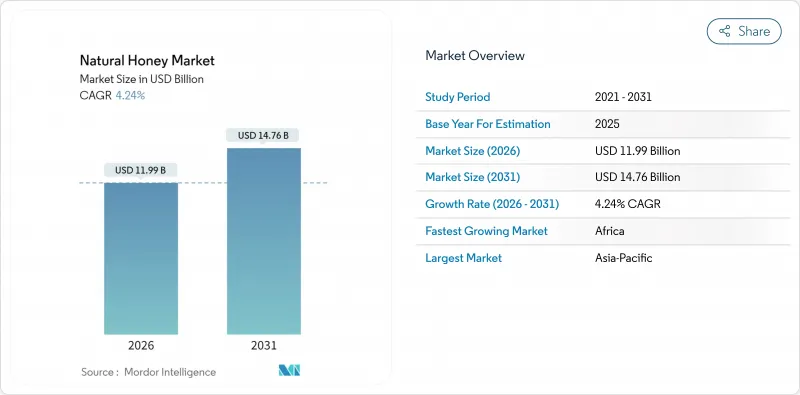
Sustained demand for clean-label products, wider adoption of precision apiculture, and stricter origin-labeling rules are reshaping supply chains and lifting value capture across producing regions. Industrial buyers are replacing refined sugar with authenticated honey in beverages, baked goods, and sports nutrition, while healthcare providers are expanding medical-grade applications that command premium pricing. Asia-Pacific remains the consumption anchor, accounting for 46.0% of 2024 volume, aided by China's dual role as top producer and fast-growing domestic market. Modern hive-monitoring systems are lowering mortality rates, yet climate-driven nectar flow volatility and Varroa infestations still threaten 55% of colonies each year, pushing producers toward IoT-enabled early-warning solutions. On the trade front, the European Union's 2024/1438 regulation has made batch-level traceability a ticket-to-play, rewarding exporters that invest in blockchain authentication and penalizing low-cost suppliers that cannot verify origin.
Global Natural Honey Market Trends and Insights
Rising Demand for Natural Sweeteners in Processed Foods and Beverages
Food and beverage manufacturers are pivoting toward honey to satisfy clean-label and sugar-reduction mandates. In South Korea, 55% of shoppers ranked hot honey as their preferred spicy flavor in 2024, driving a surge of clover-honey-infused sports drinks and snack bars. Beverage formulators in the United States increasingly select wildflower honey to replace high-fructose corn syrup in ready-to-drink teas, creating incremental demand for bulk-grade supply. The Winter Fancy Food Show's 2024 Trendspotter panel listed honey among the top three most versatile ingredients, signaling longevity for formulation pipelines. Industrial users, which already consume nearly 80% of U.S. honey imports, are now requesting tighter flavor-profile specs to ensure batch consistency across national rollouts. This confluence of culinary creativity and health awareness strengthens the natural honey market's volume outlook over the medium term.
Growth of Industrial-Scale Precision Apiculture Technologies
Commercial beekeepers are installing IoT sensors that monitor temperature, humidity, and acoustic signals inside hives, generating real-time alerts on colony stress. The University of California, Riverside's Electronic Bee-Veterinarian platform costs under USD 50 per hive yet predicts heat stress days in advance, enabling interventions that curtail mortality and raise yield per colony. Open-source entrance cameras powered by Raspberry Pi hardware and AprilTag markers track foraging trips, giving producers data to optimize apiary placement during nectar flows. Machine-learning algorithms now distinguish bee castes and parasites, supporting early treatment schedules that align with veterinary guidelines. These technologies compress labor inputs and bolster export compliance by delivering digital audit trails that satisfy U.S. and EU traceability rules. Over time, precision apiculture lowers the cost curve and expands the addressable base of smallholders, energizing the natural honey market.
Colony Losses from Varroa, Climate Change, and Pesticide Exposure
Annual colony mortality exceeding 55% jeopardizes global supply, with Varroa destructor outbreaks intensifying under warmer winters and longer flowering seasons. A 50-year Penn State study links honey yields to rising herbicide applications and weather anomalies, highlighting systemic exposure risks. California's almond belt may lose up to 73% of its suitable area by 2100, compressing pollination windows and stressing migratory colonies. Producers face higher miticide costs and must rotate active ingredients to avoid resistance while investing in shade structures and supplemental feeding during droughts. Short-term supply squeezes elevate raw-honey prices, yet chronic losses erode beekeeper profitability and temper the natural honey market's growth potential.
Other drivers and restraints analyzed in the detailed report include:
- Strengthening Traceability Rules in Major Import Markets
- Expansion of Functional and Medical-Grade Honey Applications
- Persistent Global Honey Adulteration Depressing Farm-Gate Prices
For complete list of drivers and restraints, kindly check the Table Of Contents.
Segment Analysis
The Natural Honey Market Report is Segmented by Geography (North America, Europe, Asia-Pacific, South America, Middle East, and Africa). The Report Includes Production Analysis (Volume), Consumption Analysis (Value and Volume), Export Analysis (Value and Volume), Import Analysis (Value and Volume), and Price Trend Analysis. The Market Forecasts are Provided in Terms of Value (USD) and Volume (Metric Tons).
Geography Analysis
Asia-Pacific dominates the natural honey market with 45.30% consumption share in 2025. Anchored by China's manufacturing scale and India's rapid production expansion. Regional governments extend tax holidays and low-interest loans to modernize extraction lines, while technology start-ups deploy hive sensors that alert keepers to floral conditions. Climate variability still triggers yield swings, but adaptive forage planting and migratory beekeeping mitigate extremes. Japan and South Korea showcase flavor innovation that elevates retail prices, offsetting rising compliance costs tied to residue testing.
Europe holds a prominent consumption share and advances at a stable CAGR to 2031. The EU origin-labeling rule changed the competitive calculus, favoring exporters that deliver digital passports and punishing opaque supply chains. Germany's role as an import gateway amplifies regulatory spillovers as downstream packers cascade compliance conditions to South American and African suppliers. Premiumization trends persist; organic and monofloral jars command shelf premiums above 45% versus blended imports, buffering demand against macroeconomic headwinds. Ongoing Ukrainian recovery and diversified Balkan sourcing strengthen intra-regional resilience.
North America accounts for prominent consumption and grows at a stable CAGR to 2031. U.S. antidumping duties elevate import prices but incentivize domestic producers to invest in queen-breeding programs and survival genetics that counter Varroa impact. Precision apiculture adoption is most advanced here, with commercial operators integrating sensor arrays that feed API-based dashboards guiding truck fleet movements for almond and blueberry pollination. Canadian policymakers fund biosecurity protocols to shield native bee populations, while Mexican cooperatives pursue USDA organic certification to access premium foodservice channels. The region's appetite for functional honeys and medical-grade products keeps margins above global averages, reinforcing North America's strategic weight in the natural honey market. Africa, though a smaller base, is the fastest-growing geography at a 6.39% CAGR through 2031 as urban consumers replace sugar spreads with local honey. Development grants for queen-rearing, cold-chain equipment, and export laboratories in Ethiopia, Tanzania, and Kenya are unlocking new supply streams for Middle Eastern and EU buyers.
- Capilano Honey Ltd (Hive + Wellness)
- Comvita Ltd
- Dabur India Ltd
- Langnese Honig GmbH & Co. KG
- Dutch Gold Honey Inc
- Nature Nate's Honey Co
- Barkman Honey LLC
- New Zealand Honey Co
- Wedderspoon Organic
- Billy Bee Honey Products
- Yamada Bee Company
- Savannah Bee Company
- Bee Maid Honey Ltd
- Heavenly Organics
- Capilano's Wescobee
- Rowse Honey Ltd
- Hilltop Honey Ltd
- Madhava Ltd
- Manuka Health New Zealand
- Apis Himalaya Ltd
Additional Benefits:
- The market estimate (ME) sheet in Excel format
- 3 months of analyst support
TABLE OF CONTENTS
1 Introduction
- 1.1 Study Assumptions and Market Definition
- 1.2 Scope of the Study
2 Research Methodology
3 Executive Summary
4 Market Landscape
- 4.1 Market Overview
- 4.2 Market Drivers
- 4.2.1 Rising demand for natural sweeteners in processed foods and beverages
- 4.2.2 Growth of industrial-scale precision apiculture technologies
- 4.2.3 Strengthening traceability rules in major import markets
- 4.2.4 Expansion of functional / medical-grade honey applications
- 4.2.5 Government-backed apiculture support programs in producer nations
- 4.2.6 Blockchain-enabled transparency combating honey adulteration
- 4.3 Market Restraints
- 4.3.1 Colony losses from Varroa, climate change and pesticide exposure
- 4.3.2 Persistent global honey adulteration depressing farm-gate prices
- 4.3.3 Rising compliance costs under EU 2024/1438 origin-label regulation
- 4.3.4 Export-price volatility tied to El Nino-driven nectar flow shifts
- 4.4 Value Chain and Supply Chain Analysis
- 4.5 PESTLE Analysis
- 4.6 Regulatory Landscape
- 4.7 Technological Outlook
5 Market Segmentation
- 5.1 By Geography (Production Analysis (Volume), Consumption Analysis (Volume and Value), Import Analysis (Volume and Value), Export Analysis (Volume and Value), and Price Trend Analysis)
- 5.1.1 North America
- 5.1.1.1 United States
- 5.1.1.2 Canada
- 5.1.1.3 Mexico
- 5.1.2 South America
- 5.1.2.1 Brazil
- 5.1.2.2 Argentina
- 5.1.3 Europe
- 5.1.3.1 Germany
- 5.1.3.2 Ukraine
- 5.1.3.3 Poland
- 5.1.3.4 Russia
- 5.1.4 Asia-Pacific
- 5.1.4.1 China
- 5.1.4.2 India
- 5.1.4.3 Japan
- 5.1.4.4 New Zealand
- 5.1.5 Middle East
- 5.1.5.1 Turkey
- 5.1.5.2 Iran
- 5.1.5.3 Saudi Arabia
- 5.1.6 Africa
- 5.1.6.1 Ethiopia
- 5.1.6.2 Nigeria
- 5.1.1 North America
6 Competitive Landscape
- 6.1 Company Profiles (List of Stakeholders)
- 6.1.1 Capilano Honey Ltd (Hive + Wellness)
- 6.1.2 Comvita Ltd
- 6.1.3 Dabur India Ltd
- 6.1.4 Langnese Honig GmbH & Co. KG
- 6.1.5 Dutch Gold Honey Inc
- 6.1.6 Nature Nate's Honey Co
- 6.1.7 Barkman Honey LLC
- 6.1.8 New Zealand Honey Co
- 6.1.9 Wedderspoon Organic
- 6.1.10 Billy Bee Honey Products
- 6.1.11 Yamada Bee Company
- 6.1.12 Savannah Bee Company
- 6.1.13 Bee Maid Honey Ltd
- 6.1.14 Heavenly Organics
- 6.1.15 Capilano's Wescobee
- 6.1.16 Rowse Honey Ltd
- 6.1.17 Hilltop Honey Ltd
- 6.1.18 Madhava Ltd
- 6.1.19 Manuka Health New Zealand
- 6.1.20 Apis Himalaya Ltd
7 Market Opportunities and Future Outlook

