PUBLISHER: Mordor Intelligence | PRODUCT CODE: 1910685

PUBLISHER: Mordor Intelligence | PRODUCT CODE: 1910685
Industrial Hemp - Market Share Analysis, Industry Trends & Statistics, Growth Forecasts (2026 - 2031)
The Industrial Hemp Market was valued at USD 3.05 billion in 2025 and estimated to grow from USD 3.57 billion in 2026 to reach USD 7.83 billion by 2031, at a CAGR of 17.02% during the forecast period (2026-2031).
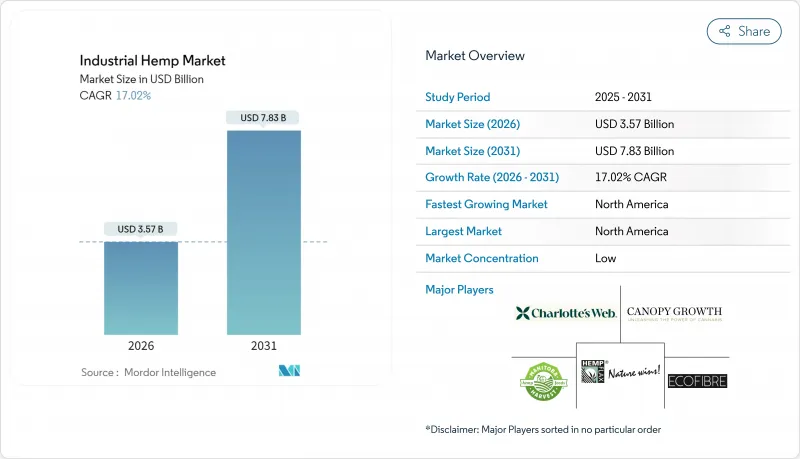
Robust demand spans food and beverages, wellness supplements, sustainable construction materials, textiles, and animal feed, underpinned by enabling legislation such as the 2018 U.S. Farm Bill that unlocked industrial cultivation across multiple states. Supply-side momentum is reinforced by Germany's 2024 Medical Cannabis Act and parallel advances in Japan and France, collectively broadening the global hemp market footprint while providing processors with greater policy certainty. Intensifying competition among vertically integrated companies is pushing efficiencies in cultivation, decortication, and formulation, while new entrants focus on niche verticals such as hempcrete and hemp-derived functional foods. Market watchers expect pricing discipline as technological upgrades lower unit costs and as millennial and Gen Z consumers demonstrate willingness to pay premiums for traceable, low-carbon products, a dynamic likely to sustain double-digit value growth across the hemp market in the current decade.
Global Industrial Hemp Market Trends and Insights
Legalization in Major Economies
Sweeping regulatory reforms continue to reshape the hemp market. Germany's twin statutes, the Medical Cannabis Act and the Consumer Cannabis Act, entered into force in 2024, creating transparent requirements for cultivation, processing, and distribution of industrial hemp, accelerating investment in European supply chains. In the United States, the 2018 Farm Bill remains the anchor framework, yet pending 2024 amendments that may tighten definitions around "intoxicating" cannabinoids keep operators vigilant. Japan's December 2024 reforms established tiered industrial hemp licences, opening a regulated path for low-THC cultivation while preserving pharmaceutical oversight. France consolidated its leadership with 15,000 ha under hemp, benefiting from the EU's 0.3% THC threshold that harmonises trade rules and encourages cross-border contracting. The regulatory trend signals continued expansion of the hemp market as more jurisdictions opt for science-based THC limits and clearer compliance requirements.
Rising Demand for Plant-Based Food and Beverages
Shifts toward plant-centric diets are fuelling the hemp market, particularly in protein drinks, fortified snacks, and dairy substitutes. Hemp seeds provide a complete amino acid profile and an optimal omega-6 to omega-3 ratio of roughly 3:1, positioning them as a nutrient-dense alternative to soy or almond. The Association of American Feed Control Officials' 2024 approval of hempseed meal for laying hens added a new high-volume outlet and signalled safety across poultry feed chains. Process optimisation studies now pinpoint 9-hour soaking and 48 °C heating for 60 minutes as ideal parameters for nutrient-rich hemp milk, thereby lowering development costs for beverage formulators. Collectively, these nutritional and sustainability tailwinds continue to widen the addressable consumer base of the hemp market.
Regulatory Uncertainty on THC/CBD Limits
Policy volatility remains a near-term headwind for the hemp market. The anticipated 2024 U.S. Farm Bill revisions could remove delta-8 THC and THCA from the federal hemp definition, jeopardising an estimated USD 28 billion gray channel for intoxicating products. California's emergency ban on synthetic cannabinoids achieved 99.7% compliance by May 2025, but created inventory write-downs for smaller brands that lacked the capital for reformulation. Europe also faces divergent implementation timelines for the EU Novel Foods regime, compelling exporters to navigate a patchwork of pre-market authorisations. These shifting rules complicate long-term supply contracts and delay capital expenditure, restraining the full acceleration of the hemp market.
Other drivers and restraints analyzed in the detailed report include:
- CBD Adoption in Wellness & OTC Channels
- Hempcrete Demand in Net-Zero Construction
- Fragmented Supply Chain and Quality Variability
For complete list of drivers and restraints, kindly check the Table Of Contents.
Segment Analysis
CBD hemp oil currently represents 50.68% of the Industrial Hemp Market share and is slated to log a 17.96% CAGR through 2031, underscoring its status as the largest and fastest-growing product class. The segment benefits from expanding OTC distribution and pharma-grade manufacturing standards, factors that encourage premium pricing and brand differentiation within the hemp market. Heightened consumer interest in stress, sleep and recovery products is reflected in Charlotte's Web CBN-infused gummies and similar SKUs that bundle multiple minor cannabinoids for targeted benefits.
Hemp seed oil follows as a nutritionally rich alternative containing omega-3 and omega-6 fatty acids, driving adoption in salad dressings, ready-to-drink shakes and topical skincare. Hemp protein powders, some of which now achieve 93.01% protein content, enjoy traction among vegan athletes seeking soy-free, allergen-light formulas. Extracts without CBD address industrial applications that require zero psychoactive risk, notably in bioplastics and lubricants. Continued phytochemical research will likely spawn nuanced functional claims, further segmenting the hemp market by therapeutic outcome.
The Industrial Hemp Market Report is Segmented by Type (Hemp Seed, Hemp Seed Oil, Cannabidiol (CBD) Hemp Oil, Hemp Protein, Hemp Extract Without CBD), Application (Food and Beverages, Healthcare Supplements, Other Applications), and Geography (Asia-Pacific, North America, Europe, South America, Middle East and Africa). The Market Forecasts are Provided in Terms of Value (USD).
Geography Analysis
North America retained 55.28% of the global revenue in 2025, with the region's industrial hemp market size rising at a 17.71% CAGR that outpaces every other geography. The United States recorded USD 445 million in farm-gate production on 32,694 harvested acres, helped by rapid mechanisation and the emergence of multistate processors such as Panda Biotech, whose Texas facility decorticates 10 metric tons hourly. Canada complements this momentum with CAD 209 million in hemp food retail sales and ongoing consultation to liberalise non-prescription CBD, actions that could unlock fresh distribution channels for the hemp market.
Europe stands out for regulatory cohesion, even as individual member states move at varied speeds. France leads cultivation with 15,000 ha, supported by InterChanvre cooperatives that provide agronomic guidance and guaranteed offtake contracts. Germany's 2024 legislative package establishes clear THC thresholds and seeds-to-sale traceability, creating confidence for institutional investors contemplating large-scale greenhouse projects. Switzerland, meanwhile, is piloting adult-use cannabis programs that could indirectly spur interest in industrial hemp derivatives due to shared processing infrastructure.
Asia-Pacific is evolving from a supply-centric to a dual supply-and-demand region within the hemp market. China's decision to regulate CBD as a precursor chemical from September 2024 introduces tighter export documentation but also formalises production standards that could reassure global buyers. Japan's tiered licensing system is expected to yield domestic pharmaceutical CBD formulations by 2027, creating a premium urban consumer segment. India and Pakistan are progressing toward full industrial hemp frameworks, aiming to capture employment and rural diversification benefits, though bureaucratic processes may temper near-term acreage growth.
- 33 Supply LLC
- Bedrocan
- Bulk Hemp Warehouse LLC
- Canopy Growth Corporation
- CANWAY Holdings Ltd.
- Charlotte's Web, Inc
- Colorado Breeders Depot
- Cornbread Hemp
- Ecofibre
- Entoura Pty Ltd
- Fresh Hemp Foods Ltd
- GenCanna
- Hemp Acres USA
- HempFlax Group BV
- Ilesol Pharmaceuticals doo
- International Flavors & Fragrances Inc.
- Manitoba Harvest Hemp Foods.
- Nutiva LLC
- PharmaCielo
- Puricon
- Robertet SA
- Signature Products GmbH
- Silver Lion Farms
- True Terpenes
- Victory Hemp Foods
Additional Benefits:
- The market estimate (ME) sheet in Excel format
- 3 months of analyst support
TABLE OF CONTENTS
1 Introduction
- 1.1 Study Assumptions & Market Definition
- 1.2 Scope of the Study
2 Research Methodology
3 Executive Summary
4 Market Landscape
- 4.1 Market Overview
- 4.2 Market Drivers
- 4.2.1 Legalization in major economies
- 4.2.2 Rising demand for plant-based food & beverages
- 4.2.3 CBD adoption in wellness and OTC channels
- 4.2.4 Hempcrete demand in net-zero construction
- 4.2.5 Automation in fiber decortication & processing
- 4.3 Market Restraints
- 4.3.1 Regulatory uncertainty on THC/CBD limits
- 4.3.2 Fragmented supply chain & quality variability
- 4.3.3 Land-use competition with specialty crops
- 4.4 Value Chain Analysis
- 4.5 Porter's Five Forces
- 4.5.1 Bargaining Power of Suppliers
- 4.5.2 Bargaining Power of Consumers
- 4.5.3 Threat of New Entrants
- 4.5.4 Threat of Substitutes
- 4.5.5 Degree of Competition
5 Market Size & Growth Forecasts (Value)
- 5.1 By Type
- 5.1.1 Hemp Seed
- 5.1.2 Hemp Seed Oil
- 5.1.3 Cannabidiol (CBD) Hemp Oil
- 5.1.4 Hemp Protein
- 5.1.5 Hemp Extract (without CBD)
- 5.2 By Application
- 5.2.1 Food & Beverages
- 5.2.2 Healthcare Supplements
- 5.2.3 Other Applications (Personal Care, Textile, Construction, Animal Feed, etc)
- 5.3 Geography
- 5.3.1 Asia-Pacific
- 5.3.1.1 China
- 5.3.1.2 India
- 5.3.1.3 Japan
- 5.3.1.4 South Korea
- 5.3.1.5 Thailand
- 5.3.1.6 Indonesia
- 5.3.1.7 Vietnam
- 5.3.1.8 Malaysia
- 5.3.1.9 Rest of Asia-Pacific
- 5.3.2 North America
- 5.3.2.1 United States
- 5.3.2.2 Canada
- 5.3.2.3 Mexico
- 5.3.3 Europe
- 5.3.3.1 Germany
- 5.3.3.2 United Kingdom
- 5.3.3.3 France
- 5.3.3.4 Italy
- 5.3.3.5 Spain
- 5.3.3.6 NORDIC Countries
- 5.3.3.7 Turkey
- 5.3.3.8 Russia
- 5.3.3.9 Rest of Europe
- 5.3.4 South America
- 5.3.4.1 Brazil
- 5.3.4.2 Argentina
- 5.3.4.3 Colombia
- 5.3.4.4 Rest of South America
- 5.3.5 Middle East and Africa
- 5.3.5.1 Saudi Arabia
- 5.3.5.2 United Arab Emirates
- 5.3.5.3 Qatar
- 5.3.5.4 Egypt
- 5.3.5.5 Nigeria
- 5.3.5.6 South Africa
- 5.3.5.7 Rest of Middle East and Africa
- 5.3.1 Asia-Pacific
6 Competitive Landscape
- 6.1 Market Concentration
- 6.2 Strategic Moves
- 6.3 Market Share (%)/Ranking Analysis
- 6.4 Company Profiles (includes Global level Overview, Market level overview, Core Segments, Financials as available, Strategic Information, Market Rank/Share, Products & Services, Recent Developments)
- 6.4.1 33 Supply LLC
- 6.4.2 Bedrocan
- 6.4.3 Bulk Hemp Warehouse LLC
- 6.4.4 Canopy Growth Corporation
- 6.4.5 CANWAY Holdings Ltd.
- 6.4.6 Charlotte's Web, Inc
- 6.4.7 Colorado Breeders Depot
- 6.4.8 Cornbread Hemp
- 6.4.9 Ecofibre
- 6.4.10 Entoura Pty Ltd
- 6.4.11 Fresh Hemp Foods Ltd
- 6.4.12 GenCanna
- 6.4.13 Hemp Acres USA
- 6.4.14 HempFlax Group BV
- 6.4.15 Ilesol Pharmaceuticals doo
- 6.4.16 International Flavors & Fragrances Inc.
- 6.4.17 Manitoba Harvest Hemp Foods.
- 6.4.18 Nutiva LLC
- 6.4.19 PharmaCielo
- 6.4.20 Puricon
- 6.4.21 Robertet SA
- 6.4.22 Signature Products GmbH
- 6.4.23 Silver Lion Farms
- 6.4.24 True Terpenes
- 6.4.25 Victory Hemp Foods
7 Market Opportunities & Future Outlook
- 7.1 White-space & unmet-need assessment

