PUBLISHER: Mordor Intelligence | PRODUCT CODE: 1910836

PUBLISHER: Mordor Intelligence | PRODUCT CODE: 1910836
Outboard Motor - Market Share Analysis, Industry Trends & Statistics, Growth Forecasts (2026 - 2031)
Outboard Motor Market size in 2026 is estimated at USD 9.79 billion, growing from 2025 value of USD 9.32 billion with 2031 projections showing USD 12.48 billion, growing at 4.99% CAGR over 2026-2031.
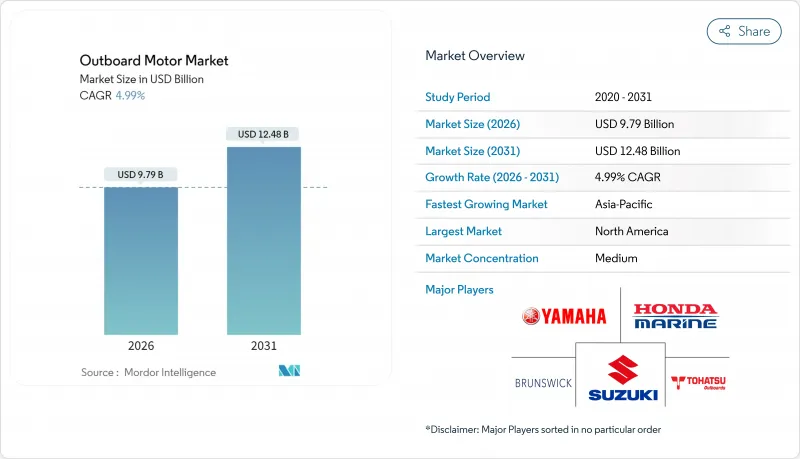
Growth is sustained by an enlarged base of post-pandemic first-time boat owners who now drive recurring replacement and upgrade cycles, the enduring popularity of mid-range gasoline models for performance craft, and rapid innovation in clean-propulsion alternatives that attract regulatory incentives and eco-conscious consumers. Supply-chain measures undertaken since 2024-such as vertical integration into aluminum boat production and multisourcing of electronics-are gradually easing cost volatility, enabling manufacturers to protect margins even as input prices fluctuate. Meanwhile, tightening emissions standards in the United States and the European Union favor advanced four-stroke and electric powertrains, pushing research spending toward low-emission and alternative-fuel platforms. Competitive pressure intensifies as electric specialists expand into higher-horsepower brackets once dominated by internal-combustion incumbents, further segmenting the outboard motors market by performance, price, and environmental profile.
Global Outboard Motor Market Trends and Insights
Boom in post-COVID first-time boat ownership
New entrants who bought their first boats in 2020-2021 continue to underpin replacement demand within the outboard motors market as they trade up from entry-level craft to higher-horsepower models. U.S. monthly new-boat sales jumped exponentially from April to May 2020, and retention surveys show that most of these owners remain active, with many planning propulsion upgrades within five years. Manufacturers target this cohort with bundled re-power packages and financing incentives, locking in lifetime customer value as owners repeatedly revisit dealerships for bigger engines, smart controls, and fuel-efficient technologies.
High-horsepower (>300 hp) re-powering of offshore craft
Offshore anglers and charter operators increasingly install triple or quad 300-plus-hp outboards-such as Mercury Marine's 5.7 L V10 Verado-on existing hulls to achieve automobile-like acceleration without purchasing new boats. Retrofits often cost two-fifth less than a new hull yet deliver comparable top-speed gains, making re-powering a high-margin growth pocket for engine makers.
Tightening Stage V / EPA SI emissions limits
Stricter caps on NOx, CO, and fine particulates mean small manufacturers must invest in costly catalytic after-treatment or exit regulated markets. Mid-range engine brackets are most exposed because consumers resist significant price increases, eroding volume growth until compliance solutions become cost-neutral.
Other drivers and restraints analyzed in the detailed report include:
- Regulatory shift toward four-stroke efficiency
- Commercial patrol agencies are adopting low-sulfur diesel outboards
- Volatility in aluminum & electronics supply
For complete list of drivers and restraints, kindly check the Table Of Contents.
Segment Analysis
Gasoline outboards represented 80.74% of the outboard motors market share in 2025, translating into the largest single revenue pool within the outboard motors market size. Four-stroke designs now reach 300-plus hp brackets with slimmer gearcases and digital-shift systems that meet EPA Stage III limits, sustaining loyalty among offshore anglers and performance cruisers. Manufacturers cross-promote aftermarket propeller kits and joystick controls to lift lifecycle value and keep internal-combustion engines relevant during the energy transition.
Electric propulsion is pacing the power-source growth leaderboard at 5.02% CAGR, propelled by harbor-craft mandates and carbon-credit financing programs on both coasts of the United States. Torqeedo's 50 kW Deep Blue and Yamaha's 48 V HARMO platform illustrate how quiet, instant-torque solutions win over marinas with strict noise and emission bylaws. Battery swap stations and floating solar charging pontoons reduce range anxiety for rental fleets. This demonstrates that well-defined duty cycles like coach boats and short-haul water taxis can go fully electric without operational penalties.
Recreational boating consumed 75.68% of the outboard motors market size in 2025 after new-boat sales spiked during the 2020 lockdowns. OEMs bundle color-matched cowlings, touchscreen helm displays, and plug-and-play mobile apps to upsell lifestyle buyers who value seamless user experiences. Subscription-based maintenance plans and extended warranties convert recreational owners into predictable annuity streams for dealers.
Commercial fleets, including patrol, fishing, charter, and aquaculture, are expanding faster at a 5.16% CAGR. Their total-cost-of-ownership equations favor fuel-sipping four-strokes and diesel models that minimize downtime. Governments tap stimulus budgets to modernize enforcement craft, while large-scale fish farms electrify auxiliary tenders to meet sustainability targets. As a result, per-unit ASPs in commercial channels run one-fourth above the recreational average, powering top-line growth even at lower volumes.
The Outboard Motor Market Report is Segmented by Power Source (Gasoline, Diesel, and More), Application Type (Recreational and Commercial), Thrust Class (Portable, Mid-Range, and High-Power), Horse-Power Range (Less Than 30 HP and More), End-User (OEM Boat Builders and After-Market/Re-Power), Sales Channel (Direct Marine Dealer and More), and Geography. The Market Forecasts are Provided in Terms of Value (USD) and Volume (Units).
Geography Analysis
North America held 38.32% of the outboard motors market share in 2025, anchored by the United States' multiple registered boats and a mature marina network that promoted high utilization. EPA clean-air regulations prompt rapid turnover of carbureted two-strokes, and state noise rules in Florida, California, and Minnesota accelerate four-stroke adoption. Dealer consolidation yields regional super-stores capable of stocking every power class and offering mobile service units that keep downtime low during peak summer months.
Asia-Pacific is set to record the highest regional CAGR at 5.13% through 2031, propelled by rising middle-class disposable income in China, India, Thailand, and Indonesia. Governments in Vietnam and the Philippines are modernizing artisanal fishing fleets with durable mid-range four-strokes to comply with new coastal-emission codes, creating sizeable replacement cycles. Domestic manufacturers in China supply more minor portable electrics, yet imported Japanese and American brands dominate 100-plus-hp brackets due to performance reputation.
Europe remains a high-value, regulation-led arena where Stage V emissions have already eliminated legacy two-strokes on most inland waterways. Scandinavian lake districts are pilot zones for HVO fueling docks that let existing four-stroke fleets cut CO2 output by up to four-fifth. At the same time, Amsterdam and Venice canals enforce zero-emission mandates favoring rim-drive electric motors. Southern Europe's charter sector rebounds strongly post-pandemic, renewing fleets with joystick-controlled twin outboards rated 150-200 hp, lifting unit ASPs across the region.
- Brunswick Corp. (Mercury Marine)
- Yamaha Motor Co. Ltd
- Suzuki Motor Corp.
- Honda Motor Co. Ltd
- Tohatsu Corp.
- Cox Marine
- OXE Marine AB
- Vision Marine Technologies
- Torqeedo GmbH
- Minn Kota (MotorGuide)
- DEUTZ AG
- Hidea Power Machinery
- Parsun Power Machine Co. Ltd
- Selva SpA
- LEHR LLC
- Pure Watercraft
- AB Volvo
- GARMIN - Navico Group
Additional Benefits:
- The market estimate (ME) sheet in Excel format
- 3 months of analyst support
TABLE OF CONTENTS
1 Introduction
- 1.1 Study Assumptions & Market Definition
- 1.2 Scope of the Study
2 Research Methodology
3 Executive Summary
4 Market Landscape
- 4.1 Market Overview
- 4.2 Market Drivers
- 4.2.1 Prolonged Boom In First-Time Boat Ownership Post-Covid-19
- 4.2.2 Surge In High-Horse-Power (More than 300 Hp) Re-Powering Of Offshore Craft
- 4.2.3 Regulatory Pivot Toward Four-Stroke Efficiency
- 4.2.4 Commercial Patrol Agencies Shifting To Low-Sulfur Diesel Outboards
- 4.2.5 Carbon-Credit-Funded Electrification Of Coach & Safety Dinghies
- 4.2.6 Pilot Roll-Out Of Sustainable Drop-In Marine Fuels
- 4.3 Market Restraints
- 4.3.1 Progressive Tightening Of Stage V / Epa Si Emission Limits
- 4.3.2 Supply-Chain Volatility In Aluminium & Electronics For Mid-Range Units
- 4.3.3 Rare-Earth Dependency Raising E-Outboard Motor Bom Costs
- 4.3.4 Dealer-Network Consolidation Limiting Rural Service Accessibility
- 4.4 Value / Supply-Chain Analysis
- 4.5 Regulatory Landscape
- 4.6 Technological Outlook
- 4.7 Porter's Five Forces
- 4.7.1 Threat of New Entrants
- 4.7.2 Bargaining Power of Buyers/Consumers
- 4.7.3 Bargaining Power of Suppliers
- 4.7.4 Threat of Substitute Products
- 4.7.5 Intensity of Competitive Rivalry
5 Market Size & Growth Forecasts (Value (USD) and Volume (Units))
- 5.1 By Power Source
- 5.1.1 Gasoline
- 5.1.2 Diesel
- 5.1.3 Electric
- 5.1.4 Hybrid / Propane / LPG
- 5.2 By Application Type
- 5.2.1 Recreational
- 5.2.2 Commercial
- 5.3 By Thrust Class
- 5.3.1 Portable
- 5.3.2 Mid-range
- 5.3.3 High-power
- 5.4 By Horse-Power Range
- 5.4.1 Less than 30 hp
- 5.4.2 30-99 hp
- 5.4.3 100-199 hp
- 5.4.4 200-299 hp
- 5.4.5 More than or equal to 300 hp
- 5.5 By End-User
- 5.5.1 OEM Boat Builders
- 5.5.2 After-Market / Re-Power
- 5.6 By Sales Channel
- 5.6.1 Direct Marine Dealer
- 5.6.2 Online Pure-Play
- 5.6.3 Boat-OEM Integrated
- 5.7 By Geography
- 5.7.1 North America
- 5.7.1.1 United States
- 5.7.1.2 Canada
- 5.7.1.3 Rest of North America
- 5.7.2 South America
- 5.7.2.1 Brazil
- 5.7.2.2 Mexico
- 5.7.2.3 Rest of South America
- 5.7.3 Europe
- 5.7.3.1 Germany
- 5.7.3.2 United Kingdom
- 5.7.3.3 France
- 5.7.3.4 Italy
- 5.7.3.5 Spain
- 5.7.3.6 Rest of Europe
- 5.7.4 Asia-Pacific
- 5.7.4.1 China
- 5.7.4.2 Japan
- 5.7.4.3 India
- 5.7.4.4 South Korea
- 5.7.4.5 Australia and New Zealand
- 5.7.4.6 Rest of Asia-Pacific
- 5.7.5 Middle-East and Africa
- 5.7.5.1 United Arab Emirates
- 5.7.5.2 Saudi Arabia
- 5.7.5.3 Turkey
- 5.7.5.4 Egypt
- 5.7.5.5 South Africa
- 5.7.5.6 Rest of Middle-East and Africa
- 5.7.1 North America
6 Competitive Landscape
- 6.1 Strategic Moves
- 6.2 Market Share Analysis
- 6.3 Company Profiles (includes Global level Overview, Market level overview, Core Segments, Financials as available, Strategic Information, Market Rank/Share for key companies, Products & Services, and Recent Developments)
- 6.3.1 Brunswick Corp. (Mercury Marine)
- 6.3.2 Yamaha Motor Co. Ltd
- 6.3.3 Suzuki Motor Corp.
- 6.3.4 Honda Motor Co. Ltd
- 6.3.5 Tohatsu Corp.
- 6.3.6 Cox Marine
- 6.3.7 OXE Marine AB
- 6.3.8 Vision Marine Technologies
- 6.3.9 Torqeedo GmbH
- 6.3.10 Minn Kota (MotorGuide)
- 6.3.11 DEUTZ AG
- 6.3.12 Hidea Power Machinery
- 6.3.13 Parsun Power Machine Co. Ltd
- 6.3.14 Selva SpA
- 6.3.15 LEHR LLC
- 6.3.16 Pure Watercraft
- 6.3.17 AB Volvo
- 6.3.18 GARMIN - Navico Group
7 Market Opportunities & Future Outlook

