
PUBLISHER: Mordor Intelligence | PRODUCT CODE: 1910843

PUBLISHER: Mordor Intelligence | PRODUCT CODE: 1910843
Germany Data Center - Market Share Analysis, Industry Trends & Statistics, Growth Forecasts (2026 - 2031)
Germany Data Center market size in 2026 is estimated at USD 10.41 billion, growing from 2025 value of USD 9.12 billion with 2031 projections showing USD 20.22 billion, growing at 14.18% CAGR over 2026-2031.
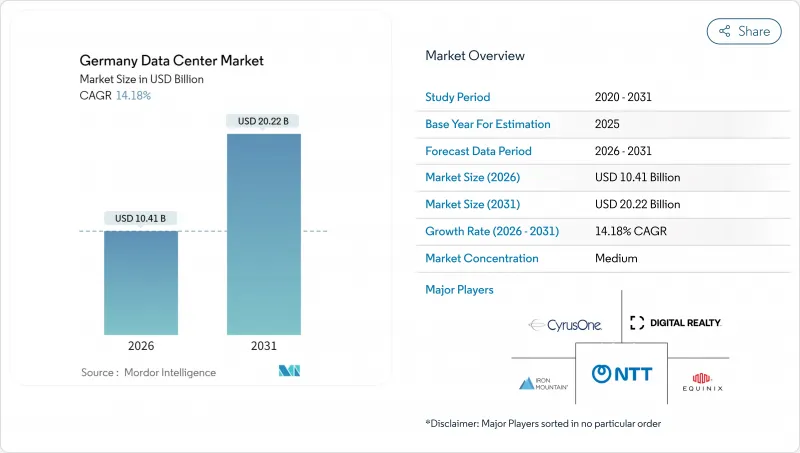
In terms of IT load capacity, the market is expected to grow from 3.44 thousand megawatts in 2025 to 6.23 thousand megawatts by 2030, at a CAGR of 12.60% during the forecast period (2025-2030). The market segment shares and estimates are calculated and reported in terms of MW. Growth is driven by the surge in artificial intelligence (AI) workloads, sustained hyperscaler capital expenditures, and regulatory requirements that favor modern, high-density facilities. The market already ranks as Europe's second-largest hub; hyperscaler pre-leasing in Frankfurt is absorbing new capacity faster than it can be delivered, while 5G-enabled edge deployments diversify demand beyond the main metro. Rising rack densities and the adoption of liquid cooling are narrowing the performance gap between cloud and on-premise environments, encouraging enterprises to abandon legacy server rooms. Finally, government incentives for sovereign AI infrastructure and waste-heat reuse create incremental revenue streams that strengthen the investment case for new projects.
Germany Data Center Market Trends and Insights
AI, Cloud and 5G-Driven Workload Surge
Ramp-up of GPU-powered inference and training is pushing rack densities to 30-100 kW, a five-fold leap from traditional enterprise footprints. Microsoft's EUR 3.2 billion program to double national AI capacity by 2026 highlights the scale shift, while Deutsche Telekom targets 10,000 edge nodes by 2030 to support 5G low-latency use cases. Average hyperscale utilization in Frankfurt now exceeds 85%, tightening available supply and pushing new entrants toward secondary sites. Liquid-cooling adoption is gaining momentum as air systems can no longer evacuate the thermal load of dense GPU clusters. These technical realities collectively amplify power and floor-space demand, directly lifting revenue opportunities for operators adhering to the Germany data center market's stringent efficiency codes.
Hyperscaler Expansion Commitments to Frankfurt
Amazon Web Services' USD 9.44 billion pledge through 2040 represents the largest single private-sector infrastructure investment in Germany to date, cementing Frankfurt as the country's AI nucleus. Such scale attracts enterprise tenants who value latency adjacency to cloud on-ramps, but the same clustering inflates land prices and exacerbates grid bottlenecks. Operators now model multi-phase builds with interim diesel-generator bridging while waiting for final high-voltage feeds. Although risk is concentrated, near-term revenue visibility improves because anchor tenants typically lock in 10- to 15-year power contracts.
Grid Connection Constraints in Frankfurt Metro
Bundesnetzagentur now allocates new high-capacity feeds via a queueing mechanism as local substations approach saturation. Developers report 18-24-month delays for >=50 MW connections, forcing staged commissioning or relocation to nearby Rhineland plots. A EUR 750 million reinforcement program will ease pressure, but full impact is unlikely before 2033. Consequently, some projects pre-purchase battery storage to self-sustain critical loads during ramp-up, inflating capital budgets and complicating financing.
Other drivers and restraints analyzed in the detailed report include:
- Strong Fiber and Submarine Connectivity via DE-CIX
- Corporate Digital Transformation and GDPR-Driven Colocation Demand
- High Electricity Costs Relative to EU Peers
For complete list of drivers and restraints, kindly check the Table Of Contents.
Segment Analysis
Large halls retained 33.62% of the Germany data center market share in 2025 thanks to hyperscaler economies of scale. Yet edge sites, while smaller, are on track for 12.97% CAGR as 5G adoption accelerates localized processing. The Germany data center market size allocated to edge remains modest today, but operators such as Deutsche Telekom plan 10,000 nodes by 2030, a roadmap that will multiply regional PoP counts. Edge units frequently occupy refurbished telecom exchanges, lowering land costs and shortening permitting cycles. Liquid-cooling retrofits are becoming standard even at micro sites because AI inferences require high-density racks similar to core campuses.
Medium facilities often 5-25 MW provide a bridging option for enterprises that outgrow on-premise rooms but are not yet ready for hyperscale footprints. In Frankfurt, mega campuses exceeding 100 MW continue to break ground, though grid scarcity forces phased energization. The Germany data center market thus combines massive centralized developments with a proliferating edge rim, bringing compute closer to users without sacrificing cloud interconnectivity.
Tier 3 halls comprised 59.25% of installed power in 2025, reflecting enterprises' preference for concurrent maintainability at a manageable price point. The Germany data center market size allocated to Tier 4 grows the fastest, 13.62% CAGR, because BFSI and AI training cannot tolerate downtime during long model-run cycles. Financial firms in Frankfurt routinely specify fault-tolerant designs delivering >=99.995% availability. Edge locations tend toward Tier 2 equivalents but increasingly add N+1 liquid-cooling loops, effectively moving up the resilience ladder.
Hyperscalers finance Tier 4 builds where workloads justify premium uptime, while auto-scaling consumer cloud instances remain content with Tier 3. Certification to the EN 50600-3 standard is now a baseline across all new German builds. Over time, hybrid architectures will mesh Tier 4 cores with resilient edge outposts, giving the Germany data center market a multi-tier topology aligned to workload criticality.
The Germany Data Center Market Report is Segmented by Data Center Size (Large, Massive, Medium, Mega, and Small), Tier Type (Tier 1 and 2, Tier 3, and Tier 4), Data Center Type (Hyperscale/Self-built, Enterprise/Edge, and Colocation), End User (BFSI, IT and ITES, E-Commerce, Government, Manufacturing, Media and Entertainment, Telecom, and More), and Hotspot. The Market Forecasts are Provided in Terms of IT Load Capacity (MW).
List of Companies Covered in this Report:
- Equinix, Inc.
- NTT Corporation
- Digital Realty Trust Inc.
- Vantage Data Centers, LLC
- Leaseweb Global B.V.
- CloudHQ, LLC
- Goodman Group
- noris network AG
- euNetworks Group Limited
- Global Switch Holdings Limited
- Telehouse International Corporation of Europe Ltd.
- AtlasEdge Data Centres Ltd.
- ITENOS GmbH
- STACK Infrastructure, Inc.
- GlobalConnect A/S
- maincubes one Services GmbH
- CyrusOne Inc.
- Iron Mountain Inc.
- EdgeConneX, Inc.
- Data4 Group
Additional Benefits:
- The market estimate (ME) sheet in Excel format
- 3 months of analyst support
TABLE OF CONTENTS
1 INTRODUCTION
- 1.1 Study Assumptions and Market Definition
- 1.2 Scope of the Study
2 RESEARCH METHODOLOGY
3 EXECUTIVE SUMMARY
4 MARKET LANDSCAPE
- 4.1 Market Overview
- 4.2 Market Drivers
- 4.2.1 AI, Cloud and 5G-Driven Workload Surge
- 4.2.2 Hyperscaler Expansion Commitments to Frankfurt
- 4.2.3 Strong Fiber and Submarine Cable Connectivity via DE-CIX
- 4.2.4 Corporate Digital Transformation and GDPR-Driven Colocation Demand
- 4.2.5 Government-Backed AI Gigafactory Initiatives Incentivizing New Build
- 4.2.6 Waste Heat Utilization Mandates Creating Secondary Revenue Streams
- 4.3 Market Restraints
- 4.3.1 Grid Connection Constraints and Power Scarcity in Frankfurt Metro
- 4.3.2 High Electricity Costs Relative to Other EU Peers
- 4.3.3 EnEfG Compliance Costs for Mandatory Renewable Sourcing and PUE Limits
- 4.3.4 Skilled Labor Shortage in High-Density Liquid Cooling Operations
- 4.4 Market Outlook
- 4.4.1 IT Load Capacity
- 4.4.2 Raised Floor Space
- 4.4.3 Colocation Revenue
- 4.4.4 Installed Racks
- 4.4.5 Rack Space Utilization
- 4.4.6 Submarine Cable
- 4.5 Key Industry Trends
- 4.5.1 Smartphone Users
- 4.5.2 Data Traffic Per Smartphone
- 4.5.3 Mobile Data Speed
- 4.5.4 Broadband Data Speed
- 4.5.5 Fiber Connectivity Network
- 4.5.6 Regulatory Framework
- 4.6 Value Chain and Distribution Channel Analysis
- 4.7 Porter's Five Forces Analysis
- 4.7.1 Threat of New Entrants
- 4.7.2 Bargaining Power of Buyers
- 4.7.3 Bargaining Power of Suppliers
- 4.7.4 Threat of Substitutes
- 4.7.5 Competitive Rivalry
5 MARKET SIZE AND GROWTH FORECASTS (MEGAWATT)
- 5.1 By Data Center Size
- 5.1.1 Large
- 5.1.2 Massive
- 5.1.3 Medium
- 5.1.4 Mega
- 5.1.5 Small
- 5.2 By Tier Type
- 5.2.1 Tier 1 and 2
- 5.2.2 Tier 3
- 5.2.3 Tier 4
- 5.3 By Data Center Type
- 5.3.1 Hyperscale / Self-built
- 5.3.2 Enterprise / Edge
- 5.3.3 Colocation
- 5.3.3.1 Non-Utilized
- 5.3.3.2 Utilized
- 5.3.3.2.1 Retail Colocation
- 5.3.3.2.2 Wholesale Colocation
- 5.4 By End User
- 5.4.1 BFSI
- 5.4.2 IT and ITES
- 5.4.3 E-Commerce
- 5.4.4 Government
- 5.4.5 Manufacturing
- 5.4.6 Media and Entertainment
- 5.4.7 Telecom
- 5.4.8 Other End Users
- 5.5 By Hotspot
- 5.5.1 Frankfurt
- 5.5.2 Hamburg
- 5.5.3 Rest of Germany
6 COMPETITIVE LANDSCAPE
- 6.1 Market Concentration
- 6.2 Strategic Moves
- 6.3 Market Share Analysis
- 6.4 Company Profiles (includes Global level Overview, Market level overview, Core Segments, Financials as available, Strategic Information, Market Rank/Share for key companies, Products and Services, and Recent Developments)
- 6.4.1 Equinix, Inc.
- 6.4.2 NTT Corporation
- 6.4.3 Digital Realty Trust Inc.
- 6.4.4 Vantage Data Centers, LLC
- 6.4.5 Leaseweb Global B.V.
- 6.4.6 CloudHQ, LLC
- 6.4.7 Goodman Group
- 6.4.8 noris network AG
- 6.4.9 euNetworks Group Limited
- 6.4.10 Global Switch Holdings Limited
- 6.4.11 Telehouse International Corporation of Europe Ltd.
- 6.4.12 AtlasEdge Data Centres Ltd.
- 6.4.13 ITENOS GmbH
- 6.4.14 STACK Infrastructure, Inc.
- 6.4.15 GlobalConnect A/S
- 6.4.16 maincubes one Services GmbH
- 6.4.17 CyrusOne Inc.
- 6.4.18 Iron Mountain Inc.
- 6.4.19 EdgeConneX, Inc.
- 6.4.20 Data4 Group
7 MARKET OPPORTUNITIES AND FUTURE OUTLOOK
- 7.1 White-space and Unmet-need Assessment

