
PUBLISHER: Mordor Intelligence | PRODUCT CODE: 1910854

PUBLISHER: Mordor Intelligence | PRODUCT CODE: 1910854
Functional Food - Market Share Analysis, Industry Trends & Statistics, Growth Forecasts (2026 - 2031)
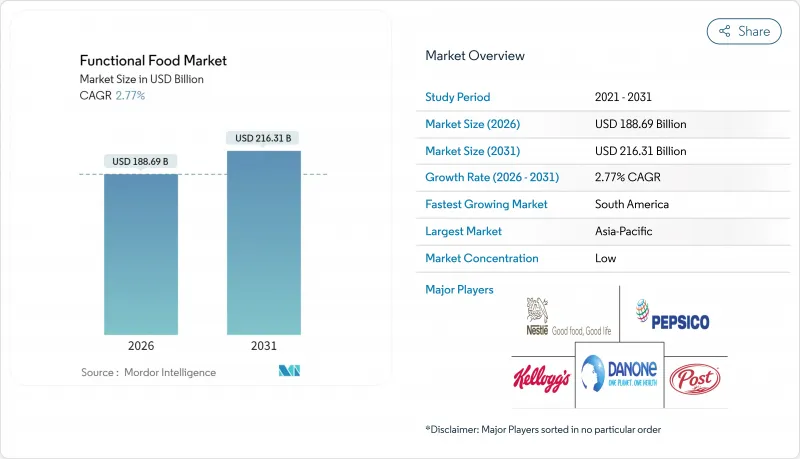
The functional food market was valued at USD 183.6 billion in 2025 and estimated to grow from USD 188.69 billion in 2026 to reach USD 216.31 billion by 2031, at a CAGR of 2.77% during the forecast period (2026-2031).
Regulatory frameworks, scientific validation, and standardized labeling requirements have integrated functional foods into mainstream retail channels, prompting traditional food manufacturers to expand their portfolios with fortified variants. These products incorporate enhanced vitamins, minerals, probiotics, and bioactive compounds that deliver specific health benefits beyond basic nutrition. Consumers now evaluate functional attributes alongside traditional factors like price, taste, and convenience, reflecting their improved understanding of the relationship between nutrient content and health outcomes. This behavioral shift has influenced purchasing patterns across dairy, beverages, cereals, and snack food categories. Regulatory authorities have implemented comprehensive standards for health claims and ingredient usage, which while increasing product development costs, protect compliant companies through evidence-based documentation requirements. These regulations specify protocols for clinical trials, safety assessments, and functional claim verification. The market's growth is supported by integrated retail channels that provide consumer education through interactive displays, mobile applications, and in-store nutritionists, while e-commerce platforms effectively serve younger consumers who value ingredient transparency and detailed product information.
Global Functional Food Market Trends and Insights
Rising health-conscious consumer base
Consumer health awareness has evolved significantly from basic nutritional knowledge to a comprehensive understanding of functional ingredients and their targeted health benefits. This fundamental shift has transformed purchasing patterns, with consumers actively seeking products that deliver measurable health outcomes rather than just avoiding harmful ingredients. According to the International Food Information Council's Food and Health Survey 2024, approximately 67% of Americans consider healthfulness very important in their food and beverage purchase decisions.The widespread influence of social media platforms and increased access to detailed nutritional information have substantially strengthened this trend, generating significant demand for scientifically validated functional foods. Digital health platforms and wearable devices enhance this evolution by providing consumers with comprehensive real-time feedback on their nutritional choices, dietary patterns, and detailed health indicators. This intensified health-focused consumer behavior has created substantial economic effects throughout the food and beverage industry, as consumers consistently demonstrate a strong willingness to pay premium prices for products that effectively address their specific health and wellness objectives, driving sustained market growth and continuous product innovation.
Growth of preventive healthcare and self-care trends
Preventive healthcare adoption drives functional food demand as consumers increasingly view nutrition as a fundamental defense against chronic diseases, including cardiovascular conditions, diabetes, and obesity. The global transition to preventive care models, especially in aging populations, establishes functional foods as cost-effective alternatives to pharmaceutical interventions, reducing long-term healthcare expenses. Healthcare systems recognize the economic advantages of nutrition-based disease prevention, with select insurance providers now covering functional food purchases for specific health conditions, particularly those related to metabolic disorders and nutritional deficiencies. Consumer focus on immune health continues to drive demand for immunity-supporting functional ingredients, including vitamin D, zinc, probiotics, and emerging bioactive compounds. The International Food Information Council's Food and Health Survey 2024 indicates that 27% of Americans sought immune function benefits from food and beverages in 2024, reflecting a growing awareness of nutrition's role in immune system support. The self-care movement extends beyond physical health into mental wellness, creating market opportunities for functional foods that target stress reduction, cognitive function, and mood regulation through validated ingredients such as omega-3 fatty acids, adaptogenic herbs, and bioactive peptides.
Stringent regulatory and labeling requirements
The complex regulatory environment creates significant barriers to market entry and product innovation, especially for smaller companies without regulatory expertise and resources. The FDA's restructured Human Foods Program in 2024 implements extensive compliance requirements for functional food manufacturers, including comprehensive hazard analysis protocols, detailed documentation procedures, and stricter health claim oversight. Companies must develop different formulations and labeling strategies for various markets due to regulatory harmonization challenges, which substantially increase development costs and extend time-to-market. The need for extensive clinical evidence to support health claims poses significant financial challenges, particularly for new ingredients without established safety profiles, requiring multiple rounds of testing and validation. Regulatory uncertainties around emerging technologies, such as precision fermentation and novel processing methods, delay product launches and investment decisions, impacting both research and development timelines and market strategies. Companies that effectively manage regulatory requirements gain competitive advantages through scientifically validated health claims and enhanced consumer trust, leading to market consolidation opportunities for companies with sufficient resources and established compliance frameworks.
Other drivers and restraints analyzed in the detailed report include:
- Rapid population ageing and lifestyle disease burden
- Innovation in ingredients and fortification technologies
- High cost of functional products
For complete list of drivers and restraints, kindly check the Table Of Contents.
Segment Analysis
Baby food held 28.18% of the market share in 2025, driven by parents seeking products with proven immunity and cognitive benefits in traditional spoonable formats. Manufacturers place premium products in pharmacy channels and collaborate with pediatricians who advocate for early pre- and postbiotic adoption, ensuring consistent household purchases throughout the two-year infancy period. The category benefits from increased middle-class consumption in Asia-Pacific regions, where urban consumers accept premium pricing for products meeting international quality standards. Dairy alternative products achieved a 4.18% CAGR, expanding in both chilled and ambient segments due to increased lactose intolerance awareness and plant-based preferences. Oat and almond beverages have gained market presence. These trends demonstrate how established companies and new entrants expand the functional food market in their respective segments. The dairy alternatives segment benefits from environmental messaging, attracting flexitarian consumers who connect health benefits with environmental impact.
Confectionery manufacturers incorporate prebiotic fibers in chocolate coatings, successfully combining indulgence with functionality. Snack Bars maintain market relevance by incorporating protein isolates with complex carbohydrates, targeting recreational athletes and professionals who use bars as meal substitutes. The breakfast cereals segment maintains its importance through continuous innovation in whole grain and fortified products. In January 2023, Kellogg introduced Pure Organic Crackers with Cheese and Veggies, providing 10% daily value of vitamin D through mushroom powder fortification. These segments illustrate the varying pace of development in the functional food industry, with rapid innovation occurring in areas with minimal regulatory restrictions and high consumer taste expectations.
The Functional Food Market Report is Segmented by Product Type (Baby Food, Confectionery, Dairy Products and More), Cateogry (Conventional and Organic), Distribution Channel (Supermarkets/Hypermarkets, Specialist Retailers, and More), and Geography (North America, Europe, Asia-Pacific, South America, and Middle East and Africa). The Market Forecasts are Provided in Terms of Value (USD).
Geography Analysis
Asia-Pacific held 50.12% of the functional food market in 2025, driven by increasing disposable incomes, urbanization, and cultural acceptance of food-as-medicine principles. China's 107 Food Medicine Substances list provides regulatory clarity for traditional botanicals, enabling domestic research and development while facilitating multinational partnerships. Japan's Foods with Health Claims system ensures consumer confidence through regulatory oversight while providing faster market access compared to EU regulations. India's 2025 FSSAI regulations strengthened high-risk product oversight while supporting immunity-enhancing nutraceuticals, attracting international ingredient manufacturers. Regional governments' nutrition-education initiatives promote fortified staples, expanding the functional food consumer base.
South America shows the highest growth rate at 4.76% CAGR through 2031, supported by Brazil's expanding food processing industry. ANVISA's September 2024 supplement regulations simplified claim approvals, enabling domestic companies to increase research investments. Brazil's clinical research regulations reduced trial approval times from 12 to 6 months, encouraging studies on local bioactive ingredients like acerola vitamin C complexes. Adjacent countries adopt similar regulatory frameworks, creating a regional innovation network that strengthens the functional food market.
North America maintains its premium consumer segment and influences global regulations through the FDA's 2024 "healthy" definition update, which includes nutrient-rich foods such as salmon and avocados in the functional category. Enhanced label requirements reduce legal risks and attract investment in precision-fermented proteins. Europe combines strict EFSA requirements with strong market demand, while retailers use nutritional traffic-light labeling to guide consumer choices. The Middle East and Africa show early market development. These regional variations in market maturity and consumer preferences require companies to adapt their strategies for successful market expansion.
- Nestle S.A
- Vitasoy Inetrnational Holdings Ltd
- The Kellog Company
- Post Holdings Inc
- B&G Foods Inc,
- Calbee Inc,
- Dairy Farmers of America
- Glanbia Nutritionals
- Yakult Honsha Co., Ltd.
- Mondelez International Inc.
- Laird Superfood Inc.
- Cocos Organic
- Oatly Group AB
- Nurture Brands
- The Coca-Cola Company
- General Mills Inc.
- Otsuka Holdings
- Suntory Holdings Limited
- Danone S.A
- PepsiCo Inc
Additional Benefits:
- The market estimate (ME) sheet in Excel format
- 3 months of analyst support
TABLE OF CONTENTS
1 INTRODUCTION
- 1.1 Study Assumptions and Market Definition
- 1.2 Scope of the Study
2 RESEARCH METHODOLOGY
3 EXECUTIVE SUMMARY
4 MARKET LANDSCAPE
- 4.1 Market Overview
- 4.2 Market Drivers
- 4.2.1 Rising health-conscious consumer base
- 4.2.2 Growth of preventive healthcare and self-care trends
- 4.2.3 Rapid population ageing and lifestyle disease burden
- 4.2.4 Innovation in ingredients and fortification technologies
- 4.2.5 Rise of sports nutrition and active lifestyle products
- 4.2.6 Boom in clean-label and natural functional products
- 4.3 Market Restraints
- 4.3.1 Stringent regulatory and labeling requirements
- 4.3.2 Taste and texture challenges
- 4.3.3 Skepticism about health claims
- 4.3.4 High cost of functional products
- 4.4 Regulatory Landscape
- 4.5 Technological Outlook
- 4.6 Porter's Five Forces
- 4.6.1 Bargaining Power of Suppliers
- 4.6.2 Bargaining Power of Buyers
- 4.6.3 Threat of New Entrants
- 4.6.4 Threat of Substitutes
- 4.6.5 Intensity of Competitive Rivalry
5 MARKET SIZE AND GROWTH FORECASTS (VALUE)
- 5.1 By Product Type
- 5.1.1 Baby Food
- 5.1.2 Confectionery Products
- 5.1.3 Breakfast Cereals
- 5.1.4 Beverages
- 5.1.5 Dairy Products
- 5.1.6 Dairy Alternative Products
- 5.1.7 Snack Bars
- 5.2 By Category
- 5.2.1 Conventional
- 5.2.2 Organic
- 5.3 By Distribution Channel
- 5.3.1 Supermarkets/Hypermarkets
- 5.3.2 Specialist Health and Wellness Retailers
- 5.3.3 Convenience/Grocery Stores
- 5.3.4 Online Retail Stores
- 5.3.5 Others
- 5.4 By Geography
- 5.4.1 North America
- 5.4.1.1 United States
- 5.4.1.2 Canada
- 5.4.1.3 Mexico
- 5.4.1.4 Rest of North America
- 5.4.2 Europe
- 5.4.2.1 United Kingdom
- 5.4.2.2 Germany
- 5.4.2.3 France
- 5.4.2.4 Italy
- 5.4.2.5 Spain
- 5.4.2.6 Netherlands
- 5.4.2.7 Poland
- 5.4.2.8 Belgium
- 5.4.2.9 Sweden
- 5.4.2.10 Rest of Europe
- 5.4.3 Asia-Pacific
- 5.4.3.1 China
- 5.4.3.2 Japan
- 5.4.3.3 India
- 5.4.3.4 Australia
- 5.4.3.5 Indonesia
- 5.4.3.6 South Korea
- 5.4.3.7 Thailand
- 5.4.3.8 Singapore
- 5.4.3.9 Rest of Asia-Pacific
- 5.4.4 South America
- 5.4.4.1 Brazil
- 5.4.4.2 Argentina
- 5.4.4.3 Colombia
- 5.4.4.4 Chile
- 5.4.4.5 Peru
- 5.4.4.6 Rest of South America
- 5.4.5 Middle East and Africa
- 5.4.5.1 South Africa
- 5.4.5.2 Saudi Arabia
- 5.4.5.3 United Arab Emirates
- 5.4.5.4 Nigeria
- 5.4.5.5 Egypt
- 5.4.5.6 Morocco
- 5.4.5.7 Turkey
- 5.4.5.8 Rest of Middle East and Africa
- 5.4.1 North America
6 COMPETITIVE LANDSCAPE
- 6.1 Market Concentration
- 6.2 Strategic Moves
- 6.3 Market Share Analysis
- 6.4 Company Profiles (includes Global level Overview, Market level overview, Core Segments, Financials as available, Strategic Information, Market Rank/Share for key companies, Products and Services, and Recent Developments)
- 6.4.1 Nestle S.A
- 6.4.2 Vitasoy Inetrnational Holdings Ltd
- 6.4.3 The Kellog Company
- 6.4.4 Post Holdings Inc
- 6.4.5 B&G Foods Inc,
- 6.4.6 Calbee Inc,
- 6.4.7 Dairy Farmers of America
- 6.4.8 Glanbia Nutritionals
- 6.4.9 Yakult Honsha Co., Ltd.
- 6.4.10 Mondelez International Inc.
- 6.4.11 Laird Superfood Inc.
- 6.4.12 Cocos Organic
- 6.4.13 Oatly Group AB
- 6.4.14 Nurture Brands
- 6.4.15 The Coca-Cola Company
- 6.4.16 General Mills Inc.
- 6.4.17 Otsuka Holdings
- 6.4.18 Suntory Holdings Limited
- 6.4.19 Danone S.A
- 6.4.20 PepsiCo Inc
7 MARKET OPPORTUNITIES AND FUTURE OUTLOOK

