PUBLISHER: Mordor Intelligence | PRODUCT CODE: 1911377

PUBLISHER: Mordor Intelligence | PRODUCT CODE: 1911377
Video Telematics - Market Share Analysis, Industry Trends & Statistics, Growth Forecasts (2026 - 2031)
The video telematics market is expected to grow from USD 9.74 million in 2025 to USD 10.38 million in 2026 and is forecast to reach USD 14.27 million by 2031 at 6.58% CAGR over 2026-2031.
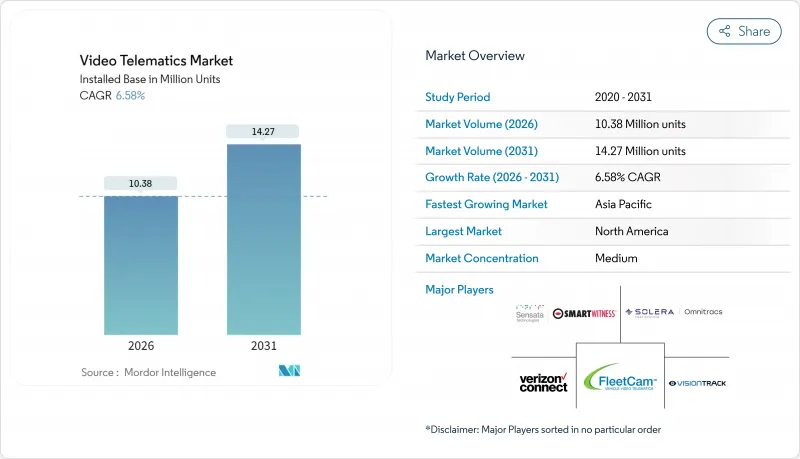
Mandated ADAS and driver-monitoring regulations in Europe, falling edge-AI hardware costs, and rising insurance incentives are accelerating adoption across commercial fleets. North American growth remains insurance-driven as carriers link premium discounts to video-verified driving behavior, while Asian demand rides on rapid electrification and smart-city programs. Integrated platforms that merge GPS, diagnostics, and AI video move to the forefront as fleets replace disparate systems, and the same convergence fuels a shift from one-time hardware sales toward subscription revenues tied to cloud analytics. Strategic acquisitions such as Powerfleet's purchase of Fleet Complete underscore the competitive race to bundle video, data, and fleet management within a single stack.
Global Video Telematics Market Trends and Insights
Regulatory mandates for driver-monitoring and ADAS data logging
The European Union enforced GSR2 in July 2024, requiring intelligent speed assist, autonomous emergency braking, and driver drowsiness detection in new vehicle approvals. Similar frameworks issued by the UN Economic Commission for Europe are prompting alignment in Asia and the Americas. Insurers now demand video-verified ADAS data to confirm liability, converting dashcams from discretionary tools into compliance necessities. The requirement for continuous driver-distraction warnings pushes fleets toward multi-camera installations that integrate with telematics dashboards. As regional rollouts widen, vendors that deliver off-the-shelf compliance packages gain a first-mover advantage. The cascading effect extends to aftermarket retrofits because mixed-age fleets must retrofit older vehicles to meet contract terms with shippers and logistics brokers.
Increasing adoption of fleet telematics-integrated video solutions
Fleet managers once balanced separate contracts for location tracking, maintenance scheduling, and video safety. Integrated video telematics platforms now bundle these functions under a single subscription, streamlining workflows and reducing false alerts by correlating speed, location, and video evidence. When GPS data validates harsh-brake events and cameras confirm distraction, driver acceptance rates improve and safety coaching becomes real time. Predictive maintenance also benefits, as AI video detects driver behavior that accelerates vehicle wear and combines it with sensor diagnostics. OEM-embedded telematics, standard on 75% of new cars sold in 2023, further propels system integration because camera-ready wiring harnesses simplify installation. Cloud deployment dominates, letting mixed fleets scale analytics without on-premise servers.
Privacy and data-protection compliance hurdles
GDPR rules require explicit consent for biometric data, right-to-erasure workflows, and secure anonymization, forcing fleets to deploy complex data-governance architectures. Cross-border operations further complicate storage because certain jurisdictions restrict cloud locations, raising infrastructure costs. Privacy obligations can clash with safety mandates that favor always-on recording, leading to geofenced masking and real-time face blurring that add processing overhead. Vendors able to deliver turnkey compliance toolkits gain a pricing premium, while smaller providers struggle to fund the necessary development. Ongoing legislative reviews in multiple regions keep compliance targets moving, prompting continuous software updates and legal consultations.
Other drivers and restraints analyzed in the detailed report include:
- Falling camera and edge-AI costs
- Growing safety-compliance focus among commercial fleets
- High hardware and installation costs for SMB fleets
For complete list of drivers and restraints, kindly check the Table Of Contents.
Segment Analysis
Integrated systems controlled 57.10% of the video telematics market in 2025 and are expanding at an 7.89% CAGR as fleets consolidate platforms for safety, maintenance, and routing. The coupling of telematics data with video evidence increases detection accuracy, improving coaching while reducing alert fatigue. OEM partnerships accelerate uptake by factory-installing camera-ready harnesses that cut retrofitting labor. In contrast, standalone cameras persist among cost-constrained operators that need basic recording but lack resources for full telematics integration.
Deployment momentum favors subscription economics tied to software add-ons rather than hardware margins. Embedded connectivity supports over-the-air updates that unlock new analytics without swapping devices. As a result, the lifetime value of an integrated subscriber outpaces a one-off camera sale, motivating vendors to bundle services. M&A activity shows telematics firms buying vision specialists to close capability gaps and secure recurring revenues.
Heavy trucks captured 35.92% of the video telematics market share in 2025, anchored by well-established ROI through litigation defense and premium discounts. Regulatory bodies mandate ELD-integrated cameras for hours-of-service compliance, cementing penetration in long-haul fleets. Buses maintain steady uptake as municipalities adopt Vision Zero targets that prioritize passenger safety. Light commercial vehicles experience moderate growth as e-commerce couriers adopt video coaching to reduce fender-benders in dense urban routes.
Passenger cars post the steepest rise at a 7.29% CAGR, propelled by rental and leasing companies that tie damage-waiver fees to real-time driver behavior monitoring. Usage-based insurance pilots embed cameras to validate telemetry and curb fraud, broadening consumer exposure. Despite price sensitivity, smartphone-linked camera dongles lower barriers, allowing personal-line policyholders to trial video without permanent installations, priming a future upsell path to integrated hardware as benefits become evident.
The Video Telematics Market Report is Segmented by Type (Integrated Systems, and Stand-Alone Systems), Vehicle Type (Heavy Trucks, Buses and Coaches, Light Commercial Vehicles, and Passenger Cars), Deployment Model (Cloud-Based, and On-premises/Hybrid), Component (Hardware [Cameras, and More}, Software and Analytics, and Services [Installation, and More]), and Geography. The Market Forecasts are Provided in Terms of Value (Units).
Geography Analysis
North America retained 38.30% share in 2025 on the back of mature telematics ecosystems and strong insurer engagement. Carriers link premium savings to documented safe driving, encouraging even small haulers to add cameras. Regulatory clarity on data usage streamlines rollouts, and 5G coverage in high-traffic corridors allows real-time video transfer for near-instant claims processing. Competitive pressure now pivots away from installation counts toward advanced analytics, where machine learning identifies predictive risk patterns before incidents occur.
Europe shows brisk uptake following GSR2, as compliance deadlines leave fleets little choice but to install driver-monitoring hardware. The strict GDPR regime simultaneously elevates the importance of robust privacy safeguards, rewarding providers with in-platform anonymization and secure data pipelines. Integrated solutions prosper because operators prefer single dashboards that satisfy both safety mandates and business optimization imperatives. Increasing investment in clean transport corridors places further emphasis on technology that validates eco-driving credentials for green freight certification.
Asia Pacific posts the fastest growth at 7.38% CAGR to 2031, fueled by large-scale electrification incentives and ambitious smart-city programs. China's electric logistics fleets require combined monitoring of battery health, charging patterns, and driver behavior, generating incremental demand for video analytics tailored to EV dynamics. India's mandate for vehicle location tracking on school buses and public transport similarly broadens addressable volumes. Cost-efficient hardware produced in regional supply chains further lowers barriers, enabling smaller operators to leapfrog to cloud analytics without legacy equipment constraints.
- SmartWitness (Sensata Technologies)
- Verizon Connect (Verizon Communications Inc.)
- Omnitracs (Solera Holdings Inc.)
- FleetCam (Pty) Ltd
- VisionTrack Ltd
- Lytx Inc.
- Nauto Inc.
- SureCam (Europe) Limited
- LightMetrics Inc.
- NetraDyne Inc.
- Geotab Inc.
- ATandT Inc.
- Fleet Complete Inc.
- Samsara Inc.
- Octo Group SpA
- Motive Technologies Inc.
- One Step GPS LLC
- MiX Telematics Ltd
- Trimble Transportation (Trimble Inc.)
- Streamax Technology Co. Ltd
- Howen Technologies Co. Ltd
- Micronet Ltd
- PFK Electronics (Pty) Ltd
- Blackvue (Pittasoft Co. Ltd)
- Garmin Ltd
- Zonar Systems Inc.
- Azuga Holdings Inc.
Additional Benefits:
- The market estimate (ME) sheet in Excel format
- 3 months of analyst support
TABLE OF CONTENTS
1 INTRODUCTION
- 1.1 Study Assumptions and Market Definition
- 1.2 Scope of the Study
2 RESEARCH METHODOLOGY
3 EXECUTIVE SUMMARY
4 MARKET LANDSCAPE
- 4.1 Market Overview
- 4.2 Market Drivers
- 4.2.1 Increasing adoption of fleet telematics-integrated video solutions
- 4.2.2 Regulatory mandates for driver-monitoring and ADAS data logging
- 4.2.3 Falling camera/edge-AI costs
- 4.2.4 Growing safety-compliance focus among commercial fleets
- 4.2.5 Usage-based-insurance shift to video-verified claims
- 4.2.6 Road-image data monetisation and smart-city partnerships
- 4.3 Market Restraints
- 4.3.1 Privacy and data-protection compliance hurdles
- 4.3.2 High hardware and installation costs for SMB fleets
- 4.3.3 Bandwidth / storage burdens for HD and 4K streaming
- 4.3.4 Lack of open standards for video-analytics interoperability
- 4.4 Industry Value Chain Analysis
- 4.5 Regulatory Landscape
- 4.6 Technological Outlook
- 4.7 Porter's Five Forces Analysis
- 4.7.1 Bargaining Power of Suppliers
- 4.7.2 Bargaining Power of Buyers
- 4.7.3 Threat of New Entrants
- 4.7.4 Threat of Substitutes
- 4.7.5 Degree of Competition
- 4.8 Investment Analysis
5 MARKET SIZE AND GROWTH FORECASTS (UNITS)
- 5.1 By Type
- 5.1.1 Integrated Systems
- 5.1.2 Stand-alone Systems
- 5.2 By Vehicle Type
- 5.2.1 Heavy Trucks
- 5.2.2 Buses and Coaches
- 5.2.3 Light Commercial Vehicles (LCV)
- 5.2.4 Passenger Cars
- 5.3 By Deployment Model
- 5.3.1 Cloud-based
- 5.3.2 On-premises / Hybrid
- 5.4 By Component
- 5.4.1 Hardware (Cameras, DVR/NVR, Sensors)
- 5.4.2 Software and Analytics
- 5.4.3 Services (Installation, Subscription, Support)
- 5.5 By Geography
- 5.5.1 North America
- 5.5.2 South America
- 5.5.3 Europe
- 5.5.4 Asia Pacific
- 5.5.5 Middle East and Africa
6 COMPETITIVE LANDSCAPE
- 6.1 Market Concentration
- 6.2 Strategic Moves
- 6.3 Market Share Analysis
- 6.4 Vendor Market Share and Positioning
- 6.4.1 Global Vendor Share
- 6.4.2 North America Vendor Ranking
- 6.4.3 Europe Vendor Ranking
- 6.5 Company Profiles (includes Global-level Overview, Market-level Overview, Core Segments, Financials as available, Strategic Information, Market Rank/Share, Products and Services, Recent Developments)
- 6.5.1 SmartWitness (Sensata Technologies)
- 6.5.2 Verizon Connect (Verizon Communications Inc.)
- 6.5.3 Omnitracs (Solera Holdings Inc.)
- 6.5.4 FleetCam (Pty) Ltd
- 6.5.5 VisionTrack Ltd
- 6.5.6 Lytx Inc.
- 6.5.7 Nauto Inc.
- 6.5.8 SureCam (Europe) Limited
- 6.5.9 LightMetrics Inc.
- 6.5.10 NetraDyne Inc.
- 6.5.11 Geotab Inc.
- 6.5.12 ATandT Inc.
- 6.5.13 Fleet Complete Inc.
- 6.5.14 Samsara Inc.
- 6.5.15 Octo Group SpA
- 6.5.16 Motive Technologies Inc.
- 6.5.17 One Step GPS LLC
- 6.5.18 MiX Telematics Ltd
- 6.5.19 Trimble Transportation (Trimble Inc.)
- 6.5.20 Streamax Technology Co. Ltd
- 6.5.21 Howen Technologies Co. Ltd
- 6.5.22 Micronet Ltd
- 6.5.23 PFK Electronics (Pty) Ltd
- 6.5.24 Blackvue (Pittasoft Co. Ltd)
- 6.5.25 Garmin Ltd
- 6.5.26 Zonar Systems Inc.
- 6.5.27 Azuga Holdings Inc.
7 MARKET OPPORTUNITIES AND FUTURE OUTLOOK
- 7.1 White-space and Unmet-need Assessment

