
PUBLISHER: Mordor Intelligence | PRODUCT CODE: 1911389

PUBLISHER: Mordor Intelligence | PRODUCT CODE: 1911389
Philippines Facility Management - Market Share Analysis, Industry Trends & Statistics, Growth Forecasts (2026 - 2031)
The Philippines facility management market is expected to grow from USD 4.15 billion in 2025 to USD 4.38 billion in 2026 and is forecast to reach USD 5.77 billion by 2031 at 5.64% CAGR over 2026-2031.
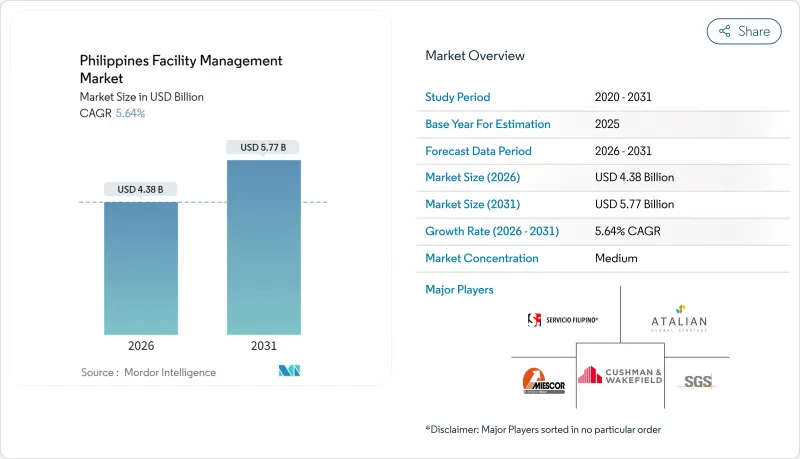
Rising capital expenditure on more than 3,700 public-works schemes, buoyant office demand from the USD 38 billion business-process-outsourcing (BPO) sector and mandatory sustainability reporting from 2026 are combining to lift spending on outsourced and technology-enabled building services across the archipelago. Hard services dominate present revenue because ageing transport links, energy assets and commercial towers require continuous mechanical, electrical and plumbing work, yet soft services are gaining traction as employers link workplace hygiene with productivity. Consolidation pressures are intensifying as multinational customers ask for integrated contracts that blend hard, soft and digital solutions. Regional demand is shifting: Cebu, Davao and Clark are registering the fastest investment growth and forcing service providers to build local delivery hubs.
Philippines Facility Management Market Trends and Insights
Infrastructure development fueling demand
Public works under the Build Better More portfolio, including the PHP 219 billion Bataan-Cavite Interlink Bridge and PHP 187.5 billion Panay-Guimaras-Negros crossings, are broadening the footprint of the Philippines facility management market. Completion of 1,200 km of roads and an equal number of bridges since 2022 has intensified the need for bridge-deck inspections, tunnel ventilation upkeep and roadside asset management. Healthcare builds such as the PHP 6 billion PGH Cancer Center and several regional hospitals add specialist clinical environments to the addressable base. Contractors therefore require suppliers able to mobilise quickly in provincial locations and manage multiform assets within single concessions. As these mixed-use corridors combine transport, retail and residential elements, service providers that offer integrated hard, soft and energy-efficiency packages are gaining bid advantages.
Technology integration transforming service delivery
IoT-enabled platforms are reshaping service scopes throughout the Philippines facility management market. Deployments of AI-powered occupancy sensors, such as Milesight's roll-out in Metro Manila offices, are providing live utilisation data that feeds predictive maintenance schedules and space optimisation strategies. PLDT Enterprise's Smart IoT suite is linking utilities meters and lift controls to unified dashboards, cutting response times and lowering energy bills. The Department of Science and Technology's PHP 4.7 million ChicIoT pilot in poultry facilities shows that sensor-based monitoring is also moving into industrial and agri-business estates. A USD 5 million smart-city programme across 100 government units in Cebu, Bacolod, Iloilo and Davao is demonstrating the scale at which integrated platforms can now be procured. Providers that can embed analytics engines within building-management systems and translate alerts into quantifiable savings are securing longer contract tenures.
Labor shortages constraining market growth
An estimated deficit of 300,000 construction workers, coupled with wage hikes in the National Capital Region, is pushing up salary expectations for facility technicians and site supervisors. Competition from overseas placements for Technical and Vocational Education Training graduates is further thinning the local labour pool. Employers in Ilocos and Cebu have started raising pay scales to secure electricians and HVAC specialists, eroding margins for service contractors that operate fixed-price agreements. Providers must therefore invest in scholarship schemes and digital work-order platforms that maximise technician productivity.
Other drivers and restraints analyzed in the detailed report include:
- Sustainable facility management bolstering competitive advantage
- Outsourcing trend gaining momentum
- Regulatory compliance increasing operational complexity
For complete list of drivers and restraints, kindly check the Table Of Contents.
Segment Analysis
Hard services accounted for 63.12% of the Philippines facility management market share in 2025, reflecting the criticality of mechanical, electrical, plumbing and fire-safety upkeep in a tropical, typhoon-prone environment. Ongoing rehabilitation of transport corridors and the refurbishing of 1990s-era office towers require round-the-clock asset management programmes. In parallel, predictive analytics is reducing downtime: IoT-enabled chillers in Metro Manila now alert engineers before efficiency drifts occur, lowering energy draw by 8-10% per site. Soft services are on a faster 6.71% CAGR route to 2031 because occupants increasingly view cleaning, security and concierge support as levers for employee retention and brand reputation. Government mandates on indoor-air-quality monitoring post-pandemic are also broadening the duty scope of janitorial teams.
As more buildings embed occupancy sensors and visitor-management apps, distinctions between hard and soft services are blurring. For example, space-booking data enables housekeeping crews to focus on high-traffic zones, while HVAC set-points are adjusted in real time based on footfall. This convergence is prompting suppliers to package both domains into single integrated proposals, a configuration expected to command a rising share of the Philippines facility management market.
The Philippine Facility Management Market Report is Segmented by Type (In-House Facility Management and Outsourced Facility Management (single FM, Bundled FM, and Integrated FM)), Offering Type (Hard FM and Soft FM), and End-User Industry (Commercial, Institutional, Public/Infrastructure, Industrial, and More). The Market Size and Forecasts are Provided in Terms of Value in (USD) for all the Above Segments.
List of Companies Covered in this Report:
- CBRE Philippines
- Servicio Filipino Inc.
- Meralco Industrial Engineering Services Corporation
- SGS Philippines Inc.
- Santos Knight Frank Inc. (Knight Frank LLP)
- Century Properties Management Inc.
- Mansion Maintenance Co. Inc.
- Kontrac Facilities Management Services Inc.
- Jones Lang LaSalle Inc.
- Artelia Group
- WeCare Facility Management Services Inc.
- Hydron Corporation
- Atalian Global Services Philippines Inc.
- Kabraso
- CPMGI
- Cushman & Wakefield Debenham Tie Leung Limited
Additional Benefits:
- The market estimate (ME) sheet in Excel format
- 3 months of analyst support
TABLE OF CONTENTS
1 INTRODUCTION
- 1.1 Study Assumptions and Market Definition
- 1.2 Scope of the Study
2 RESEARCH METHODOLOGY
3 EXECUTIVE SUMMARY
4 MARKET LANDSCAPE
- 4.1 Market Overview
- 4.1.1 Current Occupancy Rates
- 4.1.2 Profitability Rates of Major FM Players
- 4.1.3 Workforce Indicators - Labor Participation
- 4.1.4 Facility Management Market Share (%), by Service Type
- 4.1.5 Facility Management Market Share (%), by Hard Services
- 4.1.6 Facility Management Market Share (%), by Soft Services
- 4.1.7 Urbanization and Population Growth in Major Metros
- 4.1.8 Sector Investment Priorities in Philippines's Infrastructure Pipeline
- 4.1.9 Regulatory Drivers Specific to Labour and Safety Standards
- 4.2 Market Drivers
- 4.2.1 Infrastructure Development Fueling Demand
- 4.2.2 Technology Integration Transforming Service Delivery
- 4.2.3 Sustainable Facility Management Bolstering Competitive Advantage
- 4.2.4 Outsourcing Trend Gaining Momentum
- 4.2.5 Rising Demand for Integrated FM Contracts in BPO Sector
- 4.2.6 Government Green Building Mandates Driving FM Scope Expansion
- 4.3 Market Restraints
- 4.3.1 Labor Shortages Constraining Market Growth
- 4.3.2 Regulatory Compliance Increasing Operational Complexity
- 4.3.3 High Cost Sensitivity Leading to Price-based Competition
- 4.3.4 Fragmented Supplier Base Diluting Service Standardization
- 4.4 Value Chain Analysis
- 4.5 PESTEL Analysis
- 4.6 Regulatory and Legislative Framework for Market Entrants
- 4.7 Impact of Macroeconomic Indicators on FM Demand
- 4.8 Porter's Five Forces Analysis
- 4.8.1 Bargaining Power of Suppliers
- 4.8.2 Bargaining Power of Buyers
- 4.8.3 Threat of New Entrants
- 4.8.4 Threat of Substitute Services
- 4.8.5 Intensity of Competitive Rivalry
- 4.9 Investment and Funding Analysis
5 MARKET SIZE AND GROWTH FORECASTS (VALUE)
- 5.1 By Service Type
- 5.1.1 Hard Services
- 5.1.1.1 Asset Management
- 5.1.1.2 MEP and HVAC Services
- 5.1.1.3 Fire Systems and Safety
- 5.1.1.4 Other Hard FM Services
- 5.1.2 Soft Services
- 5.1.2.1 Office Support and Security
- 5.1.2.2 Cleaning Services
- 5.1.2.3 Catering Services
- 5.1.2.4 Other Soft FM Services
- 5.1.1 Hard Services
- 5.2 By Offering Type
- 5.2.1 In-house
- 5.2.2 Outsourced
- 5.2.2.1 Single FM
- 5.2.2.2 Bundled FM
- 5.2.2.3 Integrated FM
- 5.3 By End-user Industry
- 5.3.1 Commercial (IT and Telecom, Retail and Warehouses, etc.)
- 5.3.2 Hospitality (Hotels, Eateries, Large-scale Restaurants)
- 5.3.3 Institutional and Public Infrastructure (Govt, Education, Transportation)
- 5.3.4 Healthcare (Public and Private Facilities)
- 5.3.5 Industrial and Process (Manufacturing, Energy, Mining)
- 5.3.6 Other End-user Industries (Multi-housing, Entertainment, Sports and Leisure)
6 COMPETITIVE LANDSCAPE
- 6.1 Market Concentration
- 6.2 Strategic Moves and Partnerships
- 6.3 Market Share Analysis
- 6.4 Company Profiles (includes Global level Overview, Market level overview, Core Segments, Financials as available, Strategic Information, Market Rank/Share for key companies, Products and Services, and Recent Developments)
- 6.4.1 CBRE Philippines
- 6.4.2 Servicio Filipino Inc.
- 6.4.3 Meralco Industrial Engineering Services Corporation
- 6.4.4 SGS Philippines Inc.
- 6.4.5 Santos Knight Frank Inc. (Knight Frank LLP)
- 6.4.6 Century Properties Management Inc.
- 6.4.7 Mansion Maintenance Co. Inc.
- 6.4.8 Kontrac Facilities Management Services Inc.
- 6.4.9 Jones Lang LaSalle Inc.
- 6.4.10 Artelia Group
- 6.4.11 WeCare Facility Management Services Inc.
- 6.4.12 Hydron Corporation
- 6.4.13 Atalian Global Services Philippines Inc.
- 6.4.14 Kabraso
- 6.4.15 CPMGI
- 6.4.16 Cushman & Wakefield Debenham Tie Leung Limited
7 MARKET OPPORTUNITIES AND FUTURE OUTLOOK
- 7.1 White-space and Unmet-Need Assessment
- 7.2 Technology-led Integrated FM (IoT, BMS, AI-based Predictive Maintenance)
- 7.3 ESG-compliant FM Solutions Demand
- 7.4 Future Service-Model Shifts (Outcome-based Contracts)

