PUBLISHER: Mordor Intelligence | PRODUCT CODE: 1911735

PUBLISHER: Mordor Intelligence | PRODUCT CODE: 1911735
Non-Profit Software - Market Share Analysis, Industry Trends & Statistics, Growth Forecasts (2026 - 2031)
Non-Profit Software market size in 2026 is estimated at USD 4.95 billion, growing from 2025 value of USD 4.59 billion with 2031 projections showing USD 7.24 billion, growing at 7.88% CAGR over 2026-2031.
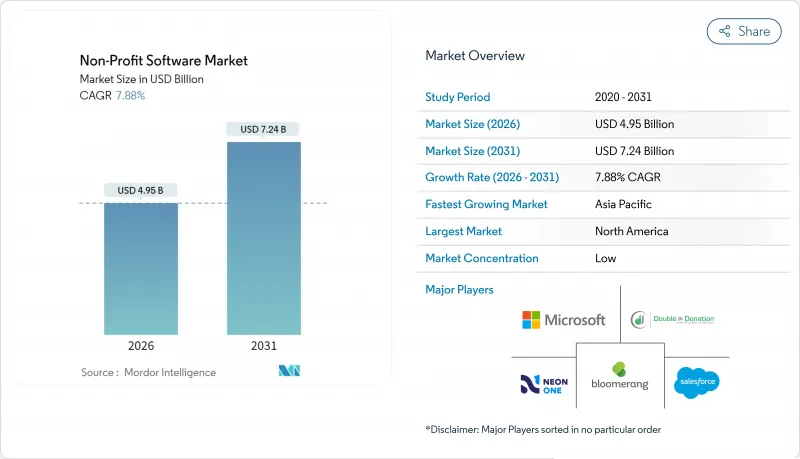
The market size expansion mirrors a pronounced shift toward cloud deployment, rapid uptake of artificial intelligence features, and stricter data-privacy regulation that elevates software compliance requirements. Demand is strongest for unified fundraising suites that collapse data silos and for automation tools that offset chronic staff shortages. Vendors that embed predictive donor analytics, mobile-first giving options, and embedded payment capabilities are carving out clear competitive advantage. Meanwhile, regulatory frameworks such as GDPR and CCPA encourage nonprofit boards to favor platforms with certified security controls, which in turn accelerates the replacement of legacy on-premises systems.
Global Non-Profit Software Market Trends and Insights
Proliferation of Cloud-Based SaaS Solutions
Cloud adoption trims capital expenditure and delivers remote access that became essential during pandemic lockdowns. Moving from on-premises to SaaS cuts total cost of ownership by around 30-40% according to implementation data. Microsoft's plan to retire its Fundraising and Engagement product by December 2026 underscores a wider pivot to cloud-native architectures. Subscription pricing meshes with nonprofit cash-flow cycles, and built-in compliance features appeal to boards grappling with GDPR and CCPA obligations. These attributes accelerate migration from spreadsheets and aging local servers into modern, continuously updated platforms that scale with campaign volume.
Growing Demand for Integrated Fundraising and Donor Management Platforms
Boards expect consolidated impact reporting, and siloed point solutions undermine that goal. OneCause's January 2025 connector for Salesforce Nonprofit Success Pack shows how tight integration reduces manual data entry and improves donor insights. Vendors able to sync seamlessly with existing CRMs gain an edge because nonprofits prefer evolutionary upgrades over risky rip-and-replace projects. The move toward unified suites reflects the sector's maturation: organizations now demand enterprise-grade analytics, automated workflows, and omnichannel engagement once reserved for commercial brands.
Budget Constraints Among Small Nonprofits
Average technology budgets of USD 2,537-3,942 per full-time employee in New Zealand and Australia reveal how limited funds delay software upgrades. Even when license discounts exist, implementation and training costs strain resources, and the absence of dedicated IT staff hampers full feature utilization. Freemium tiers and TechSoup subsidies alleviate entry costs yet rarely cover ongoing administration, reinforcing a two-speed adoption pattern between large and small organizations.
Other drivers and restraints analyzed in the detailed report include:
- Rising Automation of Routine Nonprofit Workflows
- Expansion of Mobile and Digital Giving Channels
- Data Security and Privacy Concerns with Cloud Solutions
For complete list of drivers and restraints, kindly check the Table Of Contents.
Segment Analysis
Cloud deployments generated 61.72% of the Non-Profit Software market in 2025 and are projected to expand at an 11.32% CAGR through 2031. The Non-Profit Software market size for cloud solutions is therefore set to outpace overall sector growth as nonprofits retire aging servers in favor of SaaS that matches fiscal cycles and remote-work patterns. Vendors bundle migration services so that historical donor data, volunteer records, and fund accounts transfer without downtime. The looming sunset of Microsoft's Fundraising and Engagement product compels many organizations to reevaluate infrastructure, and GDPR is shaping decisions about regional data hosting.
On-premises installations persist within large institutions that already invested heavily in in-house data centers or that must meet strict residency rules, such as hospital foundations. Yet even these organizations are adopting hybrid models to tap modern analytics while safeguarding sensitive medical donor files. The Non-Profit Software market share of on-premises solutions is forecast to decline steadily, signaling widening acceptance of cloud resilience, automatic patching, and consumption-based pricing.
Large nonprofits held 52.05% of 2025 spending thanks to deeper budgets, dedicated IT teams, and complex multi-site operations. The Boys and Girls Clubs of America deployed a universal CRM across 350 chapters within nine months, highlighting the scale possible in this tier. However, the small and medium band grows fastest at 13.05% CAGR as SaaS lowers entry barriers. Cloud subscriptions convert what used to be capital expenditure into predictable operating outlays, while freemium plans introduce functionality before a full commitment.
Despite growth, SMEs confront staff and capital shortages that limit advanced feature usage. Average technology allocations remain under USD 4,000 per employee, so vendors that provide robust onboarding, templated workflows, and peer training communities stand to gain. Continued discount programs from platforms such as TechSoup will be critical in widening adoption. The Non-Profit Software market size for SMEs is expected to close part of today's gap, yet large organizations will still account for a majority of absolute dollars.
The Non-Profit Software Market Report is Segmented by Deployment (On Premises, Cloud), by Enterprise Size (SMEs, Large Enterprise), by Type (Admission-Based Nonprofit Software, Fundraising Software, Marketing Software, Volunteer Management, CRM, Other Types), and by Geography. The Market Forecasts are Provided in Terms of Value (USD).
Geography Analysis
North America delivered 44.05% of 2025 revenue, underpinned by favorable tax incentives for charitable giving and sophisticated vendor ecosystems. Large national implementations such as Boys and Girls Clubs of America highlight the scale potential when U.S. organizations unify data across hundreds of locations. Canada and Mexico add headroom, particularly for cloud migrations spurred by security certifications that now rival U.S. standards. Data-privacy laws such as CCPA reinforce the appeal of platforms with demonstrable compliance audits, further entrenching leading vendors.
Europe forms a mature but highly regulated landscape. GDPR mandates rigorous consent tracking and breach notification, so nonprofits select providers with local data centers and robust audit trails. Emphasis on sustainability metrics and social-impact reporting fuels demand for granular analytics that tie donations to outcomes. Localization-language, currency, and statutory reporting-remains a differentiator for regional vendors competing against global platforms. Despite modest GDP growth, digital-transformation funding from the European Commission keeps investment flowing into modern nonprofit stacks.
Asia-Pacific is the fastest-growing region at an 11.36% CAGR through 2031. Only 27% of nonprofits have migrated to cloud, revealing significant runway for uptake. Smartphone penetration vastly exceeds branch banking coverage, so mobile-first giving apps resonate strongly. Google.org's USD 1.5 million grant to Infoxchange underscores a coordinated push to digitize operations among regional charities. Australia and New Zealand provide early-adopter case studies, while Southeast Asia offers a greenfield prospect where nonprofits can leapfrog directly to SaaS without legacy baggage. Vendors that tailor lightweight, mobile-optimized interfaces and deliver regional payment options stand to gain share fastest.
- Blackbaud, Inc.
- Salesforce, Inc.
- Bloomerang, LLC
- Bonterra Tech, Inc. (Network for Good & EveryAction)
- Neon One, LLC
- Microsoft Corporation
- SAP SE
- Intuit Inc.
- Oracle Corporation
- Double the Donation, LLC
- DonorSearch, LLC
- WealthEngine, Inc.
- Community Brands Intermediate, LLC
- Cvent Holding Corp.
- Classy, Inc.
- DonorPerfect (SofterWare, Inc.)
- Virtuous Software, Inc.
- Funraise, Inc.
- Qgiv, Inc.
- Give Lively LLC
Additional Benefits:
- The market estimate (ME) sheet in Excel format
- 3 months of analyst support
TABLE OF CONTENTS
1 INTRODUCTION
- 1.1 Study Assumptions and Market Definition
- 1.2 Scope of the Study
2 RESEARCH METHODOLOGY
3 EXECUTIVE SUMMARY
4 MARKET LANDSCAPE
- 4.1 Market Overview
- 4.2 Market Drivers
- 4.2.1 Proliferation of cloud-based SaaS solutions
- 4.2.2 Growing demand for integrated fundraising & donor management platforms
- 4.2.3 Rising automation of routine nonprofit workflows
- 4.2.4 Expansion of mobile & digital giving channels
- 4.2.5 Emergence of AI-driven predictive donor analytics boosting ROI
- 4.2.6 Embedded payment APIs enabling micro-donations
- 4.3 Market Restraints
- 4.3.1 Budget constraints among small nonprofits
- 4.3.2 Data security & privacy concerns with cloud solutions
- 4.3.3 Integration complexity with legacy volunteer databases
- 4.3.4 Donor fatigue limiting uptake of new software tools
- 4.4 Value / Supply-Chain Analysis
- 4.5 Regulatory Landscape
- 4.6 Technological Outlook
- 4.7 Porter's Five Forces Analysis
- 4.7.1 Threat of New Entrants
- 4.7.2 Bargaining Power of Buyers
- 4.7.3 Bargaining Power of Suppliers
- 4.7.4 Threat of Substitutes
- 4.7.5 Intensity of Competitive Rivalry
- 4.8 Investment Analysis
5 MARKET SIZE AND GROWTH FORECASTS (VALUE)
- 5.1 By Deployment
- 5.1.1 On-Premises
- 5.1.2 Cloud
- 5.2 By Enterprise Size
- 5.2.1 Small & Medium Nonprofits
- 5.2.2 Large Nonprofits
- 5.3 By Functional Module
- 5.3.1 Fundraising & Donation Management
- 5.3.2 Constituent / CRM
- 5.3.3 Marketing & Engagement
- 5.3.4 Volunteer Management
- 5.3.5 Grant Management
- 5.3.6 Finance & Accounting
- 5.3.7 Other Modules
- 5.4 By Revenue Model
- 5.4.1 Subscription SaaS
- 5.4.2 Perpetual License
- 5.4.3 Freemium & Donationware
- 5.5 By End-User Vertical
- 5.5.1 Education Nonprofits
- 5.5.2 Healthcare & Hospital Foundations
- 5.5.3 Faith-based & Religious
- 5.5.4 Human Services & International Aid
- 5.5.5 Arts & Culture
- 5.5.6 Environmental & Animal Welfare
- 5.5.7 Others
- 5.6 By Geography
- 5.6.1 North America
- 5.6.1.1 United States
- 5.6.1.2 Canada
- 5.6.1.3 Mexico
- 5.6.2 Europe
- 5.6.2.1 Germany
- 5.6.2.2 United Kingdom
- 5.6.2.3 France
- 5.6.2.4 Russia
- 5.6.2.5 Rest of Europe
- 5.6.3 Asia-Pacific
- 5.6.3.1 China
- 5.6.3.2 Japan
- 5.6.3.3 India
- 5.6.3.4 South Korea
- 5.6.3.5 Australia
- 5.6.3.6 Rest of Asia-Pacific
- 5.6.4 Middle East and Africa
- 5.6.4.1 Middle East
- 5.6.4.1.1 Saudi Arabia
- 5.6.4.1.2 United Arab Emirates
- 5.6.4.1.3 Rest of Middle East
- 5.6.4.2 Africa
- 5.6.4.2.1 South Africa
- 5.6.4.2.2 Egypt
- 5.6.4.2.3 Rest of Africa
- 5.6.4.1 Middle East
- 5.6.5 South America
- 5.6.5.1 Brazil
- 5.6.5.2 Argentina
- 5.6.5.3 Rest of South America
- 5.6.1 North America
6 COMPETITIVE LANDSCAPE
- 6.1 Market Concentration Analysis
- 6.2 Strategic Moves (M&A, Partnerships, Launches)
- 6.3 Market Share Analysis (Top-15, 2024)
- 6.4 Company Profiles (includes Global Level Overview, Market Level Overview, Core Segments, Financials as available, Strategic Information, Market Rank/Share, Products and Services, Recent Developments)
- 6.4.1 Blackbaud, Inc.
- 6.4.2 Salesforce, Inc.
- 6.4.3 Bloomerang, LLC
- 6.4.4 Bonterra Tech, Inc. (Network for Good & EveryAction)
- 6.4.5 Neon One, LLC
- 6.4.6 Microsoft Corporation
- 6.4.7 SAP SE
- 6.4.8 Intuit Inc.
- 6.4.9 Oracle Corporation
- 6.4.10 Double the Donation, LLC
- 6.4.11 DonorSearch, LLC
- 6.4.12 WealthEngine, Inc.
- 6.4.13 Community Brands Intermediate, LLC
- 6.4.14 Cvent Holding Corp.
- 6.4.15 Classy, Inc.
- 6.4.16 DonorPerfect (SofterWare, Inc.)
- 6.4.17 Virtuous Software, Inc.
- 6.4.18 Funraise, Inc.
- 6.4.19 Qgiv, Inc.
- 6.4.20 Give Lively LLC
7 MARKET OPPORTUNITIES AND FUTURE TRENDS
- 7.1 White-space & Unmet-Need Assessment

