PUBLISHER: Mordor Intelligence | PRODUCT CODE: 1911748

PUBLISHER: Mordor Intelligence | PRODUCT CODE: 1911748
India Feed Amino Acids - Market Share Analysis, Industry Trends & Statistics, Growth Forecasts (2026 - 2031)
The India feed amino acids market is expected to grow from USD 2.19 billion in 2025 to USD 2.31 billion in 2026 and is forecast to reach USD 3.01 billion by 2031 at 5.42% CAGR over 2026-2031.
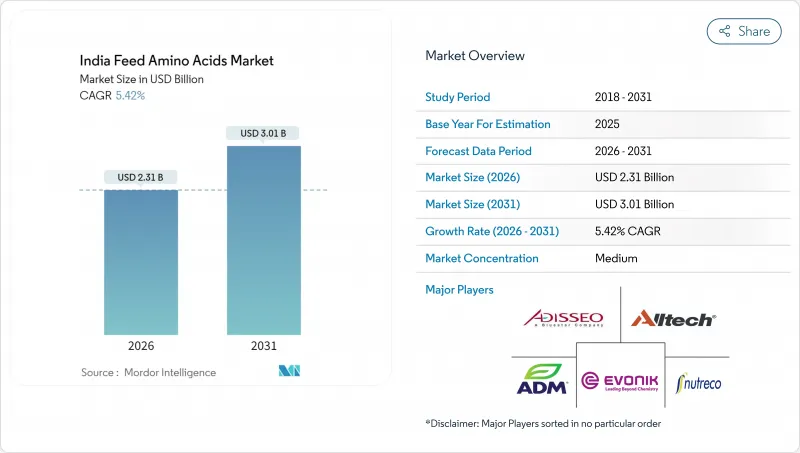
Rising household protein intake, rapid livestock industrialization, and government support for organized farming are steering sustained demand for precision nutrition additives. Poultry integrators have moved from crude protein formulas toward crystalline amino-acid-balanced diets that trim feed costs and shrink nitrogen output. In aquaculture, crop-loss concerns and stricter residue limits motivate mills to fortify shrimp and fish rations with digestible methionine and lysine. Parallel capacity additions by global suppliers and Indian fermentation start-ups are building local supply resilience while price volatility in soymeal and corn prompts feed makers to substitute part of the protein matrix with targeted amino acids.
India Feed Amino Acids Market Trends and Insights
Rising Poultry Meat and Egg Consumption
India produces around 118 billion eggs annually, with a rising affinity for egg consumption as a prominent protein source. Commercial broiler companies run phased feeding programs where synthetic lysine and DL-methionine are indispensable for hitting target feed-conversion ratios. The Food Safety and Standards Authority of India banned growth-promoter antibiotics such as colistin and chloramphenicol in April 2025, which pushed integrators to rely on amino-acid-driven performance gains . Demand clusters in Tamil Nadu and Andhra Pradesh anchor dedicated distribution depots and on-farm technical service labs. With urban consumer poultry uptake rising at near 6% annually, the India feed amino acids market maintains a structural growth pillar rooted in this species.
Organized Aquaculture Feed-Mill Expansion
Indian feed mills produced an estimated 1.1-1.15 million metric tons of shrimp feed in 2024, following a dip from the previous cycle, yet long-term prospects stay bullish as exporters target low-antibiotic certification. High-density shrimp ponds require diets fortified with protected methionine to mitigate muscle necrosis and improve feed efficiency. Coastal Andhra Pradesh hosts more than 65 integrated processors that own hatcheries, feed plants, and farms, creating tight supply corridors for amino acid concentrates. Millers are adopting twin-screw extrusion lines that help embed crystalline amino-acid premixes for uniform pellet distribution. Research funded under ICAR (Indian Council of Agricultural Research) has mapped essential amino acid profiles for Indian major carp, guiding wider uptake across freshwater fish segments.
Soymeal and Corn Price Volatility
Feed-grade soymeal touched INR 66,000 (USD 792) per metric ton in mid-2024 before sliding below INR 46,000 (USD 552) by year-end, unsettling nutrient-cost planning in all species. During low-price windows, mills sometimes revert to protein-heavy recipes, diluting amino-acid inclusion. Conversely, sudden spikes squeeze cash flows, delaying new purchase contracts. Smaller mills seldom hedge futures or hold safety stocks, amplifying procurement shocks. This volatility weighs on predictable uptake trajectories and temporarily blunts the India feed amino acids market's expansion momentum.
Other drivers and restraints analyzed in the detailed report include:
- Government Subsidies and Import Policy Relief
- Low-Protein Diet Reformulation with Crystalline Amino Acids
- BIS (Bureau of Indian Standards) and FSSAI (Food Safety and Standards Authority of India) Regulatory Hurdles
For complete list of drivers and restraints, kindly check the Table Of Contents.
Segment Analysis
Lysine dominates the sub-additive segment with 40.85% market share in 2025, reflecting its fundamental role as the first limiting amino acid in most plant-based feed formulations. Its widespread use across poultry, swine, and aquaculture applications makes it the cornerstone of amino acid supplementation programs. The development of molasses-based fermentation capacity in sugar-producing states like Maharashtra and Karnataka is creating opportunities for domestic lysine production, potentially reducing import dependence and improving supply chain resilience.
Methionine represents the fastest-growing segment at 5.56% CAGR through 2031, driven by expanding aquaculture operations and premium poultry formulations targeting improved meat quality and disease resistance. The amino acid's critical role in protein synthesis and immune function makes it particularly valuable in high-performance production systems. Regulatory compliance factors under FSSAI standards are driving demand for pharmaceutical-grade amino acids with enhanced purity specifications, particularly in export-oriented aquaculture operations.
The India Feed Amino Acids Market Report is Segmented by Sub Additive (Lysine, Methionine, Threonine, and More) and by Animal (Aquaculture, Poultry, Ruminants, and More). The Market Forecasts are Provided in Terms of Value (USD) and Volume (Metric Tons).
List of Companies Covered in this Report:
- Adisseo
- Alltech, Inc.
- Archer Daniels Midland Co.
- Evonik Industries AG
- SHV (Nutreco NV)
- Ajinomoto Co., Inc.
- Kemin Industries, Inc.
- IFF(Danisco Animal Nutrition)
- Prinova Group LLC
- Novus International, Inc.
- Cargill Incorporated
- DSM-Firmenich AG
- Sumitomo Chemical Co., Ltd.
- Kyowa Hakko Bio Co., Ltd.
Additional Benefits:
- The market estimate (ME) sheet in Excel format
- 3 months of analyst support
TABLE OF CONTENTS
1 EXECUTIVE SUMMARY & KEY FINDINGS
2 REPORT OFFERS
3 INTRODUCTION
- 3.1 Study Assumptions & Market Definition
- 3.2 Scope of the Study
- 3.3 Research Methodology
4 KEY INDUSTRY TRENDS
- 4.1 Animal Headcount Analysis
- 4.1.1 Poultry
- 4.1.2 Ruminants
- 4.1.3 Swine
- 4.2 Feed Production Analysis
- 4.2.1 Aquaculture
- 4.2.2 Poultry
- 4.2.3 Ruminants
- 4.2.4 Swine
- 4.3 Regulatory Framework
- 4.3.1 India
- 4.4 Value Chain & Distribution Channel Analysis
- 4.5 Market Drivers
- 4.5.1 Rising poultry meat and egg consumption
- 4.5.2 Organized aquaculture feed-mill expansion
- 4.5.3 Government subsidies and import policy relief
- 4.5.4 Low-protein diet reformulation with crystalline amino acids
- 4.5.5 Molasses-based domestic fermentation capacity build-out
- 4.5.6 Sulfur-balanced bio-digestate fertilizer demand
- 4.6 Market Restraints
- 4.6.1 Soymeal and corn price volatility
- 4.6.2 BIS (Bureau of Indian Standards) and FSSAI (Food Safety and Standards Authority of India) regulatory hurdles
- 4.6.3 Exposure to anti-dumping duties on imports
- 4.6.4 Cold-chain gaps for liquid blends
5 MARKET SIZE AND GROWTH FORECASTS (VALUE AND VOLUME)
- 5.1 Sub Additive
- 5.1.1 Lysine
- 5.1.2 Methionine
- 5.1.3 Threonine
- 5.1.4 Tryptophan
- 5.1.5 Other Amino Acids
- 5.2 By Animal
- 5.2.1 Aquaculture
- 5.2.1.1 By Sub Animal
- 5.2.1.1.1 Fish
- 5.2.1.1.2 Shrimp
- 5.2.1.1.3 Other Aquaculture Species
- 5.2.1.1 By Sub Animal
- 5.2.2 Poultry
- 5.2.2.1 By Sub Animal
- 5.2.2.1.1 Broiler
- 5.2.2.1.2 Layer
- 5.2.2.1.3 Other Poultry Birds
- 5.2.2.1 By Sub Animal
- 5.2.3 Ruminants
- 5.2.3.1 By Sub Animal
- 5.2.3.1.1 Beef Cattle
- 5.2.3.1.2 Dairy Cattle
- 5.2.3.1.3 Other Ruminants
- 5.2.3.1 By Sub Animal
- 5.2.4 Swine
- 5.2.5 Other Animals
- 5.2.1 Aquaculture
6 COMPETITIVE LANDSCAPE
- 6.1 Key Strategic Moves
- 6.2 Market Share Analysis
- 6.3 Company Landscape
- 6.4 Company Profiles (Includes Global Level Overview, Market Level Overview, Core Business Segments, Financials, Headcount, Key Information, Market Rank, Market Share, Products and Services, and Analysis of Recent Developments).
- 6.4.1 Adisseo
- 6.4.2 Alltech, Inc.
- 6.4.3 Archer Daniels Midland Co.
- 6.4.4 Evonik Industries AG
- 6.4.5 SHV (Nutreco NV)
- 6.4.6 Ajinomoto Co., Inc.
- 6.4.7 Kemin Industries, Inc.
- 6.4.8 IFF(Danisco Animal Nutrition)
- 6.4.9 Prinova Group LLC
- 6.4.10 Novus International, Inc.
- 6.4.11 Cargill Incorporated
- 6.4.12 DSM-Firmenich AG
- 6.4.13 Sumitomo Chemical Co., Ltd.
- 6.4.14 Kyowa Hakko Bio Co., Ltd.
7 KEY STRATEGIC QUESTIONS FOR FEED ADDITIVE CEOS

