
PUBLISHER: Mordor Intelligence | PRODUCT CODE: 1911765

PUBLISHER: Mordor Intelligence | PRODUCT CODE: 1911765
Europe Car Loan - Market Share Analysis, Industry Trends & Statistics, Growth Forecasts (2026 - 2031)
The Europe car loan market is expected to grow from USD 338.77 billion in 2025 to USD 357.57 billion in 2026 and is forecast to reach USD 468.34 billion by 2031 at 5.55% CAGR over 2026-2031.
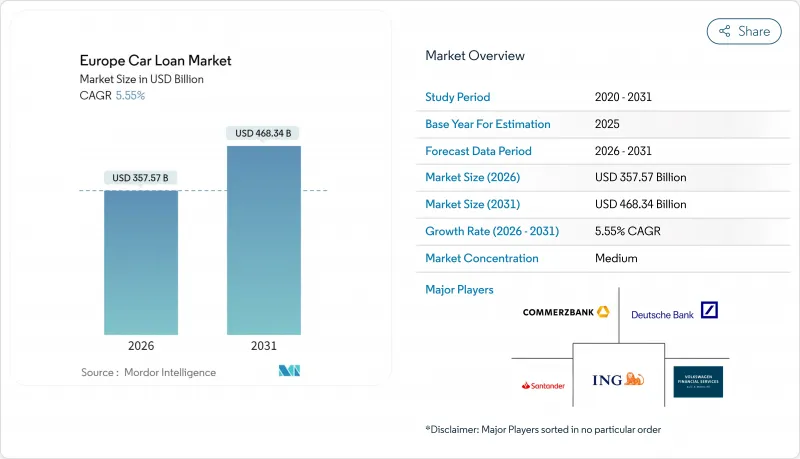
Rising electric-vehicle uptake, rapid digitalization of lending processes, and stabilizing consumer loan rates around 7.4-7.9% in 2024 underpin this steady trajectory despite lingering macroeconomic headwinds. Competitive pressure escalates as non-banking financial services providers tap asset-backed securities and private-credit inflows to fund aggressive expansion, while captive finance arms defend volumes through preferential rates linked to manufacturer incentives. Used-car financing dominates volumes because consumers prioritize value amid elevated new-car prices and economic uncertainty, and this counter-cyclical segment continues to anchor portfolio resilience across lender types. Regulatory shifts, from PSD2 open-banking access to stricter consumer-protection rules, raise compliance costs yet also enable tech-forward players to refine risk models with richer data and win share in the Europe car loan market.
Europe Car Loan Market Trends and Insights
EV Incentives and EU CO2 Subsidies Lift Loan Demand
Government schemes such as Italy's EUR 600 million 2024 program spur immediate spikes in originations, concentrating underwriting volumes into tight windows and pressuring operational capacity. Germany's subsidy sunset in December 2024 illustrated how abrupt policy shifts trigger cliff-edge drops that lenders must hedge via dynamic portfolio rebalancing. France's ecological bonus, offering up to EUR 7,000 per EV through 2025, raises average loan amounts and extends terms, bolstering net interest margins. Netherlands fleet-electrification mandates push commercial lease penetration above 80%, expanding corporate portfolios and cross-selling potential. Spain's MOVES III fund channels EUR 400 million into regional EV demand, requiring lenders to align marketing and risk models with localized uptake trends.
Digital Origination and PSD2-Enabled Credit Analytics
Fintech platforms compress approval times from days to minutes by leveraging API integrations and machine-learning underwriting, shifting customer expectations across the Europe car loan market. Embedded-finance players embed credit seamlessly into online vehicle checkouts, eroding dealership-centric models and capturing digitally native buyers. PSD2 access to real-time bank-account data improves risk discrimination for thin-file borrowers, expanding addressable demand while preserving asset quality. Traditional banks respond with omnichannel rollouts, yet legacy cores hinder full automation, widening customer-experience gaps versus agile entrants. Nordic lenders capitalize first, aided by high smartphone penetration and established digital-ID infrastructure that facilitates frictionless onboarding.
Higher Interest-Rate and Macro Volatility
European Central Bank tightening pushed consumer loan rates to 7.4-7.9% in 2024 from sub-3% in 2021, squeezing affordability and dampening demand across mass-market segments. Premium buyers exhibit more tolerance, yet aggregate application volumes dropped 15-20% in the most rate-sensitive markets during 2024. Net interest margins compress for lenders holding fixed-rate portfolios funded by variable-rate liabilities, necessitating hedging strategies and dynamic repricing. Economic uncertainty tied to inflation persistence and geopolitical tensions elevates credit-loss provisions, curbing risk appetite and balance-sheet growth. Regional banking structures influence transmission speed, with variable-rate-dominant systems absorbing shocks faster than fixed-rate counterparts.
Other drivers and restraints analyzed in the detailed report include:
- Rising Used-Car Finance Penetration
- ABS and Private-Credit Funding Inflows Lower Costs
- EV Residual-Value Swings and Battery-Health Uncertainty
For complete list of drivers and restraints, kindly check the Table Of Contents.
Segment Analysis
Non-captive banks captured 42.70% of the Europe car loan market share in 2025 as their deposit funding lets them price competitively and cross-sell across multi-product customer relationships. These banks convert branch trust into digital touchpoints, retaining customers even while fintech entrants promise faster journeys. Non-bank financial services firms, however, are growing at a 7.15% CAGR and keep reallocating capital from private-credit partners eager for granular, secured exposures in the Europe car loan market. Regulatory arbitrage and cloud-native cores let these specialists underwrite with lower overhead, forcing incumbents to accelerate API modernization.
Competitive intensity deepens as original-equipment-manufacturer captives subsidize rates to defend showroom volumes, pushing blended portfolio margins lower even as loyalty benefits rise. Asset-backed securities programs level the playing field, giving mid-tier lenders a route to match bank funding costs and scale originations quickly. Cross-border consolidation, such as BPCE's takeover of Societe Generale Equipment Finance, shows that size and balance-sheet diversification now determine endurance in the Europe car loan market. Future winners pair real-time open-banking analytics with low-cost funding to deliver risk-priced offers in seconds, an expectation set by fintech pioneers.
The Europe Car Loan Market Report is Segmented by Loan Provider Type (Non-Captive Banks, Non-Banking Financial Services, Original Equipment Manufacturers' Captives, and More), Vehicle Type (New Car, Used Car), Distribution Channel (Dealership Point-Of-Sale, Online Direct Lending, and More), and Geography (United Kingdom, Germany, France, Spain, and More). The Market Forecasts are Provided in Terms of Value (USD).
List of Companies Covered in this Report:
- Deutsche Bank
- Santander Consumer Finance
- Commerzbank
- Volkswagen Financial Services
- ING Holding Deutschland
- Unicredit Bank (Germany)
- BayernLB Group
- Stellantis Financial Services
- The Helaba Group
- BNP Paribas Personal Finance (Cetelem)
- Societe Generale
- Credit Agricole
- Nordea
- Swedbank
- Danske Bank
- Landesbank Baden-Wurttemberg (LBBW)
- Groupe BPCE
- SpareBank 1
- Banque Populaire (part of Groupe BPCE)
- DZ Bank
Additional Benefits:
- The market estimate (ME) sheet in Excel format
- 3 months of analyst support
TABLE OF CONTENTS
1 Table of Contents - Europe Car Loan Market
2 Introduction
- 2.1 Study Assumptions & Market Definition
- 2.2 Scope of the Study
3 Research Methodology
4 Executive Summary
5 Market Landscape
- 5.1 Market Overview
- 5.2 Market Drivers
- 5.2.1 EV-adoption incentives accelerating loan demand
- 5.2.2 Digital / online origination platforms scale-up
- 5.2.3 Rising used-car finance penetration
- 5.2.4 PSD2-enabled alternative credit assessment
- 5.2.5 ABS / private-credit inflows lowering funding costs
- 5.2.6 EU CO? targets & national subsidies lift EV loan demand and high-ticket loan sizes
- 5.3 Market Restraints
- 5.3.1 Higher interest-rate & macro volatility
- 5.3.2 Residual-value swings, esp. for EVs
- 5.3.3 Regulatory scrutiny & FCA-style redress risk
- 5.3.4 Battery-health uncertainty as collateral
- 5.4 Value / Supply-Chain Analysis
- 5.5 Regulatory Landscape
- 5.6 Technological Outlook
- 5.7 Porter's Five Forces
- 5.7.1 Threat of New Entrants
- 5.7.2 Bargaining Power of Suppliers
- 5.7.3 Bargaining Power of Buyers
- 5.7.4 Threat of Substitutes
- 5.7.5 Competitive Rivalry
6 Market Size & Growth Forecasts
- 6.1 By Loan Provider Type (Value)
- 6.1.1 Non-Captive Banks
- 6.1.2 Non-banking Financial Services
- 6.1.3 Original Equipment Manufacturers (Captives)
- 6.1.4 Other Providers
- 6.2 By Vehicle Type (Value)
- 6.2.1 New Car
- 6.2.2 Used Car
- 6.3 By Distribution Channel (Value)
- 6.3.1 Dealership Point-of-Sale
- 6.3.2 Online Direct Lending
- 6.3.3 Brokers & Marketplaces
- 6.4 By Country (Value)
- 6.4.1 United Kingdom
- 6.4.2 Germany
- 6.4.3 France
- 6.4.4 Spain
- 6.4.5 Italy
- 6.4.6 BENELUX (Belgium, Netherlands, and Luxembourg)
- 6.4.7 NORDICS (Denmark, Finland, Iceland, Norway, and Sweden)
- 6.4.8 Rest of Europe
7 Competitive Landscape
- 7.1 Market Concentration
- 7.2 Strategic Moves
- 7.3 Market Share Analysis
- 7.4 Company Profiles (includes Global level Overview, Market level overview, Core Segments, Financials as available, Strategic Information, Market Rank/Share for key companies, Products & Services, and Recent Developments)
- 7.4.1 Deutsche Bank
- 7.4.2 Santander Consumer Finance
- 7.4.3 Commerzbank
- 7.4.4 Volkswagen Financial Services
- 7.4.5 ING Holding Deutschland
- 7.4.6 Unicredit Bank (Germany)
- 7.4.7 BayernLB Group
- 7.4.8 Stellantis Financial Services
- 7.4.9 The Helaba Group
- 7.4.10 BNP Paribas Personal Finance (Cetelem)
- 7.4.11 Societe Generale
- 7.4.12 Credit Agricole
- 7.4.13 Nordea
- 7.4.14 Swedbank
- 7.4.15 Danske Bank
- 7.4.16 Landesbank Baden-Wurttemberg (LBBW)
- 7.4.17 Groupe BPCE
- 7.4.18 SpareBank 1
- 7.4.19 Banque Populaire (part of Groupe BPCE)
- 7.4.20 DZ Bank
8 Market Opportunities & Future Outlook
- 8.1 White-space & Unmet-Need Assessment

