PUBLISHER: Mordor Intelligence | PRODUCT CODE: 1911787

PUBLISHER: Mordor Intelligence | PRODUCT CODE: 1911787
India Full Service Restaurants - Market Share Analysis, Industry Trends & Statistics, Growth Forecasts (2026 - 2031)
The India full service restaurants market is expected to grow from USD 37.93 billion in 2025 to USD 42.09 billion in 2026 and is forecast to reach USD 70.82 billion by 2031 at 10.97% CAGR over 2026-2031.
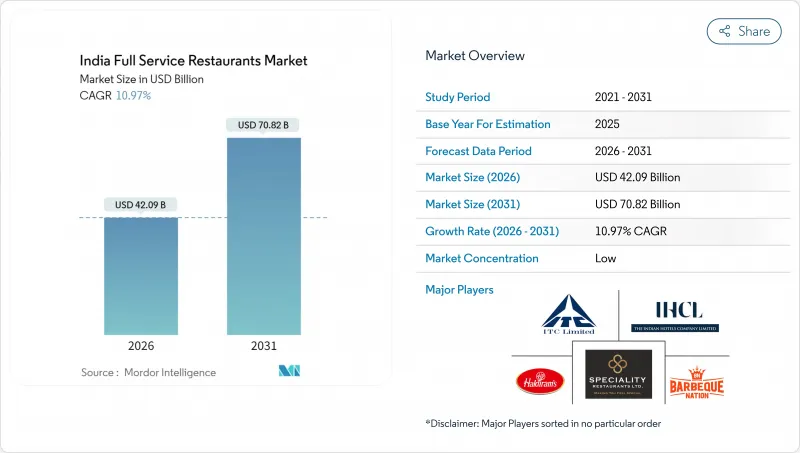
This growth reflects a shift in consumer behavior, particularly among urban and semi-urban populations, where dining out is becoming an increasingly regular social activity rather than an occasional indulgence. Factors such as rising disposable incomes, increased smartphone usage, and the growing influence of food delivery aggregator platforms have made it easier for consumers to discover and access dining options. Despite competition from quick-service restaurants, which emphasize speed and affordability, full service establishments are differentiating themselves by offering value through these experiential dining options. Furthermore, the anticipated growth in domestic tourism, which is projected to double by 2030, is expected to drive more customers to leisure destinations. In these areas, curated dining experiences are becoming an integral part of travel plans, further boosting the market. The India full service restaurants market remains highly fragmented, with numerous players competing to capture market share.
India Full Service Restaurants Market Trends and Insights
Changing consumer preferences for experiential dining
In India, full service restaurants are evolving into lifestyle destinations as customers increasingly seek more than just food; they want a complete dining experience that includes ambiance, interaction, and entertainment. To meet these expectations, restaurant operators are introducing unique features such as themed interiors, live grills, and chef-interaction counters. These elements not only encourage customers to spend more time at the restaurant but also allow businesses to charge premium prices. Rising disposable incomes in urban areas, coupled with India's robust economic growth, as estimated by the International Monetary Fund at USD 4,130 billion, are driving higher discretionary spending in India. This has led to an increase in the frequency of dining out, making experiential dining a regular activity rather than an occasional treat. Restaurants that continuously update their concepts and offerings are better positioned to attract repeat customers in this segment.
Domestic tourism and hospitality growth
India's full service restaurants market is experiencing significant growth, driven by the expansion of domestic tourism and the hospitality sector. In 2024, the country welcomed 9.66 million foreign tourists, generating INR 2,77,842 crore in foreign exchange earnings, marking a 19.8% increase, according to the Ministry of Tourism. This growing influx of tourists, along with rising domestic travel, has boosted spending on food and beverages, particularly in popular leisure and resort destinations. Hotels are increasingly promoting their signature restaurants as key attractions for both tourists and local residents. For instance, Bukhara at ITC Maurya in New Delhi has become a popular choice, benefiting from a steady flow of foreign visitors and business travelers. As travelers increasingly seek unique culinary experiences, restaurants are transforming into key highlights of travel itineraries.
Complex licensing requirements
Complex licensing requirements significantly hinder the expansion of full service restaurants in India. Restaurant operators are required to obtain multiple approvals, including Food Safety and Standards Authority of India (FSSAI) registration or license, fire-safety NOC (Fire No Objection Certificate), health-trade license from local municipal authorities, pollution control clearance, shop and establishment registration, music and entertainment permits, and, in many cases, state excise licenses for serving alcohol. This extensive list of approvals increases the initial setup costs, making it particularly challenging for first-time entrepreneurs to enter the market. Delays in regulatory processing further exacerbate the financial strain, as operators must comply with stringent guidelines set by the FSSAI and local municipal bodies. Larger restaurant chains often manage these challenges more effectively by employing dedicated compliance teams to handle the paperwork and processes.
Other drivers and restraints analyzed in the detailed report include:
- Menu innovation around fusion and regional specialties
- Corporate dining and MICE events
- High rental costs in prime metros
For complete list of drivers and restraints, kindly check the Table Of Contents.
Segment Analysis
Dine-in formats are the leading segment in India's full service restaurants market, contributing 65.12% of the market share in 2025. These restaurants attract customers by offering a unique dining experience that includes social interactions, themed interiors, and live kitchen setups. The ambiance and personalized service provided by these establishments make them a preferred choice for consumers, especially in metro cities and Tier I areas. As dining out becomes a lifestyle trend, dine-in formats continue to drive significant revenue for the market.
The delivery segment is growing rapidly and is expected to achieve a 13.67% CAGR by 2031. Consumers are increasingly opting for premium full service meals delivered to their homes, thanks to better packaging that maintains food quality during transit. Restaurants are adapting by creating delivery-specific menus, introducing exclusive chef-curated meal boxes, and partnering with efficient logistics providers to streamline their operations. With convenience becoming a key factor for customers, the delivery segment is poised to complement dine-in services and play a larger role in driving market growth.
Asian cuisines continued to dominate India's full service restaurants market in 2025, accounting for 72.10% of the total market share. This category encompasses a diverse range of offerings, including Indian regional dishes, Chinese cuisine, and other Pan-Asian menus, which remain popular due to their cultural familiarity and adaptability for vegetarian diets. Restaurants are introducing more niche Asian cuisines, such as Japanese, Korean, and Thai, to cater to the growing interest among younger consumers. The variety and adaptability of Asian food ensure consistent customer traffic in both metropolitan areas and smaller cities.
Latin American cuisine is emerging as the fastest-growing segment in the market, with a projected CAGR of 15.08% through 2031. This growth is fueled by global brands and local restaurants that are tailoring dishes to suit Indian tastes by adjusting spice levels, proteins, and accompaniments. Popular items, such as tacos, chimichurri bowls, and Peruvian grills, are increasingly featured on premium dining menus. As Indian consumers explore more global flavors, Latin American cuisine is expected to gain significant traction, both in dine-in experiences and through delivery services, outpacing other categories in terms of growth.
The India Full Service Restaurants Market Report is Segmented by Service Type (Dine-In, Delivery, and More), Cuisine (Asian, European, and More), Outlet (Chained Outlets and Independent Outlets), and Location (Leisure, Travel, and More). The Market Forecasts are Provided in Terms of Value (USD).
List of Companies Covered in this Report:
- Barbeque Nation Hospitality Ltd
- Speciality Restaurants Ltd.
- Haldiram Foods International Pvt Ltd.
- The Indian Hotels Company Ltd (Tata Group)
- ITC Ltd
- Saravana Bhavan Private Limited
- Paradise Food Court Pvt Ltd
- Sagar Ratna Restaurants Pvt Ltd
- Ohri's Group
- Bikanervala Foods Private Limited
- Absolute Barbecues Pvt Ltd (AB's)
- Impresario Handmade Restaurants
- Olive Bar & Kitchen Pvt Ltd
- The Yellow Chilli (SK Restaurants)
- Bikkgane Biryani Pvt Ltd
- Biryani By Kilo (Sky Gate Hospitality)
- Nando's India
- Chili's Grill & Bar India
- Mainland China ( Speciality Restaurants)
- Wow! Momo Foods Pvt Ltd
Additional Benefits:
- The market estimate (ME) sheet in Excel format
- 3 months of analyst support
TABLE OF CONTENTS
1 INTRODUCTION
- 1.1 Study Assumptions and Market Definition
- 1.2 Scope of the Study
2 RESEARCH METHODOLOGY
3 EXECUTIVE SUMMARY
4 MARKET LANDSCAPE
- 4.1 Market Overview
- 4.2 Industry Trend Analysis
- 4.2.1 Number of Outlets
- 4.2.2 Average Order Value
- 4.2.3 Menu Analysis
- 4.3 Market Drivers
- 4.3.1 Changing consumer preferences for diverse cuisines, themed restaurants, and experiential dining.
- 4.3.2 Digital transformation through online reservations, delivery apps, and social media marketing
- 4.3.3 Increasing domestic tourism and growth in the hospitality sector
- 4.3.4 Growing corporate dining and MICE events
- 4.3.5 Penetration of international chains and partnerships with Indian operators
- 4.3.6 Increasing focus on menu innovationto introduce fusion dishes, regional specialties, and seasonal offerings
- 4.4 Market Restraints
- 4.4.1 High rental and real estate costs in prime urban areas
- 4.4.2 Intense competition from quick-service restaurants
- 4.4.3 Complex licensing requirements and multiple regulatory approvals
- 4.4.4 Rising food inflation and supply chain inefficiencies
- 4.5 Regulatory Outlook
- 4.6 Porter's Five Forces
- 4.6.1 Threat of New Entrants
- 4.6.2 Bargaining Power of Buyers
- 4.6.3 Bargaining Power of Suppliers
- 4.6.4 Threat of Substitute Products
- 4.6.5 Intensity of Competitive Rivalry
5 MARKET SIZE AND GROWTH FORECASTS (VALUE)
- 5.1 By Service Type
- 5.1.1 Dine-In
- 5.1.2 Takeaway
- 5.1.3 Delivery
- 5.2 By Cuisine
- 5.2.1 Asian
- 5.2.2 European
- 5.2.3 Latin American
- 5.2.4 Middle Eastern
- 5.2.5 North American
- 5.2.6 Other FSR Cuisines
- 5.3 By Outlet
- 5.3.1 Chained Outlets
- 5.3.2 Independent Outlets
- 5.4 By Location
- 5.4.1 Leisure
- 5.4.2 Lodging
- 5.4.3 Retail
- 5.4.4 Standalone
- 5.4.5 Travel
6 COMPETITIVE LANDSCAPE
- 6.1 Market Concentration
- 6.2 Strategic Moves
- 6.3 Market Share Analysis
- 6.4 Company Profiles (includes Global-level Overview, Market-level Overview, Core Segments, Financials (if available), Strategic Information, Market Rank/Share, Products and Services, Recent Developments)
- 6.4.1 Barbeque Nation Hospitality Ltd
- 6.4.2 Speciality Restaurants Ltd.
- 6.4.3 Haldiram Foods International Pvt Ltd.
- 6.4.4 The Indian Hotels Company Ltd (Tata Group)
- 6.4.5 ITC Ltd
- 6.4.6 Saravana Bhavan Private Limited
- 6.4.7 Paradise Food Court Pvt Ltd
- 6.4.8 Sagar Ratna Restaurants Pvt Ltd
- 6.4.9 Ohri's Group
- 6.4.10 Bikanervala Foods Private Limited
- 6.4.11 Absolute Barbecues Pvt Ltd (AB's)
- 6.4.12 Impresario Handmade Restaurants
- 6.4.13 Olive Bar & Kitchen Pvt Ltd
- 6.4.14 The Yellow Chilli (SK Restaurants)
- 6.4.15 Bikkgane Biryani Pvt Ltd
- 6.4.16 Biryani By Kilo (Sky Gate Hospitality)
- 6.4.17 Nando's India
- 6.4.18 Chili's Grill & Bar India
- 6.4.19 Mainland China ( Speciality Restaurants)
- 6.4.20 Wow! Momo Foods Pvt Ltd
7 MARKET OPPORTUNITIES AND FUTURE OUTLOOK

