PUBLISHER: Mordor Intelligence | PRODUCT CODE: 2125709

PUBLISHER: Mordor Intelligence | PRODUCT CODE: 2125709
India Lathe Machines - Market Share Analysis, Industry Trends & Statistics, Growth Forecasts (2026 - 2031)
According to Mordor Intelligence, the India lathe machines market size is expected to increase from USD 1.07 billion in 2025 to USD 1.21 billion in 2026 and reach USD 2.26 billion by 2031, growing at a CAGR of 13.31% over 2026-2031.
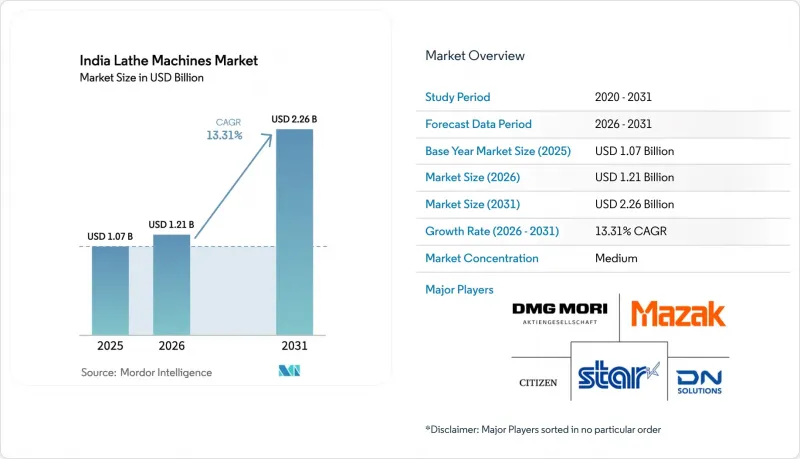
This report is Segmented by Product Type (CNC Lathe, Conventional Lathe, and Swiss-Type Automatic Lathe), Control Type (Manual, Semi-Automatic, and Automatic), Operation (Turning, Facing, and More), End-User Industry (Automotive, Aerospace and Defence, and More). The Market Forecasts are Provided in Terms of Value (USD).
India Lathe Machines Market Trends and Insights
Accelerated Automation Adoption In Indian MSME Manufacturing
India hosts about 72 million registered MSMEs, many of which are upgrading from conventional to CNC lathes to meet domestic supply-chain and export quality norms. A 2024 Gujarat pilot covering 750 factories showed scrap rates falling from 8-12% to 2-3% after CNC conversion, prompting wider replication programs. CNC installations at MSMEs grew 18% year-over-year in 2025 as the Credit Guarantee Fund Trust covered up to 85% of equipment value on loans below INR 50 lakh (USD 60,000). Yet penetration remains uneven because tier-2 cities such as Rajkot and Ludhiana still run 60-65% conventional lathes. The National Capital Goods Policy, which targets domestic machine-tool output of USD 4 billion, is cutting lead times to as little as four months, so the influence of this driver peaks by 2027.
Government PLI Incentives For Domestic Capital-Goods Production
The 2024 PLI scheme earmarked INR 1,207 crore (USD 14.5 million) for 33 CNC-oriented projects, reimbursing 4-6% of incremental sales for five years. India imported machine tools worth INR 15,352 crore (USD 1.85 billion) in 2023-24, of which turning centers formed roughly one-third. New greenfield facilities in Karnataka and Tamil Nadu promise 4- and 5-axis lathes with home-grown Fanuc-compatible controllers, while the 530-acre Tumakuru Machine Tools Park integrates foundry, fabrication and assembly services to slash component lead times by up to 40% . Because capacity commissioning spans two to three years, the bulk of output and export push arrives between 2027 and 2029.
High Upfront Capex For Multi-Axis CNC Systems
Four- to six-axis lathes cost USD 80,000-250,000, roughly double or triple the annual turnover of a typical Indian job shop. A 2024 survey showed 62% of MSMEs quoting purchase price as the main block to CNC migration. Leasing penetration is barely 18%, far below the 50% norm in Germany, while the CGTMSE ceiling of INR 50 lakh falls short of premium machine prices. Advance payments of up to 40% strain liquidity for manufacturers in Rajkot, Coimbatore and Faridabad, so many defer purchases despite 18-24 month payback periods. The restraint bites hardest in the next two years as interest-rate volatility keeps risk premiums high.
Other drivers and restraints analyzed in the detailed report include:
- Surge In EV Power-Train Machining Demand
- Rapid Rise Of Medical-Device Clusters In Tamil Nadu And Telangana
- Shortage Of Trained CNC Programmers And Operators
For complete list of drivers and restraints, kindly check the Table Of Contents.
Segment Analysis
CNC lathes captured 62.34% of 2025 India lathe machines market share, reflecting their broad use across automotive, general engineering and metal fabrication. Swiss-type automatics, however, are forecast to outpace the India lathe machines market size with a 13.86% CAGR through 2031, fueled by implant and aerospace components that demand bar-fed machining and tolerances below 5 microns. Conventional lathes remain entrenched in roughly one-third of workshops that produce pump shafts and textile rolls, yet ISO 9001- and AS9100-driven audits increasingly disqualify non-CNC equipment.
Imports still dominate the Swiss segment, with Citizen Machinery, Tsugami and Star Micronics holding nearly three-quarters of sales. Domestic builders such as Jyoti CNC Automation and Ace Micromatic target MSMEs with entry-level models priced USD 25,000-40,000, integrating Fanuc or Siemens controls to bridge cost and capability gaps. Licensing moves, including Lakshmi Machine Works' 2024 guide-bushing collaboration, aim to localize critical components and chip away at foreign dominance. Miniaturization trends in wearables and catheter fittings ensure a durable growth premium for Swiss automatics.
Automatic systems commanded 58.78% of 2025 India lathe machines market share and are set for a 13.98% CAGR through 2031 as factories push unmanned night shifts to offset labor cost inflation. Semi-automatic units linger in prototype and short-run roles but lose share as robotic loaders and pallet changers drop below USD 20,000 per cell. Manual machines still serve 25-30% of small repair shops yet face a generational skills void, with younger machinists gravitating toward CNC touchscreens.
Retrofit kits costing USD 8,000-15,000 allow MSMEs to reach 70-80% of new-machine precision, extending the useful life of cast-iron beds by a decade. Gujarat's upgrade pilot showed cycle-time cuts of 25-35% after retrofit adoption. Still, limited spindle speeds and absence of live tooling restrict kits from high-spec EV and orthopedic work. Tier-1 suppliers increasingly treat Industry 4.0 predictive-maintenance readiness as table stakes, accelerating the pull toward fully automatic platforms.
Complete Report Scope:
- By Product Type
- CNC Lathe
- Conventional Lathe
- Swiss-Type Automatic Lathe
- By Control Type
- Manual
- Semi-automatic
- Automatic
- By Operation
- Turning
- Facing
- Boring
- Cutting / Parting
- By End-user Industry
- Automotive
- Aerospace and Defence
- General Manufacturing
- Metal Industry
- Other End-user Industries
List of Companies Covered in this Report:
- Yamazaki Mazak Corporation
- DMG MORI Aktiengesellschaft
- Doosan Machine Tools Co. Ltd. (DN Solutions)
- Citizen Machinery Co. Ltd.
- Star Micronics Co. Ltd.
- Okuma Corporation
- Haas Automation Inc.
- Tsugami Corporation
- Tornos Group SA
- Bharat Fritz Werner Ltd.
- Lakshmi Machine Works Ltd.
- Ace Micromatic Group (Ace Designers Ltd.)
- Jyoti CNC Automation Ltd.
- HMT Machine Tools Ltd.
- Galaxy-Tajmac India Pvt Ltd.
- Laxmi Metal and Machines
- Arrow Machine Tools Pvt Ltd.
- Micromatic Machine Tools Pvt Ltd.
- Emag India Pvt Ltd.
- Murata Machinery Ltd.
Additional Benefits:
- The market estimate (ME) sheet in Excel format
- 3 months of analyst support
TABLE OF CONTENTS
1 INTRODUCTION
- 1.1 Study Assumptions and Market Definition
- 1.2 Scope of the Study
2 RESEARCH METHODOLOGY
3 EXECUTIVE SUMMARY
4 MARKET LANDSCAPE
- 4.1 Market Overview
- 4.2 Market Drivers
- 4.2.1 Accelerated Automation Adoption in Indian MSME Manufacturing
- 4.2.2 Government PLI Incentives for Domestic Capital-Goods Production
- 4.2.3 Surge in EV Power-Train Machining Demand
- 4.2.4 Rapid Rise of Medical-Device Clusters in Tamil Nadu and Telangana
- 4.2.5 Industry 4.0 Retrofit Kits Lowering Upgrade Costs
- 4.2.6 Local Sourcing Mandates in Defence Offset Contracts
- 4.3 Market Restraints
- 4.3.1 High Upfront Capex for Multi-Axis CNC Systems
- 4.3.2 Inadequate Nationwide Machine-Tool Financing Instruments
- 4.3.3 Shortage of Trained CNC Programmers and Operators
- 4.3.4 Persistent Power-Quality Issues in Tier-2 Industrial Hubs
- 4.4 Industry Value, Supply-Chain Analysis
- 4.5 Regulatory Landscape
- 4.6 Technological Outlook
- 4.7 Porter's Five Forces Analysis
- 4.7.1 Bargaining Power of Suppliers
- 4.7.2 Bargaining Power of Buyers
- 4.7.3 Threat of New Entrants
- 4.7.4 Threat of Substitute Products
- 4.7.5 Intensity of Competitive Rivalry
- 4.8 Impact of Macroeconomic Factors on the Market
5 MARKET SIZE AND GROWTH FORECASTS (VALUE)
- 5.1 By Product Type
- 5.1.1 CNC Lathe
- 5.1.2 Conventional Lathe
- 5.1.3 Swiss-Type Automatic Lathe
- 5.2 By Control Type
- 5.2.1 Manual
- 5.2.2 Semi-automatic
- 5.2.3 Automatic
- 5.3 By Operation
- 5.3.1 Turning
- 5.3.2 Facing
- 5.3.3 Boring
- 5.3.4 Cutting / Parting
- 5.4 By End-user Industry
- 5.4.1 Automotive
- 5.4.2 Aerospace and Defence
- 5.4.3 General Manufacturing
- 5.4.4 Metal Industry
- 5.4.5 Other End-user Industries
6 COMPETITIVE LANDSCAPE
- 6.1 Market Concentration
- 6.2 Strategic Moves
- 6.3 Market Share Analysis
- 6.4 Company Profiles
- 6.4.1 Yamazaki Mazak Corporation
- 6.4.2 DMG MORI Aktiengesellschaft
- 6.4.3 Doosan Machine Tools Co. Ltd. (DN Solutions)
- 6.4.4 Citizen Machinery Co. Ltd.
- 6.4.5 Star Micronics Co. Ltd.
- 6.4.6 Okuma Corporation
- 6.4.7 Haas Automation Inc.
- 6.4.8 Tsugami Corporation
- 6.4.9 Tornos Group SA
- 6.4.10 Bharat Fritz Werner Ltd.
- 6.4.11 Lakshmi Machine Works Ltd.
- 6.4.12 Ace Micromatic Group (Ace Designers Ltd.)
- 6.4.13 Jyoti CNC Automation Ltd.
- 6.4.14 HMT Machine Tools Ltd.
- 6.4.15 Galaxy-Tajmac India Pvt Ltd.
- 6.4.16 Laxmi Metal and Machines
- 6.4.17 Arrow Machine Tools Pvt Ltd.
- 6.4.18 Micromatic Machine Tools Pvt Ltd.
- 6.4.19 Emag India Pvt Ltd.
- 6.4.20 Murata Machinery Ltd.
7 MARKET OPPORTUNITIES AND FUTURE OUTLOOK
- 7.1 White-Space and Unmet-Need Assessment

