PUBLISHER: Mordor Intelligence | PRODUCT CODE: 1911824

PUBLISHER: Mordor Intelligence | PRODUCT CODE: 1911824
Europe Two-Wheeler - Market Share Analysis, Industry Trends & Statistics, Growth Forecasts (2026 - 2031)
The Europe two-wheeler market is expected to grow from USD 17.84 billion in 2025 to USD 18.74 billion in 2026 and is forecast to reach USD 23.97 billion by 2031 at 5.05% CAGR over 2026-2031.
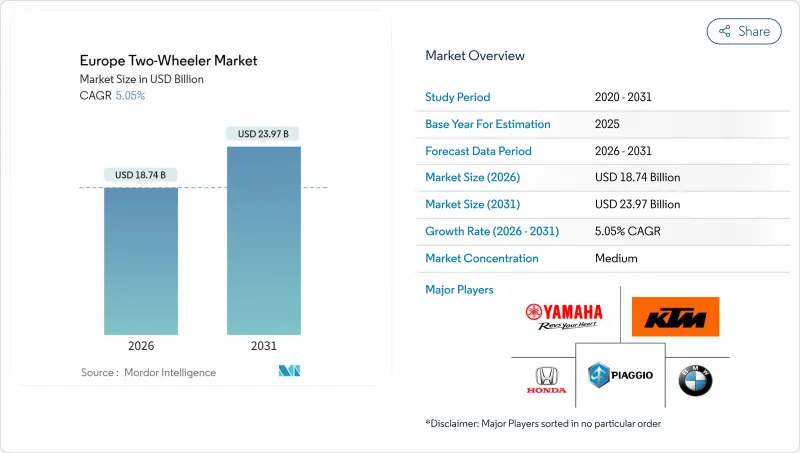
Momentum stems from Euro 5+ emission enforcement, the fast-growing delivery economy, and EU funding for local battery supply chains. Motorcycles are leading because of their highway versatility, while scooters are gaining ground in dense urban cores. Electric propulsion moves from niche to mainstream as battery-swap networks lower upfront cost and urban clean-air zones tighten rules on internal-combustion models. Price polarization grows: sub-USD 1,000 entry scooters sustain mass appeal, yet premium electric bikes above USD 3,001 post the sharpest gains as riders trade up for connectivity, safety tech, and subscription-ready drivetrains. Competition is moderate; legacy brands rely on dealer reach and brand equity, whereas electric specialists exploit direct-to-consumer channels and modular software updates to shorten model cycles.
Europe Two-Wheeler Market Trends and Insights
Rapid Expansion of E-Commerce Delivery Fleets Demanding Low-TCO 2Ws
Online shopping's rise places two-wheelers at the heart of last-mile logistics; Amazon's network of over 13,000 European delivery partners in 2024 typifies the scale. Fleet buyers favor robust frames, telematics, and battery-swap readiness to minimize downtime. Total cost of ownership now eclipses sticker price, making electric scooters preferable despite higher MSRP. Delivery operators lock in bulk orders with service contracts, pressuring OEMs to provide modular battery packs and predictive maintenance APIs. This commercial pivot diversifies demand beyond leisure riders and supports the European two-wheeler market's resilience during economic slowdowns.
Euro 5+ Emission Shift Triggering Pre-Buy and Model Refresh
Euro 5+ standards compel manufacturers to upgrade engines and accelerate electric programs, causing a short-lived pre-buy surge as riders lock in older models before price rises. OEMs clear legacy inventory while pushing premium Euro 5+ offerings, enjoying temporary margin lifts that help bankroll future electric lines. The regulation particularly influences the dominant 126-150 cc class, prompting rapid model cycles and fueling demand for compliant exhaust after-treatment systems. Dealers report elevated showroom traffic ahead of the 2025 enforcement window, reinforcing near-term volume but advancing the long-term shift toward zero-tailpipe-emission products.
Lithium-Spot-Price Volatility Hitting EV MSRP Stability
Lithium carbonate swung in 2024, forcing manufacturers either to re-price monthly or absorb margin hits. Hedging contracts mitigate some spikes, but smaller electric specialists lack balance-sheet heft, threatening production delays. Battery chemistry R&D seeks manganese-rich cathodes to reduce lithium intensity, yet commercialization lies beyond 2026.
Other drivers and restraints analyzed in the detailed report include:
- EU Net-Zero Industry Act Funding Local Battery Supply Chains
- OEM Modular Platforms Enabling 6-Month Model Cycles
- High Insurance Premiums for Below 25-Year-Old Riders
For complete list of drivers and restraints, kindly check the Table Of Contents.
Segment Analysis
Motorcycles controlled 81.02% of the European two-wheeler market share in 2025, reflecting their versatility for commuting and leisure touring. Continuous engine efficiency gains and safety electronics keep loyalists invested, while premium adventure and sport models lift average selling prices. Scooters, although smaller in base, deliver an 7.9% CAGR thanks to congestion charges, parking scarcity, and e-commerce courier demand in megacities. Electric scooters lead urban fleet tenders because simplified drivetrains trim service downtime, reinforcing their commercial edge. Manufacturers market detachable-battery scooters targeting apartment dwellers who lack garage outlets. As more cities restrict high-emission zones, scooter registrations broaden beyond traditional Southern European strongholds into Germany and the Nordics, closing the gap with motorcycle volumes.
Internal-combustion engines retain 90.86% of the European two-wheeler market share in 2025, buoyed by legacy infrastructure and proven reliability. Euro 5+ engines post cleaner emissions without compromising highway performance, keeping demand alive among rural and touring riders. Though with only an 9.14% share, electric variants post a 6.88% CAGR as charging grids densify and battery-swap nodes proliferate. Urban policies increasingly tax or ban low-Euro-class ICE bikes, making electric the default for city commuting and delivery jobs. Subscription bundles that wrap energy, insurance, and maintenance offset upfront battery premiums. Rural adoption lags as fast chargers remain sparse, but planned EU alternative-fuels corridors may narrow the divide after 2027.
The Europe Two-Wheeler Market Report is Segmented by Vehicle Type (Motorcycles and Scooters), Propulsion (ICE and Electric), Engine Capacity/Motor Power (Up To 110cc, and More), Price Band (Up To USD 1, 000, and More), End User (B2C and B2B), Sales Channel (Online and Offline), and by Country. The Market Forecasts are Provided in Terms of Value (USD) and Volume (Units).
List of Companies Covered in this Report:
- BMW Motorrad
- Ducati Motor Holding S.p.A.
- Harley-Davidson Inc.
- Honda Motor Co., Ltd.
- KTM AG
- Piaggio and C. SpA
- Royal Enfield (Eicher Motors)
- Suzuki Motor Corporation
- Triumph Motorcycles Ltd
- Yamaha Motor Co., Ltd.
- Niu Technologies
- Yadea Group Holdings Ltd
- Zero Motorcycles Inc.
- Kawasaki Motors Ltd
- Peugeot Motocycles
Additional Benefits:
- The market estimate (ME) sheet in Excel format
- 3 months of analyst support
TABLE OF CONTENTS
1 Introduction
- 1.1 Study Assumptions and Market Definition
- 1.2 Scope of the Study
2 Research Methodology
3 Executive Summary
4 Key Industry Trend
- 4.1 Population and Urbanization Rate
- 4.2 GDP per Capita (PPP) and Median Disposable Income
- 4.3 Consumer Spend on Vehicle Purchase/Transport (CVP)
- 4.4 Fuel Prices
- 4.5 Interest Rate for 2-Wheeler/Auto Loans and Credit Access
- 4.6 2-Wheeler Penetration and Parc
- 4.7 Dealer/Service Network Density
- 4.8 Two-Wheeler Trade and Revenue (Imports/Exports)
- 4.9 Electrification Readiness (Infrastructure and Power)
- 4.10 Battery Pack Price and Chemistry Mix
- 4.11 Battery Swapping Stations (Network Density and Utilization)
- 4.12 New Model Pipeline and OEM Coverage
- 4.13 Value-Chain Localization and Assembly Capacity
- 4.14 Regulatory Framework
- 4.14.1 Vehicle Standards, Safety and Roadworthiness
- 4.14.2 CBU/CKD/SKD Duties, VAT and Local-Content Rules
- 4.14.3 Electrification, Energy and Environmental Policy
- 4.14.4 Rules for Bike-Taxi, Delivery Fleets and Financing
5 Market Landscape
- 5.1 Market Overview
- 5.2 Market Drivers
- 5.2.1 Euro 5+ Emission Shift Triggering Pre-Buy and Model Refresh
- 5.2.2 Rapid Expansion of E-Commerce Delivery Fleets Demanding Low-TCO 2Ws
- 5.2.3 Battery-Swap Business Models Lowering Up-Front EV Cost for Urban Users
- 5.2.4 Youth Preference for Subscription-Based Mobility Services
- 5.2.5 OEM Modular Platforms Enabling 6-Month Model Cycles
- 5.2.6 EU Net-Zero Industry Act Funding Local Battery Supply Chains
- 5.3 Market Restraints
- 5.3.1 High Insurance Premiums for Below 25-Year-Old Riders
- 5.3.2 Tightened Shared-Scooter Caps in Tier-1 Cities
- 5.3.3 Lithium-Spot-Price Volatility Hitting EV MSRP Stability
- 5.3.4 Dealer Network Consolidation Reducing Rural Service Access
- 5.4 Value / Supply-Chain Analysis
- 5.5 Regulatory Landscape
- 5.6 Technological Outlook
- 5.7 Porter's Five Forces
- 5.7.1 Threat of New Entrants
- 5.7.2 Bargaining Power of Suppliers
- 5.7.3 Bargaining Power of Buyers
- 5.7.4 Threat of Substitutes
- 5.7.5 Industry Rivalry
6 Market Size and Growth Forecasts (Value (USD) and Volume (Units))
- 6.1 By Vehicle Type
- 6.1.1 Motorcycles
- 6.1.2 Scooters
- 6.2 By Propulsion
- 6.2.1 Internal Combustion Engine (ICE)
- 6.2.2 Electric
- 6.3 By Engine Capacity / Motor Power
- 6.3.1 Internal Combustion Engine (ICE)
- 6.3.1.1 Up to110 cc
- 6.3.1.2 111-125 cc
- 6.3.1.3 126-150 cc
- 6.3.1.4 151-200 cc
- 6.3.1.5 201-250 cc
- 6.3.1.6 250-350 cc
- 6.3.1.7 350-500 cc
- 6.3.1.8 Above 500 cc
- 6.3.2 Electric
- 6.3.2.1 Up to 1.0 kW
- 6.3.2.2 1.1-3.0 kW
- 6.3.2.3 3.1-5.0 kW
- 6.3.2.4 Above 5.0 kW
- 6.3.1 Internal Combustion Engine (ICE)
- 6.4 By Price Band
- 6.4.1 Up to USD 1,000
- 6.4.2 USD 1,000-1,500
- 6.4.3 USD 1,501-2,000
- 6.4.4 USD 2,001-3,000
- 6.4.5 USD 3,001-5,000
- 6.4.6 Above USD 5,000
- 6.5 By End User
- 6.5.1 B2C
- 6.5.2 B2B
- 6.5.2.1 Ride-Hail / Bike-Taxi / Rental / Tourism
- 6.5.2.2 Delivery and Logistics
- 6.5.2.3 Corporate and SME Fleets
- 6.5.2.4 Others (Government and Institutional, NGO)
- 6.6 Sales Channel
- 6.6.1 Online
- 6.6.2 Offline
- 6.7 Geography
- 6.7.1 Germany
- 6.7.2 France
- 6.7.3 Italy
- 6.7.4 Spain
- 6.7.5 United Kingdom
- 6.7.6 Netherlands
- 6.7.7 Sweden
- 6.7.8 Poland
- 6.7.9 Austria
- 6.7.10 Belgium
- 6.7.11 Norway
- 6.7.12 Czech Republic
- 6.7.13 Portugal
- 6.7.14 Greece
7 Competitive Landscape
- 7.1 Market Concentration
- 7.2 Strategic Moves
- 7.3 Market Share Analysis
- 7.4 Company Profiles (Includes Global level Overview, Market level overview, Core Segments, Financials as available, Strategic Information, Market Rank/Share for key companies, Products and Services, and Recent Developments)
- 7.4.1 BMW Motorrad
- 7.4.2 Ducati Motor Holding S.p.A.
- 7.4.3 Harley-Davidson Inc.
- 7.4.4 Honda Motor Co., Ltd.
- 7.4.5 KTM AG
- 7.4.6 Piaggio and C. SpA
- 7.4.7 Royal Enfield (Eicher Motors)
- 7.4.8 Suzuki Motor Corporation
- 7.4.9 Triumph Motorcycles Ltd
- 7.4.10 Yamaha Motor Co., Ltd.
- 7.4.11 Niu Technologies
- 7.4.12 Yadea Group Holdings Ltd
- 7.4.13 Zero Motorcycles Inc.
- 7.4.14 Kawasaki Motors Ltd
- 7.4.15 Peugeot Motocycles
8 Market Opportunities and Future Outlook
- 8.1 White-Space and Unmet-Need Assessment
9 Key Strategic Questions for CEOs

