PUBLISHER: Mordor Intelligence | PRODUCT CODE: 1911825

PUBLISHER: Mordor Intelligence | PRODUCT CODE: 1911825
Indonesia Digital Advertising - Market Share Analysis, Industry Trends & Statistics, Growth Forecasts (2026 - 2031)
The Indonesia digital advertising market is expected to grow from USD 3.23 billion in 2025 to USD 3.41 billion in 2026 and is forecast to reach USD 4.51 billion by 2031 at 5.70% CAGR over 2026-2031.
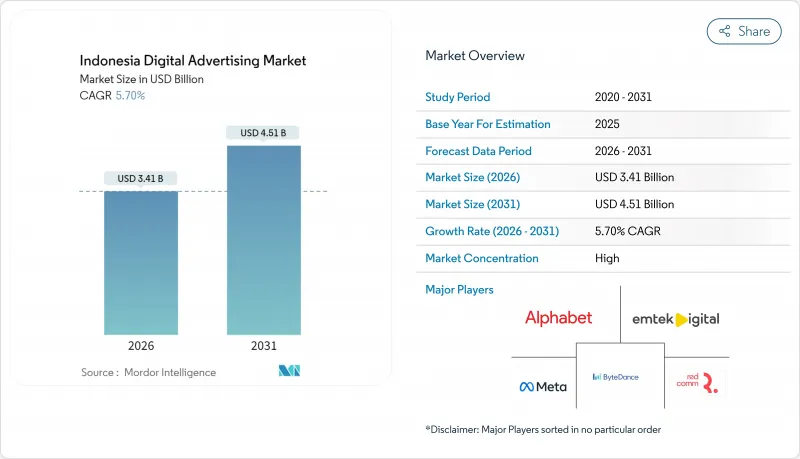
Rising broadband smartphone adoption, social-commerce integration, and video-first consumption patterns continue to redefine media budgets, while performance-oriented models gain traction as brands demand measurable outcomes. Intensifying consolidation talks among super-apps, sovereign AI investments that localize creative at scale, and stricter data-privacy enforcement collectively reshape platform economics and competitive tactics. Meanwhile, connected-TV expansion and live-commerce monetization unlock fresh inventory, encouraging omnichannel strategies that link awareness to conversion across devices. In parallel, higher brand-safety standards and contextual verification tools protect reputation without eroding reach.
Indonesia Digital Advertising Market Trends and Insights
Smartphone penetration and mobile internet boom
Indonesia's mobile-first transition accelerates advertising-budget shifts as smartphone ownership is forecast to climb from 86% in 2025 to 91.3% by 2028. Daily app usage now exceeds 5 hours, and 4G coverage blankets 96.48% of populated areas, enabling reliable programmatic reach even in peri-urban zones. Operator concentration around Telkomsel, Indosat, and XL Axiata provides scaled inventory and deterministic audience data, while Telkomsel's TADEX platform packages premium impressions across thousands of publishers. Rising mobile traffic, up 17.99% YoY in 2024, ensures that the Indonesia digital advertising market remains anchored to handheld screens for the foreseeable future.
Budget shift from traditional to digital media
Marketers allocate progressively larger shares of total spend online as linear-TV ratings wane and OOH fragmentation dilutes impact. National advertisers moved 7 percentage-points of budget from analog to digital between 2023-2025, spurred by compelling ROI evidence and granular targeting unavailable on legacy channels. The shift is led by Jakarta-based multinationals, yet regional brands quickly replicate best practices through performance-marketing workshops. The Indonesia digital advertising market consequently benefits from multi-format experimentation, with dynamic creative optimization and sequential-storytelling campaigns replacing static mass-reach placements.
Ad-fraud and brand-safety concerns
Election-year misinformation surged, with most of consumers perceiving fake news as severe. Brands thus tighten controls, opting for verification partners that classify content at page level rather than blunt keyword blocks. Demand for impression-level transparency grows, yet fragmented publisher quality and livestream complexity raise monitoring costs. Until verification standards mature, pockets of the Indonesia digital advertising market may face supply-side pricing pressure.
Other drivers and restraints analyzed in the detailed report include:
- E-commerce and social-commerce surge
- OTT / short-form video consumption spike
- Personal-Data Protection Law compliance burden
For complete list of drivers and restraints, kindly check the Table Of Contents.
Segment Analysis
Video ads represented 34.02% of spend in 2025, capturing the largest slice of the Indonesia digital advertising market size as OTT viewership soared beyond 3.5 billion monthly hours. High completion rates and improved measurement tools attracted FMCG, automotive, and telco budgets, while six-second bumper ads safeguarded user experience on constrained bandwidth connections. Social media, however, is poised for the quickest ascent at a 6.11% CAGR, buoyed by TikTok's 157.6 million users and frictionless commerce checkout journeys forged after its Tokopedia merger. Even with stricter social-commerce rules, branded-content labeling and first-party data access underpin performance consistency, ensuring continued share gains.
Display and banner formats evolve with responsive designs optimized for vertical video feeds, whereas search remains indispensable for high-intent conversions, especially within travel and financial-services categories. Audio ads benefit from a weekly podcast reach of 42.6%, providing brand-safe storytelling environments. Native integrations and email nurture flows add complementary frequency touches. Collectively, these dynamics keep the Indonesia digital advertising market expanding as advertisers diversify creative to match nuanced consumer moments.
Mobile handsets absorbed 68.10% of expenditure in 2025, underlining the Indonesia digital advertising market share leadership of smartphones in a country where SIM penetration exceeds population and 67% of e-commerce checkouts occur on handhelds. Lightweight SDKs that compress creatives for low-bandwidth regions drive incremental reach without compromising latency. Simultaneously, connected-TV spending is forecast to grow at 6.72% CAGR, turning living-room screens into addressable inventory. Subscription-video households surpass pay-TV, enabling dynamic ad insertion and household-level frequency capping, a boon for brand-lift studies that previously relied on panel-based measurement.
Desktop campaigns persist for B2B intent harvesting and long-form research journeys, while tablets furnish incremental impressions across education and children's content. Next-generation 5G rollouts across Surabaya and Medan further reduce buffering, allowing interactive shoppable ads that merge QR codes with broadcast visuals. Fiber-to-home coverage reaching 97.86% of districts cushions peak-time quality. These infrastructure upgrades reinforce omni-device planning as the Indonesia digital advertising market matures.
The Indonesia Digital Advertising Market Report is Segmented by Advertising Format (Display/Banner, Video, and More), Device (Mobile Handset, Desktop/Laptop, and More), Industry Vertical (FMCG, Telecom, Healthcare and Pharma, and More), Buying Model (Cost-Per-Click, Cost-Per-Mille, and More), and Geography. The Market Forecasts are Provided in Terms of Value (USD).
List of Companies Covered in this Report:
- PT Google Indonesia (Alphabet Inc.)
- Meta Platforms Inc.
- ByteDance Ltd. (TikTok Indonesia)
- PT GoTo Gojek Tokopedia Tbk (GoTo Ads)
- PT Shopee Internasional Indonesia (Sea Ltd.)
- PT Telekomunikasi Indonesia Tbk (IndiHome Ads)
- PT Bukalapak.com Tbk
- PT Traveloka Digital Indonesia
- Dentsu Group Inc. (PT Dentsu Indonesia)
- WPP plc (GroupM Indonesia)
- Omnicom Group Inc. (OMD/PHD Indonesia)
- Publicis Groupe SA (Publicis Indonesia)
- Havas Group SA (Havas Indonesia)
- PT Emtek Digital
- PT ADA Asia (ADA Indonesia)
- PT RedComm Indonesia
- PT HeartMedia Digital (IDN Media)
- PT Verizon Media Indonesia (Yahoo Ads)
- PT InMobi Indonesia
- PT Revindo Jakarta (Reevo)
- PT Kantar Indonesia
- PT Comscore Indonesia
- PT MOLOCO Indonesia
- PT Samsung Ads Indonesia
Additional Benefits:
- The market estimate (ME) sheet in Excel format
- 3 months of analyst support
TABLE OF CONTENTS
1 INTRODUCTION
- 1.1 Study Assumptions and Market Definition
- 1.2 Scope of the Study
2 RESEARCH METHODOLOGY
3 EXECUTIVE SUMMARY
4 MARKET LANDSCAPE
- 4.1 Market Overview
- 4.2 Market Drivers
- 4.2.1 Smartphone penetration and mobile internet boom
- 4.2.2 Budget shift from traditional to digital media
- 4.2.3 E-commerce and social-commerce surge
- 4.2.4 OTT / short-form video consumption spike
- 4.2.5 Govt "Making Indonesia 4.0" SME digitization incentives
- 4.2.6 AI-driven hyper-local targeting via ride-hailing and POS data
- 4.3 Market Restraints
- 4.3.1 Ad-fraud and brand-safety concerns
- 4.3.2 Measurement and attribution fragmentation
- 4.3.3 Personal-Data Protection Law (PDP) compliance burden
- 4.3.4 Uneven broadband outside tier-1 cities
- 4.4 Regulatory Landscape
- 4.5 Technological Outlook
- 4.6 Porter's Five Forces Analysis
- 4.6.1 Bargaining Power of Buyers
- 4.6.2 Bargaining Power of Suppliers
- 4.6.3 Threat of New Entrants
- 4.6.4 Threat of Substitutes
- 4.6.5 Intensity of Competitive Rivalry
5 MARKET SIZE AND GROWTH FORECASTS (VALUE)
- 5.1 By Advertising Format
- 5.1.1 Display/Banner
- 5.1.2 Video
- 5.1.3 Social Media
- 5.1.4 Search
- 5.1.5 Audio/Podcast
- 5.1.6 Native
- 5.1.7 Email
- 5.2 By Device
- 5.2.1 Mobile Handset
- 5.2.2 Desktop / Laptop
- 5.2.3 Connected TV
- 5.2.4 Tablet and Others
- 5.3 By Industry Vertical
- 5.3.1 FMCG
- 5.3.2 Telecom
- 5.3.3 Healthcare and Pharma
- 5.3.4 Media and Entertainment
- 5.3.5 Financial Services
- 5.3.6 Travel and Tourism
- 5.3.7 E-commerce and Marketplaces
- 5.3.8 Others Industry Verticals
- 5.4 By Buying Model
- 5.4.1 Cost-Per-Click (CPC)
- 5.4.2 Cost-Per-Mille (CPM)
- 5.4.3 Cost-Per-Acquisition (CPA)
- 5.4.4 Cost-Per-View (CPV)
- 5.4.5 Hybrid / Other Buying Models
6 COMPETITIVE LANDSCAPE
- 6.1 Market Concentration
- 6.2 Strategic Moves
- 6.3 Market Share Analysis
- 6.4 Company Profiles (includes Global level Overview, Market level overview, Core Segments, Financials as available, Strategic Information, Market Rank/Share for key companies, Products and Services, and Recent Developments)
- 6.4.1 PT Google Indonesia (Alphabet Inc.)
- 6.4.2 Meta Platforms Inc.
- 6.4.3 ByteDance Ltd. (TikTok Indonesia)
- 6.4.4 PT GoTo Gojek Tokopedia Tbk (GoTo Ads)
- 6.4.5 PT Shopee Internasional Indonesia (Sea Ltd.)
- 6.4.6 PT Telekomunikasi Indonesia Tbk (IndiHome Ads)
- 6.4.7 PT Bukalapak.com Tbk
- 6.4.8 PT Traveloka Digital Indonesia
- 6.4.9 Dentsu Group Inc. (PT Dentsu Indonesia)
- 6.4.10 WPP plc (GroupM Indonesia)
- 6.4.11 Omnicom Group Inc. (OMD/PHD Indonesia)
- 6.4.12 Publicis Groupe SA (Publicis Indonesia)
- 6.4.13 Havas Group SA (Havas Indonesia)
- 6.4.14 PT Emtek Digital
- 6.4.15 PT ADA Asia (ADA Indonesia)
- 6.4.16 PT RedComm Indonesia
- 6.4.17 PT HeartMedia Digital (IDN Media)
- 6.4.18 PT Verizon Media Indonesia (Yahoo Ads)
- 6.4.19 PT InMobi Indonesia
- 6.4.20 PT Revindo Jakarta (Reevo)
- 6.4.21 PT Kantar Indonesia
- 6.4.22 PT Comscore Indonesia
- 6.4.23 PT MOLOCO Indonesia
- 6.4.24 PT Samsung Ads Indonesia
7 MARKET OPPORTUNITIES AND FUTURE OUTLOOK
- 7.1 White-space and Unmet-Need Assessment

