PUBLISHER: Mordor Intelligence | PRODUCT CODE: 2120406

PUBLISHER: Mordor Intelligence | PRODUCT CODE: 2120406
Agricultural Tires - Market Share Analysis, Industry Trends & Statistics, Growth Forecasts (2026 - 2031)
According to Mordor Intelligence, the agricultural tires market size is expected to grow from USD 8.61 billion in 2025 to USD 9.11 billion in 2026 and is forecast to reach USD 12.12 billion by 2031 at a 5.86% CAGR over 2026-2031.
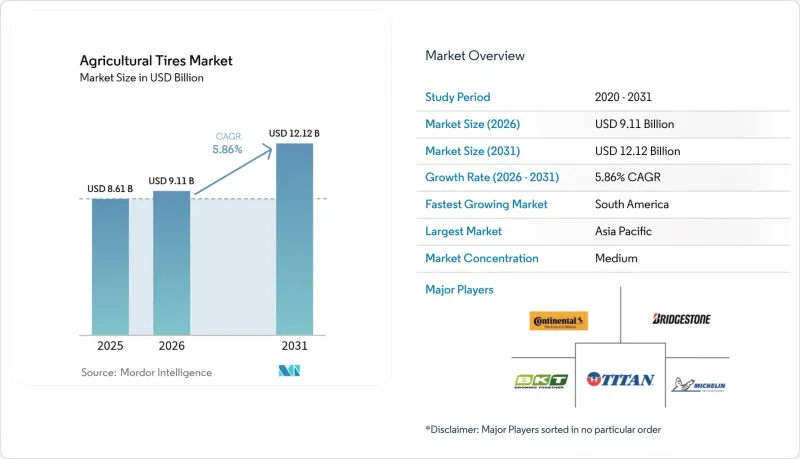
This report is Segmented by Sales Channel (OEM and Replacement/Aftermarket), Application (Tractors, Combine Harvesters, and More), Tire Construction (Bias, Radial, and IF/VF Radial), Rim-Size (Less Than 20 Inch and More), Equipment Horse-Power Class (Less Than 30 HP and More), Inflation-Technology Compatibility, and Geography. The Market Forecasts are Provided in Terms of Value (USD) and Volume (Units).
Global Agricultural Tires Market Trends and Insights
EU-Ukraine Reconstruction Demand Spike
The World Bank's ARISE facility has channelled USD 700 million into farm machinery recovery, aimed at reaching over 90,000 farmers and accelerating orders for high-horsepower tractors that ship with premium radials. Suppliers are reallocating European plant capacity toward IF/VF sizes as cleared acreage returns to grain, sunflower, and rapeseed. Dealers report that tires are among the first consumables replaced when equipment is rebuilt after being destroyed, pushing OEM backlogs higher. Logistics corridors reopened as damaged rail lines were restored, shortening delivery cycles for finished tires and raw materials. The spike is expected to taper after 2027 as the replacement wave normalizes.
Mechanization Momentum in Emerging Economies
Brazilian tractor output is projected to rise after government credit lines revived capital spending on large planters and sprayers. In India, subsidy tweaks and a good monsoon are lifting sentiment, although penetration remains below half of arable land. Chinese cooperatives are pooling plots to justify investments in 100-plus-HP tractors that need larger-diameter radials. Fleet renewal also drives demand, as tractors bought during the 2010-2015 surge are now due for their first tire change. As mechanization progresses, the agricultural tires market benefits from a structural rise in average rim size and load index.
Natural-Rubber and Petrochemical Cost Swings
Plant disease outbreaks in Thailand and Indonesia cut latex yields, while crude-oil fluctuations lifted synthetic rubber and carbon-black costs. Mid-tier tire makers, lacking sophisticated hedging, pushed through multiple price increases, which some cash-constrained farmers deferred by extending tire life. Natural rubber prices fluctuated annually between 13,550 and 17,400 CNY (USD 1,960-2,516.91) per ton in 2025. Larger manufacturers accelerated sustainable-rubber pilot programs to lower exposure, but commercialization will take time. The restraint is cyclical yet recurs often enough to influence contracting strategies and inventory buffers throughout the agricultural tires market.
Other drivers and restraints analyzed in the detailed report include:
- Shift From Bias to Radial / IF-VF Tires
- Real-Time Tire-Pressure and CTIS Adoption
- Commodity-Price Volatility Affecting Farm Income
For complete list of drivers and restraints, kindly check the Table Of Contents.
Segment Analysis
Replacement/Aftermarket tires dominate the agricultural tires market, with a commanding 71.29% share in 2025, reflecting the long operational life of farm equipment and the frequent tire wear cycles under heavy field use. Farmers typically prioritize maintenance to avoid downtime during peak planting and harvest seasons, which drives consistent replacement demand. The aftermarket segment also benefits from expanding rural distribution networks and increasing availability of multi-brand tire options across emerging markets.
Additionally, fluctuations in crop cycles and terrain conditions create steady pull-through demand for new tires, reinforcing the segment's leadership within the global agricultural tires market. Meanwhile, the OEM channel represents the fastest-growing segment, expanding at a 5.97% CAGR through 2031 as new tractor and harvester sales rise in mechanizing economies. Growth in large-horsepower machinery and precision farming equipment further accelerates OEM tire demand, particularly for advanced tire technologies aligned with new equipment specifications.
Tractor tires hold the largest share at 56.73% in 2025, affirming their critical role as the backbone of agricultural machinery worldwide. Tractors require multiple tire configurations for tasks ranging from soil preparation to hauling, making them the single most significant contributor to overall agricultural tire demand. The segment benefits from continuous fleet modernization, growing mechanization in Asia and Africa, and the increasing adoption of high-traction radial and IF/VF technologies for improved fuel efficiency.
Sprayers form the fastest-growing application segment, expanding at a 6.03% CAGR as precision agriculture intensifies. Modern sprayers require specialized tires with low soil compaction and high flotation, creating demand for advanced radial and VF tires that protect crop yields and enhance field productivity. Harvesters require the largest casings to carry heavy grain tanks through soft soils, leading to premium average selling prices. Implementers such as trailers and telehandlers add incremental demand, especially in mixed farming zones where livestock or materials handling broaden tire-use scenarios. Overall, the application mix gradually tilts the agricultural tires market toward specialized patterns and higher value per unit.
Complete Report Scope:
- By Sales Channel
- OEM
- Replacement / Aftermarket
- By Application
- Tractors
- Combine Harvesters
- Sprayers
- Trailers
- Loaders & Telehandlers
- Other Implements
- By Tire Construction
- Bias
- Radial
- IF / VF Radial
- By Rim-Size
- Less than 20 inch
- 20 to 30 inch
- 30 to 40 inch
- More than 40 inch
- By Equipment Horse-Power Class
- Less than 30 HP
- 30 to 70 HP
- 71 to 150 HP
- More than 150 HP
- By Inflation-Technology Compatibility
- Standard Tires
- CTIS-Ready / Smart Tires
- By Geography
- North America
- United States
- Canada
- Rest of North America
- South America
- Brazil
- Argentina
- Rest of South America
- Europe
- Germany
- United Kingdom
- France
- Italy
- Spain
- Russia
- Rest of Europe
- Asia-Pacific
- China
- Japan
- India
- South Korea
- Australia
- Rest of Asia-Pacific
- Middle East and Africa
- United Arab Emirates
- Saudi Arabia
- Turkey
- Egypt
- South Africa
- Rest of Middle East and Africa
- North America
Geography Analysis
Asia-Pacific leads the agricultural tires market, capturing 37.83% of revenue share in 2025, driven by a vast fleet that is still modernizing. Government incentives in India and China encourage tractor ownership beyond traditional cereal belts, while Southeast Asian plantations mechanize to offset labor shortages. Farmers in the region often choose bias or basic radials due to price sensitivity, yet awareness of soil compaction is rising as double-cropping intensifies. Local manufacturers meet entry-level needs, but premium brands grow share where high-value horticulture justifies IF/VF investments.
North America and Europe together represent a mature yet sizable slice of the agricultural tire market. Replacement cycles dominate because mechanization is already universal. Farmers here experiment early with CTIS and smart-tire analytics, making these regions incubators for next-gen features. However, cyclical dips in commodity prices or subsidy reforms quickly filter into OEM production schedules, making demand somewhat erratic. Reconstruction in Eastern Europe adds a transient spike as contaminated fields re-enter cultivation, drawing new machinery with premium tire packages into service.
South America records the fastest growth rate of 6.21% to 2031, propelled by Brazil's soy and corn expansion across the Cerrado and Argentina's push for scale to hedge export volatility. Credit programs enable upgrades to larger tractors and high-capacity sprayers, thus increasing demand for wider rims and advanced tread patterns. The Middle East and Africa remain smaller in absolute value but offer a long runway. Government-backed food security projects, irrigated desert farming, and donor-funded mechanization schemes slowly raise baseline demand. Distribution challenges and harsh climates put a premium on puncture resistance and heat-tolerant compounds. Over time, as credit access widens, a leapfrog effect could move many buyers straight from bias to smart radials, contributing incremental share to the agricultural tires market.
- Bridgestone Corporation
- Michelin
- Continental AG
- Balkrishna Industries Ltd (BKT)
- Titan International Inc.
- Trelleborg AB
- Yokohama Rubber Co. Ltd. (ATG)
- Nokian Tyres plc
- Apollo Tyres Ltd.
- Prometeon Tyre Group
- CEAT Ltd.
- Mitas a.s.
- Goodyear Tire & Rubber Co.
- Hankook Tire & Technology
- GRI Tires
- Maxam Tire International
- Specialty Tires of America
- Magna Tyres Group
- Petlas Tire Industry
Additional Benefits:
- The market estimate (ME) sheet in Excel format
- 3 months of analyst support
TABLE OF CONTENTS
1 Introduction
- 1.1 Study Assumptions & Market Definition
- 1.2 Scope of the Study
2 Research Methodology
3 Executive Summary
4 Market Landscape
- 4.1 Market Overview
- 4.2 Market Drivers
- 4.2.1 Rapid Mechanization & Fleet Renewal in Emerging Markets
- 4.2.2 Shift From Bias to Radial / If-VF Low-Compaction Tires
- 4.2.3 Growing Global Population & Food-Security Pressure
- 4.2.4 Surging Replacement Demand from Aging Tractor Fleet
- 4.2.5 Real-Time Tire-Pressure & CTIS Adoption Accelerating Upgrades
- 4.2.6 EU-Ukraine Reconstruction Triggering OEM Demand Spike
- 4.3 Market Restraints
- 4.3.1 Fluctuating Agricultural Commodity Prices
- 4.3.2 Natural-Rubber & Petrochemical Cost Volatility
- 4.3.3 Supplier Exits Limiting Choice & Raising Prices
- 4.3.4 Rubber-Leaf Disease Constraining Raw-Material Supply
- 4.4 Value / Supply-Chain Analysis
- 4.5 Regulatory Landscape
- 4.6 Technological Outlook
- 4.7 Porter's Five Forces
- 4.7.1 Bargaining Power of Suppliers
- 4.7.2 Bargaining Power of Buyers
- 4.7.3 Threat of New Entrants
- 4.7.4 Threat of Substitutes
- 4.7.5 Competitive Rivalry
5 Market Size & Growth Forecasts (Value (USD) and Volume (Units))
- 5.1 By Sales Channel
- 5.1.1 OEM
- 5.1.2 Replacement / Aftermarket
- 5.2 By Application
- 5.2.1 Tractors
- 5.2.2 Combine Harvesters
- 5.2.3 Sprayers
- 5.2.4 Trailers
- 5.2.5 Loaders & Telehandlers
- 5.2.6 Other Implements
- 5.3 By Tire Construction
- 5.3.1 Bias
- 5.3.2 Radial
- 5.3.3 IF / VF Radial
- 5.4 By Rim-Size
- 5.4.1 Less than 20 inch
- 5.4.2 20 to 30 inch
- 5.4.3 30 to 40 inch
- 5.4.4 More than 40 inch
- 5.5 By Equipment Horse-Power Class
- 5.5.1 Less than 30 HP
- 5.5.2 30 to 70 HP
- 5.5.3 71 to 150 HP
- 5.5.4 More than 150 HP
- 5.6 By Inflation-Technology Compatibility
- 5.6.1 Standard Tires
- 5.6.2 CTIS-Ready / Smart Tires
- 5.7 By Geography
- 5.7.1 North America
- 5.7.1.1 United States
- 5.7.1.2 Canada
- 5.7.1.3 Rest of North America
- 5.7.2 South America
- 5.7.2.1 Brazil
- 5.7.2.2 Argentina
- 5.7.2.3 Rest of South America
- 5.7.3 Europe
- 5.7.3.1 Germany
- 5.7.3.2 United Kingdom
- 5.7.3.3 France
- 5.7.3.4 Italy
- 5.7.3.5 Spain
- 5.7.3.6 Russia
- 5.7.3.7 Rest of Europe
- 5.7.4 Asia-Pacific
- 5.7.4.1 China
- 5.7.4.2 Japan
- 5.7.4.3 India
- 5.7.4.4 South Korea
- 5.7.4.5 Australia
- 5.7.4.6 Rest of Asia-Pacific
- 5.7.5 Middle East and Africa
- 5.7.5.1 United Arab Emirates
- 5.7.5.2 Saudi Arabia
- 5.7.5.3 Turkey
- 5.7.5.4 Egypt
- 5.7.5.5 South Africa
- 5.7.5.6 Rest of Middle East and Africa
- 5.7.1 North America
6 Competitive Landscape
- 6.1 Market Concentration
- 6.2 Strategic Moves
- 6.3 Market Share Analysis
- 6.4 Company Profiles (Includes Global Level Overview, Market Level Overview, Core Segments, Financials as Available, Strategic Information, Market Rank/Share for Key Companies, Products and Services, SWOT Analysis, and Recent Developments)
- 6.4.1 Bridgestone Corporation
- 6.4.2 Michelin
- 6.4.3 Continental AG
- 6.4.4 Balkrishna Industries Ltd (BKT)
- 6.4.5 Titan International Inc.
- 6.4.6 Trelleborg AB
- 6.4.7 Yokohama Rubber Co. Ltd. (ATG)
- 6.4.8 Nokian Tyres plc
- 6.4.9 Apollo Tyres Ltd.
- 6.4.10 Prometeon Tyre Group
- 6.4.11 CEAT Ltd.
- 6.4.12 Mitas a.s.
- 6.4.13 Goodyear Tire & Rubber Co.
- 6.4.14 Hankook Tire & Technology
- 6.4.15 GRI Tires
- 6.4.16 Maxam Tire International
- 6.4.17 Specialty Tires of America
- 6.4.18 Magna Tyres Group
- 6.4.19 Petlas Tire Industry
7 Market Opportunities & Future Outlook
- 7.1 White-space & Unmet-Need Assessment

