
PUBLISHER: Mordor Intelligence | PRODUCT CODE: 1934689

PUBLISHER: Mordor Intelligence | PRODUCT CODE: 1934689
Europe Functional Water - Market Share Analysis, Industry Trends & Statistics, Growth Forecasts (2026 - 2031)
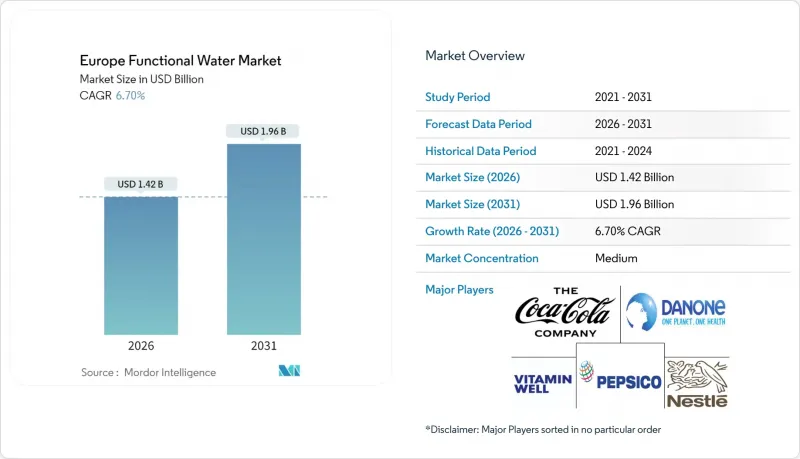
The European functional water market is expected to grow from USD 1.33 billion in 2025 to USD 1.42 billion in 2026 and is forecast to reach USD 1.96 billion by 2031 at 6.7% CAGR over 2026-2031.
As wellness-focused millennials and Gen Z consumers turn away from sugary sodas, they are rapidly embracing nutrient-enhanced hydration, especially those with EFSA-approved claims. This shift is driven by growing health consciousness and a preference for beverages that offer functional benefits beyond basic hydration. The surge in online grocery shopping, strategic premium placements of these beverages alongside mineral water, and the growing trend of at-home fitness all bolster the appeal of scientifically-backed drinks. Today, ingredient transparency holds equal weight to flavor in driving purchases, leading brands to prominently feature clinically supported electrolytes, botanicals, and vitamins on their labels. Consumers increasingly seek products that align with their health goals, further emphasizing the importance of clear and credible ingredient information. While retailers aggressively push their private labels, intensifying price competition, the inherent costs of claim validation create natural barriers, safeguarding innovative formulations. As a result, Europe's functional water market has transitioned from a niche wellness segment to a mainstream premium category, now enjoying margins that outpace those of standard bottled water.
Europe Functional Water Market Trends and Insights
Functional beverages emerge as carbonates alternative
European shoppers are increasingly turning to fortified waters as viable alternatives to sugary sodas, particularly in light of recent tax increases. These beverages are gaining traction due to their perceived health benefits and alignment with wellness trends. Supermarkets are now positioning functional waters alongside premium still water, signaling their premium status and justifying their higher prices. With the sugar levy rising in both France and the United Kingdom, the price difference between sugary sodas and fortified waters has narrowed, encouraging more cost-conscious families to explore these healthier options. Additionally, endorsements from the European Food Safety Authority on vitamin and mineral benefits play a critical role in building consumer trust, as they validate the health claims made by these products. This trust, in turn, fosters brand loyalty and repeat purchases. Brands that effectively communicate calorie-free hydration along with tangible wellness advantages are not only attracting a growing customer base but also creating a strong competitive edge against traditional soft-drink players, ensuring long-term market resilience.
Clean-label and sugar-reduction regulations
EU reforms on nutrition labeling, coupled with local sugar taxes, are favoring categories that naturally align with "no-added-sugar" labels. These reforms aim to address growing consumer demand for healthier options and encourage manufacturers to prioritize transparency in product formulations. Functional waters, often infused with natural fruit essences, seamlessly align with emerging front-of-pack traffic-light schemes, avoiding the need for reformulation. This makes them an attractive choice for health-conscious consumers and a strategic focus for brands looking to expand their market share. Governments in the Nordic region are advocating for ultra-low-sugar standards, prompting retailers to dedicate more shelf space to compliant products, thereby driving competition among manufacturers to meet these stringent requirements. The European Food Safety Authority (EFSA) has clarified which plant extracts are permissible, allowing innovators to craft clean-label recipes that are audit-ready and compliant with future regulatory expectations. Those who were early to invest in these compliant formulations are now reaping price premiums of 15-20% in upscale urban markets, reflecting the growing consumer willingness to pay more for healthier and transparent product options.
Price-sensitive consumers shift to tap/soda
As economic pressures mount across Europe, price-sensitive consumers are increasingly opting for tap water or discounted carbonated drinks. This shift poses challenges for premium functional water brands, especially during inflationary times. Eastern European markets feel this pinch more acutely, as their growth in disposable income trails that of Western Europe. Despite a rising health consciousness, this economic backdrop limits the uptake of functional waters. The situation worsens in times of economic uncertainty, with consumers leaning towards essential purchases over wellness-oriented products. In response, brands are pivoting, introducing value-tier offerings to safeguard their market share. Brands that effectively highlight health benefits, justifying premium prices, find success, especially in regions where high healthcare costs spur preventive wellness spending. This economic constraint also opens doors for brands crafting affordable functional formulations or bulk packaging, ensuring reduced per-serving costs without compromising their health-centric image.
Other drivers and restraints analyzed in the detailed report include:
- Rise of at-home fitness and hydration tech
- Premiumization via novel botanicals
- Sustainability scrutiny on single-use pet
For complete list of drivers and restraints, kindly check the Table Of Contents.
Segment Analysis
In 2025, vitamin-fortified functional waters captured an 18.22% share of the European market. This success stems from consumers' long-standing trust in multivitamins and their immune-boosting claims. Positioned as premium offerings, these waters cater to health-conscious consumers seeking enhanced hydration and command prime shelf space in supermarkets and convenience stores. Yet, this dominance faces challenges. With a surge in gym memberships and heightened awareness of sports nutrition, athletes and fitness enthusiasts are gravitating towards mineral- and electrolyte-rich drinks that replenish essential minerals like sodium, potassium, and magnesium. In response, traditional brands are introducing hybrid products that combine both vitamins and minerals, ensuring they retain their legacy customer base. While the children's market continues to be a stronghold for vitamin-fortified waters, there's a noticeable shift towards next-gen formulations boasting enhanced performance benefits.
Electrolyte and mineral-based functional waters, buoyed by credible performance claims and a surge in sports participation, are forecasted to grow at an impressive 8.65% CAGR. By 2031, this segment's market size is set to more than double, offering newcomers an opportunity to distinguish themselves through validated absorption trials and transparent ingredient disclosures. Capitalizing on this trend, sports-nutrition chains frequently pair functional waters with powders, amplifying sales among active consumers. However, while protein-infused waters and specialized formulations like those with adaptogens or probiotics are benefiting from the high-protein snacking trend, they encounter hurdles. Stringent EFSA regulations on health claims and the "source of protein" terminology escalate their development costs. Smaller innovators face regulatory uncertainties with novel ingredients, hindering their market entry. Conversely, larger players, equipped with robust research and development capabilities and cross-merchandising benefits, are propelling the segment's growth. As the decade progresses, with a focus on evidence-backed claims, market leaders boasting vitamin franchises are broadening their portfolios and fine-tuning formulations, steering Europe's functional water market towards premium, science-driven innovations.
In 2025, PET and glass bottles commanded a dominant 87.18% share of Europe's functional water packaging market. Their stronghold is attributed to established filling lines, widespread consumer familiarity, and advantageous cost structures. PET, which holds the lion's share, is lauded for its lightweight, durable, and recyclable nature. On the other hand, glass bottles uphold a premium image, catering to spa-sourced and restaurant brands that emphasize purity and luxury. Yet, as environmental regulations tighten and recycling incentives grow most notably the Scandinavian deposit schemes consumer preferences are subtly shifting. In areas where bottle deposits hit USD 0.25, there's a noticeable pivot towards aluminum, driven by its promise of infinite recyclability and a reduced carbon footprint.
Forecasts predict a robust 9.45% CAGR growth for canned functional water, buoyed by their sustainable appeal and recyclability in the circular economy. Aluminum cans, with their calibrated pH and oxygen levels, safeguard flavor and nutrient integrity, making them a favorite among eco-conscious consumers and brands. Should recycling rates continue their upward trend, Europe's canned functional water market could surpass USD 820 million by 2031. This surge is bolstered by a growing preference for aluminum over PET or single-use glass, spurred by government and retailer initiatives. In a bid to reduce transport emissions, Germany's Green Dot framework is piloting refillable glass cases for local circulation. Additionally, reverse-vending stations are cropping up in logistics hubs, offering detailed ESG metrics for corporate buyers. While glass remains the go-to for high-end positioning due to its weighty prestige, innovations like refillable systems and digital bottle-tracking technology are pushing sustainability and traceability goals for both retailers and brands.
The Europe Functional Water Market Report is Segmented by Product Type (Vitamin, Protein, Electrolyte/Mineral, and Others), Packaging Type (PET Bottles, and More), Flavor (Flavored, and Non-Flavored), Distribution Channel (Supermarkets/Hypermarkets, Convenience Stores, and More), and Geography (Germany, France, Italy, Spain, Netherlands, and More). The Market Forecasts are Provided in Terms of Value (USD) and Volume (Units).
List of Companies Covered in this Report:
- The Coca-Cola Company
- PepsiCo Inc.
- Danone SA
- Nestle SA
- Acqua Minerale San Benedetto SpA
- Vitamin Well AB
- Gerolsteiner Brunnen GmbH & Co. KG
- Highland Spring Ltd
- Donat Mg (Atlantic Grupa d.d.)
- Viwa Vitamin Water
- Ohmg Water
- Actiph Water
- Mattoni 1873 a.s.
- Protein2o Inc.
- Ferrarelle SpA
- Tata Consumer Products
- Sanpellegrino SpA
- Aqua Carpatica SA
- Vichy Catalan Corp.
- Acqua Minerale San Benedetto SpA
Additional Benefits:
- The market estimate (ME) sheet in Excel format
- 3 months of analyst support
TABLE OF CONTENTS
1 INTRODUCTION
- 1.1 Study Assumptions and Market Definition
- 1.2 Scope of the Study
2 RESEARCH METHODOLOGY
3 EXECUTIVE SUMMARY
4 MARKET LANDSCAPE
- 4.1 Market Overview
- 4.2 Market Drivers
- 4.2.1 Functional beverages are emerging as an alternative to Carbonates
- 4.2.2 Clean-label and sugar-reduction regulations
- 4.2.3 Rise of at-home fitness and hydration tech
- 4.2.4 Premiumisation via novel botanicals
- 4.2.5 Retailer private-label penetration
- 4.2.6 Electrolyte waters in womens wellness
- 4.3 Market Restraints
- 4.3.1 Price-sensitive consumers shift to tap/soda
- 4.3.2 Sustainability scrutiny on single-use PET
- 4.3.3 Functional-claim regulatory tightening
- 4.3.4 Shelf-space squeeze from other high value beverages
- 4.4 Value Chain Analysis
- 4.5 Regulatory Landscape
- 4.6 Technological Outlook
- 4.7 Porter's Five Forces
- 4.7.1 Bargaining Power of Suppliers
- 4.7.2 Bargaining Power of Buyers
- 4.7.3 Threat of New Entrants
- 4.7.4 Threat of Substitutes
- 4.7.5 Competitive Rivalry
5 MARKET SIZE AND GROWTH FORECASTS (VALUE and VOLUME)
- 5.1 By Product Type
- 5.1.1 Vitamin
- 5.1.2 Protein
- 5.1.3 Electrolyte/Mineral
- 5.1.4 Others
- 5.2 By Packaging Type
- 5.2.1 PET Bottles
- 5.2.2 Cans
- 5.2.3 Others
- 5.3 BY Flavor
- 5.3.1 Flavored
- 5.3.2 Non-Flavored
- 5.4 Distribution Channel
- 5.4.1 Supermarkets/Hypermarkets
- 5.4.2 Convenience Stores
- 5.4.3 Online Retail Stores
- 5.4.4 Other Channels
- 5.5 By Geography
- 5.5.1 Germany
- 5.5.2 United Kingdom
- 5.5.3 France
- 5.5.4 Italy
- 5.5.5 Spain
- 5.5.6 Netherlands
- 5.5.7 Poland
- 5.5.8 Belgium
- 5.5.9 Sweden
- 5.5.10 Rest of Europe
6 COMPETITIVE LANDSCAPE
- 6.1 Market Concentration
- 6.2 Strategic Moves
- 6.3 Market Share Analysis
- 6.4 Company Profiles (includes Global level Overview, Market level overview, Core Segments, Financials as available, Strategic Information, Market Rank/Share for key companies, Products and Services, and Recent Developments)
- 6.4.1 The Coca-Cola Company
- 6.4.2 PepsiCo Inc.
- 6.4.3 Danone SA
- 6.4.4 Nestle SA
- 6.4.5 Acqua Minerale San Benedetto SpA
- 6.4.6 Vitamin Well AB
- 6.4.7 Gerolsteiner Brunnen GmbH & Co. KG
- 6.4.8 Highland Spring Ltd
- 6.4.9 Donat Mg (Atlantic Grupa d.d.)
- 6.4.10 Viwa Vitamin Water
- 6.4.11 Ohmg Water
- 6.4.12 Actiph Water
- 6.4.13 Mattoni 1873 a.s.
- 6.4.14 Protein2o Inc.
- 6.4.15 Ferrarelle SpA
- 6.4.16 Tata Consumer Products
- 6.4.17 Sanpellegrino SpA
- 6.4.18 Aqua Carpatica SA
- 6.4.19 Vichy Catalan Corp.
- 6.4.20 Acqua Minerale San Benedetto SpA
7 MARKET OPPORTUNITIES AND FUTURE OUTLOOK

