PUBLISHER: Mordor Intelligence | PRODUCT CODE: 1934702

PUBLISHER: Mordor Intelligence | PRODUCT CODE: 1934702
Cooking Oil - Market Share Analysis, Industry Trends & Statistics, Growth Forecasts (2026 - 2031)
The global cooking oil market was valued at USD 296.41 billion in 2025 and estimated to grow from USD 308.74 billion in 2026 to reach USD 378.54 billion by 2031, at a CAGR of 4.16% during the forecast period (2026-2031).
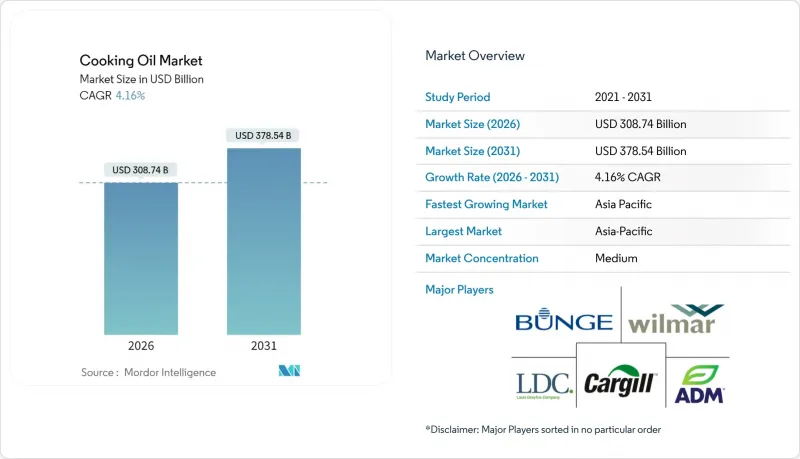
Market growth is primarily driven by shifting consumer preferences, regulatory updates, and advancements in oil extraction and processing technologies. Factors such as urbanization, varied dietary habits, and the recovery of the foodservice industry further contribute to market expansion, as more consumers seek convenient and diverse food options. The adoption of cold-press and subcritical extraction technologies has enhanced product quality and yield, offering healthier and more sustainable alternatives to traditional methods. Additionally, rising consumer demand for functional, organic, and sustainably certified oils, influenced by updated nutrition labeling regulations in key markets, is shaping the industry by encouraging manufacturers to innovate and meet evolving standards. Significant developments, including the Bunge-Viterra merger, Cargill's processing facility upgrades, and new crushing facility projects, are reshaping global supply chains and the competitive landscape, enabling companies to optimize production and distribution processes to meet growing demand efficiently.
Global Cooking Oil Market Trends and Insights
Increasing Consumer Preference for Healthy and Functional Oils
The FDA's revised definition of "healthy," taking effect February 25, 2025, represents a significant shift in food labeling regulations by including oils in its classification, enabling olive oil products to carry healthy food labels for the first time . This regulatory update addresses growing consumer interest in oils containing beneficial compounds such as omega-3 fatty acids, antioxidants, and vitamin E, which has created opportunities for manufacturers to develop premium products across various food categories. In the United States, market analysis reveals diverse consumer attitudes toward seed oils, with purchasing decisions increasingly shaped by social media discussions and health-related content. The inclusion of vegetable oils in healthy diet recommendations by the 2025 Dietary Guidelines Advisory Committee provides scientific backing for continued market expansion, particularly benefiting manufacturers of olive, avocado, and specialty seed oils who position their products as functional ingredients with specific health benefits.
Demand for Organic, Cold-Pressed, and Non-GMO Cooking Oils
Soybeans have emerged as the dominant organic oilseed crop within the organic arable land segment, reflecting a significant shift in agricultural production patterns. The organic market's sustained expansion has generated robust demand for premium oils, particularly in Europe and North America, where increasingly informed consumers actively pursue certified organic and non-GMO products for their dietary requirements. The financial analysis of small-scale cold-press extraction operations demonstrates compelling economic viability, with businesses achieving breakeven within 23 months at their specified production volumes and market-driven pricing structures. This accessible business model has created valuable opportunities for local entrepreneurs to establish themselves in the premium oil production market. Responding to these market dynamics, ADM made a strategic move to enhance its European presence in September 2024 through the acquisition of specialized facilities in Hungary dedicated to non-GMO soybean and corn oil production, effectively addressing European consumer preferences while ensuring compliance with the region's comprehensive regulatory framework for genetic modification labeling.
Increasing Regulatory Scrutiny on Labeling, Additives, and Contaminants
The global cooking oil industry faces increasingly complex regulatory requirements across major markets, reflecting heightened concerns about product quality and consumer safety. The Canadian Food Inspection Agency has implemented rigorous compliance measures for olive oil, requiring manufacturers to ensure their products meet precise international standards for free fatty acid content in 'extra virgin' and 'virgin' classifications . Similarly, the European Union's introduction of mineral oil hydrocarbon restrictions has created significant operational challenges for vegetable oil producers, particularly regarding MOAH contamination limits in infant formula, with potential expansion to other food categories. In the United States, regional regulations have become more stringent, with Texas implementing comprehensive warning label requirements for 44 food additives starting January 2027, while Louisiana now requires detailed disclosure through QR codes and menu listings for common seed oils such as canola and soybean. These regional and national requirements operate alongside international standards, as evidenced by the Codex Alimentarius Committee's 28th session, which expanded its vegetable oil standards to include emerging products like avocado and Camellia seed oils, necessitating substantial investments in compliance measures by industry participants.
Other drivers and restraints analyzed in the detailed report include:
- Growth in Fast Food and Processed Food Industries Boosting Cooking Oil Usage
- Rising Adoption of Sustainable and Ethically Sourced Oils
- Risk of Adulteration and Counterfeit Products
For complete list of drivers and restraints, kindly check the Table Of Contents.
Segment Analysis
Palm oil continues to dominate the vegetable oils market, commanding a substantial 33.12% market share in 2025. This prominence stems from its exceptional land use efficiency, yielding 2.9 tonnes per hectare, which sets it apart from competing vegetable oil alternatives in terms of productivity and resource optimization. The market structure reflects a significant geographical concentration, with Indonesia and Malaysia jointly controlling 83% of global production. This duopoly has established these nations as pivotal players in the international vegetable oils trade, influencing global supply dynamics and price mechanisms.
The coconut oil segment presents a compelling growth narrative, exhibiting a robust CAGR of 4.97% through 2031. This expansion is fundamentally driven by evolving consumer preferences in developed markets, particularly in the United States and European Union, where demand for premium coconut oil products continues to strengthen. The market's growth trajectory is further reinforced by increasing Chinese import volumes, which contribute significantly to market momentum. Despite these positive demand indicators, global production capacity remains consistent at 3.22 million metric tons, creating an interesting dynamic between supply stability and growing market demand.
The Cooking Oil Market Report is Segmented by Product Type (Palm Oil, Soybean Oil, Rapeseed/Canola Oil, and More), Processing Type (Refined, and Unrefined), End User (Food Processing, Foodservice/HoReCa, and Retail), and Geography (North America, Europe, Asia-Pacific, South America, and Middle East and Africa). The Market Forecasts are Provided in Terms of Value (USD).
Geography Analysis
Asia-Pacific currently dominates the global vegetable oil market with a substantial 52.70% market share in 2025. This leadership position is primarily attributed to Indonesia and Malaysia's commanding presence in palm oil production, collectively contributing 83% of global output. The region's market strength is further reinforced by significant domestic consumption patterns in China and India. Thailand has established a comprehensive approach to palm oil industry development, implementing supportive government policies including tax incentives and infrastructure subsidies to enhance cultivation practices.
North America is emerging as the fastest-growing region, marked by strategic investments in processing infrastructure. A notable example is Louis Dreyfus Company's USD 375 million investment in Ohio, establishing a state-of-the-art facility capable of processing 175,000 bushels daily and producing 320,000 metric tons of refined soybean oil annually by mid-2026. This expansion demonstrates the region's commitment to increasing domestic processing capabilities and meeting growing market demand.
Europe continues to adapt to market changes, particularly in response to geopolitical tensions affecting sunflower oil supply chains and the implementation of the EU Deforestation Regulation, which has introduced new requirements for palm oil imports and certification. In the Middle East and Africa region, Egypt exemplifies market development potential, targeting 1,000 metric tons of olive oil exports for 2023/24, supported by an extensive cultivation program that has added 23 million olive trees since 2015, showcasing the region's commitment to agricultural diversification and export market development.
- Archer Daniels Midland
- Cargill Incorporated
- Bunge Global SA
- Wilmar International Ltd
- Louis Dreyfus Company
- Olam Agri
- Fuji Oil Holdings Inc.
- Musim Mas Group
- Richardson International
- J-Oil Mills Inc.
- Golden Agri-Resources
- COFCO Corporation
- Adani Wilmar Ltd
- Marico Ltd
- Conagra Brands (Wesson)
- Borges International Group
- Grupo Nutresa (Alianza Team)
- Nutiva Inc.
- PT Astra Agro Lestari Tbk
- Henan Glory Oils & Fats Engineering
Additional Benefits:
- The market estimate (ME) sheet in Excel format
- 3 months of analyst support
TABLE OF CONTENTS
1 INTRODUCTION
- 1.1 Study Assumptions and Market Definition
- 1.2 Scope of the Study
2 RESEARCH METHODOLOGY
3 EXECUTIVE SUMMARY
4 MARKET LANDSCAPE
- 4.1 Market Overview
- 4.2 Market Drivers
- 4.2.1 Increasing consumer preference for healthy and functional oils
- 4.2.2 Demand for organic, cold-pressed, and non-GMO cooking oils
- 4.2.3 Growth in fast food and processed food industries boosting cooking oil usage
- 4.2.4 Rising adoption of sustainable and ethically sourced oils
- 4.2.5 Growing popularity of plant-based and vegan diets encouraging oil consumption
- 4.2.6 Technological advancements in oil extraction improving quality and yield
- 4.3 Market Restraints
- 4.3.1 Increasing regulatory scrutiny on labeling, additives, and contaminants
- 4.3.2 Limited shelf-life and storage challenges for premium unrefined oils
- 4.3.3 Variable regional dietary preferences limiting uniform demand
- 4.3.4 Risk of adulteration and counterfeit products
- 4.4 Supply Chain Analysis
- 4.5 Regulatory Outlook
- 4.6 Porter's Five Forces
- 4.6.1 Threat of New Entrants
- 4.6.2 Bargaining Power of Buyers/Consumers
- 4.6.3 Bargaining Power of Suppliers
- 4.6.4 Threat of Substitute Products
- 4.6.5 Intensity of Competitive Rivalry
5 MARKET SIZE and GROWTH FORECASTS (VALUE)
- 5.1 By Product Type
- 5.1.1 Palm Oil
- 5.1.2 Soybean Oil
- 5.1.3 Rapeseed/Canola Oil
- 5.1.4 Sunflower Oil
- 5.1.5 Peanut Oil
- 5.1.6 Coconut Oil
- 5.1.7 Olive Oil
- 5.1.8 Corn Oil
- 5.1.9 Others
- 5.2 By Processing Type
- 5.2.1 Refined
- 5.2.2 Unrefined
- 5.3 By End User
- 5.3.1 Food Processing
- 5.3.2 Foodservice/HoReCa
- 5.3.3 Retail
- 5.3.3.1 Supermarkets and Hypermarkets
- 5.3.3.2 Convenience Stores
- 5.3.3.3 Online Retail
- 5.3.3.4 Others
- 5.4 By Geography
- 5.4.1 North America
- 5.4.1.1 United States
- 5.4.1.2 Canada
- 5.4.1.3 Mexico
- 5.4.1.4 Rest of North America
- 5.4.2 Europe
- 5.4.2.1 Germany
- 5.4.2.2 United Kingdom
- 5.4.2.3 Italy
- 5.4.2.4 France
- 5.4.2.5 Spain
- 5.4.2.6 Netherlands
- 5.4.2.7 Poland
- 5.4.2.8 Belgium
- 5.4.2.9 Sweden
- 5.4.2.10 Rest of Europe
- 5.4.3 Asia-Pacific
- 5.4.3.1 China
- 5.4.3.2 India
- 5.4.3.3 Japan
- 5.4.3.4 Australia
- 5.4.3.5 Indonesia
- 5.4.3.6 South Korea
- 5.4.3.7 Thailand
- 5.4.3.8 Singapore
- 5.4.3.9 Rest of Asia-Pacific
- 5.4.4 South America
- 5.4.4.1 Brazil
- 5.4.4.2 Argentina
- 5.4.4.3 Colombia
- 5.4.4.4 Chile
- 5.4.4.5 Peru
- 5.4.4.6 Rest of South America
- 5.4.5 Middle East and Africa
- 5.4.5.1 South Africa
- 5.4.5.2 Saudi Arabia
- 5.4.5.3 United Arab Emirates
- 5.4.5.4 Nigeria
- 5.4.5.5 Egypt
- 5.4.5.6 Morocco
- 5.4.5.7 Turkey
- 5.4.5.8 Rest of Middle East and Africa
- 5.4.1 North America
6 COMPETITIVE LANDSCAPE
- 6.1 Market Concentration
- 6.2 Strategic Moves
- 6.3 Market Ranking Analysis
- 6.4 Company Profiles (includes Global-level Overview, Market-level Overview, Core Segments, Financials (if available), Strategic Information, Market Rank/Share, Products and Services, Recent Developments)
- 6.4.1 Archer Daniels Midland
- 6.4.2 Cargill Incorporated
- 6.4.3 Bunge Global SA
- 6.4.4 Wilmar International Ltd
- 6.4.5 Louis Dreyfus Company
- 6.4.6 Olam Agri
- 6.4.7 Fuji Oil Holdings Inc.
- 6.4.8 Musim Mas Group
- 6.4.9 Richardson International
- 6.4.10 J-Oil Mills Inc.
- 6.4.11 Golden Agri-Resources
- 6.4.12 COFCO Corporation
- 6.4.13 Adani Wilmar Ltd
- 6.4.14 Marico Ltd
- 6.4.15 Conagra Brands (Wesson)
- 6.4.16 Borges International Group
- 6.4.17 Grupo Nutresa (Alianza Team)
- 6.4.18 Nutiva Inc.
- 6.4.19 PT Astra Agro Lestari Tbk
- 6.4.20 Henan Glory Oils & Fats Engineering
7 MARKET OPPORTUNITIES AND FUTURE OUTLOOK

