
PUBLISHER: Mordor Intelligence | PRODUCT CODE: 1934721

PUBLISHER: Mordor Intelligence | PRODUCT CODE: 1934721
Aggregates - Market Share Analysis, Industry Trends & Statistics, Growth Forecasts (2026 - 2031)
Aggregates market size in 2026 is estimated at 62.3 Billion tons, growing from 2025 value of 58.67 Billion tons with 2031 projections showing 84.12 Billion tons, growing at 6.19% CAGR over 2026-2031.
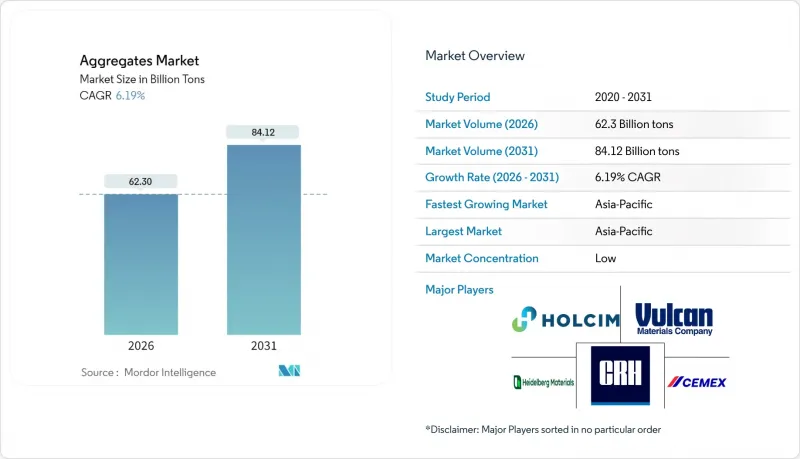
Rising governmental capital-expenditure programs designed to modernize roads, railways, ports, and renewable-energy sites anchor the growth outlook. Demand also benefits from rapid urbanization in emerging economies, widening adoption of ready-mix concrete, and public-sector incentives for low-carbon building materials. Leading producers are deepening vertical integration so that quarry ownership, asphalt, and ready-mix operations share logistics and procurement efficiencies, while circular-economy mandates accelerate investments in recycled aggregates processing. However, high diesel costs inflate haulage expenses, time-consuming environmental approvals delay new quarries, and regulators increasingly scrutinize recycled materials for micro-plastic contamination, creating compliance hurdles.
Global Aggregates Market Trends and Insights
Surging Infrastructure Spending in Emerging Asia-Pacific Markets
China's five-year plan requires 3,800 km of additional high-speed rail lines by 2025, a target that alone necessitates tens of millions of tons of ballast, sand, and crushed stone. Parallel investments in nuclear energy from 58.08 million kW installed in 2024 to 70 million kW by 2025 further expand concrete demand for reactor bases and ancillary facilities. India's 2024-25 Union Budget raised capital outlays by 17.1% to INR 11.1 lakh crore (USD 134 billion), with 24.5% earmarked for the Ministry of Road Transport and Highways, propelling quarry output for highways, bridges, and metro corridors. Across Asia, transport infrastructure needs of USD 43 trillion between 2020 and 2035, of which 63% is dedicated to roads, cement the region's status as the prime growth engine for the construction aggregates market . Smart-city programs in Indonesia, Vietnam, and the Philippines add specialized demand for permeable aggregates used in green pavements and stormwater management systems.
Rising Adoption of Ready-mix Concrete Requiring High-Spec Aggregates
Ready-mix concrete plants now dominate urban supply chains, pushing baseline specifications for gradation, shape, and cleanliness of aggregates used in high-strength mixes. Aggregate Industries opened a 120 m3/hour plant in Birmingham in 2024, emphasizing low-carbon ECOPact concrete, illustrating how formulation changes ripple back to quarry operations that must supply more precisely crushed and washed stone. US residential-construction sentiment is expected to firm as the Federal Reserve guides policy rates to 5.5% by mid-2025, sustaining premium-grade aggregate demand in housing and data-center builds. Highway refurbishments funded by the Bipartisan Infrastructure Law require Superpave asphalt mixes demanding cubical, low-absorption aggregates derived from advanced vertical-shaft impact crushing lines. Emerging data-center and Artificial Intelligence (AI)-compute campuses specify aggregates that support concrete mixes engineered for thermal mass and electromagnetic shielding, opening high-margin niches for mineral fillers rich in magnetite or hematite.
High Transportation and Handling Costs
Diesel-fuel expenses can equal 25% of delivered aggregate price when average haul distances exceed 50 miles. Research shows that trimming haul routes by 15 miles could cut 178 million truck-miles, save 23 million gallons of fuel, and avoid 238,000 tons of CO2 yearly, translating into USD 446 million of logistical savings. Rail is 3-times more fuel-efficient than trucks, yet only 9% of United States shipments move by rail because limited sidings and opaque rate-setting deter adoption . Fuel-price volatility following geopolitical events magnifies budget risk, and carbon-pricing schemes in the EU raise freight surcharges, prompting some contractors to substitute locally available yet lower-quality aggregates to stay within project budgets.
Other drivers and restraints analyzed in the detailed report include:
- Government Stimulus for Low-Carbon Construction Solutions
- Circular-Economy Mandates Boosting Use of Recycled Aggregates
- Stringent Environmental Permitting for New Quarries
For complete list of drivers and restraints, kindly check the Table Of Contents.
Segment Analysis
Sand commanded 40.03% of the Aggregates market in 2025, reflecting its indispensable role in ready-mix concrete, plaster, and asphalt. At 6.19% CAGR, sand remains aligned with the overall Aggregates market trajectory as urban mega-projects across Asia and the Middle East sustain bulk demand. Gravel follows, preferred for road bases and drainage layers, while crushed stone supplies precise gradation for structural concrete and bridge decks. The Aggregates market size attributed to sand is projected to climb steadily, but permit caps on river-sand extraction in China, Vietnam, and Malaysia shift volumes toward manufactured sand sourced from basalt and granite.
Other aggregate types, including recycled concrete, manufactured sand, and lightweight synthetics, represent the fastest-growing slice at a 7.6% CAGR. Recycled concrete aggregates now meet national-standard water-absorption and Los Angeles-abrasion limits, allowing use in structural elements for the first time in Germany and the Netherlands. Cemex's Berlin plant processes 400,000 tons of CDW annually, signalling commercial-scale viability and offering a template for other urban nodes . When a London office tower reused 25% recycled aggregate in its floor slabs in 2024, embodied-carbon intensity fell by 12%, a metric increasingly embedded in asset valuations. As property developers chase green-building credits, the construction aggregates market share of recycled materials is poised to widen beyond its current single-digit level.
The Aggregate Market Report is Segmented by Aggregate Type (Sand, Gravel, Crushed Stone, Slag, and Other Aggregate Types (Recycled, Manufactured, Etc. )), Application (Construction, Insulation, and Other Applications), and Geography (Asia-Pacific, North America, Europe, South America, and Middle East and Africa). The Market Forecasts are Provided in Terms of Volume (tons).
Geography Analysis
Asia-Pacific held 52.07% of global volume in 2025 and is pacing at 7.33% CAGR to 2031. China's need for 3,800 km of new high-speed rail by 2025 and a nuclear-power-capacity uplift of 11.9 million kW push quarry production to records, while India's INR 11.1 lakh crore capital program enriches demand for crushed granite, especially in the Golden Quadrilateral highway upgrades. Japan invests in earthquake-resilient transport arteries and seawall refurbishments, sustaining orders for hard-rock rip-rap.
North America ranks second: United States quarries shipped 2.52 billion tons in 2023 valued at USD 36.8 billion, a 12.5% year-over-year gain, on the back of the Bipartisan Infrastructure Law and manufacturing-onshoring wave. Canada accelerates rail-grade separations in Ontario and British Columbia, while Mexico's nearshoring adds industrial parks along the Bajio and northern corridors that favour limestone. Robust public budgets and an anticipated interest-rate easing cycle underpin 2025-26 pour volumes.
Europe maintains stable, policy-driven consumption. European Union (EU)-wide Construction and Demolition Waste (CDW) recycling mandates create pull-through for secondary aggregates, particularly in Germany, France, and the Nordics, where public procurement favors low-carbon alternatives. Scandinavia's emphasis on passive-house standards lifts demand for lightweight insulation aggregates. South America and the Middle East & Africa trail but exhibit pockets of acceleration: Saudi Arabia's NEOM (New Future) project sources granitic gabbro from domestic quarries, and Brazil revives its federal-road-maintenance backlog, each injecting incremental demand into the global construction aggregates market.
- Breedon Group plc
- Buzzi S.p.A.
- Cemex S.A.B DE C.V.
- China Resources Building Materials Technology Holdings
- CRH
- Eurocem Limited
- Heidelberg Materials AG
- HOLCIM
- Luck Stone
- Martin Marietta Materials
- Rogers Group Inc.
- Vulcan Materials Company
Additional Benefits:
- The market estimate (ME) sheet in Excel format
- 3 months of analyst support
TABLE OF CONTENTS
1 Introduction
- 1.1 Study Assumptions and Market Definition
- 1.2 Scope of the Study
2 Research Methodology
3 Executive Summary
4 Market Landscape
- 4.1 Market Overview
- 4.2 Market Drivers
- 4.2.1 Surging Infrastructure Spending, Especially in Emerging Asia-Pacific Markets
- 4.2.2 Rising Adoption of Ready-mix Concrete Driving Demand for High-spec Aggregates
- 4.2.3 Government Stimulus for Low-Carbon Construction Solutions
- 4.2.4 Circular-economy Mandates Boosting Use of Recycled Aggregates
- 4.2.5 Internet of Things (IoT)-enabled "Smart Aggregates" for Structural Health Monitoring
- 4.3 Market Restraints
- 4.3.1 High Transportation and Handling Costs
- 4.3.2 Stringent Environmental Permitting for New Quarries
- 4.3.3 Volatility in Diesel Prices Impacting Quarry Opex
- 4.3.4 Micro-plastic Contamination Concerns in Recycled Aggregates
- 4.4 Value / Supply-Chain Analysis
- 4.5 Regulatory Landscape
- 4.6 Technological Outlook
- 4.7 Porter's Five Forces
- 4.7.1 Threat of New Entrants
- 4.7.2 Bargaining Power of Buyers
- 4.7.3 Bargaining Power of Suppliers
- 4.7.4 Threat of Substitutes
- 4.7.5 Degree of Competition
5 Market Size and Growth Forecasts (Volume)
- 5.1 By Aggregate Type
- 5.1.1 Sand
- 5.1.2 Gravel
- 5.1.3 Crushed Stone
- 5.1.4 Slag
- 5.1.5 Other Aggregate Types (Recycled, Manufactured, etc.)
- 5.2 By Application
- 5.2.1 Construction
- 5.2.1.1 Buildings
- 5.2.1.2 Railways
- 5.2.1.3 Roadways
- 5.2.1.4 Others
- 5.2.2 Insulation
- 5.2.3 Other Applications
- 5.2.1 Construction
- 5.3 By Geography
- 5.3.1 Asia-Pacific
- 5.3.1.1 China
- 5.3.1.2 Japan
- 5.3.1.3 India
- 5.3.1.4 South Korea
- 5.3.1.5 ASEAN Countries
- 5.3.1.6 Rest of Asia-Pacific
- 5.3.2 North America
- 5.3.2.1 United States
- 5.3.2.2 Canada
- 5.3.2.3 Mexico
- 5.3.3 Europe
- 5.3.3.1 Germany
- 5.3.3.2 United Kingdom
- 5.3.3.3 France
- 5.3.3.4 Italy
- 5.3.3.5 Spain
- 5.3.3.6 Russia
- 5.3.3.7 NORDIC Countries
- 5.3.3.8 Rest of Europe
- 5.3.4 South America
- 5.3.4.1 Brazil
- 5.3.4.2 Argentina
- 5.3.4.3 Rest of South America
- 5.3.5 Middle East and Africa
- 5.3.5.1 Saudi Arabia
- 5.3.5.2 South Africa
- 5.3.5.3 Rest of Middle East and Africa
- 5.3.1 Asia-Pacific
6 Competitive Landscape
- 6.1 Market Concentration
- 6.2 Strategic Moves
- 6.3 Market Share(%)/Ranking Analysis
- 6.4 Company Profiles (includes Global level Overview, Market level overview, Core Segments, Financials as available, Strategic Information, Market Rank/Share for key companies, Products and Services, and Recent Developments)
- 6.4.1 Breedon Group plc
- 6.4.2 Buzzi S.p.A.
- 6.4.3 Cemex S.A.B DE C.V.
- 6.4.4 China Resources Building Materials Technology Holdings
- 6.4.5 CRH
- 6.4.6 Eurocem Limited
- 6.4.7 Heidelberg Materials AG
- 6.4.8 HOLCIM
- 6.4.9 Luck Stone
- 6.4.10 Martin Marietta Materials
- 6.4.11 Rogers Group Inc.
- 6.4.12 Vulcan Materials Company
7 Market Opportunities and Future Outlook
- 7.1 White-space and unmet-need assessment
- 7.2 Smart and Self-Healing Concrete Transforming Aggregate Market

