PUBLISHER: Mordor Intelligence | PRODUCT CODE: 2123789

PUBLISHER: Mordor Intelligence | PRODUCT CODE: 2123789
Textile Dye - Market Share Analysis, Industry Trends & Statistics, Growth Forecasts (2026 - 2031)
According to Mordor Intelligence, the textile dye market size is projected to be USD 12.65 billion in 2025, USD 13.21 billion in 2026, and reach USD 16.71 billion by 2031, growing at a CAGR of 4.81% from 2026 to 2031.
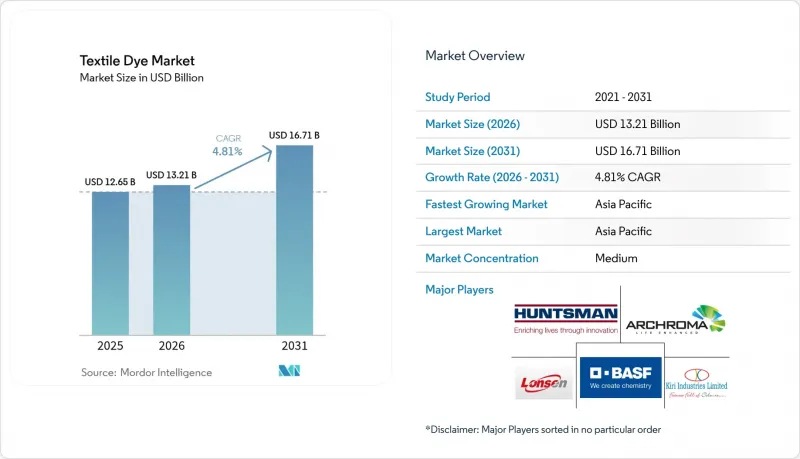
This report is Segmented by Dye Type (Reactive, Dispersive, Direct, Vat, and More), Fiber Type (Cotton, Polyester, Nylon, Wool, Acrylic, Viscose, and Other Fiber Types), Application (Apparel, Household Textiles, Industrial Fabrics, and Other Applications), and Geography (Asia-Pacific, North America, Europe, South America, and Middle East and Africa). The Market Forecasts are Provided in Terms of Value (USD).
Global Textile Dye Market Trends and Insights
Soaring Fast-Fashion Output in Emerging Economies
Bangladesh exported USD 47.4 billion in ready-made garments in 2025, a 12% rise over 2024, and polyester-blend fabrics represented 68% of those shipments. Vietnam attracted USD 3.2 billion in textile foreign direct investment during 2025, mainly in dyeing and finishing plants serving near-shoring strategies of Western retailers. India's Production-Linked Incentive program committed USD 1.44 billion through 2029 to upgrade technical-textile capacity, spurring installations of effluent-treatment units that comply with Zero Discharge of Hazardous Chemicals (ZDHC) protocols. Polyester dyeing consumes 30-40 liters of water per kilogram of fabric compared with 80-100 liters for cotton, lowering energy costs by close to 20% and reinforcing the long-term growth of the textile dyes market. Shorter lead times, from 45 days to 21 days, are now standard for global fast-fashion chains, making the rapid-cycle advantages of dispersive chemistries indispensable.
Expansion of On-Demand Digital Textile Printing
Global digital textile printing capacity increased 28% in 2025, buoyed by 1,847 industrial printer shipments from Kornit Digital, up 28% year on year. On-demand printing slashes inventory waste by 35-40% because brands can trial micro-collections without committing to 5,000-unit minimums. Reactive dyes remain dominant in inkjet formulations for cotton because of their covalent bonding, which delivers ISO 105-C06 Grade 4 wash-fastness without extra processing. Pigment-based solutions are gaining traction on polyester but still face color-gamut limitations that constrain their penetration in fashion lines driven by vibrant shades. As printer droplet sizes shrink to 10 picoliters, dye suppliers must reformulate products for viscosity control, drying speed, and nozzle anti-clogging performance.
Tightening Global Effluent Discharge Norms
China's January 2025 wastewater revision cut allowable chemical oxygen demand to 50 mg/L, forcing 127 dye houses in the Yangtze River Delta to suspend operations pending upgrades. The ZDHC Manufacturing Restricted Substances List added 18 azo dyes in 2024, prompting audits across 11 countries. Installing closed-loop water systems costs USD 2.8-5.1 million per plant, a burden that eliminated roughly one-quarter of smaller facilities in 2025 and drove regional consolidation. Bangladesh's Department of Environment issued 89 closure notices in 2025, disrupting 15-18% of polyester-blend capacity used by Western brands. Stricter norms disproportionately affect reactive and direct dyes with higher biochemical oxygen demand, nudging consumption toward dispersive formulations aligned with polyester growth.
Other drivers and restraints analyzed in the detailed report include:
- Growth in Technical & Protective Textile Usage
- Retail Brand Sustainability Mandates (Bio-Based Dyes)
- Volatility in Petro-Derived Dye Intermediates
For complete list of drivers and restraints, kindly check the Table Of Contents.
Segment Analysis
Dispersive dyes secured 32.11% of 2025 revenue, while the segment's 5.61% CAGR forecast to 2031 exceeds the overall textile dyes market. Polyester's share of global fiber use underpins that trajectory because dispersive formulations bond effectively without auxiliary reducing agents, trimming process time by up to 25%. Reactive dyes will trail at sub-4% growth as cotton's environmental scrutiny intensifies. Direct dyes, valued for economical coloration of cellulosic home textiles, contribute 12-14% but face substitution in regions tightening effluent rules.
Huntsman's supercritical CO2-compatible dispersive range, commercialized in seven East Asian mills during 2025, eliminates water completely, aligning with regulatory pressures and bolstering premium pricing. Vat dyes retain a lucrative slice through durable outdoor and workwear applications, while acidic dyes keep a foothold in nylon and wool. Basic dyes and niche chemistries round out the remainder, with growth limited by declining acrylic fiber use. Collectively, these shifts will keep the textile dyes market share of dispersive dyes on an upward course through 2031.
Complete Report Scope:
- By Dye Type
- Reactive
- Dispersive
- Direct
- Vat
- Acidic
- Basic
- Other Dye Types
- By Fiber Type
- Cotton
- Polyester
- Nylon
- Wool
- Acrylic
- Viscose
- Other Fiber Types
- By Application
- Apparel
- Household Textiles
- Industrial Fabrics
- Other Applications
- By Geography
- Asia-Pacific
- China
- India
- Japan
- South Korea
- Rest of Asia-Pacific
- North America
- United States
- Canada
- Mexico
- Europe
- Germany
- United Kingdom
- France
- Italy
- Russia
- Rest of Europe
- South America
- Brazil
- Argentina
- Rest of South America
- Middle East and Africa
- Saudi Arabia
- United Arab Emirates
- South Africa
- Egypt
- Rest of Middle East and Africa
- Asia-Pacific
Geography Analysis
Asia-Pacific commanded 49.85% of global value in 2025 and is on track for a 5.75% CAGR to 2031. Bangladesh delivered 12% garment-export growth to USD 47.4 billion, Vietnam's USD 3.2 billion 2025 FDI inflows targeted dyeing facilities, and India's USD 1.44 billion incentive budget accelerated effluent-treatment adoption. China remains the largest single country, but ceded 180 basis points of share in 2025 as brands diversify for geopolitical resilience. Japan and South Korea, with stringent OEKO-TEX adoption, fulfill specialty-dye demand in automotive and electronics textiles. Indonesia and Thailand benefit from wage arbitrage yet rely heavily on imported intermediates, exposing them to feedstock volatility.
North America's market share is aided by near-shoring to Mexico, whose 2025 textile FDI totaled USD 890 million. California's AB 405 places end-of-life recyclability at the forefront, prompting investment in bio-based and easily de-inkable dyes suitable for fiber-to-fiber recycling streams. Canada's cold-climate outdoor sector continues to specify vat and acidic dyes with extreme colorfastness, while the United States remains import-reliant for 75-plus % of its dye needs.
Europe is constrained by the 2024 REACH ban on 34 azo dyes and the pending Ecodesign passports by 2027. Germany, Italy, and France compose more than half of regional demand, leveraging premium positioning to pass through sustainability-driven cost uplifts. The United Kingdom contends with 4.5% import tariffs post-Brexit, and Russia's sanctions-impacted sector struggles with specialty-intermediate shortages. South America, led by Brazil is driven by a 214-million-consumer domestic apparel base, while the Middle East and Africa, anchored by Egypt's USD 3.1 billion export milestone and Saudi Arabia's Vision 2030 investments.
- AkikDye
- Archroma
- Atul Ltd
- BASF
- Clariant
- Colourtex Industries Private Limited
- Huntsman International LLC
- Jiangsu World Chemical Co., Ltd
- KeyColour
- Kiri Industries Ltd
- Zhejiang Longsheng Group
- Mahickra Chemicals Limited
- NICCA CHEMICAL CO.,LTD.
- Sun Chemical
- TAIYO HOLDINGS CO., LTD.
- Vipul Organics Ltd
Additional Benefits:
- The market estimate (ME) sheet in Excel format
- 3 months of analyst support
TABLE OF CONTENTS
1 Introduction
- 1.1 Study Assumptions & Market Definition
- 1.2 Scope of the Study
2 Research Methodology
3 Executive Summary
4 Market Landscape
- 4.1 Market Overview
- 4.2 Market Drivers
- 4.2.1 Soaring Fast-Fashion Output in Emerging Economies
- 4.2.2 Expansion of On-Demand Digital Textile Printing
- 4.2.3 Growth in Technical & Protective Textile Usage
- 4.2.4 Retail Brand Sustainability Mandates (Bio-Based Dyes)
- 4.2.5 E-commerce Led Rise in Small-Lot Apparel Orders
- 4.3 Market Restraints
- 4.3.1 Tightening Global Effluent Discharge Norms
- 4.3.2 Volatility in Petro-Derived Dye Intermediates
- 4.3.3 Competitive Threat from Naturally-Colored Cotton
- 4.4 Value Chain Analysis
- 4.5 Porter's Five Forces
- 4.5.1 Bargaining Power of Suppliers
- 4.5.2 Bargaining Power of Buyers
- 4.5.3 Threat of New Entrants
- 4.5.4 Threat of Substitutes
- 4.5.5 Degree of Competition
5 Market Size & Growth Forecasts (Value)
- 5.1 By Dye Type
- 5.1.1 Reactive
- 5.1.2 Dispersive
- 5.1.3 Direct
- 5.1.4 Vat
- 5.1.5 Acidic
- 5.1.6 Basic
- 5.1.7 Other Dye Types
- 5.2 By Fiber Type
- 5.2.1 Cotton
- 5.2.2 Polyester
- 5.2.3 Nylon
- 5.2.4 Wool
- 5.2.5 Acrylic
- 5.2.6 Viscose
- 5.2.7 Other Fiber Types
- 5.3 By Application
- 5.3.1 Apparel
- 5.3.2 Household Textiles
- 5.3.3 Industrial Fabrics
- 5.3.4 Other Applications
- 5.4 By Geography
- 5.4.1 Asia-Pacific
- 5.4.1.1 China
- 5.4.1.2 India
- 5.4.1.3 Japan
- 5.4.1.4 South Korea
- 5.4.1.5 Rest of Asia-Pacific
- 5.4.2 North America
- 5.4.2.1 United States
- 5.4.2.2 Canada
- 5.4.2.3 Mexico
- 5.4.3 Europe
- 5.4.3.1 Germany
- 5.4.3.2 United Kingdom
- 5.4.3.3 France
- 5.4.3.4 Italy
- 5.4.3.5 Russia
- 5.4.3.6 Rest of Europe
- 5.4.4 South America
- 5.4.4.1 Brazil
- 5.4.4.2 Argentina
- 5.4.4.3 Rest of South America
- 5.4.5 Middle East and Africa
- 5.4.5.1 Saudi Arabia
- 5.4.5.2 United Arab Emirates
- 5.4.5.3 South Africa
- 5.4.5.4 Egypt
- 5.4.5.5 Rest of Middle East and Africa
- 5.4.1 Asia-Pacific
6 Competitive Landscape
- 6.1 Market Concentration
- 6.2 Strategic Moves
- 6.3 Market Share(%)/Ranking Analysis
- 6.4 Company Profiles (includes Global level Overview, Market level overview, Core Segments, Financials as available, Strategic Information, Products & Services, Recent Developments)
- 6.4.1 AkikDye
- 6.4.2 Archroma
- 6.4.3 Atul Ltd
- 6.4.4 BASF
- 6.4.5 Clariant
- 6.4.6 Colourtex Industries Private Limited
- 6.4.7 Huntsman International LLC
- 6.4.8 Jiangsu World Chemical Co., Ltd
- 6.4.9 KeyColour
- 6.4.10 Kiri Industries Ltd
- 6.4.11 Zhejiang Longsheng Group
- 6.4.12 Mahickra Chemicals Limited
- 6.4.13 NICCA CHEMICAL CO.,LTD.
- 6.4.14 Sun Chemical
- 6.4.15 TAIYO HOLDINGS CO., LTD.
- 6.4.16 Vipul Organics Ltd
7 Market Opportunities & Future Outlook
- 7.1 White-space & Unmet-need Assessment

