PUBLISHER: Mordor Intelligence | PRODUCT CODE: 2124031

PUBLISHER: Mordor Intelligence | PRODUCT CODE: 2124031
Building Insulation Materials - Market Share Analysis, Industry Trends & Statistics, Growth Forecasts (2026 - 2031)
According to Mordor Intelligence, the building insulation materials market size is expected to increase from USD 32.51 billion in 2025 to USD 33.79 billion in 2026 and reach USD 40.99 billion by 2031, growing at a CAGR of 3.94% over 2026-2031.
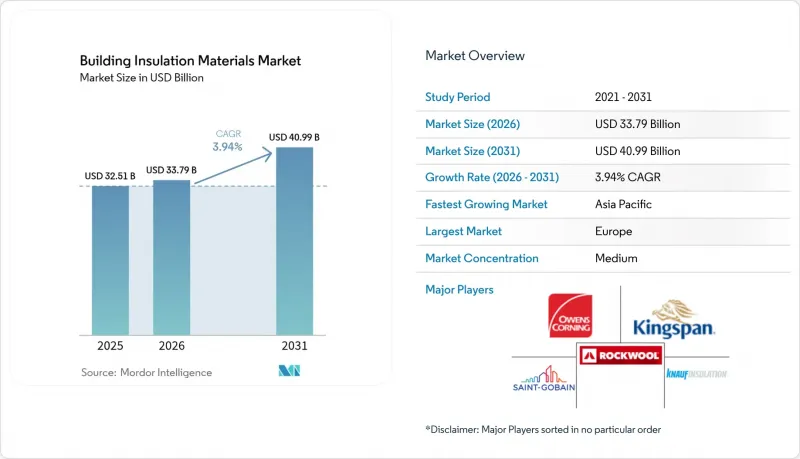
This report is Segmented by Material Type (Fiberglass, Mineral Wool, Cellulose, and More), Application (Roof, Wall, Floor and Basement, and More), End-User (Residential, Non-Residential), Installation (New Construction, Renovation), and Geography (Asia-Pacific, North America, Europe, South America, Middle East and Africa). The Market Forecasts are Provided in Terms of Value (USD).
Global Building Insulation Materials Market Trends and Insights
Growing Demand for Energy-Efficient Buildings
Forty-seven countries strengthened envelope standards in 2024 as buildings consumed 30% of global final energy. California's Title 24-2025 increased attic minimums to R-49, displacing lower-value fiberglass in favor of blown-in cellulose. The EU EPBD recast obliges member states to upgrade 3% of public floor area each year, adding roughly 240 million m2 of facade insulation by 2030. Japan now requires third-party certification for non-residential structures above 300 m2, which is accelerating continuous-insulation systems that eliminate thermal bridges. These rules collectively position high-R-value products as default specifications rather than premium add-ons.
Increasing Green Retrofitting Incentives in North America
The U.S. Inflation Reduction Act offers a 30% tax credit on insulation materials up to USD 1,200 annually, while the 179D deduction pays USD 5 per square foot for deep-energy retrofits. Canada's Greener Homes Grant provided USD 3,700 equivalent per homeowner in 2024-2025 and drove attic and basement projects where heat loss surpasses 35%. Utility rebates such as Pacific Gas & Electric's USD 0.15 per square foot wall-cavity incentive shorten payback periods to under five years. These fiscal levers have shifted insulation from a long-term payback purchase to near-term cash-flow positive upgrades, lifting renovation demand ahead of the new-build cycle.
High Materials and Installation Cost
Spray polyurethane foam averages USD 1.50-2.00 per board foot installed in the United States, double fiberglass batts, while delivering only 30-40% higher R-value. Contractor shortages left North America 15,000 insulators short in 2025, pushing lead times to 12 weeks. Glass-fiber rovings rose 9% on Europe's energy spike, and styrene volatility added USD 80 per cubic meter to foam costs. These economics split the market into premium projects that adopt aerogels and value segments that postpone upgrades.
Other drivers and restraints analyzed in the detailed report include:
- Increasing Government Support for Eco-Friendly and Sustainable Materials
- Growing Preference for Low-VOC Bio-based Foams
- Availability of Affordable Alternatives
For complete list of drivers and restraints, kindly check the Table Of Contents.
Segment Analysis
Fiberglass held 34.65% of the building insulation materials market share in 2025, reflecting its low installed cost and contractor familiarity. Polystyrene materials are forecast to grow at a 4.18% CAGR through 2031 as continuous-insulation codes favor rigid boards that break thermal bridges. Mineral wool volume climbed 11% in European high-rise retrofits after tighter flame-spread rules. Polyurethane and polyisocyanurate foams are transitioning to HFO blowing agents, while aerogels and vacuum panels take niche share in space-constrained retrofits.
The building insulation materials market size for premium aerogel solutions commands 40-50% price premiums. Contractors default to fiberglass in code-minimum residential walls, reserve polystyrene for R-30+ commercial envelopes, and adopt bio-based foams for green-certified projects. Mineral wool's non-combustibility exempts it from costly intumescent coatings, giving it an embedded cost edge where fire testing is strict.
Roof assemblies captured 29.19% of the 2025 demand. However, acoustic partitions and HVAC duct wraps are projected to expand at a 4.85% CAGR as open-plan retrofits seek better sound privacy and ASHRAE 90.1-2022 tightens duct leakage limits. Wall insulation applications are mainly driven by EU facade upgrades, which account for a significant share. Floor and basement products grow modestly where frost-protected foundations need under-slab foam.
Ceiling and attic applications favor blown-in cellulose that trims labor costs by 30%. LEED's new Acoustic Performance credit is pivoting commercial builders toward mineral-wool batts and tiles. The building insulation materials market size for HVAC wraps is poised to reach USD 5 billion by 2031 as data centers specify R-6 duct jackets to cut fan energy, while cool-roof assemblies are pulling polyiso into steep-slope housing.
Complete Report Scope:
- By Material Type
- Fiberglass
- Mineral Wool
- Cellulose
- Polyurethane/Polyisocyanurate Foams (PUR/PIR)
- Polystyrene
- Other Materials (Cork, Aerogel and Vacuum Insulation Panels, Spray Foams, Hemp, Calcium-Silicate, etc.)
- By Application
- Roof
- Wall (External and Cavity)
- Floor and Basement
- Ceiling and Attic
- Acoustic Partition and HVAC Duct
- By End-User
- Residential
- Non-Residential
- Commercial
- Infrastructure
- Other Non-Residential Industries (Education, Healthcare, Civic and Religious,etc.)
- By Installation
- New Construction
- Renovation
- By Geography
- Asia-Pacific
- China
- India
- Japan
- South Korea
- ASEAN Countries
- Rest of Asia-Pacific
- North America
- United States
- Canada
- Mexico
- Europe
- Germany
- United Kingdom
- France
- Italy
- Spain
- Nordics Countries
- Rest of Europe
- South America
- Brazil
- Argentina
- Rest of South America
- Middle East and Africa
- Saudi Arabia
- South Africa
- Rest of Middle East and Africa
- Asia-Pacific
Geography Analysis
Europe held 36.91% of 2025 revenue as the EPBD recast steers every member state toward zero-emission buildings by 2030. Germany processed 420,000 retrofits in 2024 under BEG, and France's ban on F- and G-rated rentals from 2025 affects 4.8 million dwellings. Sweden now requires U-values below 0.15 W/m2K, achieved only with thick mineral wool or vacuum panels.
Asia-Pacific is the fastest-growing region at 4.89% CAGR, propelled by China's plan for 75% of urban buildings to meet green standards by 2025. India's 2024 code extension covers commercial buildings above 100 m2 and tightens wall U-values to 0.40 W/m2K. Japan requires new non-residential buildings to beat baseline energy use by 20% from 2025. Emerging ASEAN markets adopt EDGE and Green Mark in premium projects, though residential penetration remains below 15%.
North America commands a significant market share, with growth rooted in tax-driven retrofits rather than new homes, as mortgage rates dampen housing starts. Canada's interest-free loans up to USD 29,600 are targeting 9.5 million pre-1980 homes. Mexico's updated NOM-020-ENER introduces mandatory envelope resistance in air-conditioned zones. South America and MEA together contribute under 10% but show episodic surges; Saudi Arabia's code now mandates R-13 walls in all government projects, relying on 60% imports.
- Armacell
- Aspen Aerogels Inc.
- Atlas Roofing Corporation
- BASF SE
- Beijing New Building Materials Public Limited Company
- Cellofoam North America Inc.
- Covestro AG
- Dow
- DuPont
- GAF Materials LLC
- Holcim
- Huntsman International LLC
- Johns Manville
- Kingspan Group
- Knauf Group
- Owens Corning
- Recticel NV/SA
- ROCKWOOL A/S
- Saint-Gobain
- Synthos
Additional Benefits:
- The market estimate (ME) sheet in Excel format
- 3 months of analyst support
TABLE OF CONTENTS
1 Introduction
- 1.1 Study Assumptions and Market Definition
- 1.2 Scope of the Study
2 Research Methodology
3 Executive Summary
4 Market Landscape
- 4.1 Market Overview
- 4.2 Market Drivers
- 4.2.1 Growing Demand for Energy Efficient Buildings
- 4.2.2 Increasing Green Retrofitting Incentives in North America
- 4.2.3 Increasing Governemnt Support for the Usage of Eco-Friendly and Sustainable Materials
- 4.2.4 Growing Preference for Low-VOC Bio-based Foams
- 4.2.5 Rising Infrastructure and Industrialization in Asia-Pacific
- 4.3 Market Restraints
- 4.3.1 High Materials and Installation Cost
- 4.3.2 Availability of Affordable Alternatives
- 4.3.3 Regulatory Scrutiny on Global Warming Potential of Blowing Agents
- 4.4 Value Chain Analysis
- 4.5 Regulatory Outlook
- 4.6 Porter's Five Forces
- 4.6.1 Bargaining Power of Suppliers
- 4.6.2 Bargaining Power of Buyers
- 4.6.3 Threat of New Entrants
- 4.6.4 Threat of Substitutes
- 4.6.5 Degree of Competition
5 Market Size and Growth Forecasts (Value)
- 5.1 By Material Type
- 5.1.1 Fiberglass
- 5.1.2 Mineral Wool
- 5.1.3 Cellulose
- 5.1.4 Polyurethane/Polyisocyanurate Foams (PUR/PIR)
- 5.1.5 Polystyrene
- 5.1.6 Other Materials (Cork, Aerogel and Vacuum Insulation Panels, Spray Foams, Hemp, Calcium-Silicate, etc.)
- 5.2 By Application
- 5.2.1 Roof
- 5.2.2 Wall (External and Cavity)
- 5.2.3 Floor and Basement
- 5.2.4 Ceiling and Attic
- 5.2.5 Acoustic Partition and HVAC Duct
- 5.3 By End-User
- 5.3.1 Residential
- 5.3.2 Non-Residential
- 5.3.2.1 Commercial
- 5.3.2.2 Infrastructure
- 5.3.2.3 Other Non-Residential Industries (Education, Healthcare, Civic and Religious,etc.)
- 5.4 By Installation
- 5.4.1 New Construction
- 5.4.2 Renovation
- 5.5 By Geography
- 5.5.1 Asia-Pacific
- 5.5.1.1 China
- 5.5.1.2 India
- 5.5.1.3 Japan
- 5.5.1.4 South Korea
- 5.5.1.5 ASEAN Countries
- 5.5.1.6 Rest of Asia-Pacific
- 5.5.2 North America
- 5.5.2.1 United States
- 5.5.2.2 Canada
- 5.5.2.3 Mexico
- 5.5.3 Europe
- 5.5.3.1 Germany
- 5.5.3.2 United Kingdom
- 5.5.3.3 France
- 5.5.3.4 Italy
- 5.5.3.5 Spain
- 5.5.3.6 Nordics Countries
- 5.5.3.7 Rest of Europe
- 5.5.4 South America
- 5.5.4.1 Brazil
- 5.5.4.2 Argentina
- 5.5.4.3 Rest of South America
- 5.5.5 Middle East and Africa
- 5.5.5.1 Saudi Arabia
- 5.5.5.2 South Africa
- 5.5.5.3 Rest of Middle East and Africa
- 5.5.1 Asia-Pacific
6 Competitive Landscape
- 6.1 Market Concentration
- 6.2 Strategic Moves
- 6.3 Market Share (%)/Ranking Analysis
- 6.4 Company Profiles (includes Global Overview, Market Overview, Core Segments, Financials, Strategic Information, Products and Services, Recent Developments)
- 6.4.1 Armacell
- 6.4.2 Aspen Aerogels Inc.
- 6.4.3 Atlas Roofing Corporation
- 6.4.4 BASF SE
- 6.4.5 Beijing New Building Materials Public Limited Company
- 6.4.6 Cellofoam North America Inc.
- 6.4.7 Covestro AG
- 6.4.8 Dow
- 6.4.9 DuPont
- 6.4.10 GAF Materials LLC
- 6.4.11 Holcim
- 6.4.12 Huntsman International LLC
- 6.4.13 Johns Manville
- 6.4.14 Kingspan Group
- 6.4.15 Knauf Group
- 6.4.16 Owens Corning
- 6.4.17 Recticel NV/SA
- 6.4.18 ROCKWOOL A/S
- 6.4.19 Saint-Gobain
- 6.4.20 Synthos
7 Market Opportunities and Future Outlook
- 7.1 White-space and Unmet-Need Assessment

