PUBLISHER: Mordor Intelligence | PRODUCT CODE: 1934743

PUBLISHER: Mordor Intelligence | PRODUCT CODE: 1934743
Commercial Vehicles Tires - Market Share Analysis, Industry Trends & Statistics, Growth Forecasts (2026 - 2031)
The Commercial Vehicles Tires Market is expected to grow from USD 34.17 billion in 2025 to USD 35.55 billion in 2026 and is forecast to reach USD 43.3 billion by 2031 at 4.03% CAGR over 2026-2031.
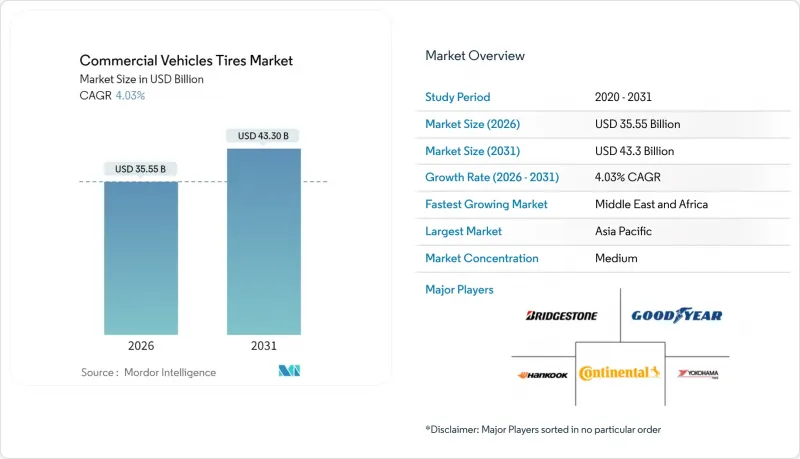
Expanding e-commerce networks intensify last-mile delivery activity, while large infrastructure programs in emerging regions keep construction and haulage fleets active. Radialization of legacy fleets, rising adoption of subscription-based tire services, and stronger demand for premium compounds that lower total operating costs reinforce spending momentum. Growth also benefits from OEM channel acceleration as carriers upgrade vehicles to meet tightening emission norms. Input-cost exposure to natural rubber volatility and evolving sustainability rules temper the overall upside, yet do not derail the demand trend.
Global Commercial Vehicles Tires Market Trends and Insights
Rising E-Commerce Last-Mile Deliveries Boost LCV Tire Demand
E-commerce players continue to densify micro-fulfillment footprints, which keeps light vans operating with higher trip frequency than traditional freight routes. Elevated stop-start patterns raise heat build-up and tread wear, lifting replacement intervals by one-third per vehicle. Electric vans add torque-induced strain that accelerates shoulder abrasion, prompting demand for compounds tuned to resist early fatigue. Manufacturers with broad aftermarket footprints secure quick replenishment businesses that value uptime above price positioning. The phenomenon concentrates in dense urban zones where delivery density is highest and stringent noise and emission rules further favor advanced low-rolling-resistance designs that offset range anxiety.
Fleet Modernization and Radialization in Emerging Markets
Mandates tied to Bharat Stage VI in India and comparable norms in Southeast Asia push carriers to swap bias tires for radials that trim fuel use and extend mileage. Incentive programs reduce the cost gap, accelerating de-stocking of older bias inventories and lifting radial unit value. Suppliers enjoy dual streams during this transition: orderly bias run-outs and fresh radial replenishment. Parallel safety standards on braking distance and load rating strengthen the preference for steel-belted radials, helping manufacturers capture margin lift from advanced designs. Latin American fleets and Eastern European operators mirror the shift as regional emission laws converge with global patterns.
Volatile Natural Rubber and Crude Prices Inflate Input Costs
Raw materials account for nearly half of tire production expense, so swings in latex or oil derivatives quickly erode gross margins. Weather-led supply dips in Thailand or geopolitical shocks that lift crude prices cascade into synthetic polymer spikes. While hedging dampens immediate shocks, there is usually a lag before list prices adjust, creating margin compression in highly competitive bid cycles. Budget segments see sharper demand slowdowns whenever price hikes filter through because fleets postpone discretionary replacements. As a structural response, leading suppliers invest in guayule research and compounding innovations that lower virgin rubber content to curb volatility exposure.
Other drivers and restraints analyzed in the detailed report include:
- Infrastructure Spending Expands Construction Haulage Fleets
- Expansion of Global Logistics Trade Corridors
- Stricter Emission and Disposal Regulations on Tire Makers
For complete list of drivers and restraints, kindly check the Table Of Contents.
Segment Analysis
Light commercial vehicles held 62.68% of the commercial vehicles tires market share in 2025, reflecting unmatched density in parcel, grocery, and service fleets. Cargo density and urban emission regimes accelerate the electrification of these vans, pushing demand for low-noise patterns and stronger sidewalls to cope with battery weight. However, smaller in unit count, medium commercial vehicles are projected to chart the quickest 4.05% CAGR as developing nations up-gauge payload to trim per-trip fuel. Heavy commercial vehicles maintain a stable baseline tied to long-haul freight and earthmoving, yet improved drivetrain efficiency lengthens replacement cycles. Across classes, tire leasing gains acceptance as fleet managers seek to synchronize payment schedules with revenue generation.
Second-generation last-mile platforms that rely on real-time routing elevate mileage unpredictability, making predictive tread-life models valuable. Suppliers respond with RFID tagging to provide casing provenance, simplifying mid-contract asset swaps. The commercial vehicles tire market gains additional volume as ride-sharing couriers acquire vans rather than sedans, boosting average tire diameter and price realization. Safety standards that cap braking distance encourage wider footprints, indirectly raising raw material per unit. Consequently, the commercial vehicles tire industry prioritizes compound R&D that maintains grip without sacrificing wear.
Radial products commanded an 87.25% of the commercial vehicles tires market share in 2025, driven by economies of scale and consistent global OE fitment. Their steel-belt structure delivers lower rolling resistance, supporting carbon-reduction goals. However, solid tires post a 4.14% CAGR by eliminating punctures in forklifts, telehandlers, and underground mining trucks, where downtime is costlier than ride comfort. Bias tires persist only in select low-speed agricultural or off-road niches. Airless prototypes entering pilot fleets show the market's openness to disruptive architectures that promise zero maintenance.
Manufacturers expand radial portfolios with heat-shielding rubber blends that tolerate electric axle torque spikes. Concurrently, they tweak bead geometry for lighter wheels to enhance payload capacity. Solid tire innovators explore polyurethane hybrids, targeting lower weight versus traditional press-on solids. The commercial vehicles tire market size linked to solid formats remains small today but enjoys strong pricing power. Over the forecast horizon, cross-integration between solid and radial technologies may produce hybrid casings aimed at ports and warehouse automation.
The Global Commercial Vehicles Tires Market Report is Segmented by Vehicle Type (Light Commercial Vehicles and More), Tire Type (Radial Tires and More), Application (Cargo Transportation and More), Sales Channel (OEM and Aftermarket), Distribution Channel (Online and Offline), Price Category (Budget, Economy, and Premium), and Geography. The Market Forecasts are Provided in Terms of Value (USD) and Volume (Units).
Geography Analysis
Asia-Pacific contributed 38.30% of the commercial vehicles tires market share in 2025, anchored by China's manufacturing corridors and India's construction boom that keep both OE and replacement lines moving. Government-backed logistics parks and expressway expansions escalate vehicle counts and average axle load, directly raising replacement frequency. Japan and South Korea add high-margin premium demand through advanced fleet digitalization projects that favor integrated tire-data platforms. The region's scale attracts new local production, tightening lead times and buffering currency swings.
The Middle East and Africa posts the fastest 4.12% CAGR to 2031 as Gulf diversification agendas invest in rail-to-port road links and Sub-Saharan mineral extraction. Morocco and Egypt emerge as export hubs, supported by duty-free access to Europe that incentivizes tire plant siting. Mining in South Africa and construction in Saudi Arabia yield sustained demand for off-the-road compounds, which lifts the commercial vehicles' tires market in the region despite modest vehicle density today.
North America and Europe maintain mature but sizeable bases, fueled chiefly by replacement demand. E-commerce keeps less-than-truckload routes busy, while European environmental mandates stimulate a swift shift to low-rolling-resistance radials. Cold-climate regulations drive specialized winter fitments, extending seasonal peaks beyond regular cycles. Across both regions, retreading maintains resilience under sustainability pressure, and digital twins built on real-world wear data guide next procurement rounds, reinforcing premium uptake.
- Bridgestone Corporation
- Michelin
- The Goodyear Tire & Rubber Company
- Continental AG
- Hankook Tire & Technology
- Yokohama Rubber Co., Ltd.
- Sumitomo Rubber Industries, Ltd.
- Pirelli & C. S.p.A.
- Zhongce Rubber Group Co., Ltd. (ZC Rubber)
- Giti Tire Pte. Ltd.
- Apollo Tyres Ltd.
- MRF Limited
- Kumho Tire Co., Inc.
- Toyo Tire Corporation
- Nokian Tyres plc
- CEAT Ltd.
- Linglong Tire Co., Ltd.
- Double Coin Tire Group Ltd.
- Sailun Group Co., Ltd.
Additional Benefits:
- The market estimate (ME) sheet in Excel format
- 3 months of analyst support
TABLE OF CONTENTS
1 Introduction
- 1.1 Study Assumptions & Market Definition
- 1.2 Scope of the Study
2 Research Methodology
3 Executive Summary
4 Market Landscape
- 4.1 Market Overview
- 4.2 Market Drivers
- 4.2.1 Rising E-Commerce Last-Mile Deliveries Boost LCV Tire Demand
- 4.2.2 Fleet Modernization & Radialization In Emerging Markets
- 4.2.3 Infrastructure Spending Expands Construction Haulage Fleets
- 4.2.4 Expansion Of Global Logistics Trade Corridors
- 4.2.5 Tire-As-A-Service Subscription Adoption By Large Fleets
- 4.2.6 Telematics-Led Predictive Maintenance UPS Premium Tire Uptake
- 4.3 Market Restraints
- 4.3.1 Volatile Natural-Rubber & Crude Prices Inflate Input Costs
- 4.3.2 Stricter Emission & Disposal Regulations On Tire Makers
- 4.3.3 Longer-Life Low-Rolling-Resistance Tires Delay Replacement
- 4.3.4 Retread Competition Suppresses New-Tire Demand In EMS
- 4.4 Value / Supply-Chain Analysis
- 4.5 Regulatory Landscape
- 4.6 Technological Outlook
- 4.7 Porter's Five Forces
- 4.7.1 Threat of New Entrants
- 4.7.2 Bargaining Power of Suppliers
- 4.7.3 Bargaining Power of Buyers
- 4.7.4 Threat of Substitutes
- 4.7.5 Competitive Rivalry
5 Market Size & Growth Forecasts (Value (USD) and Volume (Units))
- 5.1 By Vehicle Type
- 5.1.1 Light Commercial Vehicles (LCVs)
- 5.1.2 Medium Commercial Vehicles (MCVs)
- 5.1.3 Heavy Commercial Vehicles (HCVs)
- 5.2 By Tire Type
- 5.2.1 Radial Tires
- 5.2.2 Bias Tires
- 5.2.3 Solid Tires
- 5.3 By Application
- 5.3.1 Cargo Transportation
- 5.3.2 Public Transportation
- 5.3.3 Construction
- 5.3.4 Mining
- 5.3.5 Agriculture
- 5.4 By Sales Channel
- 5.4.1 OEM
- 5.4.2 Aftermarket
- 5.5 By Distribution Channel
- 5.5.1 Online
- 5.5.2 Offline
- 5.6 By Price Category
- 5.6.1 Budget
- 5.6.2 Economy
- 5.6.3 Premium
- 5.7 By Geography
- 5.7.1 North America
- 5.7.1.1 United States
- 5.7.1.2 Canada
- 5.7.1.3 Rest of North America
- 5.7.2 South America
- 5.7.2.1 Brazil
- 5.7.2.2 Argentina
- 5.7.2.3 Rest of South America
- 5.7.3 Europe
- 5.7.3.1 Germany
- 5.7.3.2 United Kingdom
- 5.7.3.3 France
- 5.7.3.4 Italy
- 5.7.3.5 Spain
- 5.7.3.6 Rest of Europe
- 5.7.4 Asia-Pacific
- 5.7.4.1 China
- 5.7.4.2 India
- 5.7.4.3 Japan
- 5.7.4.4 South Korea
- 5.7.4.5 Rest of Asia-Pacific
- 5.7.5 Middle East and Africa
- 5.7.5.1 United Arab Emirates
- 5.7.5.2 Saudi Arabia
- 5.7.5.3 South Africa
- 5.7.5.4 Turkey
- 5.7.5.5 Rest of Middle East and Africa
- 5.7.1 North America
6 Competitive Landscape
- 6.1 Market Concentration
- 6.2 Strategic Moves
- 6.3 Market Share Analysis
- 6.4 Company Profiles (Includes Global Level Overview, Market Level Overview, Core Segments, Financials as Available, Strategic Information, Market Rank/Share for Key Companies, Products and Services, SWOT Analysis, and Recent Developments)
- 6.4.1 Bridgestone Corporation
- 6.4.2 Michelin
- 6.4.3 The Goodyear Tire & Rubber Company
- 6.4.4 Continental AG
- 6.4.5 Hankook Tire & Technology
- 6.4.6 Yokohama Rubber Co., Ltd.
- 6.4.7 Sumitomo Rubber Industries, Ltd.
- 6.4.8 Pirelli & C. S.p.A.
- 6.4.9 Zhongce Rubber Group Co., Ltd. (ZC Rubber)
- 6.4.10 Giti Tire Pte. Ltd.
- 6.4.11 Apollo Tyres Ltd.
- 6.4.12 MRF Limited
- 6.4.13 Kumho Tire Co., Inc.
- 6.4.14 Toyo Tire Corporation
- 6.4.15 Nokian Tyres plc
- 6.4.16 CEAT Ltd.
- 6.4.17 Linglong Tire Co., Ltd.
- 6.4.18 Double Coin Tire Group Ltd.
- 6.4.19 Sailun Group Co., Ltd.
7 Market Opportunities & Future Outlook
- 7.1 White-space & Unmet-Need Assessment

