PUBLISHER: Mordor Intelligence | PRODUCT CODE: 2124884

PUBLISHER: Mordor Intelligence | PRODUCT CODE: 2124884
Dental 3D Printing - Market Share Analysis, Industry Trends & Statistics, Growth Forecasts (2026 - 2031)
According to Mordor Intelligence, the dental 3D printing market size is expected to grow from USD 3.69 billion in 2025 to USD 4.28 billion in 2026 and is forecast to reach USD 8.96 billion by 2031 at 15.92% CAGR over 2026-2031.
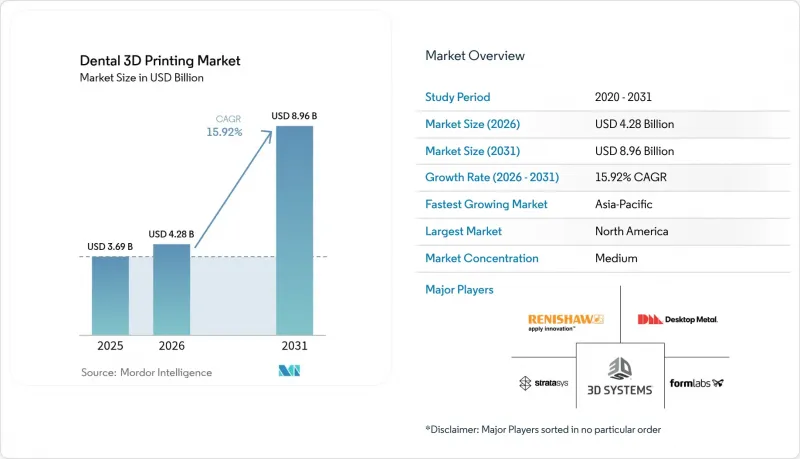
This report is Segmented by Product Type (Equipment, Materials, Services), Printing Technology (Stereolithography, SLS, Polyjet, DLP, FDM), Material Type (Resin, Metal, Polymer, Ceramic), Application (Implants, Prosthodontics, Orthodontics, Surgical Guides), End User (Labs, Clinics, Academia), and Geography (North America, Europe, Asia-Pacific, MEA, South America). Market Forecasts are in Value (USD).
Global Dental 3D Printing Market Trends and Insights
Rising Demand for Cosmetic Dentistry & Aesthetic Restorations
Cosmetic procedures have moved from luxury to expectation, especially among millennials and Gen Z cohorts who link career success to smile aesthetics. DLP resins now ship with 16-shade Vita libraries and tunable translucency, letting labs replicate dentin halos in a single print run while slashing finishing labor. A four-unit anterior bridge costs USD 8-12 in resin and 90 minutes of machine time, versus USD 40-60 for zirconia blanks and 4 hours of milling. Social media exposure, exemplified by 2.1 million #veneers posts in 2025, continues to drive chairside demand. ISO 20795-1 now explicitly covers additive denture polymers, smoothing regulatory paths for new cosmetic materials. Practices that advertise same-day veneers report 15-20% higher case acceptance rates than peers who still rely on lab-based porcelain.
Increasing Adoption of Clear Aligners & Customized Prosthetics
Clear-aligner treatment started at over 15 million in 2025, each requiring 20-40 printed staging models. Mass customization is also spreading to partial dentures, where finite-element modeling tailors clasp forces and reduces enamel wear. Price elasticity drives uptake in emerging markets: Indian clinics sell a flexible-printed denture for USD 80-120, undercutting acrylic by 35%. The FDA's 2024 point-of-care guidance allows orthodontists to print retainers on-site, compressing delivery from 10 days to same-day. Implant crowns with patient-specific emergence profiles show 18-22% lower tissue inflammation, underscoring the additive's clinical edge.
High Capital Investment & Maintenance
A full chairside setup costs USD 35,000-50,000 and includes a scanner, printer, post-cure, wash station, and CAD licenses. Consumables add USD 1,800-2,500 annually, and resin-tank and LCD replacements compound expenses. Leasing options remain scarce in price-sensitive markets where credit costs are high; foreign-exchange swings lift USD-denominated leases by up to 25% in local currency. Return on investment extends beyond 2 years for offices handling fewer than 40 cases per month. Disposal of resin waste, classified as hazardous in the EU, costs EUR 150-200 per quarter, further eroding margins.
Other drivers and restraints analyzed in the detailed report include:
- Cost Reduction & Accuracy Improvements in Dental 3D Printers
- Chairside Intra-Oral-Scanner Integration Enabling Same-Day Restorations
- Regulatory Variability for Material Certification
For complete list of drivers and restraints, kindly check the Table Of Contents.
Segment Analysis
Services are emerging as the fastest-growing slice of the Dental 3D Printing market, advancing at a 16.61% CAGR as practices favor per-case fees over capital purchases. Materials still generated 54.02% of 2025 revenue because every printed crown or aligner model consumes resin, solvent, and build trays. Equipment demand remains healthy among large labs, yet the outsourcing model allows solo offices to access selective laser melting of titanium without spending USD 200,000 on hardware. This pivot aligns with broader healthcare trends toward asset-light operations. Bureau operators leverage scale benefits, buying resin at bulk discounts and running multi-printer farms overnight to keep utilization above 80%. The shift also lifts software subscriptions for cloud-based design portals that link dentists directly to off-site printers, reducing administrative friction. Regulatory nuance shapes uptake; Japan's facility-registration rules push clinics toward external service centers, while the FDA's point-of-care exemption in the United States nudges some offices back to do-it-yourself workflows, creating a patchwork adoption map.
Stereolithography accounted for 34.27% of global volume in 2025, thanks to an early lead and a broad resin catalog. Digital Light Processing, however, will record a 17.65% CAGR as clinics prize its 5-second layer cure and sub-50-micron resolution, which minimizes post-finish polishing. DLP's build rates of 30-40 mm per hour make it indispensable for overnight aligner-model batches where labs output up to 1,000 arches. PolyJet remains a premium niche, prized for multi-material dentures but limited by USD 400-per-liter jets and high support-material waste. Fused Deposition Modeling lingers in orthodontic models, yet its Dental 3D Printing market share is shrinking as DLP unit prices converge toward USD 3,000-4,000. ISO protocols favor resins' mechanical properties, further pressuring FDM.
Complete Report Scope:
- By Product Type
- Equipment
- Materials
- Services
- By Printing Technology
- Stereolithography
- Selective Laser Sintering
- PolyJet / Material Jetting
- Digital Light Processing
- Fused Deposition Modelling
- By Material Type
- Resin
- Metal
- Plastic / Polymer Filament
- Ceramic
- By Application
- Dental Implants
- Prosthodontics
- Orthodontics
- Surgical Guides & Models
- By End User
- Dental Laboratories
- Dental Clinics
- Academic & Research Institutes
- By Geography
- North America
- United States
- Canada
- Mexico
- Europe
- Germany
- United Kingdom
- France
- Italy
- Spain
- Rest of Europe
- Asia-Pacific
- China
- Japan
- India
- Australia
- South Korea
- Rest of Asia-Pacific
- Middle East & Africa
- GCC
- South Africa
- Rest of Middle East & Africa
- South America
- Brazil
- Argentina
- Rest of South America
- North America
Geography Analysis
North America contributed 37.18% of global 2025 revenue, supported by 68% intra-oral-scanner penetration and CDT billing codes that reimburse printed and milled restorations at parity. Fourteen new dental resins secured FDA clearance in 2025 alone, slashing approval cycles to eight months and widening material choice. Canada's 2024 public-insurance expansion adds restorative demand for cost-sensitive removable prosthetics. Near-shoring sees U.S. labs opening facilities in Mexico to tap USD 12-18/hour CAD labor while maintaining 24-hour turnaround. Competitive intensity is high, squeezing resin gross margins to 40%.
Europe shows robust growth despite MDR friction, as standardized rules now span 27 markets. The NHS in England trialed three centralized printing hubs that cut denture queues from 14 to 5 days. Southern Europe is expected to catch up by 2025, with subsidies covering half of the equipment costs for practices in underserved areas. ISO working groups expect final denture-polymer standards by 2027, likely to further streamline continental rollouts.
Asia-Pacific is the fastest-growing region, forecast to grow at an 18.51% CAGR. China's oral-health action plan targets 80% caries-treatment coverage by 2030, and domestic OEMs undercut Western rivals by 30-40% on price. Japan's edentulous seniors drive implant overdenture demand, where metal printing halves framework costs. Indian corporate chains centralize labs to serve 50-100 clinics each, leveraging Ayushman Bharat's denture benefits. Regulatory diversity persists; ASEAN states still require ten distinct approvals, elongating launches by a year.
The Middle East & Africa and South America offer emerging upside. GCC nations fund state-of-the-art digital labs to lure dental tourists. Brazil protects local industry through 18% import tariffs, but gains cost relief from domestic resin production. South African private clinics invest in printers for high-margin cosmetic procedures, but rural public facilities lag behind. Workforce shortages-fewer than 500 CAD-trained technicians across sub-Saharan Africa-limit capacity even when hardware is present.
- 3D Systems
- Align Technology
- Carbon Inc.
- Dentsply Sirona
- Desktop Metal
- EOS GmbH
- EnvisionTEC
- Formlabs Inc.
- Ivoclar Vivadent
- Kulzer
- Prodways Group
- Renishaw plc
- Roland DG Corporation
- SLM Solutions Group AG
- SprintRay
- Stratasys
- Straumann Group
- Voxeljet AG
- Zortrax S.A
Additional Benefits:
- The market estimate (ME) sheet in Excel format
- 3 months of analyst support
TABLE OF CONTENTS
1 Introduction
- 1.1 Study Assumptions & Market Definition
- 1.2 Scope of the Study
2 Research Methodology
3 Executive Summary
4 Market Landscape
- 4.1 Market Overview
- 4.2 Market Drivers
- 4.2.1 Rising Demand for Cosmetic Dentistry & Aesthetic Restorations
- 4.2.2 Increasing Adoption of Clear Aligners & Customised Prosthetics
- 4.2.3 Cost Reduction & Accuracy Improvements in Dental 3D Printers
- 4.2.4 Chairside Intra-Oral-Scanner Integration Enabling Same-Day Restorations
- 4.2.5 Eco-Friendly Bio-Resorbable Resins Demand
- 4.2.6 Increasing Incidence of Dental Caries & Edentulism
- 4.3 Market Restraints
- 4.3.1 High Capital Investment & Maintenance
- 4.3.2 Regulatory Variability for Material Certification
- 4.3.3 IP Concerns Around Intra-Oral Scan Data/Files
- 4.3.4 Shortage Of Trained Digital Dental Technicians
- 4.4 Regulatory Landscape
- 4.5 Technological Outlook
- 4.6 Porter's Five Forces Analysis
- 4.6.1 Threat of New Entrants
- 4.6.2 Bargaining Power of Buyers
- 4.6.3 Bargaining Power of Suppliers
- 4.6.4 Threat of Substitute Products
- 4.6.5 Intensity of Competitive Rivalry
5 Market Size & Growth Forecasts
- 5.1 By Product Type
- 5.1.1 Equipment
- 5.1.2 Materials
- 5.1.3 Services
- 5.2 By Printing Technology
- 5.2.1 Stereolithography
- 5.2.2 Selective Laser Sintering
- 5.2.3 PolyJet / Material Jetting
- 5.2.4 Digital Light Processing
- 5.2.5 Fused Deposition Modelling
- 5.3 By Material Type
- 5.3.1 Resin
- 5.3.2 Metal
- 5.3.3 Plastic / Polymer Filament
- 5.3.4 Ceramic
- 5.4 By Application
- 5.4.1 Dental Implants
- 5.4.2 Prosthodontics
- 5.4.3 Orthodontics
- 5.4.4 Surgical Guides & Models
- 5.5 By End User
- 5.5.1 Dental Laboratories
- 5.5.2 Dental Clinics
- 5.5.3 Academic & Research Institutes
- 5.6 By Geography
- 5.6.1 North America
- 5.6.1.1 United States
- 5.6.1.2 Canada
- 5.6.1.3 Mexico
- 5.6.2 Europe
- 5.6.2.1 Germany
- 5.6.2.2 United Kingdom
- 5.6.2.3 France
- 5.6.2.4 Italy
- 5.6.2.5 Spain
- 5.6.2.6 Rest of Europe
- 5.6.3 Asia-Pacific
- 5.6.3.1 China
- 5.6.3.2 Japan
- 5.6.3.3 India
- 5.6.3.4 Australia
- 5.6.3.5 South Korea
- 5.6.3.6 Rest of Asia-Pacific
- 5.6.4 Middle East & Africa
- 5.6.4.1 GCC
- 5.6.4.2 South Africa
- 5.6.4.3 Rest of Middle East & Africa
- 5.6.5 South America
- 5.6.5.1 Brazil
- 5.6.5.2 Argentina
- 5.6.5.3 Rest of South America
- 5.6.1 North America
6 Competitive Landscape
- 6.1 Market Concentration
- 6.2 Market Share Analysis
- 6.3 Company Profiles (includes Global Level Overview, Market Level Overview, Core Segments, Financials as Available, Strategic Information, Market Rank/Share for Key Companies, Products & Services, and Recent Developments)
- 6.3.1 3D Systems Corporation
- 6.3.2 Align Technology Inc.
- 6.3.3 Carbon Inc.
- 6.3.4 Dentsply Sirona Inc.
- 6.3.5
Desktop Metal
- 6.3.6 EOS GmbH
- 6.3.7 EnvisionTEC
- 6.3.8 Formlabs Inc.
- 6.3.9 Ivoclar Vivadent AG
- 6.3.10 Kulzer GmbH
- 6.3.11 Prodways Group
- 6.3.12 Renishaw plc
- 6.3.13 Roland DG Corporation
- 6.3.14 SLM Solutions Group AG
- 6.3.15 SprintRay Inc.
- 6.3.16 Stratasys Ltd.
- 6.3.17 Straumann Group
- 6.3.18 Voxeljet AG
- 6.3.19 Zortrax S.A
7 Market Opportunities & Future Outlook
- 7.1 White-space & Unmet-Need Assessment

