
PUBLISHER: Mordor Intelligence | PRODUCT CODE: 1934890

PUBLISHER: Mordor Intelligence | PRODUCT CODE: 1934890
Weather Forecasting Services - Market Share Analysis, Industry Trends & Statistics, Growth Forecasts (2026 - 2031)
The weather forecasting services market is expected to grow from USD 3.47 billion in 2025 to USD 3.72 billion in 2026 and is forecast to reach USD 5.23 billion by 2031 at 7.08% CAGR over 2026-2031.
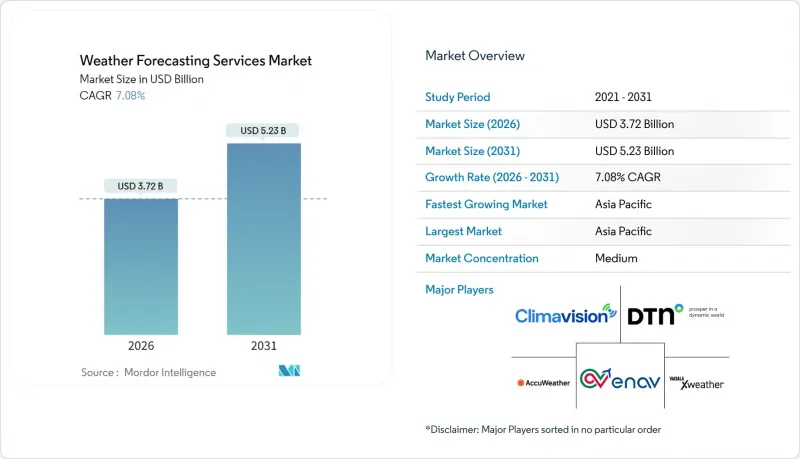
Rising climate volatility, intensifying regulatory mandates, the proliferation of artificial intelligence, and growing reliance on renewable energy form the primary engines behind this upward trajectory for the weather forecasting services market. Companies are integrating high-resolution nowcasting to mitigate operational disruptions, while governments are expanding early-warning networks to limit economic losses from extreme events. Parametric insurance, autonomous mobility, and precision agriculture present fresh commercial opportunities that reward providers capable of sub-kilometer accuracy. Concurrently, high-performance computing investments and satellite constellation renewals underpin technological competitiveness, though cost barriers remain steep for new entrants.
Global Weather Forecasting Services Market Trends and Insights
Intensifying Climate-Change-Driven Extreme Weather Events
Global economic losses from severe storms surged to USD 90 billion in 2024, doubling the count of billion-dollar disasters since 2020. As a result, insurers seek sub-daily updates and agriculture operators request 10-day rainfall probabilities exceeding 90% confidence levels. These requirements elevate demand for ensemble forecast models that communicate uncertainty bands rather than single-point predictions, pushing the weather forecasting services market toward more sophisticated, sector-specific solutions.
Rapid AI and ML Adoption Boosting Forecast Accuracy and Speed
Machine-learning models such as GraphCast now generate global forecasts in minutes while improving seven-day accuracy by up to 20%. Commercial providers embed similar architectures to deliver real-time route optimization for aviation and 15-minute solar irradiance updates for utilities. The performance leap strengthens incumbent positions but raises computational and data-set barriers for newcomers.
High-Performance Computing and Data-License Costs
Running state-of-the-art numerical weather prediction models requires exascale systems that consume 20-30 MW continuously and cost upwards of USD 163.5 million, mirroring the European Centre for Medium-Range Weather Forecasts' procurement in 2024. Annual satellite-data licenses, ranging from USD 50,000 to USD 200,000, augment the burden, limiting participation by small regional providers and tempering competitive dynamics in the weather forecasting services market.
Other drivers and restraints analyzed in the detailed report include:
- Grid-Scale Renewable-Energy Integration Needs Ultra-Short-Term Forecasts
- Aviation and Maritime Safety Mandates for Route Optimization
- Model Complexity and Shortage of Expert Meteorologists
For complete list of drivers and restraints, kindly check the Table Of Contents.
Segment Analysis
Short-range products held 45.30% of the weather forecasting services market in 2025, reflecting their critical role in real-time operations for aviation, logistics, and emergency response. Medium-range solutions, however, outpace the overall weather forecasting services market at a 7.14% CAGR as energy trading, agriculture, and insurance seek eight- to ten-day horizons for hedging and planning. Commercial vendors increasingly package ensemble outputs that quantify confidence levels to satisfy risk-adjusted decision frameworks.
Advances from the European Centre for Medium-Range Weather Forecasts have narrowed the skill gap between ten-day and historic seven-day accuracy levels, encouraging enterprises to extend planning cycles without sacrificing precision. Long-range outlooks remain niche, yet seasonal climate projections gain relevance for crop selection and reservoir management in regions vulnerable to drought or flooding.
Utilities, mining, and energy firms captured 23.20% of the weather forecasting services market in 2025, underpinned by the need for renewable integration, grid stability imperatives, and commodity-trading volatility. Transportation and logistics, which are expanding at a 7.18% CAGR, are increasingly relying on minute-scale nowcasting for autonomous fleets and just-in-time supply chains. The aviation segment maintains regulated demand, whereas insurers deploy hyper-local forecasts to price parametric products that pay automatically when predefined thresholds are breached.
Agriculture and forestry users seek precision irrigation and pest management support, and government agencies incorporate weather intelligence into disaster readiness protocols. Retailers and e-commerce platforms utilize meteorological data to refine their demand-forecast algorithms and optimize store-level inventory allocations.
The Weather Forecasting Services Market Report is Segmented by Forecasting Type (Short-Range, and More), End User (Aviation, Transportation and Logistics, Government and Defense, and More), Purpose (Operational Efficiency, and More), Delivery Platform (Web-Based Portals, and More), Organization Size (Large Enterprises, Small and Medium-Sized Enterprises), and Geography. The Market Forecasts are Provided in Terms of Value (USD).
Geography Analysis
The Asia Pacific commanded a 54.60% market share of the weather forecasting services market in 2025 and is projected to compound at a 7.48% annual growth rate through 2031. Government-funded radar expansions under India's Mission Mausam and Japan's phased-array networks enhance regional forecast precision, while China's AI-enabled modernization continues to drive public and private demand. Southeast Asian cross-border collaborations improve typhoon and monsoon predictability, directly benefiting agriculture and insurance uptake.
North America retains the second-largest position, leveraging advanced computational grids, a mature insurance sector, and robust regulatory frameworks that mandate weather inputs across aviation, maritime, and emergency-management functions. Energy-transition priorities accelerate utility spending on ultra-short-term forecasting, further stimulating the weather forecasting services market.
Europe pursues standardization through the European Centre for Medium-Range Weather Forecasts and World Meteorological Organization guidelines, promoting shared data pools and joint satellite missions. This harmonized environment reduces duplication costs and elevates baseline accuracy for regional participants.
The Middle East and Africa, as well as Latin America, represent emerging frontiers. African Union drought-alert programs and Gulf state aviation hubs drive fresh investments, whereas Brazil's agricultural economy underpins demand for seasonal and planting-window forecasts across Latin America.
- The Weather Company LLC (IBM)
- AccuWeather Inc.
- DTN LLC
- StormGeo AS (Alfa Laval AB)
- Vaisala Oyj
- Met Office
- Fugro NV
- ENAV S.p.A.
- Pelmorex Corp.
- Climavision
- Spire Global Inc.
- Precision Weather Services
- Foreca Ltd.
- The Tomorrow Companies Inc.
- AEM (Advanced Environmental Monitoring)
- BMT Group Ltd.
- Skymet Weather Services Pvt Ltd.
- Skyview Systems Ltd.
- Global Weather Corporation
- MeteoGroup
Additional Benefits:
- The market estimate (ME) sheet in Excel format
- 3 months of analyst support
TABLE OF CONTENTS
1 INTRODUCTION
- 1.1 Study Assumptions and Market Definition
- 1.2 Scope of the Study
2 RESEARCH METHODOLOGY
3 EXECUTIVE SUMMARY
4 MARKET LANDSCAPE
- 4.1 Market Overview
- 4.2 Market Drivers
- 4.2.1 Intensifying climate-change-driven extreme weather events
- 4.2.2 Rapid AI/ML adoption boosting forecast accuracy and speed
- 4.2.3 Grid-scale renewable-energy integration needs ultra-short-term forecasts
- 4.2.4 Aviation and maritime safety mandates for route optimization
- 4.2.5 Parametric micro-insurance products demanding hyper-local data
- 4.2.6 Autonomous vehicles and drones requiring minute-scale now-casting
- 4.3 Market Restraints
- 4.3.1 High-performance computing and data-license costs
- 4.3.2 Model complexity and shortage of expert meteorologists
- 4.3.3 Uneven telecom / sensor infrastructure in developing regions
- 4.3.4 Looming satellite data gaps as aging constellations retire
- 4.4 Industry Value Chain Analysis
- 4.5 Regulatory Landscape
- 4.6 Technological Outlook
- 4.7 Porter's Five Forces Analysis
- 4.7.1 Bargaining Power of Suppliers
- 4.7.2 Bargaining Power of Buyers
- 4.7.3 Threat of New Entrants
- 4.7.4 Threat of Substitutes
- 4.7.5 Intensity of Competitive Rivalry
- 4.8 Impact of Macroeconomic Factors
5 MARKET SIZE AND GROWTH FORECASTS (VALUE)
- 5.1 By Forecasting Type
- 5.1.1 Short-range Forecasting
- 5.1.2 Medium-range Forecasting
- 5.1.3 Long-range Forecasting
- 5.2 By End User
- 5.2.1 Aviation
- 5.2.2 Transportation and Logistics
- 5.2.3 Energy, Utilities and Mining
- 5.2.4 Government and Defense
- 5.2.5 Banking, Financial Services and Insurance
- 5.2.6 Agriculture and Forestry
- 5.2.7 Media and Entertainment
- 5.2.8 Retail and E-commerce
- 5.2.9 Construction and Mining
- 5.3 By Purpose
- 5.3.1 Operational Efficiency
- 5.3.2 Safety and Security
- 5.3.3 Risk Management and Claims Optimization
- 5.3.4 Disaster Management and Emergency Response
- 5.4 By Delivery Platform
- 5.4.1 Web-based Portals
- 5.4.2 Mobile Applications
- 5.4.3 API / Data-feed Services
- 5.4.4 Consulting and Managed Services
- 5.5 By Organization Size
- 5.5.1 Large Enterprises
- 5.5.2 Small and Medium-sized Enterprises
- 5.6 By Geography
- 5.6.1 North America
- 5.6.1.1 United States
- 5.6.1.2 Canada
- 5.6.1.3 Mexico
- 5.6.2 South America
- 5.6.2.1 Brazil
- 5.6.2.2 Argentina
- 5.6.2.3 Rest of South America
- 5.6.3 Europe
- 5.6.3.1 United Kingdom
- 5.6.3.2 Germany
- 5.6.3.3 France
- 5.6.3.4 Italy
- 5.6.3.5 Spain
- 5.6.3.6 Russia
- 5.6.3.7 Rest of Europe
- 5.6.4 Asia Pacific
- 5.6.4.1 China
- 5.6.4.2 Japan
- 5.6.4.3 India
- 5.6.4.4 South Korea
- 5.6.4.5 Australia and New Zealand
- 5.6.4.6 Southeast Asia
- 5.6.4.7 Rest of Asia Pacific
- 5.6.5 Middle East
- 5.6.5.1 Saudi Arabia
- 5.6.5.2 United Arab Emirates
- 5.6.5.3 Turkey
- 5.6.5.4 Rest of Middle East
- 5.6.6 Africa
- 5.6.6.1 South Africa
- 5.6.6.2 Nigeria
- 5.6.6.3 Kenya
- 5.6.6.4 Rest of Africa
- 5.6.1 North America
6 COMPETITIVE LANDSCAPE
- 6.1 Market Concentration
- 6.2 Strategic Moves
- 6.3 Market Share Analysis
- 6.4 Company Profiles (includes Global level Overview, Market level overview, Core Segments, Financials as available, Strategic Information, Market Rank/Share for key companies, Products and Services, and Recent Developments)
- 6.4.1 The Weather Company LLC (IBM)
- 6.4.2 AccuWeather Inc.
- 6.4.3 DTN LLC
- 6.4.4 StormGeo AS (Alfa Laval AB)
- 6.4.5 Vaisala Oyj
- 6.4.6 Met Office
- 6.4.7 Fugro NV
- 6.4.8 ENAV S.p.A.
- 6.4.9 Pelmorex Corp.
- 6.4.10 Climavision
- 6.4.11 Spire Global Inc.
- 6.4.12 Precision Weather Services
- 6.4.13 Foreca Ltd.
- 6.4.14 The Tomorrow Companies Inc.
- 6.4.15 AEM (Advanced Environmental Monitoring)
- 6.4.16 BMT Group Ltd.
- 6.4.17 Skymet Weather Services Pvt Ltd.
- 6.4.18 Skyview Systems Ltd.
- 6.4.19 Global Weather Corporation
- 6.4.20 MeteoGroup
7 MARKET OPPORTUNITIES AND FUTURE OUTLOOK
- 7.1 White-space and Unmet-Need Assessment

