
PUBLISHER: Mordor Intelligence | PRODUCT CODE: 1934892

PUBLISHER: Mordor Intelligence | PRODUCT CODE: 1934892
GCC Paper Bags - Market Share Analysis, Industry Trends & Statistics, Growth Forecasts (2026 - 2031)
GCC paper bags market size in 2026 is estimated at USD 507.48 million, growing from 2025 value of USD 469.53 million with 2031 projections showing USD 748.26 million, growing at 8.08% CAGR over 2026-2031.
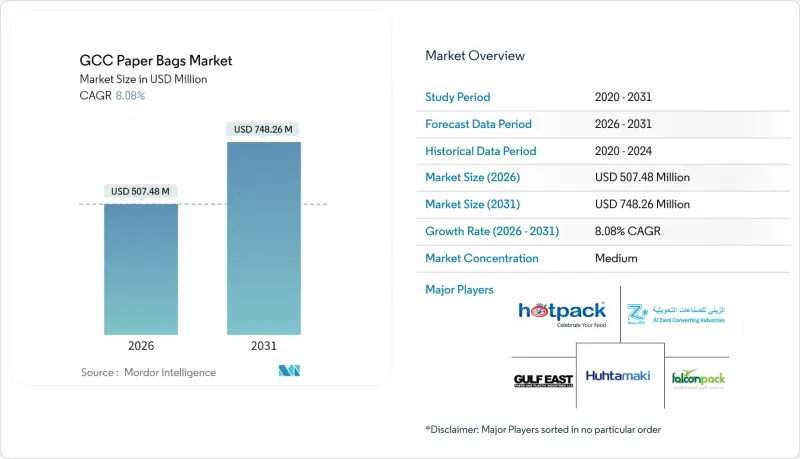
Rapid regulatory action against single-use plastics, booming e-commerce order volumes, and the expansion of food delivery are accelerating the shift from polymer to fiber-based packaging across Saudi Arabia, the United Arab Emirates, Qatar, Kuwait, Oman, and Bahrain. Government incentives tied to Saudi Vision 2030 and the UAE Circular Economy Policy are driving local manufacturing investments, while recycled-content mandates are encouraging converters to adopt post-consumer and agricultural fiber inputs. At the same time, cross-border trade liberalization and free-trade agreements are widening export prospects for regionally produced bags, prompting global packaging groups to pursue joint ventures and capacity additions. Competitive intensity is rising as local players scale up brown and recycled kraft output, even as multinational suppliers leverage automation, design-for-recycling expertise, and compliance credentials to win high-value contracts.
GCC Paper Bags Market Trends and Insights
Sustainable-Packaging Regulations Spur Paper Adoption
Coordinated policy frameworks across the GCC are driving an irreversible migration away from plastic carry sacks toward cellulose-based alternatives. Dubai began its phased restrictions in January 2025 and will implement import, production, and trade bans on single-use plastics from January 2026. The UAE federal prohibition mirrors these timelines and is reinforced by an extended producer responsibility pilot that obligates brand owners to finance collection and sorting systems. Oman aligned with its own ban in July 2025. Such harmonized measures provide converters with clear visibility into volume uptake, incentivize capital spending on additional kraft lines, and favor suppliers who can document food-contact and compostability certifications under the Saber platform in Saudi Arabia.
E-Commerce Parcel Growth Fuels Protective Paper Mailers
Online retail across the Gulf climbed from USD 8.5 billion in 2018 to USD 21.2 billion in 2023, a 20.2% CAGR, and penetration remains well below the global norm, signaling further upsid. Saudi Arabia accounted for USD 8.7 billion of the total, followed by the UAE at USD 7.5 billion. Large marketplaces such as Talabat, whose Dubai IPO in December 2024 raised USD 2 billion on a USD 10 billion valuation, process millions of orders that require dimensionally consistent mailers able to glide through automated sorters. As fulfillment centers strive to process 1,500 orders per minute, suppliers that deliver tight tolerances in gusset width, basis weight, and tear strength gain a competitive edge.
Volatile Wood-Pulp Prices and Import Dependence
Bleached eucalyptus kraft pulp (BEKP) prices fluctuated between USD 150 and USD 590 per metric ton between July and September 2024, while northern bleached softwood prices remained at USD 740-760, creating a widening spread that squeezes converters' margins. With negligible native forest resources, Gulf mills rely on long-haul imports from South America and North America, exposing them to fluctuations in freight costs and currency exchange rates. Adding desalinated water requirements increases operating costs in a region where 23.9% of freshwater comes from energy-intensive seawater plants. Although research into using date-palm fronds as pulp feedstock shows promise, commercialization remains years away.
Other drivers and restraints analyzed in the detailed report include:
- Vision 2030 Manufacturing Diversification Incentives
- Food-Delivery Boom Boosts Takeaway Paper Bags
- Competition from Reusable PP and Cotton Tote Bags
For complete list of drivers and restraints, kindly check the Table Of Contents.
Segment Analysis
Flat-bottom bags accounted for 35.72% of the value in 2025, reflecting their stability on store shelves and efficient cubing inside cartons. This design remains a staple for fashion, grocery, and pharmacy outlets, anchoring the GCC paper bags market size at the retail checkout. Conversely, pasted open-mouth sacks record the quickest 8.76% CAGR, as grocery e-commerce and produce exporters favor their low-cost, high-throughput filling characteristics. Pasted valve and pinched bottom options serve powdered chemicals and construction adhesives where controlled discharge is vital, while sewn open mouth formats retain a niche in animal feed. The advent of automatic packers in Saudi mega-distribution hubs is pushing converters to achieve tighter depth tolerances and reinforced side seams, which in turn improves pallet stability and shortens line changeovers.
Demand for gusseted constructions is rising in the GCC paper bags market as brands seek billboard-like surfaces for promotional art during high-traffic shopping events such as Dubai Summer Surprises. Digital inkjet presses allow converters to offer SKU-level personalization without lengthy plate setups, supporting promotional cycles as short as four weeks. Saudi regulations governing fruit and vegetable packaging, issued in September 2025, impose recyclability and airflow performance requirements that are most easily met by paper substrates with micro-perforations. As B2C groceries scale same-day delivery, bottom-reinforced paper satchels that maintain shape despite moisture condensation gain favor among aggregators testing refrigerated lockers and robot couriers.
Unbleached brown kraft captured 58.35% of revenue in 2025, underpinned by its cost efficiency, runnability, and eco-friendly appearance. The grade meets most tensile and burst requirements with minimal use of wet-strength resins, making it a suitable choice for food service and general retail. Regulatory nudges, however, are fueling a 10.31% CAGR for recycled brown kraft, as the UAE EPR pilot and Dubai's waste-diversion fees reward high post-consumer fiber content. Bleached and white kraft grades continue to serve luxury boutiques and cosmetics, while coated kraft lines supply moisture-sensitive quick-service restaurant meals.
The GCC paper bags market share for recycled content is expected to expand as Arabian Kraft Paper Manufacturing ramps up its Umm Al-Quwain mill, offering virgin-to-100% recycled mixes that reduce lead times for local converters. Mills are also trialing enzyme-treated date-palm fiber blends to offset imported softwood, aligning with Vision 2030 stewardship goals. Brand owners are increasingly requesting chain-of-custody certification under the Forest Stewardship Council or Programme for the Endorsement of Forest Certification to comply with European customer audits, prompting suppliers to segment their warehouse inventories by certified and non-certified reels.
The GCC Paper Bags Market Report is Segmented by Bag Type (Flat Bottom, Pasted Valve, Pinched Bottom Open Mouth, Pasted Open Mouth, and Sewn Open Mouth), Material Type (Brown Kraft, Bleached Kraft, White Kraft, Coated Kraft, and Recycled Brown Kraft), Ply Thickness (1-Ply, 2-Ply, 3-Ply, and 4-Ply), End User (Retail, and More), and Geography (Saudi Arabia, and More). The Market Forecasts are Provided in Terms of Value (USD).
List of Companies Covered in this Report:
- Huhtamaki Flexibles UAE
- Gulf East Paper & Plastic Industries LLC
- Hotpack Packaging Industries LLC
- Falcon Pack Industries LLC
- Al Zaini Converting Industries
- Mondi plc
- BreezPack FZ-LLC
- MEPCO (Middle East Paper Co.)
- Segezha Group PJSC
- Novolex Holdings LLC
- Gascogne SA
- Unipack Containers and Carton Products LLC
- Union Paper Mills LLC
- Smurfit Kappa Group plc
- Klabin S.A.
- Ronpak Inc.
- Detpak Manufacturing LLC
- Star Paper Mill Paper Industry LLC
- International Paper Company
- Billerud AB
- Printpack Packaging Industries LLC
Additional Benefits:
- The market estimate (ME) sheet in Excel format
- 3 months of analyst support
TABLE OF CONTENTS
1 INTRODUCTION
- 1.1 Study Assumptions and Market Definition
- 1.2 Scope of the Study
2 RESEARCH METHODOLOGY
3 EXECUTIVE SUMMARY
4 MARKET LANDSCAPE
- 4.1 Market Overview
- 4.2 Market Drivers
- 4.2.1 Sustainable-packaging regulations spur paper adoption
- 4.2.2 E-commerce parcel growth fuels protective paper mailers
- 4.2.3 Vision 2030 manufacturing diversification incentives
- 4.2.4 Food-delivery boom boosts takeaway paper bags
- 4.2.5 Date-palm fibre-based kraft pulp pilot projects
- 4.2.6 Regional recycled-containerboard capacity expansions
- 4.3 Market Restraints
- 4.3.1 Volatile wood-pulp prices and import dependence
- 4.3.2 Competition from reusable PP and cotton tote bags
- 4.3.3 Weak GCC paper-recycling logistics network
- 4.3.4 Gulf humidity challenges bag integrity in wet uses
- 4.4 Industry Value Chain Analysis
- 4.5 Impact of Macroeconomic Factors
- 4.6 Regulatory Landscape
- 4.7 Technological Outlook
- 4.8 Porter's Five Forces Analysis
- 4.8.1 Bargaining Power of Suppliers
- 4.8.2 Bargaining Power of Buyers
- 4.8.3 Threat of New Entrants
- 4.8.4 Threat of Substitutes
- 4.8.5 Intensity of Competitive Rivalry
- 4.9 Industry Raw-Material and Equipment Suppliers
5 MARKET SIZE AND GROWTH FORECASTS (VALUE)
- 5.1 By Bag Type
- 5.1.1 Flat Bottom
- 5.1.2 Pasted Valve
- 5.1.3 Pinched Bottom Open Mouth
- 5.1.4 Pasted Open Mouth
- 5.1.5 Sewn Open Mouth
- 5.2 By Material Type
- 5.2.1 Brown Kraft
- 5.2.2 Bleached Kraft
- 5.2.3 White Kraft
- 5.2.4 Coated Kraft
- 5.2.5 Recycled Brown Kraft
- 5.3 By Ply Thickness
- 5.3.1 1-Ply
- 5.3.2 2-Ply
- 5.3.3 3-Ply
- 5.3.4 4-Ply
- 5.4 By End User
- 5.4.1 Retail
- 5.4.2 Agriculture and Animal Feed
- 5.4.3 Food Service
- 5.4.4 Cosmetics and Personal Care
- 5.4.5 E-commerce
- 5.5 By Geography
- 5.5.1 Saudi Arabia
- 5.5.2 Oman
- 5.5.3 United Arab Emirates
- 5.5.4 Bahrain
- 5.5.5 Qatar
6 COMPETITIVE LANDSCAPE
- 6.1 Market Concentration
- 6.2 Strategic Moves
- 6.3 Market Share Analysis
- 6.4 Company Profiles (includes Global level Overview, Market level overview, Core Segments, Financials as available, Strategic Information, Market Rank/Share for key companies, Products and Services, and Recent Developments)
- 6.4.1 Huhtamaki Flexibles UAE
- 6.4.2 Gulf East Paper & Plastic Industries LLC
- 6.4.3 Hotpack Packaging Industries LLC
- 6.4.4 Falcon Pack Industries LLC
- 6.4.5 Al Zaini Converting Industries
- 6.4.6 Mondi plc
- 6.4.7 BreezPack FZ-LLC
- 6.4.8 MEPCO (Middle East Paper Co.)
- 6.4.9 Segezha Group PJSC
- 6.4.10 Novolex Holdings LLC
- 6.4.11 Gascogne SA
- 6.4.12 Unipack Containers and Carton Products LLC
- 6.4.13 Union Paper Mills LLC
- 6.4.14 Smurfit Kappa Group plc
- 6.4.15 Klabin S.A.
- 6.4.16 Ronpak Inc.
- 6.4.17 Detpak Manufacturing LLC
- 6.4.18 Star Paper Mill Paper Industry LLC
- 6.4.19 International Paper Company
- 6.4.20 Billerud AB
- 6.4.21 Printpack Packaging Industries LLC
7 MARKET OPPORTUNITIES AND FUTURE OUTLOOK
- 7.1 White-space and Unmet-Need Assessment

