PUBLISHER: Mordor Intelligence | PRODUCT CODE: 1937255

PUBLISHER: Mordor Intelligence | PRODUCT CODE: 1937255
Failure Analysis - Market Share Analysis, Industry Trends & Statistics, Growth Forecasts (2026 - 2031)
The Failure Analysis market is expected to grow from USD 5.31 billion in 2025 to USD 5.69 billion in 2026 and is forecast to reach USD 8.05 billion by 2031 at 7.18% CAGR over 2026-2031.
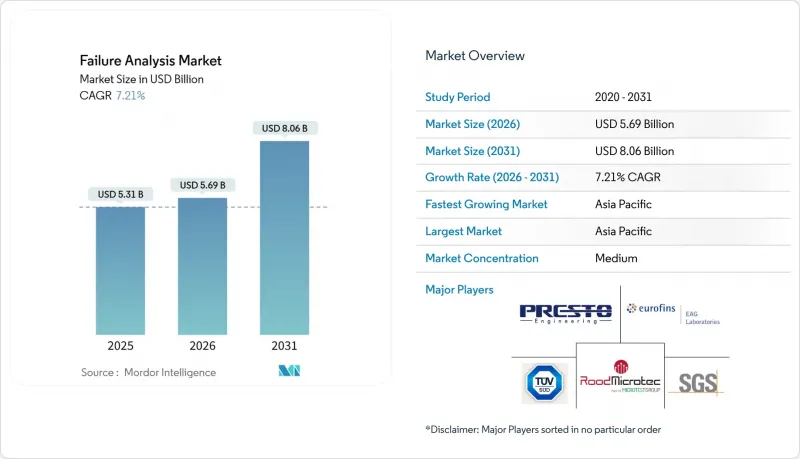
Persistent growth rests on rising precision-diagnostics demand in semiconductor manufacturing, aging industrial infrastructure that mandates deeper inspection routines, and the steady shift to nanoscale devices where conventional test methods lose resolution. Intensifying supply-chain localization, most visibly under the U.S. CHIPS Act and similar initiatives elsewhere, accelerates in-house analytical-lab adoption inside fabs, creating parallel demand for compact, automated tools. Equipment vendors are responding with dual-beam platforms and AI-assisted workflows that shorten root-cause cycles, while asset-heavy sectors such as oil and gas adopt predictive protocols to curb costly downtime events. Asia-Pacific remains the epicenter of capital expenditure, helped by government subsidies and its dense foundry network, whereas North America leverages policy incentives to reshore capacity and tighten intellectual-property control.
Global Failure Analysis Market Trends and Insights
Ageing Infrastructure and Increasing Maintenance Needs
Corrosion-related failures cost the oil and gas sector USD 1.372 billion each year, a burden that is steering operators toward predictive failure analysis programs that detect degradation before unplanned shutdowns. Deep-learning-enabled finite-element models are now embedded into pipeline-integrity routines, replacing slower manual inspections and cutting diagnostic time in harsh operating zones. Similar patterns appear in aging discrete-manufacturing equipment, where nanoscale materials analysis helps extend tool life and prevent multi-million-dollar production halts. Utilities, refineries, and transportation infrastructure owners increasingly embed scanning-electron-microscopy checks in scheduled maintenance, illustrating how industrial asset longevity fuels recurring demand across the failure analysis market.
Technological Advancements in Failure-Analysis Tools
AI-assisted image-recognition now segments complex defect patterns in minutes, slashing analysis-cycle time from weeks to hours. ZEISS demonstrated an automated Crossbeam FIB-SEM that can autonomously mill, image, and classify faults in 3D NAND stacks, shaving 60% off typical turnaround schedules. TESCAN's expansion in Taiwan further underscores toolmakers' push into advanced-packaging nodes that require resolution below 10 nm. Real-time analytics embedded directly on the tool allow immediate process-window corrections inside fab lines, effectively relocating failure analysis from separate laboratories to production floors. Advancements in detectors, ion columns, and high-brightness sources also extend the field-of-view without compromising resolution, fostering multimodal workflows that merge secondary-ion and X-ray spectrometry in a single pass.
High Acquisition and Ownership Cost of Equipment
A state-of-the-art dual-beam FIB-SEM can command several million USD and requires vibration-isolated rooms with strict environmental controls, doubling the lifetime investment once maintenance, consumables, and facility retrofits are factored in. Budget-constrained enterprises often resort to outsourcing, introducing logistics delays and potential confidentiality issues. Tool vendors are countering with modular systems, shared-facility business models, and subscription-based ownership structures that spread capital outlays and democratize access.
Other drivers and restraints analyzed in the detailed report include:
- Innovation in Materials, Design and Production Methods
- Miniaturization of Electronic Components Boosts Demand
- Shortage of Skilled Failure Analysis Professionals
For complete list of drivers and restraints, kindly check the Table Of Contents.
Segment Analysis
SIMS held 28.85% of the failure analysis market share in 2025, favored for dopant-profiling accuracy that scales into single-digit nanometers. The failure analysis market size tied to Focused Ion Beam tools is on course for an 8.36% CAGR, propelled by demand for site-specific cross-sectioning during 3D-device diagnostics. Hybrid platforms that merge SIMS, EDX, and time-of-flight mass spectrometry on the same stage now shorten workflow steps and improve data correlation. Emerging Relative Ion Etching complements MEMS and advanced-materials projects that need depth-resolved compositional profiling without masking artifacts. Over the next five years, AI-assisted routine-spectra interpretation will extend usability to mid-tier fabs, expanding the addressable base for SIMS while reinforcing FIB traction in automated defect isolation.
Wider 3D packaging adoption also lifts scanning-probe methodologies, especially for quantum-device development that hinges on atomic-scale surface fidelity. As photonics-integrated circuits enter mass production, ultraviolet laser-assisted SIMS steps in to map low-signal defects. Collectively, technology diversification will sustain double-digit tool refresh cycles and anchor continuous investment in the failure analysis market.
The Failure Analysis Market Report is Segmented by Technology (Secondary ION Mass Spectrometry, Energy Dispersive X-Ray Spectroscopy, and More), Equipment (Scanning Electron Microscope, Focused Ion Beam System, and More), End-User Industry (Automotive, Oil and Gas, and More), and Geography (North America, South America, Europe, Asia-Pacific, and Middle East and Africa). The Market Forecasts are Provided in Terms of Value (USD).
Geography Analysis
Asia-Pacific held 46.72% of global revenue in 2025 and is forecast to grow at 7.89% CAGR through 2031, bolstered by concentrated foundry capacity and national subsidies that target semiconductor self-sufficiency. Japan earmarked JPY 3.9 trillion (USD 25.7 billion) to lift domestic output, sparking a surge in regional tool installations and specialized-service inquiries. China's localization strategy keeps domestic tool vendors and overseas suppliers occupied, even amid export-control headwinds. South Korea's memory leadership and Taiwan's advanced-logic dominance reinforce steady procurement of next-generation analytical platforms.
North America ranks second as the CHIPS and Science Act allocates USD 52 billion in grants and tax incentives, motivating new fabs that embed in-house failure analysis laboratories during planning phases. Electric-vehicle supply-chain growth around the Great Lakes and U.S. Southwest further increases regional demand for power-device reliability studies. Europe follows with strong adoption in Germany's automotive and industrial-automation clusters, where ISO 9001 compliance drives systematic defect-prevention cycles. Middle East and Africa exhibit emerging traction, primarily tied to oil-and-gas pipeline integrity programs and early moves to build semiconductor ecosystems under policy umbrellas such as Saudi Arabia's Vision 2030 semiconductor hub. South America remains a smaller market but shows promise in mining-equipment fault diagnostics and renewable-energy component analysis, leading multinational tool vendors to explore distributor partnerships
- Presto Engineering Inc.
- TUV SUD
- Rood Microtec GmbH
- Eurofins EAG Laboratories
- SGS SA
- CoreTest Technologies Inc.
- Materials Testing Inc.
- McDowell Owens Engineering Inc.
- Exponent Inc.
- TechInsights Inc.
- Hitachi High-Tech Analytical Science Ltd.
- Intertek Group plc
- NanoScope Services Ltd
- Applus+ Laboratories Inc.
- Advanced Nanolab Pte Ltd
- Toray Engineering Co., Ltd.
- Tescan Orsay Holding
- Leica Microsystems Inc.
- Keysight Technologies Inc.
- Crane Engineering Inc.
Additional Benefits:
- The market estimate (ME) sheet in Excel format
- 3 months of analyst support
TABLE OF CONTENTS
1 INTRODUCTION
- 1.1 Study Assumptions and Market Definition
- 1.2 Scope of the Study
2 RESEARCH METHODOLOGY
3 EXECUTIVE SUMMARY
4 MARKET LANDSCAPE
- 4.1 Market Overview
- 4.2 Market Drivers
- 4.2.1 Ageing infrastructure and increasing maintenance needs
- 4.2.2 Technological advancements in failure-analysis tools
- 4.2.3 Innovation in materials, design and production methods
- 4.2.4 Miniaturisation of electronic components boosts demand
- 4.2.5 AI-driven root-cause analytics adoption
- 4.2.6 Supply-chain localization spurs in-house FA labs
- 4.3 Market Restraints
- 4.3.1 High acquisition and ownership cost of equipment
- 4.3.2 Shortage of skilled FA professionals
- 4.3.3 Long turnaround time hampers productivity
- 4.3.4 IP-protection limits cross-border sample sharing
- 4.4 Industry Value Chain Analysis
- 4.5 Regulatory Landscape
- 4.6 Technological Outlook
- 4.7 Porter's Five Forces Analysis
- 4.7.1 Bargaining Power of Suppliers
- 4.7.2 Bargaining Power of Buyers
- 4.7.3 Threat of New Entrants
- 4.7.4 Threat of Substitutes
- 4.7.5 Intensity of Competitive Rivalry
- 4.8 Assessment of Macro-economic Trends on the Market
5 MARKET SIZE AND GROWTH FORECASTS (VALUE)
- 5.1 By Technology
- 5.1.1 Secondary ION Mass Spectrometry (SIMS)
- 5.1.2 Energy Dispersive X-ray Spectroscopy (EDX)
- 5.1.3 Chemical Mechanical Planarization (CMP)
- 5.1.4 Scanning Probe Microscopy
- 5.1.5 Focused Ion Beam (FIB)
- 5.1.6 Relative Ion Etching (RIE)
- 5.1.7 Other Technologies
- 5.2 By Equipment
- 5.2.1 Scanning Electron Microscope (SEM)
- 5.2.2 Focused Ion Beam (FIB) System
- 5.2.3 Transmission Electron Microscope (TEM)
- 5.2.4 Dual Beam System
- 5.2.5 Other Equipment's
- 5.3 By End-user Industry
- 5.3.1 Automotive
- 5.3.2 Oil and Gas
- 5.3.3 Defense
- 5.3.4 Construction
- 5.3.5 Manufacturing
- 5.3.6 Electronics and Semiconductors
- 5.3.7 Other End-user Industries
- 5.4 By Geography
- 5.4.1 North America
- 5.4.1.1 United States
- 5.4.1.2 Canada
- 5.4.1.3 Mexico
- 5.4.2 South America
- 5.4.2.1 Brazil
- 5.4.2.2 Argentina
- 5.4.2.3 Rest of South America
- 5.4.3 Europe
- 5.4.3.1 Germany
- 5.4.3.2 United Kingdom
- 5.4.3.3 France
- 5.4.3.4 Italy
- 5.4.3.5 Spain
- 5.4.3.6 Rest of Europe
- 5.4.4 Asia-Pacific
- 5.4.4.1 China
- 5.4.4.2 Japan
- 5.4.4.3 India
- 5.4.4.4 Singapore
- 5.4.4.5 Australia
- 5.4.4.6 Malaysia
- 5.4.4.7 Rest of Asia-Pacific
- 5.4.5 Middle East and Africa
- 5.4.5.1 Middle East
- 5.4.5.1.1 Saudi Arabia
- 5.4.5.1.2 United Arab Emirates
- 5.4.5.1.3 Rest of Middle East
- 5.4.5.2 Africa
- 5.4.5.2.1 South Africa
- 5.4.5.2.2 Egypt
- 5.4.5.2.3 Rest of Africa
- 5.4.5.1 Middle East
- 5.4.1 North America
6 COMPETITIVE LANDSCAPE
- 6.1 Market Concentration
- 6.2 Strategic Moves
- 6.3 Market Share Analysis
- 6.4 Company Profiles (includes Global level Overview, Market level overview, Core Segments, Financials as available, Strategic Information, Market Rank/Share for key companies, Products and Services, and Recent Developments)
- 6.4.1 Presto Engineering Inc.
- 6.4.2 TUV SUD
- 6.4.3 Rood Microtec GmbH
- 6.4.4 Eurofins EAG Laboratories
- 6.4.5 SGS SA
- 6.4.6 CoreTest Technologies Inc.
- 6.4.7 Materials Testing Inc.
- 6.4.8 McDowell Owens Engineering Inc.
- 6.4.9 Exponent Inc.
- 6.4.10 TechInsights Inc.
- 6.4.11 Hitachi High-Tech Analytical Science Ltd.
- 6.4.12 Intertek Group plc
- 6.4.13 NanoScope Services Ltd
- 6.4.14 Applus+ Laboratories Inc.
- 6.4.15 Advanced Nanolab Pte Ltd
- 6.4.16 Toray Engineering Co., Ltd.
- 6.4.17 Tescan Orsay Holding
- 6.4.18 Leica Microsystems Inc.
- 6.4.19 Keysight Technologies Inc.
- 6.4.20 Crane Engineering Inc.
7 MARKET OPPORTUNITIES AND FUTURE OUTLOOK
- 7.1 White-space and Unmet-Need Assessment

