PUBLISHER: Mordor Intelligence | PRODUCT CODE: 2121985

PUBLISHER: Mordor Intelligence | PRODUCT CODE: 2121985
Veterinary Animal Healthcare - Market Share Analysis, Industry Trends & Statistics, Growth Forecasts (2026 - 2031)
According to Mordor Intelligence, the veterinary animal healthcare market size is projected to expand from USD 62.28 billion in 2025 and USD 66.48 billion in 2026 to USD 92.34 billion by 2031, registering a CAGR of 6.79% between 2026 to 2031.
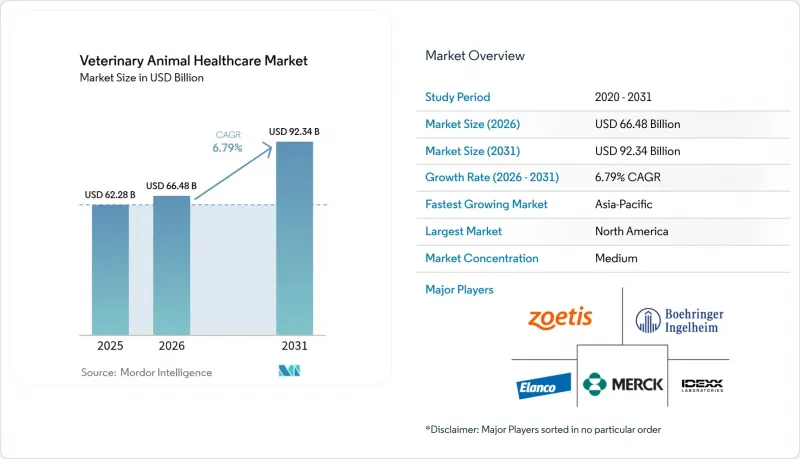
This report is Segmented by Product (Therapeutics [Vaccines, and More], Diagnostics), Animal Type (Dogs & Cats, Horses, Ruminants, and More), Route of Administration (Oral, Parenteral, and More), End User (Veterinary Hospitals & Clinics, Reference Laboratories, and More), and Geography (North America, Europe, and More). The Market Forecasts are Provided in Terms of Value (USD).
Global Veterinary Animal Healthcare Market Trends and Insights
Rising Demand for Protein-Rich Animal Products
Annual per-capita meat intake in Asia-Pacific climbed to 35 kilograms in 2025, spurring integrators to adopt real-time diagnostics against African swine fever and avian influenza, which in turn increases per-animal veterinary spend . Poultry producers in Thailand and Indonesia demonstrate mortality reductions of up to 18 percentage points after deploying autogenous vaccines. Brazil invested USD 240 million in 2025 for traceability upgrades that align with antibiotic-free import standards. Cage-free transitions in North America raise pathogen exposure, necessitating broader vaccine coverage. Gulf markets expand cold-storage capacity for halal-certified biologics, widening distribution channels for thermostable formulations.
Increasing Pet Humanization and Healthcare Spending
Average U.S. household veterinary outlay reached USD 1,480 per dog in 2025, a 22% increase versus 2020 . Pet-insurance penetration climbed to 4.2%, lowering price sensitivity for MRI, CT, and genomic screens. Urban millennials in China subscribe to preventive-care bundles that combine dental, vaccine, and parasite prophylaxis, posting 30% growth in 2025 clinic subscriptions. Specialist oncology centers installed linear accelerators for radiation therapy, expanding advanced-care capacity in California and Texas. Tele-consult platforms processed 8.5 million visits in 2025, yet several EU states still require in-person exams before prescribing.
Other drivers and restraints analyzed in the detailed report include:
- Expanding Livestock Production in Emerging Economies
- Digital Transformation of Veterinary Practices
- Stringent Regulatory Compliance & Approval Timelines
- Antimicrobial-Resistance Stewardship Restrictions
For complete list of drivers and restraints, kindly check the Table Of Contents.
Segment Analysis
Therapeutics accounted for 62.4% of 2025 revenue within the Veterinary Animal Healthcare Market, anchored by combination vaccines and anti-infectives. Diagnostics are forecast to grow at 7.86% annually, supported by point-of-care immunoassays and AI-enabled imaging. Vaccines dominate therapeutic volume, with multivalent canine and bovine formulations displacing monovalent products. Pricing pressure on parasiticides arises as isoxazoline generics arrive, yet new chewable endectocides that cover flea, tick, and heartworm in one dose gain traction.
Molecular diagnostics expand as PCR unit prices fall below USD 15,000, opening mid-tier clinic adoption. Portable ultrasound and digital radiography penetrate equine and large-animal field work where ruggedness and mobility are essential. Clinical-chemistry analyzers bundled with hematology modules become standard in critical-care rooms, reducing reliance on external labs. Feed additives based on phytogenics deliver 4-7% feed-conversion gains relative to antibiotics. Anti-infective portfolios increasingly emphasize narrow-spectrum cephalosporins that meet stewardship criteria.
Dogs and cats commanded 55.1% of 2025 revenue, reflecting high spend on preventive dentistry, orthopedic repair, and oncology. Poultry is the fastest-growing segment, advancing at 7.12% CAGR to 2031 as Asia-Pacific integrators lift biosecurity spend and deploy onsite influenza antigen tests. The Veterinary Animal Healthcare Market size for poultry is projected to expand at USD-denominated mid-single-digit billions by 2031, reflecting continuous integration investments.
Equine care remains niche, driven by performance-medicine spending in North America and Europe. Dairy operations intensify mastitis-prevention and reproductive-efficiency programs, while beef herds shrink amid drought and plant-protein consumption trends. Swine herds in China and Vietnam rebuild after ASF, driving sales of biosecure infrastructure. Aquaculture vaccines reduce antibiotic use 30% since 2023, boosting health budgets in Norwegian salmon and Southeast Asian shrimp farming. The Veterinary Animal Healthcare Market share for exotic and zoo animals remains under 2%, concentrated in accredited institutions.
Complete Report Scope:
- By Product
- Therapeutics
- Vaccines
- Parasiticides
- Anti-Infectives
- Medical Feed Additives
- Other Therapeutics
- Diagnostics
- Immunodiagnostic Tests
- Molecular Diagnostics
- Diagnostic Imaging
- Clinical Chemistry
- Other Diagnostics
- Therapeutics
- By Animal Type
- Dogs & Cats
- Horses
- Ruminants
- Swine
- Poultry
- Other Animal Types
- By Route of Administration
- Oral
- Parenteral
- Topical
- Other Routes
- By End User
- Veterinary Hospitals & Clinics
- Reference Laboratories
- Point-of-Care / In-House Settings
- Academic & Research Institutes
- Geography
- North America
- United States
- Canada
- Mexico
- Europe
- Germany
- United Kingdom
- France
- Italy
- Spain
- Rest of Europe
- Asia-Pacific
- China
- India
- Japan
- South Korea
- Australia
- Rest of Asia-Pacific
- Middle East and Africa
- GCC
- South Africa
- Rest of Middle East and Africa
- South America
- Brazil
- Argentina
- Rest of South America
- North America
Geography Analysis
North America accounted for 45.3% of 2025 revenue due to high per-pet spend and consolidated practice networks. Asia-Pacific is projected to grow at 8.11% CAGR, adding USD-denominated double-digit billions to the Veterinary Animal Healthcare Market size by 2031. China's pet population exceeded 120 million dogs and cats, fueling multispecialty clinic growth. India's dairy sector elevates veterinary input intensity, though rural coverage gaps persist, creating room for mobile and tele-health service expansion.
Europe benefits from stringent welfare rules that mandate veterinary oversight across production systems, yet stagnant companion-animal numbers temper revenue growth. The EU Farm-to-Fork strategy's 50% antimicrobial-reduction target accelerates vaccine and probiotic adoption. Middle East and Africa present bifurcated demand: Gulf states invest in camel and equine centers, while sub-Saharan regions focus on cold-chain expansions for livestock vaccines.
South America's export-oriented poultry and beef sectors invest in traceability and surveillance to satisfy import partners, driving Veterinary Animal Healthcare Market adoption of rapid PCR and blockchain certification. Brazil's USD 240 million 2025 traceability outlay underscores commitment to disease-free status. Argentina and Colombia replicate Brazil's hatchery-based PCR programs. Across regions, tele-enabled clinics and thermostable biologics emerge as common denominators of future growth
- Bimeda
- Boehringer Ingelheim
- Ceva Sante Animale
- Covetrus
- Dechra Pharmaceuticals
- Elanco
- Heska
- IDEXX
- ImmuCell
- INDICAL Bioscience
- Innovative Diagnostics
- Merck
- Neogen
- Norbrook
- PetIQ
- Phibro Animal Health
- Randox Laboratories
- Thermo Fisher Scientific
- Vetoquinol
- Virbac
- Zoetis
- Zomedica
Additional Benefits:
- The market estimate (ME) sheet in Excel format
- 3 months of analyst support
TABLE OF CONTENTS
1 Introduction
- 1.1 Study Assumptions & Market Definition
- 1.2 Scope of the Study
2 Research Methodology
3 Executive Summary
4 Market Landscape
- 4.1 Market Overview
- 4.2 Market Drivers
- 4.2.1 Rising Demand for Protein-Rich Animal Products
- 4.2.2 Increasing Pet Humanization and Healthcare Spending
- 4.2.3 Expanding Livestock Production in Emerging Economies
- 4.2.4 Digital Transformation of Veterinary Practices
- 4.2.5 Tele-Medicine-Based Herd-Health Management Growth
- 4.2.6 AI-Enabled Early Disease-Detection Platforms
- 4.3 Market Restraints
- 4.3.1 Stringent Regulatory Compliance & Approval Timelines
- 4.3.2 Antimicrobial-Resistance Stewardship Restrictions
- 4.3.3 Cold-Chain Gaps for Critical Biologics
- 4.3.4 Alternative-Protein Diets Curb Livestock Numbers
- 4.4 Supply-Chain Analysis
- 4.5 Regulatory Landscape
- 4.6 Technological Outlook
- 4.7 Porter's Five Forces
- 4.7.1 Threat of New Entrants
- 4.7.2 Bargaining Power of Buyers
- 4.7.3 Bargaining Power of Suppliers
- 4.7.4 Threat of Substitutes
- 4.7.5 Intensity of Competitive Rivalry
5 Market Size & Growth Forecasts (Value, USD)
- 5.1 By Product
- 5.1.1 Therapeutics
- 5.1.1.1 Vaccines
- 5.1.1.2 Parasiticides
- 5.1.1.3 Anti-Infectives
- 5.1.1.4 Medical Feed Additives
- 5.1.1.5 Other Therapeutics
- 5.1.2 Diagnostics
- 5.1.2.1 Immunodiagnostic Tests
- 5.1.2.2 Molecular Diagnostics
- 5.1.2.3 Diagnostic Imaging
- 5.1.2.4 Clinical Chemistry
- 5.1.2.5 Other Diagnostics
- 5.1.1 Therapeutics
- 5.2 By Animal Type
- 5.2.1 Dogs & Cats
- 5.2.2 Horses
- 5.2.3 Ruminants
- 5.2.4 Swine
- 5.2.5 Poultry
- 5.2.6 Other Animal Types
- 5.3 By Route of Administration
- 5.3.1 Oral
- 5.3.2 Parenteral
- 5.3.3 Topical
- 5.3.4 Other Routes
- 5.4 By End User
- 5.4.1 Veterinary Hospitals & Clinics
- 5.4.2 Reference Laboratories
- 5.4.3 Point-of-Care / In-House Settings
- 5.4.4 Academic & Research Institutes
- 5.5 Geography
- 5.5.1 North America
- 5.5.1.1 United States
- 5.5.1.2 Canada
- 5.5.1.3 Mexico
- 5.5.2 Europe
- 5.5.2.1 Germany
- 5.5.2.2 United Kingdom
- 5.5.2.3 France
- 5.5.2.4 Italy
- 5.5.2.5 Spain
- 5.5.2.6 Rest of Europe
- 5.5.3 Asia-Pacific
- 5.5.3.1 China
- 5.5.3.2 India
- 5.5.3.3 Japan
- 5.5.3.4 South Korea
- 5.5.3.5 Australia
- 5.5.3.6 Rest of Asia-Pacific
- 5.5.4 Middle East and Africa
- 5.5.4.1 GCC
- 5.5.4.2 South Africa
- 5.5.4.3 Rest of Middle East and Africa
- 5.5.5 South America
- 5.5.5.1 Brazil
- 5.5.5.2 Argentina
- 5.5.5.3 Rest of South America
- 5.5.1 North America
6 Competitive Landscape
- 6.1 Market Concentration
- 6.2 Market Share Analysis
- 6.3 Company Profiles (includes Global level Overview, Market level overview, Core Segments, Financials as available, Strategic Information, Market Rank/Share for key companies, Products & Services, Recent Developments)
- 6.3.1 Bimeda
- 6.3.2 Boehringer Ingelheim
- 6.3.3 Ceva Sante Animale
- 6.3.4 Covetrus
- 6.3.5 Dechra Pharmaceuticals
- 6.3.6 Elanco
- 6.3.7 Heska Corporation
- 6.3.8 IDEXX Laboratories
- 6.3.9 ImmuCell
- 6.3.10 INDICAL Bioscience
- 6.3.11 Innovative Diagnostics (IDVet)
- 6.3.12 Merck Animal Health
- 6.3.13 Neogen Corporation
- 6.3.14 Norbrook
- 6.3.15 PetIQ
- 6.3.16 Phibro Animal Health
- 6.3.17 Randox Laboratories
- 6.3.18 Thermo Fisher Scientific
- 6.3.19 Vetoquinol
- 6.3.20 Virbac
- 6.3.21 Zoetis
- 6.3.22 Zomedica
7 Market Opportunities & Future Outlook
- 7.1 White-space & Unmet-Need Assessment

