PUBLISHER: Mordor Intelligence | PRODUCT CODE: 2122884

PUBLISHER: Mordor Intelligence | PRODUCT CODE: 2122884
Camping Equipment - Market Share Analysis, Industry Trends & Statistics, Growth Forecasts (2026 - 2031)
According to Mordor Intelligence, the camping equipment market size in 2026 is estimated at USD 22.08 billion, growing from 2025 value of USD 20.85 billion with 2031 projections showing USD 29.49 billion, growing at 5.92% CAGR over 2026-2031.
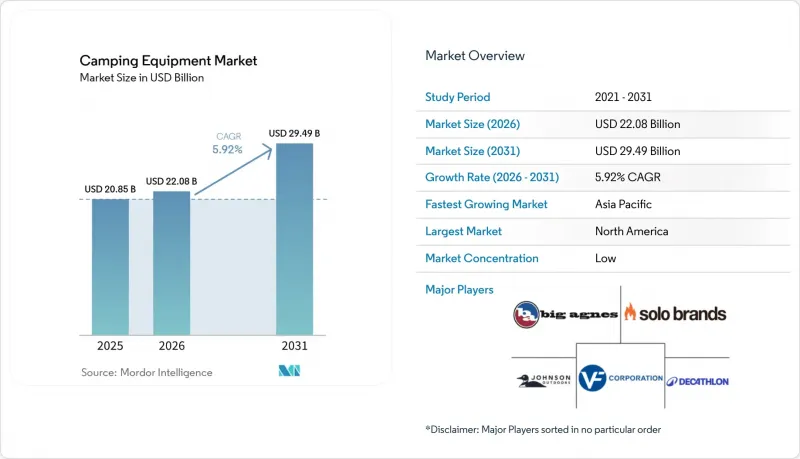
This report is Segmented by Product Type (Tents, Sleeping Bags and Pads, Cooking Systems and Cookware, Backpacks, Furniture, Lighting and Power, and More), Application (Personal Use, Commercial), Distribution Channel (Online Retail, Offline Retail), and Geography (North America, Europe, Asia-Pacific, South America, Middle East and Africa). The Market Forecasts are Provided in Terms of Value (USD).
Global Camping Equipment Market Trends and Insights
Rising participation in outdoor recreation and wellness tourism
Outdoor recreation participation rose to 175.8 million Americans in 2024, 57.3% of the population, adding 7.7 million first-time campers, according to the Outdoor Industry Association. Employers are increasingly subsidizing outdoor activities through wellness stipends, while flexible work schedules enable midweek trips that lengthen stay durations. Gen Z and Millennials are shaping demand with "micro-adventures" that blend fitness, digital detox, and social content creation, prompting brands to foreground sleep quality, recovery, and mindfulness in their messaging. Climbing, hiking, and tent camping generated USD 10.5 billion in U.S. value-added output in 2023 (U.S. BEA), highlighting the significant economic engine behind leisure-focused gear spending. As a result, companies that authentically integrate wellness narratives are gaining traction with urban professionals who frame gear purchases as investments in preventive health rather than discretionary spend.
Surge in domestic travel and "staycations"
Domestic tourism resilience has elevated camping from a budget-friendly alternative to a premium leisure category, as travelers reallocate international airfare budgets toward high-end gear and destination campgrounds. U.S. national park visitation rebounded to near-record levels in 2024, although it remained below 2019 peaks due to capacity limits and reservation systems that restrict peak-period access (National Park Service). In Europe, "staycation" momentum, reinforced by Brexit-related travel friction and climate-driven flight avoidance, has fueled double-digit growth in caravan and motorhome sales, led by Germany and the UK. This shift is accelerating demand for premium camping furniture, modular cooking systems, and durable equipment that delivers multi-trip value rather than single-use utility. Asia-Pacific markets reflect these patterns: China's domestic camping boom has expanded to more than 200 million participants, prompting investment in "glamping" sites that combine natural settings with hotel-grade amenities (China Tourism Academy). The resulting barbell-shaped market, budget campers trading up and luxury travelers trading down, continues to compress the mid-tier, pressuring brands to commit to either value engineering or premium differentiation to maintain relevance.
Seasonality and weather dependency of demand
Camping equipment sales are highly seasonal, with Q2-Q3 generating over half of annual revenue as consumers prepare for summer trips, while Q4-Q1 demand collapses, forcing retailers into promotional cycles that can erode margins by 15-20%. This seasonality strains working capital, as manufacturers finance inventory buildup in Q1 for Q2 delivery and absorb the risk of obsolescence when weather disruptions suppress demand. Climate volatility is intensifying these effects: 2024 saw wildfire closures in the western U.S. and extreme heat exceeding 110°F, which shortened the season by 3-4 weeks and delayed replacement purchases, according to the National Interagency Fire Center. Brands are attempting to extend the season through winter camping and "cold-weather glamping" campaigns, yet structural challenges remain, including declining participation among aging Baby Boomers and the scarcity of all-weather infrastructure, such as heated shelters or climate-controlled facilities, that would support year-round operations.
Other drivers and restraints analyzed in the detailed report include:
- Innovation in lightweight and compact gear
- Government support for national parks and outdoor infrastructure
- Counterfeit/low-quality imports eroding brand equity
For complete list of drivers and restraints, kindly check the Table Of Contents.
Segment Analysis
Backpacks accounted for 28.12% of the camping equipment market in 2025, reflecting their role as foundational purchases for day hikers and multi-day backpackers, while camping furniture is projected to grow at a 7.76% CAGR through 2031, the fastest among categories, highlighting a bifurcation in camping styles: ultralight enthusiasts prioritize weight reduction and invest in premium backpacks with advanced suspension systems, whereas "glamping" consumers allocate budgets toward collapsible chairs, cots, and tables that transform campsites into outdoor living spaces. Tents, the second-largest segment, are advancing through innovations in Dyneema fabrics, enabling sub-1-kilogram shelters from brands like Big Agnes and NEMO Equipment (2024) without compromising structural integrity. Sleeping bags and pads are differentiated via integrated systems that improve thermal efficiency by 15%, eliminating gaps that previously required ad hoc solutions.
Cooking systems benefit from dual trends: solo campers adopt compact, fuel-efficient stoves such as Jetboil's 100-second boil system, while group campers prefer modular cookware sets that nest for transport but expand to serve 6-8 people. Lighting and power solutions are increasingly solar-enabled, with portable power stations from Goal Zero and Jackery supporting multi-day trips for environmental purists and digital nomads. Coolers and hydration products face commoditization, though premium brands like YETI sustain pricing power through brand loyalty and lifetime warranties. Accessories, including navigation devices, safety kits, and repair tools, represent the smallest segment but maintain stable demand due to European regulatory requirements for backcountry first-aid and emergency equipment.
Complete Report Scope:
- By Product Type
- Tents
- Sleeping Bags and Pads
- Cooking Systems and Cookware
- Backpacks
- Furniture
- Lighting and Power
- Coolers and Hydration
- Accessories (Navigation, Safety, and Repair kits)
- By Application
- Personal Use
- Commercial (Rental,Tour Operators, and Campgrounds)
- By Distribution Channel
- Online Retail Channel
- Offline Retail Channel
- By Geography
- North America
- United States
- Canada
- Mexico
- Rest of North America
- Europe
- Germany
- United Kingdom
- Italy
- France
- Spain
- Netherlands
- Poland
- Belgium
- Sweden
- Rest of Europe
- Asia-Pacific
- China
- India
- Japan
- Australia
- Indonesia
- South Korea
- Thailand
- Singapore
- Rest of Asia-Pacific
- South America
- Brazil
- Argentina
- Colombia
- Chile
- Peru
- Rest of South America
- Middle East and Africa
- South Africa
- Saudi Arabia
- United Arab Emirates
- Nigeria
- Egypt
- Morocco
- Turkey
- Rest of Middle East and Africa
- North America
Geography Analysis
North America accounted for 38.52% of camping equipment revenue in 2025, supported by a strong camping culture, extensive public lands, and robust park funding. The Great American Outdoors Act allocates up to USD 1.3 billion annually through 2025 to reduce deferred maintenance, including electrification of 500 campsites that increase capacity by 20% (National Park Service), while outdoor recreation contributed USD 639.5 billion to U.S. GDP in 2023, or 2.3% of economic output (Bureau of Economic Analysis). Canada sustains high per-capita demand, and Mexico is promoting regional eco-tourism in Baja California and Yucatan. Climate volatility, including wildfires and extreme heat, shortens Western seasons, reducing utilization and delaying replacement cycles.
The Asia-Pacific region is projected to grow at a 7.34% CAGR through 2031, the fastest globally, driven by China's 200 million-strong camping population and USD 5 billion in 2024 government investment for 1,000 new campgrounds (China Tourism Academy). India's Himalayan states are developing adventure-tourism corridors, though infrastructure lags demand, while Japan's "solo camping" trend favors ultralight kits, tempered by an aging population. Australia's caravan market remains strong, yet bushfire risks increase capital outlays for fire-resistant designs.
Europe is mature but innovation-driven, with Germany hosting 3,000+ campgrounds and 8% caravan ownership, while the European Green Deal directs EUR 500 million toward low-carbon tourism infrastructure, favoring ISO 14001-certified suppliers (European Commission). The UK's post-Brexit "staycation" trend boosts discretionary spending on premium gear, whereas France's large campground network sees growth mainly in luxury "glamping" upgrades.
South America and the Middle East remain smaller markets, led by Brazil, Argentina, and Saudi Arabia, which has committed USD 800 million to desert-camp facilities under Vision 2030, though political and climatic uncertainties constrain forecasts.
- Johnson Outdoors Inc.
- Newell Brands
- VF Corporation
- Oase Outdoors ApS
- Big Agnes, Inc.
- Exxel Outdoors LLC
- NEMO Equipment, Inc.
- Dometic Group AB
- Snow Peak Inc.
- Hilleberg AB
- Nordisk Company AS
- Montbell Co., Ltd.
- Cascade Designs, Inc.
- Decathlon S.A.
- Sea to Summit Pty Ltd
- Black Diamond Equipment, Ltd.
- Marmot Mountain, LLC
- Eureka! Camping
- Vango
- Sierra Designs
Additional Benefits:
- The market estimate (ME) sheet in Excel format
- 3 months of analyst support
TABLE OF CONTENTS
1 INTRODUCTION
- 1.1 Study Assumptions and Market Definition
- 1.2 Scope of the Study
2 RESEARCH METHODOLOGY
3 EXECUTIVE SUMMARY
4 MARKET DYNAMICS
- 4.1 Market Overview
- 4.2 Market Drivers
- 4.2.1 Rising participation in outdoor recreation and wellness tourism
- 4.2.2 Surge in domestic travel and "staycations"
- 4.2.3 Innovation in lightweight and compact gear
- 4.2.4 Government support for nnational parks and outdoor infrastructure
- 4.2.5 Expansion of E-commerce and direct-to-consumer brands
- 4.2.6 Expansion of eco-Ffiendly and sustainable product lines
- 4.3 Market Restraints
- 4.3.1 Seasonality and weather dependency of demand
- 4.3.2 Counterfeit/low-quality imports eroding brand equity
- 4.3.3 Complex setup for technical tents and systems
- 4.3.4 Lack of standardization in quality
- 4.4 Technological Outlook
- 4.5 Regulatory Landscape
- 4.6 Porter's Five Forces
- 4.6.1 Threat of New Entrants
- 4.6.2 Bargaining Power of Buyers
- 4.6.3 Bargaining Power of Suppliers
- 4.6.4 Threat of Substitute Products
- 4.6.5 Intensity of Competitive Rivalry
5 MARKET SIZE AND GROWTH FORECASTS (VALUE)
- 5.1 By Product Type
- 5.1.1 Tents
- 5.1.2 Sleeping Bags and Pads
- 5.1.3 Cooking Systems and Cookware
- 5.1.4 Backpacks
- 5.1.5 Furniture
- 5.1.6 Lighting and Power
- 5.1.7 Coolers and Hydration
- 5.1.8 Accessories (Navigation, Safety, and Repair kits)
- 5.2 By Application
- 5.2.1 Personal Use
- 5.2.2 Commercial (Rental,Tour Operators, and Campgrounds)
- 5.3 By Distribution Channel
- 5.3.1 Online Retail Channel
- 5.3.2 Offline Retail Channel
- 5.4 By Geography
- 5.4.1 North America
- 5.4.1.1 United States
- 5.4.1.2 Canada
- 5.4.1.3 Mexico
- 5.4.1.4 Rest of North America
- 5.4.2 Europe
- 5.4.2.1 Germany
- 5.4.2.2 United Kingdom
- 5.4.2.3 Italy
- 5.4.2.4 France
- 5.4.2.5 Spain
- 5.4.2.6 Netherlands
- 5.4.2.7 Poland
- 5.4.2.8 Belgium
- 5.4.2.9 Sweden
- 5.4.2.10 Rest of Europe
- 5.4.3 Asia-Pacific
- 5.4.3.1 China
- 5.4.3.2 India
- 5.4.3.3 Japan
- 5.4.3.4 Australia
- 5.4.3.5 Indonesia
- 5.4.3.6 South Korea
- 5.4.3.7 Thailand
- 5.4.3.8 Singapore
- 5.4.3.9 Rest of Asia-Pacific
- 5.4.4 South America
- 5.4.4.1 Brazil
- 5.4.4.2 Argentina
- 5.4.4.3 Colombia
- 5.4.4.4 Chile
- 5.4.4.5 Peru
- 5.4.4.6 Rest of South America
- 5.4.5 Middle East and Africa
- 5.4.5.1 South Africa
- 5.4.5.2 Saudi Arabia
- 5.4.5.3 United Arab Emirates
- 5.4.5.4 Nigeria
- 5.4.5.5 Egypt
- 5.4.5.6 Morocco
- 5.4.5.7 Turkey
- 5.4.5.8 Rest of Middle East and Africa
- 5.4.1 North America
6 COMPETITIVE LANDSCAPE
- 6.1 Market Concentration
- 6.2 Strategic Moves
- 6.3 Market Share Analysis
- 6.4 Company Profiles (includes Global level Overview, Market level overview, Core Segments, Financials, Strategic Information, Market Rank/Share, Products and Services, Recent Developments)
- 6.4.1 Johnson Outdoors Inc.
- 6.4.2 Newell Brands
- 6.4.3 VF Corporation
- 6.4.4 Oase Outdoors ApS
- 6.4.5 Big Agnes, Inc.
- 6.4.6 Exxel Outdoors LLC
- 6.4.7 NEMO Equipment, Inc.
- 6.4.8 Dometic Group AB
- 6.4.9 Snow Peak Inc.
- 6.4.10 Hilleberg AB
- 6.4.11 Nordisk Company AS
- 6.4.12 Montbell Co., Ltd.
- 6.4.13 Cascade Designs, Inc.
- 6.4.14 Decathlon S.A.
- 6.4.15 Sea to Summit Pty Ltd
- 6.4.16 Black Diamond Equipment, Ltd.
- 6.4.17 Marmot Mountain, LLC
- 6.4.18 Eureka! Camping
- 6.4.19 Vango
- 6.4.20 Sierra Designs
7 MARKET OPPORTUNITIES AND FUTURE TRENDS

