
PUBLISHER: Mordor Intelligence | PRODUCT CODE: 1937305

PUBLISHER: Mordor Intelligence | PRODUCT CODE: 1937305
Tractor - Market Share Analysis, Industry Trends & Statistics, Growth Forecasts (2026 - 2031)
Tractor market size in 2026 is estimated at USD 95.03 billion, growing from 2025 value of USD 89.8 billion with 2031 projections showing USD 126.18 billion, growing at 5.83% CAGR over 2026-2031.
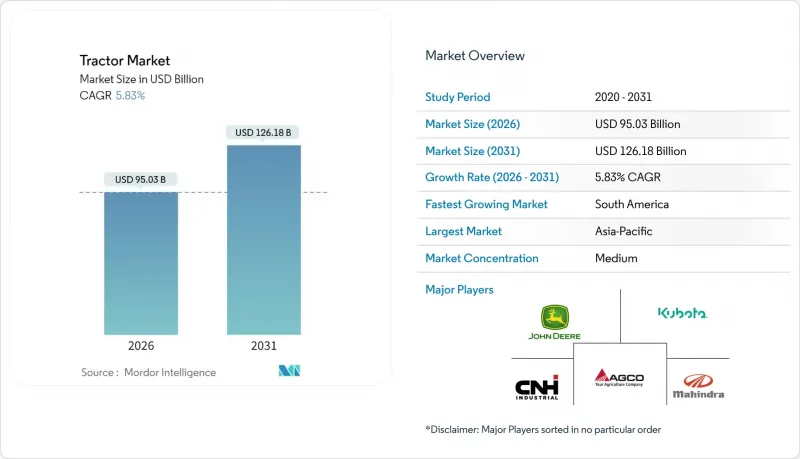
A confluence of mechanization demand in emerging economies, rapid precision-ag adoption, and expanding rental models underpins this steady rise. Asia-Pacific dominates volume, while South America records the fastest regional growth, reflecting divergent maturity curves. Power segmentation trends favor 40-100 HP for versatility, yet demand for above-100 HP machines accelerates as farms consolidate. Drive-type choices still lean toward cost-efficient 2WD, but 4WD gains ground where terrain dictates higher traction and data-driven practices require consistent wheel-slip control. Diesel propulsion remains the workhorse, although electric variants are scaling quickly as battery density improves and decarbonization rules tighten.
Global Tractor Market Trends and Insights
Rising Mechanization Demand in Emerging Economies
Urban migration and shrinking rural labor pools make mechanization a strategic necessity across Asia and Africa. India's 40-45% mechanization rate trails China's 57% and the United States' 95%, offering clear catch-up potential. New subsidy schemes in China prioritize smart 4WD tractors, promoting a shift toward higher horsepower that lifts per-acre productivity. Cooperative ownership models and equipment-sharing apps further catalyze adoption by spreading costs, while precision-placement benefits such as optimized fertilizer use improve soil health. Collectively, these trends embed tractors as multifunctional assets rather than basic power units, reinforcing long-term demand for the global tractor market.
Escalating Farm-Labor Shortages in OECD and BRICS
United States farmers grapple with a significant labor shortage, leading to heightened wage costs and squeezed profit margins. Similar gaps exist in the European Union and China. Growers respond by accelerating machinery purchases, now adopting labor-saving technology ahead of wage hikes. Autonomous and remotely operated tractors are making significant strides in the realms of horticulture and specialty crop farming, particularly in areas where securing a reliable seasonal workforce has become an ongoing challenge. This persistent labor shortage creates a fundamental baseline for the demand in the global tractor market, underscoring a transformative shift in agricultural practices. As these advanced machines take to the fields, they are not just filling a gap; they are revolutionizing the way crops are cultivated and harvested, opening up new possibilities for efficiency and productivity in an industry in need of innovation.
Electronics-Grade Chip Supply Bottlenecks
The ongoing semiconductor shortages are casting a long shadow over the production of power-train controllers and sensor modules. In early 2025, the lead times for 32-bit microcontrollers soared beyond a staggering 50 weeks, leading to frustrating line stoppages and protracted delivery timelines. While some automotive chip fabrication facilities are finally beginning to open their doors, the strain on capacity persists, limiting the immediate output crucial for the global tractor market. The ripple effects of this constraint are felt deeply, as manufacturers scramble to keep pace with demand amid an increasingly competitive landscape.
Other drivers and restraints analyzed in the detailed report include:
- Rapid Adoption of Precision-Ag and Telematics Platforms
- Growth of Data-Driven Tractor-Rental Platforms
- New Localization and Content-Origin Rules in Trade Pacts
For complete list of drivers and restraints, kindly check the Table Of Contents.
Segment Analysis
The 40-100 HP class supplied mainstream versatility and claimed 46.93% of the tractor market size in 2025, anchoring the global tractor market. Above-100 HP units are forecast to grow at a 7.16% CAGR during the forecast period, as larger farms seek acreage efficiency. This up-powering supports advanced hydraulic systems and greater implement widths, allowing integrated precision technologies. John Deere's Iowa expansion to build 9RX machines underscores long-term confidence in significant iron demand.
Farm business models focusing on larger scales harness the power of telematics-driven fleet coordination, transforming horsepower into a catalyst for extraordinary productivity. While smaller tractors with less than 40 HP continue to carve out their niche in the specialized realm of horticulture, the gradual pace of mechanization in micro-plots casts a shadow over their prospects. Consequently, high-horsepower momentum lifts the premium end of the global tractor market size, propelling revenue faster than unit volume.
Cost-efficient 2WD platforms held a 77.10% share of the tractor market in 2025. Yet 4WD adoption benefits from added traction, distributing torque for tillage under wetter or sloped conditions. The 7.69% CAGR projected for 4WD through 2031 aligns with broader precision-ag uptake, where consistent wheel slip protects seed placement accuracy.
The unpredictable nature of climate variability is reshaping the landscape of agricultural practices, extending the fleeting windows of opportunity for fieldwork when soil moisture levels fall below ideal conditions. This shift underscores the value of Alternate Wetting and Drying (AWD) investments, forging a stronger connection between farmers and innovative solutions. As they strive for year-round cultivation, many are now viewing four-wheel drive (4WD) vehicles as a vital safeguard against the whims of the weather. This evolving mindset deepens the relationship between the adoption of 4WD and the quest for greater profitability, highlighting how essential these advancements have become in navigating the challenges of modern farming.
The Tractor Market is Segmented by Horsepower (Below 40 HP, and More), Drive Type (Two-Wheel Drive and Four-/All-Wheel Drive), Propulsion Type (Diesel, Battery-Electric, and Hybrid), Application (Agriculture, Construction, Forestry, and More), and Geography. The Market Forecasts are Provided in Terms of Value (USD).
Geography Analysis
Asia-Pacific contributed 55.35% of the tractor market size in 2025. China remains pivotal as it pivots toward high-horsepower and smart tractors. Southeast Asian governments channel concessional credit into machinery purchases, maintaining a solid growth runway for the global tractor market in the region.
South America delivers the fastest expansion at 6.89% CAGR, buoyed by Brazil's soy and corn acreage gains and domestic credit lines that spur equipment upgrades. Massey Ferguson, Valtra, and New Holland have a significant share of Brazilian sales, illustrating the influence of localized assembly on customer preference. Chile and Colombia inject incremental demand through fruit-export diversification, reinforcing continental momentum.
North America and Europe showcase well-established markets characterized by a more measured pace of volume growth, yet they boast a higher value per unit. In 2024, European vehicle registrations plummeted to a decade low, reflecting the tightening grip of profitability challenges. Despite this, Europe stands at the forefront of pioneering electric vehicle trials and developing regulatory frameworks for autonomous technology.
Meanwhile, the Middle East and Africa, still in their early stages of market development, are becoming increasingly vital to the long-term expansion and diversity of the global tractor industry. Their strategic importance cannot be understated as they represent emerging opportunities in a landscape ripe for growth.
- Deere & Company
- CNH Industrial N.V. (Case IH, New Holland)
- AGCO Corporation (Massey Ferguson, Valtra, Fendt)
- Mahindra & Mahindra Ltd.
- Kubota Corporation
- CLAAS KGaA mbH
- Escorts Kubota Ltd.
- TAFE Ltd.
- Sonalika (International Tractors Ltd.)
- SDF Group (Same Deutz-Fahr)
- Yanmar Co. Ltd.
- Argo Tractors S.p.A.
- LS Mtron Ltd.
- Daedong (Kioti)
- TYM Corporation
- Weichai Lovol Intelligent Agricultural Technology CO., LTD
- YTO Group Corp.
- XCMG Construction Machinery Co., Ltd.
- Zetor Tractors a.s.
- J C Bamford Excavators Ltd
Additional Benefits:
- The market estimate (ME) sheet in Excel format
- 3 months of analyst support
TABLE OF CONTENTS
1 Introduction
- 1.1 Study Assumptions & Market Definition
- 1.2 Scope of the Study
2 Research Methodology
3 Executive Summary
4 Market Landscape
- 4.1 Market Overview
- 4.2 Market Drivers
- 4.2.1 Rising Mechanization Demand in Emerging Economies
- 4.2.2 Government Subsidies and Low-Interest Ag-Credit Lines
- 4.2.3 Escalating Farm-Labor Shortages in OECD and BRICS
- 4.2.4 Rapid Adoption of Precision-Ag and Telematics Platforms
- 4.2.5 Commercialization of Battery-Electric and Fuel-Cell Tractors
- 4.2.6 Growth of Data-Driven Tractor-Rental Platforms
- 4.3 Market Restraints
- 4.3.1 High Upfront Cost and Commodity-Price Volatility
- 4.3.2 Seasonal Income Dependence on Monsoon/Weather Cycles
- 4.3.3 Electronics-Grade Chip Supply Bottlenecks
- 4.3.4 New Localization and Content-Origin Rules In Trade Pacts
- 4.4 Value / Supply-Chain Analysis
- 4.5 Regulatory Landscape
- 4.6 Technological Outlook
- 4.7 Porter's Five Forces
- 4.7.1 Threat of New Entrants
- 4.7.2 Bargaining Power of Buyers/Consumers
- 4.7.3 Bargaining Power of Suppliers
- 4.7.4 Threat of Substitute Products
- 4.7.5 Intensity of Competitive Rivalry
5 Market Size & Growth Forecasts (Value (USD) and Volume (Units))
- 5.1 By Horsepower
- 5.1.1 Below 40 HP
- 5.1.2 40 - 100 HP
- 5.1.3 Above 100 HP
- 5.2 By Drive Type
- 5.2.1 Two-Wheel Drive (2WD)
- 5.2.2 Four-/All-Wheel Drive (4WD/AWD)
- 5.3 By Propulsion Type
- 5.3.1 Diesel
- 5.3.2 Battery-Electric
- 5.3.3 Hybrid (Diesel-Electric)
- 5.4 By Application
- 5.4.1 Agriculture
- 5.4.2 Construction
- 5.4.3 Forestry
- 5.4.4 Municipal & Grounds Maintenance
- 5.4.5 Haulage & Logistics
- 5.5 By Geography
- 5.5.1 North America
- 5.5.1.1 United States
- 5.5.1.2 Canada
- 5.5.1.3 Rest of North America
- 5.5.2 South America
- 5.5.2.1 Brazil
- 5.5.2.2 Argentina
- 5.5.2.3 Rest of South America
- 5.5.3 Europe
- 5.5.3.1 Germany
- 5.5.3.2 United Kingdom
- 5.5.3.3 France
- 5.5.3.4 Italy
- 5.5.3.5 Spain
- 5.5.3.6 Russia
- 5.5.3.7 Rest of Europe
- 5.5.4 Asia-Pacific
- 5.5.4.1 China
- 5.5.4.2 India
- 5.5.4.3 Japan
- 5.5.4.4 South Korea
- 5.5.4.5 Australia
- 5.5.4.6 Rest of Asia-Pacific
- 5.5.5 Middle-East and Africa
- 5.5.5.1 United Arab Emirates
- 5.5.5.2 Saudi Arabia
- 5.5.5.3 Turkey
- 5.5.5.4 Egypt
- 5.5.5.5 South Africa
- 5.5.5.6 Rest of Middle-East and Africa
- 5.5.1 North America
6 Competitive Landscape
- 6.1 Market Concentration
- 6.2 Strategic Moves
- 6.3 Market Share Analysis
- 6.4 Company Profiles (Includes Global level Overview, Market level overview, Core Segments, Financials as available, Strategic Information, Market Rank/Share, Products & Services, Recent Developments)
- 6.4.1 Deere & Company
- 6.4.2 CNH Industrial N.V. (Case IH, New Holland)
- 6.4.3 AGCO Corporation (Massey Ferguson, Valtra, Fendt)
- 6.4.4 Mahindra & Mahindra Ltd.
- 6.4.5 Kubota Corporation
- 6.4.6 CLAAS KGaA mbH
- 6.4.7 Escorts Kubota Ltd.
- 6.4.8 TAFE Ltd.
- 6.4.9 Sonalika (International Tractors Ltd.)
- 6.4.10 SDF Group (Same Deutz-Fahr)
- 6.4.11 Yanmar Co. Ltd.
- 6.4.12 Argo Tractors S.p.A.
- 6.4.13 LS Mtron Ltd.
- 6.4.14 Daedong (Kioti)
- 6.4.15 TYM Corporation
- 6.4.16 Weichai Lovol Intelligent Agricultural Technology CO., LTD
- 6.4.17 YTO Group Corp.
- 6.4.18 XCMG Construction Machinery Co., Ltd.
- 6.4.19 Zetor Tractors a.s.
- 6.4.20 J C Bamford Excavators Ltd
7 Market Opportunities & Future Outlook

