
PUBLISHER: Mordor Intelligence | PRODUCT CODE: 1937317

PUBLISHER: Mordor Intelligence | PRODUCT CODE: 1937317
Macadamia Nuts - Market Share Analysis, Industry Trends & Statistics, Growth Forecasts (2026 - 2031)
The macadamia nuts market is expected to grow from USD 1.79 billion in 2025 to USD 1.95 billion in 2026 and is forecast to reach USD 3.02 billion by 2031 at 9.08% CAGR over 2026-2031.
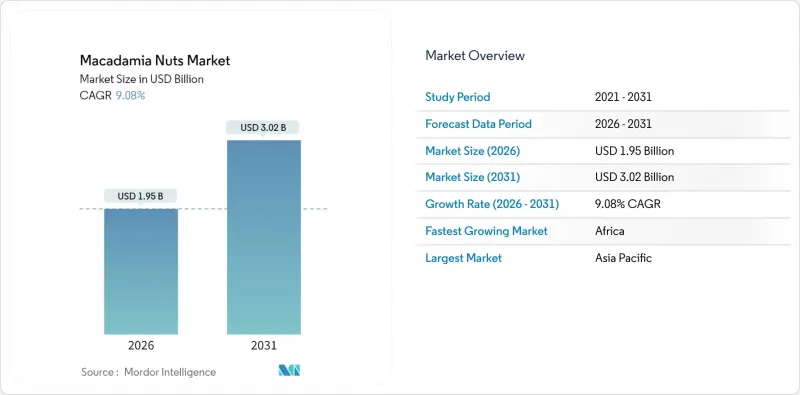
This growth is driven by increasing demand in premium healthy snacking and specialty ingredient segments. Consumer awareness of the nuts' high monounsaturated fat content and their benefits for cardiovascular health and skin care supports premium pricing compared to other tree nuts. While production expansion in South Africa, Australia, and Kenya has increased supply, the extended maturation period of macadamia trees limits market availability, supporting stable farm-gate prices. The market benefits from increased industrial procurement for plant-based dairy alternatives, cosmetic oils, and protein concentrates, reducing the seasonal volatility previously dominated by retail gift sales. Industry improvements in optical sorting technology, kernel extraction efficiency, and sustainable farming practices have enhanced production yields, strengthening the market's competitive position.
Global Macadamia Nuts Market Trends and Insights
Accelerated Demand from Premium Plant-based Dairy Producers
Macadamias are gaining prominence among plant-based beverage manufacturers for their natural creamy texture, which minimizes the need for additives. This characteristic makes them suitable for premium "barista ready" products that serve coffeehouse chains and upscale retailers. Manufacturers are establishing long-term supply contracts with growers in Australia and South Africa, increasing farm revenue and supporting orchard renewal. Advanced extraction methods preserve flavor, increasing product appeal in global markets. Recent regulatory changes in Europe permit nut milks to use traditional dairy terms, eliminating a significant marketing constraint and creating new opportunities for brand positioning.
Expanding Cosmetic-grade Oil Applications
Macadamia oil's lipid profile mirrors human skin oils, making it valuable for anti-aging skincare products. Beauty companies in Asia and Western markets incorporate it into high-end formulations for enhanced hydration and antioxidant protection. Advanced extraction methods increase its effectiveness, enabling premium positioning and enhanced consumer appeal. Companies obtain oil from certified orchards to validate sustainability claims and enhance traceability. The oil's value as a coproduct strengthens financial stability for nut processors, who benefit from multiple revenue streams while meeting increased demand in the luxury personal care market.
Price Volatility due to Weather-sensitive Harvests
Macadamia production is sensitive to weather conditions, particularly during the flowering period. While unseasonal rainfall can increase yields, it also leads to quality defects. Crop insurance policies typically do not cover these quality-related issues, exposing producers to financial risks. Restrictions on fungicide usage limit disease management options during humid conditions. The resulting lower kernel grades reduce processing efficiency and create price instability. To mitigate these challenges, buyers source macadamias from diverse regions including South Africa, Kenya, and Australia. This diversification helps maintain product quality standards and reduces the impact of regional harvest variations on global supply chains.
Other drivers and restraints analyzed in the detailed report include:
- Surging Investment in Regenerative Nut Farming
- Rising Popularity of Macadamia-based Protein Concentrates
- Competition from Lower-priced Tree Nuts
For complete list of drivers and restraints, kindly check the Table Of Contents.
Segment Analysis
The Macadamia Nuts Market Report is Segmented by Geography (North America, Europe, Asia-Pacific, South America, Middle East, and Africa). The Report Includes Production Analysis (Volume), Consumption Analysis (Value and Volume), Export Analysis (Value and Volume), Import Analysis (Value and Volume), and Price Trend Analysis. The Market Forecasts are Provided in Terms of Value (USD) and Volume (Metric Tons).
Geography Analysis
Asia-Pacific held 46.00% of the macadamia market nuts share in 2025, primarily due to increased Chinese imports following tariff reductions that decreased landed costs. Australia benefits from its geographic location, delivering kernels to Guangzhou within two weeks through chilled containers to maintain quality. The cooperative reinvests levies collected under Australia's increased 2025 rates into orchard innovation and disease research, reinforcing supply chain resilience. Japan's demand remains stable through its premium chocolate industry, while Vietnam shows increased consumption through modern retail channels due to its expanding middle class. Regional processors are obtaining HACCP and BRC safety certifications to comply with e-commerce platform requirements.
Africa, with South Africa and Kenya as key producers, shows the highest regional growth rate at 7.72% CAGR from 2026 to 2031. The region supplies 25% of global kernel production, using advanced sorting technologies to improve export quality. Kenya's temporary halt in in-shell harvesting has improved shipment quality standards and buyer confidence. The implementation of regenerative farming practices helps combat drought effects, while new orchards in Tanzania and Malawi utilize South African agricultural expertise to expand regional production.
North America and Europe focus on premium market segments. Hawaii maintains its macadamia production alongside tourism, while California explores macadamia cultivation in citrus-affected areas. European markets prioritize certified organic and Fairtrade kernels, supporting small-scale farmers in Kenya and Guatemala. Middle Eastern countries consider nuts as essential food items, with Saudi Arabia streamlining import procedures to increase protein source diversity.
- Market Overview
- Market Drivers
- Market Restraints
- Regulatory Landscape
- Technological Outlook
- Value / Supply-Chain Analysis
- PESTLE Analysis
- List of Stakeholders
Additional Benefits:
- The market estimate (ME) sheet in Excel format
- 3 months of analyst support
TABLE OF CONTENTS
1 Introduction
- 1.1 Study Assumptions and Market Definition
- 1.2 Scope of the Study
2 Research Methodology
3 Executive Summary
4 Market Landscape
- 4.1 Market Overview
- 4.2 Market Drivers
- 4.2.1 Accelerated Demand from Premium Plant-based Dairy Producers
- 4.2.2 Expanding Cosmetic-grade Oil Applications
- 4.2.3 Surging Investment in Regenerative Nut Farming
- 4.2.4 Rising Popularity of Macadamia-based Protein Concentrates
- 4.2.5 Adoption of Integrated Orchard-processing Models
- 4.2.6 Favorable Tariff Revisions in Key Importing Nations
- 4.3 Market Restraints
- 4.3.1 Price Volatility due to Weather-sensitive Harvests
- 4.3.2 Lengthy Juvenile Period of Macadamia Trees
- 4.3.3 Capital-intensive Post-harvest Cracking Infrastructure
- 4.3.4 Competition from Lower-priced Tree Nuts
- 4.4 Regulatory Landscape
- 4.5 Technological Outlook
- 4.6 Value / Supply-Chain Analysis
- 4.7 PESTLE Analysis
5 Market Size and Growth Forecasts (Value and Volume)
- 5.1 By Geography (Production Analysis (Volume), Consumption Analysis (Volume and Value), Import Analysis (Volume and Value), Export Analysis (Volume and Value), and Price Trend Analysis)
- 5.1.1 North America
- 5.1.1.1 United States
- 5.1.1.2 Canada
- 5.1.2 Europe
- 5.1.2.1 Germany
- 5.1.2.2 Netherlands
- 5.1.2.3 United Kingdom
- 5.1.2.4 France
- 5.1.3 Asia-Pacific
- 5.1.3.1 Australia
- 5.1.3.2 China
- 5.1.3.3 Vietnam
- 5.1.3.4 Japan
- 5.1.4 South America
- 5.1.4.1 Brazil
- 5.1.4.2 Colombia
- 5.1.5 Africa
- 5.1.5.1 South Africa
- 5.1.5.2 Kenya
- 5.1.6 Middle East
- 5.1.6.1 Saudi Arabia
- 5.1.1 North America
6 Competitive Landscape
- 6.1 List of Stakeholders
- 6.1.1 Marquis Macadamias Ltd.
- 6.1.2 Hamakua Macadamia Nut Company
- 6.1.3 Golden Macadamias (PTY) LTD.
- 6.1.4 Nambucca Macnuts Pty Ltd.
- 6.1.5 Royal Macadamia (Buderim Group Limited)
- 6.1.6 Nutworks Pty Ltd.
- 6.1.7 Tropical Mac EPZ Ltd.
- 6.1.8 Wondaree Macadamia Nuts
- 6.1.9 AmberMacs
- 6.1.10 Afrimac Nut Company Limited
- 6.1.11 Exotic EPZ Ltd (Nawiri Agribusiness EPZ Ltd)
- 6.1.12 Green & Gold Macadamias
- 6.1.13 Macadamias Direct (Finasucre Group)
- 6.1.14 Macridge
- 6.1.15 Mayan Gold Macadamia
7 Market Opportunities and Future Outlook

