
PUBLISHER: Mordor Intelligence | PRODUCT CODE: 1937340

PUBLISHER: Mordor Intelligence | PRODUCT CODE: 1937340
Base Metals - Market Share Analysis, Industry Trends & Statistics, Growth Forecasts (2026 - 2031)
Base Metals market size in 2026 is estimated at 141.85 million tons, growing from 2025 value of 137.05 million tons with 2031 projections showing 168.45 million tons, growing at 3.5% CAGR over 2026-2031.
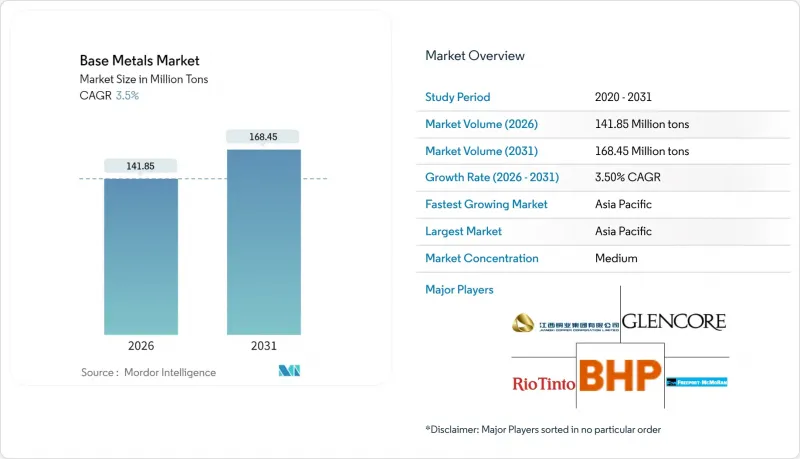
Continued electrification, widespread infrastructure renewal, and the shift from purely volume to value-focused production underpin this steady trajectory. Mining companies now emphasize strategic positioning, supply security, and technological efficiency instead of aggressive green-field capacity, while downstream manufacturers balance cost control with carbon-reduction imperatives as policy pressure intensifies. A growing preference for recycled feedstock, coupled with advances in high-efficiency processing, further reconfigures profit pools across the base metals market. In parallel, mergers and long-term supply partnerships are supplanting traditional large-scale acquisitions, signalling a maturing competitive environment where risk-sharing and proprietary technology determine leadership.
Global Base Metals Market Trends and Insights
Expanding Copper Demand for EV Wiring and Charging Infrastructure
Electric vehicle adoption multiplies copper intensity: each battery-electric car contains about 83 kg of copper, far exceeding the 23 kg in internal-combustion models. Public fast-charging stations require eight to ten times the copper used in home chargers, creating a parallel infrastructure growth engine. BHP's 2025 memorandum with CATL focuses on electrifying mine fleets and recycling batteries, illustrating how miners increasingly consume their own copper output while promoting closed-loop value chains. Government mandates for national charging networks, especially in China and the United States, provide transparency that allows miners to plan multi-year extraction and expansion schedules with greater confidence.
Infrastructure Stimulus in Emerging Economies
Major public works programmes in developing nations run on longer project horizons and higher metal intensities than maintenance cycles in mature markets. China's Belt and Road Initiative and India's USD 1.4 trillion National Infrastructure Pipeline elevate base-metal use as whole transport corridors and utilities networks are built from scratch. Research from Rice University's Baker Institute projects a tripling of per-capita base-metal consumption in India as urbanisation accelerates. Such green-field demand creates enduring plateaus rather than short spikes, giving producers the economic justification for sustained output growth and technological investment.
Trade Policy Volatility and Supply-Chain Disruptions
Sudden tariffs, quotas, and sanctions disrupt procurement cycles and inflate working capital needs. Manufacturers hedge by operating parallel supply chains, often duplicating inventory and logistics functions. Such redundancy raises total system costs and diverts cash away from mine development. Heightened geopolitical risk also increases the discount rates used to value large projects, thereby delaying capacity additions that might otherwise keep pace with demand.
Other drivers and restraints analyzed in the detailed report include:
- Aluminium Substitution in Automotive Lightweighting
- Improved Mining, Processing and Recycling Capabilities
- Environmental and Regulatory Pressures
For complete list of drivers and restraints, kindly check the Table Of Contents.
Segment Analysis
Copper controlled the largest slice of the base metals market size at 44.12% in 2025, a testament to its unmatched conductivity in electricity transmission. Zinc, though smaller, is on course for a brisk 5.18% CAGR, buoyed by its roles in corrosion-resistant coatings and emerging zinc-air battery chemistries. Aluminium retains a solid growth runway from vehicle lightweighting and packaging, while nickel benefits from stainless-steel output and high-nickel battery cathodes. Lead remains range-bound, except in select medical shielding and industrial battery niches; tin stays resilient in electronics solder due to stricter halogen-free assembly standards.
The broadening application set for zinc reduces the segment's dependence on construction cycles and lowers correlation with copper pricing. Breakthrough zinc-air installations designed for renewable energy storage signal a structural demand source that is less sensitive to macro cycles. Simultaneously, nickel catalyst research for synthetic fuel production expands the scope of base-metal applications beyond traditional metallurgical uses.
The Base Metals Market Report is Segmented by Metal Type (Copper, Aluminium, Zinc, Nickel, Lead, Tin), End-User Industry (Construction, Automotive and Transportation, Electrical and Electronics, Consumer Products, and More), Source (Primary Mining, Secondary Metals), and Geography (Asia-Pacific, North America, Europe, South America, Middle East and Africa). The Market Forecasts are Provided in Terms of Volume (tons).
Geography Analysis
Asia Pacific holds the largest share of the base metals market and delivers the fastest expansion, supported by coordinated industrial policy in China, India's infrastructure surge, and ASEAN manufacturing gains. The region's combined consumer-producer role underpins vertically integrated chains that tighten feedback loops between demand and upstream investment, accelerating innovation in mine automation and low-carbon processing. Australia, already a top exporter, benefits from stable governance and proximity to regional demand, capturing processing margins in addition to raw-material revenue.
North America, leveraging the US Defense Production Act, secures preferential financing and permitting for new copper and nickel projects. Ivanhoe Electric's joint exploration with BHP demonstrates how public incentives catalyse private deployment of modern geophysical methods that can accelerate discovery cycles. Grid-hardening and EV-charging roll-outs form a predictable demand baseline less sensitive to short-term economic swings.
Europe's CBAM creates a differentiated market for certified low-carbon base metals, rewarding producers that deploy renewable power or novel low-temperature extraction routes. Aluminium smelters in Norway and Iceland already sell premium billets, and steelmakers trial hydrogen-based direct-reduction technologies to maintain export competitiveness.
South America, despite Chile's regulatory resets, attracts fresh investment as majors pursue high-grade deposits with lower discovery risk. Anglo American's USD 5 billion partnership with Codelco underscores the value-creation potential in joint optimisation of adjacent assets. Infrastructure deficits and community-relations hurdles, however, lengthen project timelines.
The Middle East and Africa register incremental demand from industrial diversification and urbanisation. Large-scale mining opportunities, such as the Simandou iron ore project, demonstrate the scale advantage but also expose investors to governance and logistics challenges. Collaborative infrastructure investments between Chinese engineering firms and African governments help de-risk select corridors.
- Alcoa Corporation
- Anglo American PLC
- Aurubis AG
- BHP
- First Quantum Minerals Ltd.
- Freeport-McMoRan
- Glencore PLC
- Grupo Mexico
- Jiangxi Copper Corporation
- Jubilee Metals Group PLC
- Lundin Mining Corporation
- Norilsk Nickel
- Norsk Hydro ASA
- Rio Tinto
- Sumitomo Metal Mining Co., Ltd.
- Vale
- Vedanta Resources Limited
- Zijin Mining Group Co. Ltd
Additional Benefits:
- The market estimate (ME) sheet in Excel format
- 3 months of analyst support
TABLE OF CONTENTS
1 Introduction
- 1.1 Study Assumptions and Market Definition
- 1.2 Scope of the Study
2 Research Methodology
3 Executive Summary
4 Market Landscape
- 4.1 Market Overview
- 4.2 Market Drivers
- 4.2.1 Expanding copper demand for EV wiring and charging infrastructure
- 4.2.2 Infrastructure stimulus in emerging economies
- 4.2.3 Aluminium substitution in automotive lightweighting
- 4.2.4 Strategic stockpiling for critical-mineral security
- 4.2.5 Improved mining, processing, and recycling capabilities
- 4.3 Market Restraints
- 4.3.1 Rising carbon-pricing on energy-intensive smelting
- 4.3.2 Trade policy volatility and supply chain distrubtions
- 4.3.3 Environmental and Regulatory Pressures
- 4.4 Value Chain Analysis
- 4.5 Porter's Five Forces
- 4.5.1 Bargaining Power of Suppliers
- 4.5.2 Bargaining Power of Buyers
- 4.5.3 Threat of New Entrants
- 4.5.4 Threat of Substitute Products and Services
- 4.5.5 Degree of Competition
5 Market Size and Growth Forecasts (Volume)
- 5.1 By Metal Type
- 5.1.1 Copper
- 5.1.2 Aluminium
- 5.1.3 Zinc
- 5.1.4 Nickel
- 5.1.5 Lead
- 5.1.6 Tin
- 5.2 By End-user Industry
- 5.2.1 Construction
- 5.2.2 Automotive and Transportation
- 5.2.3 Electrical and Electronics
- 5.2.4 Consumer Products
- 5.2.5 Medical Devices
- 5.2.6 Other End-user Industries
- 5.3 By Source
- 5.3.1 Primary Mining
- 5.3.2 Secondary (Recycled) Metals
- 5.4 By Geography
- 5.4.1 Asia-Pacific
- 5.4.1.1 China
- 5.4.1.2 India
- 5.4.1.3 Japan
- 5.4.1.4 South Korea
- 5.4.1.5 ASEAN
- 5.4.1.6 Australia
- 5.4.1.7 Rest of Asia-Pacific
- 5.4.2 North America
- 5.4.2.1 United States
- 5.4.2.2 Canada
- 5.4.2.3 Mexico
- 5.4.3 Europe
- 5.4.3.1 Germany
- 5.4.3.2 United Kingdom
- 5.4.3.3 France
- 5.4.3.4 Italy
- 5.4.3.5 Spain
- 5.4.3.6 Nordics
- 5.4.3.7 Russia
- 5.4.3.8 Rest of Europe
- 5.4.4 South America
- 5.4.4.1 Brazil
- 5.4.4.2 Argentina
- 5.4.4.3 Rest of South America
- 5.4.5 Middle East and Africa
- 5.4.5.1 Saudi Arabia
- 5.4.5.2 United Arab Emirates
- 5.4.5.3 Qatar
- 5.4.5.4 South Africa
- 5.4.5.5 Nigeria
- 5.4.5.6 Egypt
- 5.4.5.7 Rest of Middle East and Africa
- 5.4.1 Asia-Pacific
6 Competitive Landscape
- 6.1 Market Concentration
- 6.2 Strategic Moves
- 6.3 Market Share(%)/Ranking Analysis
- 6.4 Company Profiles (includes Global level Overview, Market level overview, Core Segments, Financials as available, Strategic Information, Market Rank/Share for key companies, Products and Services, and Recent Developments)
- 6.4.1 Alcoa Corporation
- 6.4.2 Anglo American PLC
- 6.4.3 Aurubis AG
- 6.4.4 BHP
- 6.4.5 First Quantum Minerals Ltd.
- 6.4.6 Freeport-McMoRan
- 6.4.7 Glencore PLC
- 6.4.8 Grupo Mexico
- 6.4.9 Jiangxi Copper Corporation
- 6.4.10 Jubilee Metals Group PLC
- 6.4.11 Lundin Mining Corporation
- 6.4.12 Norilsk Nickel
- 6.4.13 Norsk Hydro ASA
- 6.4.14 Rio Tinto
- 6.4.15 Sumitomo Metal Mining Co., Ltd.
- 6.4.16 Vale
- 6.4.17 Vedanta Resources Limited
- 6.4.18 Zijin Mining Group Co. Ltd
7 Market Opportunities and Future Outlook
- 7.1 White-space and Unmet-need Assessment
- 7.2 Increased Demand for Clean Energy Technologies

