
PUBLISHER: Mordor Intelligence | PRODUCT CODE: 1937361

PUBLISHER: Mordor Intelligence | PRODUCT CODE: 1937361
Champagne - Market Share Analysis, Industry Trends & Statistics, Growth Forecasts (2026 - 2031)
champagne market size in 2026 is estimated at USD 19.53 billion, growing from 2025 value of USD 18.63 billion with 2031 projections showing USD 24.75 billion, growing at 4.85% CAGR over 2026-2031.
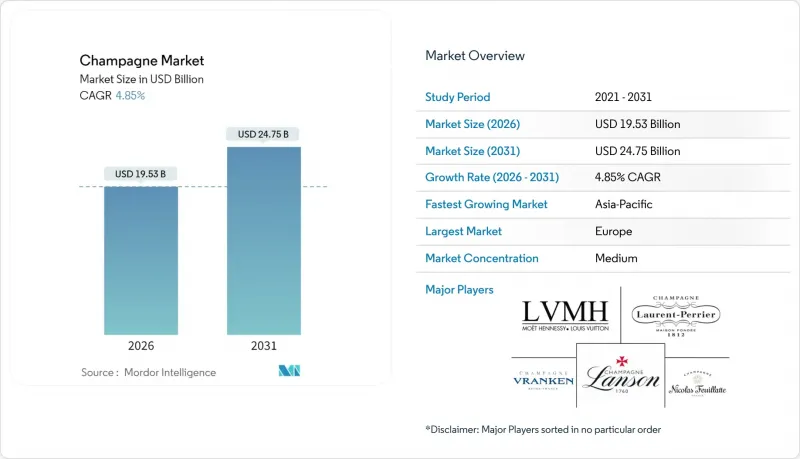
Even as overall shipment volumes stabilize, trends like premiumization, climate-smart viticulture, and a resilient demand for luxury continue to drive value expansion. Europe, bolstered by its deep-rooted celebratory culture and stringent AOC protections, maintains its leadership. In contrast, the Asia Pacific region experiences steady growth, fueled by a burgeoning middle class, lively tourism, and the tradition of gifting as a social status symbol. On the supply side, vigilance against spring frost and mildew episodes keeps inventories in check. This discipline allows for price increases that counterbalance rising costs. Additionally, tools for digital authentication and limited editions tied to NFTs not only bolster brand integrity but also unveil new revenue streams. Brands that weave heritage storytelling with sustainable practices and immersive marketing enjoy heightened consumer loyalty.
Global Champagne Market Trends and Insights
Premiumization and luxury positioning of celebratory culture
In a notable pivot, the champagne industry is prioritizing premiumization, mirroring shifts in global consumer behavior that now favor value creation over sheer volume. LVMH's champagne division epitomizes this trend, reporting revenue growth fueled by strategic price hikes, especially in Europe and Japan. This comes even as volumes dipped from 70.9 million bottles in 2022 to 61.7 million in 2024, as highlighted by LVMH. But premiumization isn't just about price; it's about crafting an experience. Champagne houses are delving into heritage storytelling and rolling out exclusive access programs. Take Veuve Clicquot, for instance. They're honing in on their La Grande Dame prestige cuvee, blending modern imagery to allure younger consumers while steadfastly upholding traditional quality, as noted by Formes de Luxe. The ultra-luxury segment's projected 8.25% CAGR through 2030 underscores this strategy's validity. Today's consumers are increasingly perceiving champagne not just as a drink, but as a savvy investment in social capital. Adding fuel to this trend, France welcomed a record 100 million international tourists in 2024, raking in a staggering EUR 71 billion. This influx, as reported by Campus France, is not just a boon for the economy but a golden opportunity, immersing global visitors in genuine champagne experiences.
Product innovation and new flavor profiles
Champagne producers are pushing traditional boundaries while adhering to AOC constraints, crafting unique offerings that resonate with shifting consumer tastes. The debut of Voltis, a hybrid grape variety engineered to resist downy and powdery mildew, underscores the industry's proactive stance on climate challenges. However, strict regulations cap its vineyard allocation at 5% and blending at 10%. Sustainability is at the forefront, with champagne houses boasting over 70% environmental certification under the Sustainable Viticulture in Champagne (VDC) framework, eyeing a 100% target by 2030, as highlighted by The Comite Champagne. Packaging is also evolving; Veuve Clicquot has slashed its packaging volume by 40% since 2019 and is experimenting with sustainable materials, such as hemp, for its premium offerings, as reported by Formes de Luxe. These strides not only tackle the twin challenges of climate adaptation and rising consumer sustainability demands but also uphold the exclusivity that champagne is renowned for. Meanwhile, the rose segment, with a 5.82% CAGR, showcases successful innovations in color and style, resonating with younger audiences while staying true to traditional craftsmanship.
Tightening advertising regulations on alcohol in key markets
Major champagne markets are tightening advertising restrictions, limiting brand visibility, and making it harder to attract consumers. This is especially true for digital marketing, which is crucial for engaging younger audiences. Stricter alcohol advertising rules in key European markets are not only curbing traditional promotional avenues but also driving up compliance costs for global champagne brands. In response, these brands are shifting towards experiential marketing and influencer collaborations, both of which demand a heftier investment for each consumer interaction than conventional advertising. The situation is even more pronounced in the Asia Pacific region, where countries have vastly different regulatory frameworks. This disparity creates a challenging compliance environment, benefiting larger champagne houses with the means to navigate legal complexities, while smaller producers struggle. Additionally, restrictions on digital platforms for alcohol advertising pose hurdles for market entry, especially for premium brands aiming to reach affluent younger audiences on social media. As the regulatory landscape increasingly emphasizes health concerns, it poses long-term challenges for the growth of the champagne category. With diminished advertising exposure, there's a risk of stunted brand discovery and fewer opportunities for premiumization in emerging markets, where champagne consumption habits are still evolving.
Other drivers and restraints analyzed in the detailed report include:
- Growing demand for low-dosage "Brut Nature/Extra Brut" styles
- Innovation in sustainable viticulture and carbon-neutral wineries
- Supply-side pressure from climate-induced grape yield volatility
For complete list of drivers and restraints, kindly check the Table Of Contents.
Segment Analysis
In 2025, white champagne commands a dominant 90.86% market share, underscoring its entrenched consumer preferences and production mastery. Meanwhile, rose champagne, with a brisk 5.61% CAGR projected through 2031, hints at burgeoning prospects in premium branding and lifestyle-centric marketing. The white champagne segment thrives on the age-old blending of Chardonnay, Pinot Noir, and Pinot Meunier, cementing its foundational identity. Established production techniques, honed over time, ensure both consistency and quality at scale. On the other hand, rose champagne's ascent is fueled by its visual allure and the overarching trend of premiumization. This segment fetches elevated price points, a nod to its intricate production methods and the constraints of limited availability. Notably, the color segmentation unveils strategic avenues: rose's allure resonates with younger audiences, especially those swayed by social media, who prioritize aesthetics as much as taste.
Production limitations shape the dynamics of color segments. Rose champagne, necessitating meticulous grape selection and processing, faces scalability challenges absent in the more streamlined workflows of white champagne. Furthermore, the repercussions of climate change aren't uniform across these segments. Rose's reliance on precise grape maturity renders it susceptible to weather fluctuations, a vulnerability not as pronounced in traditional white blends. This segment's trajectory mirrors the broader luxury market's pivot towards exclusivity and distinctiveness. Rose carves out a niche as a more approachable gateway to the premium champagne realm, yet it cleverly retains a level of scarcity, justifying its price premiums.
In 2025, Brut champagne commands a dominant 78.88% market share, epitomizing the industry's classic sweetness profile that harmonizes widespread consumer appeal with efficient production. Meanwhile, Extra Brut is witnessing a robust 6.05% CAGR through 2031, signaling a shift among discerning premium consumers who now prioritize terroir expression over mere sweetness. The Demi-Sec and Doux segments cater to specialized markets: Demi-Sec finds favor during dessert pairings, while Doux holds significance in certain cultural settings where its sweeter notes resonate with local tastes.
The segmentation by sweetness underscores the technical prowess in winemaking. Producing Extra Brut necessitates top-tier grape quality and meticulous fermentation oversight, as any flavor flaws can't be masked by a reduced dosage. Such stringent quality demands naturally erect barriers to entry, benefiting established houses with deep vineyard ties and seasoned winemaking acumen. As consumers become more educated, especially in mature markets, there's a growing appreciation for the intricate flavor profiles of Extra Brut, unmasked by sugar. This segment's rise also mirrors a broader trend: health-conscious consumers are gravitating towards authenticity and natural production methods, moving away from conventional sweetness norms.
The Champagne Market Report is Segmented by Color (Rose, White), Sweetness Level (Brut, Extra Brut, Demi-Sec, Doux), Price Point (Economy, Luxury, Ultra Luxury), Packaging Size (Mini 187ml and Half 375ml, Standard 750ml, and More), Distribution Channel (On-Trade, Off-Trade), and Geography (North America, Europe, Asia-Pacific, South America, Middle East and Africa). The Market Forecasts are Provided in Terms of Value (USD).
Geography Analysis
Europe holds a 58.01% market share in 2025, underpinned by its champagne production heritage and consumption culture. France maintains its leadership in consumption and exports, despite an 11.2% volume decline in 2023, according to Meininger's International. The region's strength stems from established distribution networks and regulatory frameworks, particularly the AOC designations overseen by INAO. Germany, the United Kingdom, and the Netherlands remain primary consumption markets, with the UK retaining its position as the second-largest champagne importer despite Brexit challenges. European consumption patterns demonstrate stability during economic downturns, as champagne remains integral to cultural celebrations and business functions. Tourism further enhances consumption through hospitality channels, with international visitor arrivals exceeding 100 million in 2024, according to Campus France.
Asia Pacific exhibits the highest growth rate at 6.52% CAGR through 2031, supported by middle-class expansion and increasing adoption of Western celebration customs. China represents significant growth potential, with wine imports reaching USD 437.9 million in 2024, despite a 6.16% year-over-year decline. France remains China's primary source at USD 176.3 million, according to the China Food and Native Produce Import and Export Chamber of Commerce. Japan displays mature market characteristics, with wine consumption tripling since 1989 and French champagne representing 40% of sparkling wine imports, as reported by Kirin Holdings. India shows promise with 6% growth in alcoholic beverage consumption, while Southeast Asian markets benefit from tourism recovery. Regional growth depends on economic development, urbanization, and cultural integration of champagne consumption.
North America maintains consistent demand, with the United States as the largest export market consuming 27.4 million bottles and generating EUR 820 million in revenue for 2024, according to the Comite Champagne. The region exhibits mature consumption patterns with established premium positioning. Canada and Mexico provide additional volume, with Mexico showing growth potential through expanding luxury consumption. However, proposed 30% tariffs on EU wines present challenges for market accessibility. American consumers increasingly prioritize premium quality over volume, aligning with champagne's heritage-focused positioning. The region's distribution infrastructure and hospitality sector provide growth foundations, though tariff policies and economic conditions create market uncertainties.
- LVMH Moet Hennessy Louis Vuitton
- Pernod Ricard SA
- Vranken-Pommery Monopole
- Laurent-Perrier Group
- Lanson-BCC Group
- Diageo plc
- Remy Cointreau SA
- Taittinger CCVC
- Bollinger SA
- Piper-Heidsieck (CVRG)
- Nicolas Feuillatte (Coopp)
- Deutz & Geldermann SA
- Champagne AYALA
- Andre Champagne Cellars
- Cook's Champagne Cellars
- Barefoot Bubbly (E.&J. Gallo)
- Societa Agricola F. Korbel & Bros.
- Gruppo Italiano Vini - GIC
- Treasury Wine Estates - Chandon
- Henkell Freixenet GmbH
Additional Benefits:
- The market estimate (ME) sheet in Excel format
- 3 months of analyst support
TABLE OF CONTENTS
1 INTRODUCTION
- 1.1 Study Assumptions and Market Definition
- 1.2 Scope of the Study
2 RESEARCH METHODOLOGY
3 EXECUTIVE SUMMARY
4 MARKET DYNAMICS
- 4.1 Market Overview
- 4.2 Market Drivers
- 4.2.1 Premiumization and luxury positioning of celebratory culture
- 4.2.2 Product innovation and new flavor profiles
- 4.2.3 Growing demand for low-dosage "Brut Nature/Extra Brut" styles
- 4.2.4 Innovation in sustainable viticulture and carbon-neutral wineries
- 4.2.5 Wine tourism and experiential consumption
- 4.2.6 NFT-backed limited-edition cuvees creating new revenue streams
- 4.3 Market Restraints
- 4.3.1 Tightening advertising regulations on alcohol in key markets
- 4.3.2 Supply-side pressure from climate-induced grape yield volatility
- 4.3.3 Regulatory and appellation constraints
- 4.3.4 Widespread counterfeiting and brand dilution
- 4.4 Consumer Behavior Analysis
- 4.5 Regulatory Landscape
- 4.6 Technological Outlook
- 4.7 Porter's Five Forces
- 4.7.1 Threat of New Entrants
- 4.7.2 Bargaining Power of Buyers
- 4.7.3 Bargaining Power of Suppliers
- 4.7.4 Threat of Substitute Products
- 4.7.5 Intensity of Competitive Rivalry
5 MARKET SIZE AND GROWTH FORECASTS (VALUE)
- 5.1 By Color
- 5.1.1 Rose
- 5.1.2 White
- 5.2 By Sweetness Level
- 5.2.1 Brut
- 5.2.2 Extra Brut
- 5.2.3 Demi-Sec
- 5.2.4 Doux
- 5.3 By Price Point
- 5.3.1 Economy
- 5.3.2 Luxury
- 5.3.3 Ultra Luxury
- 5.4 By Packaging Size
- 5.4.1 Mini (187 ml) and Half (375 ml)
- 5.4.2 Standard (750 ml)
- 5.4.3 Magnum (1.5 L) and Large Formats
- 5.5 By Distribution Channel
- 5.5.1 On-Trade
- 5.5.2 Off-Trade
- 5.5.2.1 Online Retailers
- 5.5.2.2 Offline Retailers
- 5.6 By Geography
- 5.6.1 North America
- 5.6.1.1 United States
- 5.6.1.2 Canada
- 5.6.1.3 Mexico
- 5.6.1.4 Rest of North America
- 5.6.2 Europe
- 5.6.2.1 Germany
- 5.6.2.2 United Kingdom
- 5.6.2.3 Italy
- 5.6.2.4 France
- 5.6.2.5 Spain
- 5.6.2.6 Netherlands
- 5.6.2.7 Poland
- 5.6.2.8 Belgium
- 5.6.2.9 Sweden
- 5.6.2.10 Rest of Europe
- 5.6.3 Asia-Pacific
- 5.6.3.1 China
- 5.6.3.2 India
- 5.6.3.3 Japan
- 5.6.3.4 Australia
- 5.6.3.5 Indonesia
- 5.6.3.6 South Korea
- 5.6.3.7 Thailand
- 5.6.3.8 Singapore
- 5.6.3.9 Rest of Asia-Pacific
- 5.6.4 South America
- 5.6.4.1 Brazil
- 5.6.4.2 Argentina
- 5.6.4.3 Rest of South America
- 5.6.5 Middle East and Africa
- 5.6.5.1 South Africa
- 5.6.5.2 United Arab Emirates
- 5.6.5.3 Rest of Middle East and Africa
- 5.6.1 North America
6 COMPETITIVE LANDSCAPE
- 6.1 Market Concentration
- 6.2 Strategic Moves
- 6.3 Market Share Analysis
- 6.4 Company Profiles (includes Global level Overview, Market level overview, Core Segments, Financials, Strategic Information, Market Rank/Share, Products and Services, Recent Developments)
- 6.4.1 LVMH Moet Hennessy Louis Vuitton
- 6.4.2 Pernod Ricard SA
- 6.4.3 Vranken-Pommery Monopole
- 6.4.4 Laurent-Perrier Group
- 6.4.5 Lanson-BCC Group
- 6.4.6 Diageo plc
- 6.4.7 Remy Cointreau SA
- 6.4.8 Taittinger CCVC
- 6.4.9 Bollinger SA
- 6.4.10 Piper-Heidsieck (CVRG)
- 6.4.11 Nicolas Feuillatte (Coopp)
- 6.4.12 Deutz & Geldermann SA
- 6.4.13 Champagne AYALA
- 6.4.14 Andre Champagne Cellars
- 6.4.15 Cook's Champagne Cellars
- 6.4.16 Barefoot Bubbly (E.&J. Gallo)
- 6.4.17 Societa Agricola F. Korbel & Bros.
- 6.4.18 Gruppo Italiano Vini - GIC
- 6.4.19 Treasury Wine Estates - Chandon
- 6.4.20 Henkell Freixenet GmbH
7 MARKET OPPORTUNITIES AND FUTURE TRENDS

