PUBLISHER: Mordor Intelligence | PRODUCT CODE: 2124720

PUBLISHER: Mordor Intelligence | PRODUCT CODE: 2124720
Benzene-Toluene-Xylene (BTX) - Market Share Analysis, Industry Trends & Statistics, Growth Forecasts (2026 - 2031)
According to Mordor Intelligence, the benzene-Toluene-Xylene market size is projected to be 149.82 million tons in 2025, 155.83 million tons in 2026, and reach 189.68 million tons by 2031, growing at a CAGR of 4.01% from 2026 to 2031.
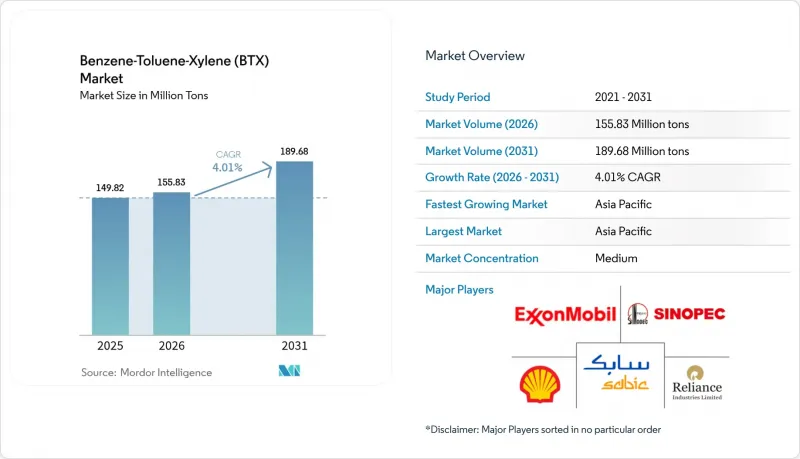
This report is Segmented by Type (Benzene, Toluene, Xylene [Ortho, Meta, and Para]), Application (Benzene [Ethylbenzene, Cyclohexane, Alkylbenzene, Cumene, Nitrobenzene, and Other], Toluene [Coatings, Adhesives/Inks, Explosives, and Chemical Intermediates], Xylenes [Solvents, Monomer, and Other]), and Geography (Asia-Pacific, North America, Europe, and More). Market Forecasts are in Volume (Tons).
Global Benzene-Toluene-Xylene (BTX) Market Trends and Insights
CAPEX Boom in New Aromatics Complexes Reshapes Regional Supply
Between 2024 and 2027, China, India, Saudi Arabia, and Malaysia are set to unveil greenfield and brownfield aromatics projects. In March 2024, a para-xylene unit was inaugurated in Gulei, boasting a significant capacity. Meanwhile, a facility at Pengerang is on the verge of completion, eyeing a mid-2026 debut. Late in 2024, a project expanded its capacity by leveraging a toluene hydro-dealkylation loop for benzene production. Together, these ventures contribute to BTX supply, further solidifying Asia-Pacific's dominance in production. By mandating compliance with ISO 9001 and ISO 14001, the projects emphasize construction quality, emissions monitoring, and worker safety. This commitment elevates initial capital intensity but mitigates operational risks over the project's lifespan.
Surging PET Demand Keeps Para-Xylene Balances Tight
In India, Indonesia, and Vietnam, where per-capita PET penetration lags behind North America's, the demand for polyethylene terephthalate resin is surging, predominantly for beverage bottles. Para-xylene, accounting for the majority of xylene demand, is in high demand because producing purified terephthalic acid (PTA) requires this feedstock. Zhejiang-based Rongsheng Petrochemical operates para-xylene facilities with significant annual capacity, running at high utilization, which leaves little room for unexpected demand surges. While ortho and meta-xylene together make up a smaller portion of xylene consumption, their growth is tempered, largely due to phthalic anhydride's struggle against plasticizer substitutions. In January 2026, the premium of para-xylene over mixed xylene reached its peak since 2021. This price surge has led refiners to modify their toluene disproportionation loops, resulting in a trade-off where ortho-xylene and benzene outputs are compromised. To protect downstream polymer catalysts, adherence to ASTM D5453 standards is crucial, ensuring sulfur levels remain below 1 ppm.
Carcinogenicity-Driven Exposure Limits Raise Compliance Costs
The U.S. Occupational Safety and Health Administration (OSHA) enforces strict benzene exposure limits: a time-weighted average of 1 ppm and a short-term ceiling of 5 ppm. These measures are in response to links between benzene overexposure and acute myeloid leukemia. Operators are now mandated to invest in sealed loading arms, vapor-recovery systems, and real-time air monitors. Additionally, they must finance annual blood tests for staff with exposure records surpassing the set thresholds. The World Health Organization (WHO) and corresponding EU directives advocate for these stringent thresholds on a global scale. Retrofitting a mid-1980s aromatics extraction train to meet contemporary ventilation and monitoring standards demands significant investment. Furthermore, for a plant with 100 personnel, ongoing surveillance and personal protective equipment (PPE) expenses are considerable. In 2025, Shell closed its aging Pulau Bukom benzene unit, deeming the upgrade costs economically unviable. Similarly, SABIC shut down its Geleen operations for the same reason.
Other drivers and restraints analyzed in the detailed report include:
- Refinery-Petrochemical Integration Unlocks Captive Extraction
- Styrene-Linked Ethylbenzene Revival in Post-Tariff Markets
- VOC Caps in Coatings Redirect Solvent Demand
For complete list of drivers and restraints, kindly check the Table Of Contents.
Segment Analysis
In 2025, benzene accounted for 38.33% of the total volume, bolstering chains from ethylbenzene to styrene, cyclohexane to nylon, and cumene to bisphenol A. Ethylbenzene, in particular, consumed a major share of the 2025 benzene output. The market for benzene derivatives within the Benzene-Toluene-Xylene (BTX) segment is projected to grow steadily through 2031. Demand from detergents and polyurethanes has secured an additional share from cumene, nitrobenzene, and alkylbenzene. Cyclohexane, accounting for a notable portion of benzene's usage, is witnessing growth, driven by the increasing adoption of nylon 6 fiber in automotive under-hood components.
Toluene, while smaller today, is the Benzene-Toluene-Xylene (BTX) market's fastest-advancing aromatic at a 4.48% CAGR. As of now, a significant portion of toluene is being funneled into disproportionation and trans-alkylation units, producing benzene and para-xylene, a notable rise from earlier years. While traditional sectors like paint, ink, and adhesives-previously accounting for a substantial share of toluene's consumption-have diminished due to VOC regulations, niches such as explosives and nitration chemistry continue to thrive. Adhering to ASTM purity standards ensures that metal and sulfur contaminants remain within catalyst-tolerance limits, thereby enhancing downstream efficiency.
Complete Report Scope:
- By Type
- Benzene
- Toluene
- Xylene
- Ortho-xylene
- Meta-xylene
- Para-xylene
- By Application
- Benzene
- Ethylbenzene
- Cyclohexane
- Alkylbenzene
- Cumene
- Nitrobenzene
- Other Applications
- Toluene
- Paints and Coatings
- Adhesives and Inks
- Explosives
- Chemical Intermediates
- Xylenes
- Solvents
- Monomer
- Other Applications
- Benzene
- By Geography
- Asia-Pacific
- China
- India
- Japan
- South Korea
- Rest of Asia-Pacific
- North America
- United States
- Canada
- Mexico
- Europe
- Germany
- United Kingdom
- Italy
- France
- Rest of Europe
- South America
- Brazil
- Argentina
- Rest of South America
- Middle-East and Africa
- Saudi Arabia
- South Africa
- Rest of Middle-East and Africa
- Asia-Pacific
Geography Analysis
Asia-Pacific anchored 62.41% of 2025 volume and is forecast to clock a 4.22% CAGR through 2031. China commands a significant portion of the regional demand, driven by para-xylene production operating at near full capacity. Meanwhile, India is set to bolster this demand further, with additional aromatics capacity being added between 2024 and 2026. In Japan and South Korea, capacity dynamics shift as output is reduced in some units and exports are redirected towards Southeast Asia.
North America sees its Benzene-Toluene-Xylene (BTX) market size stabilize, albeit with greater integration. By 2026, new capacity is set to be introduced, predominantly targeting in-house styrene and polyester chains. While Canada maintains steady benzene output, Mexico faces challenges with unit utilization, hindered by delays in refinery modernization.
Europe's share shrinks as traditional refineries shift focus from aromatics. Some units have been closed or repurposed for biofuel production. However, certain facilities remain resilient, boasting significant production capacities. South America, spearheaded by a major complex, contributes to the global volume, while contributions from the Middle-East and Africa rise, buoyed by capacity extensions and new projects.
- BASF
- BP p.l.c.
- Chevron Phillips Chemical Company LLC
- China Petrochemical Corporation
- China National Offshore Oil Corporation (CNOOC)
- Dow
- ENEOS Corporation
- Exxon Mobil Corporation
- Formosa Plastics Group
- GS Caltex Corporation
- INEOS
- IRPC Public Company Limited
- JFE Chemical Corporation
- JX Nippon Oil & Gas Exploration Corporation (ENEOS)
- Mitsubishi Gas Chemical Trading, Inc.
- MOLGROUP
- OCI Company Ltd.
- Reliance Industries Limited
- SABIC
- Shell plc
- S-OIL Corporation
- TotalEnergies
- YEOCHUN NCC CO., LTD.
Additional Benefits:
- The market estimate (ME) sheet in Excel format
- 3 months of analyst support
TABLE OF CONTENTS
1 Introduction
- 1.1 Study Assumptions and Market Definition
- 1.2 Scope of the Study
2 Research Methodology
3 Executive Summary
4 Market Landscape
- 4.1 Market Overview
- 4.2 Market Drivers
- 4.2.1 CAPEX boom in new aromatics complexes (Asia and Middle-East)
- 4.2.2 Surging PET demand keeps para-xylene balances tight
- 4.2.3 Refinery-petchem integration unlocking captive BTX extraction
- 4.2.4 Styrene-linked ethylbenzene revival in post-tariff U.S. and India
- 4.2.5 China's refinery's Aromatics-Plus policy incentives for high-purity BTX
- 4.3 Market Restraints
- 4.3.1 Carcinogenicity-driven occupational exposure curbs
- 4.3.2 VOC caps in paints/adhesives favour low-aromatic blends
- 4.3.3 Octane-for-aromatics trade-off in gasoline pool after E10 rollout
- 4.4 Value Chain Analysis
- 4.5 Porter's Five Forces
- 4.5.1 Bargaining Power of Suppliers
- 4.5.2 Bargaining Power of Buyers
- 4.5.3 Threat of New Entrants
- 4.5.4 Threat of Substitutes
- 4.5.5 Degree of Competition
5 Market Size and Growth Forecasts (Volume)
- 5.1 By Type
- 5.1.1 Benzene
- 5.1.2 Toluene
- 5.1.3 Xylene
- 5.1.3.1 Ortho-xylene
- 5.1.3.2 Meta-xylene
- 5.1.3.3 Para-xylene
- 5.2 By Application
- 5.2.1 Benzene
- 5.2.1.1 Ethylbenzene
- 5.2.1.2 Cyclohexane
- 5.2.1.3 Alkylbenzene
- 5.2.1.4 Cumene
- 5.2.1.5 Nitrobenzene
- 5.2.1.6 Other Applications
- 5.2.2 Toluene
- 5.2.2.1 Paints and Coatings
- 5.2.2.2 Adhesives and Inks
- 5.2.2.3 Explosives
- 5.2.2.4 Chemical Intermediates
- 5.2.3 Xylenes
- 5.2.3.1 Solvents
- 5.2.3.2 Monomer
- 5.2.3.3 Other Applications
- 5.2.1 Benzene
- 5.3 By Geography
- 5.3.1 Asia-Pacific
- 5.3.1.1 China
- 5.3.1.2 India
- 5.3.1.3 Japan
- 5.3.1.4 South Korea
- 5.3.1.5 Rest of Asia-Pacific
- 5.3.2 North America
- 5.3.2.1 United States
- 5.3.2.2 Canada
- 5.3.2.3 Mexico
- 5.3.3 Europe
- 5.3.3.1 Germany
- 5.3.3.2 United Kingdom
- 5.3.3.3 Italy
- 5.3.3.4 France
- 5.3.3.5 Rest of Europe
- 5.3.4 South America
- 5.3.4.1 Brazil
- 5.3.4.2 Argentina
- 5.3.4.3 Rest of South America
- 5.3.5 Middle-East and Africa
- 5.3.5.1 Saudi Arabia
- 5.3.5.2 South Africa
- 5.3.5.3 Rest of Middle-East and Africa
- 5.3.1 Asia-Pacific
6 Competitive Landscape
- 6.1 Market Concentration
- 6.2 Strategic Moves
- 6.3 Market Share(%)/Ranking Analysis
- 6.4 Company Profiles (includes Global Overview, Market Overview, Core Segments, Financials, Strategic Information, Products and Services, Recent Developments)
- 6.4.1 BASF
- 6.4.2 BP p.l.c.
- 6.4.3 Chevron Phillips Chemical Company LLC
- 6.4.4 China Petrochemical Corporation
- 6.4.5 China National Offshore Oil Corporation (CNOOC)
- 6.4.6 Dow
- 6.4.7 ENEOS Corporation
- 6.4.8 Exxon Mobil Corporation
- 6.4.9 Formosa Plastics Group
- 6.4.10 GS Caltex Corporation
- 6.4.11 INEOS
- 6.4.12 IRPC Public Company Limited
- 6.4.13 JFE Chemical Corporation
- 6.4.14 JX Nippon Oil & Gas Exploration Corporation (ENEOS)
- 6.4.15 Mitsubishi Gas Chemical Trading, Inc.
- 6.4.16 MOLGROUP
- 6.4.17 OCI Company Ltd.
- 6.4.18 Reliance Industries Limited
- 6.4.19 SABIC
- 6.4.20 Shell plc
- 6.4.21 S-OIL Corporation
- 6.4.22 TotalEnergies
- 6.4.23 YEOCHUN NCC CO., LTD.
7 Market Opportunities and Future Outlook
- 7.1 White-space and Unmet-need Assessment

